Fast-Track Valve Delivery: Technical Strategies for Minimising Industrial Downtime
April 04, 2026
Home+Fast-Track Valve Delivery: Technical Strategies for Minimising Industrial Downtime
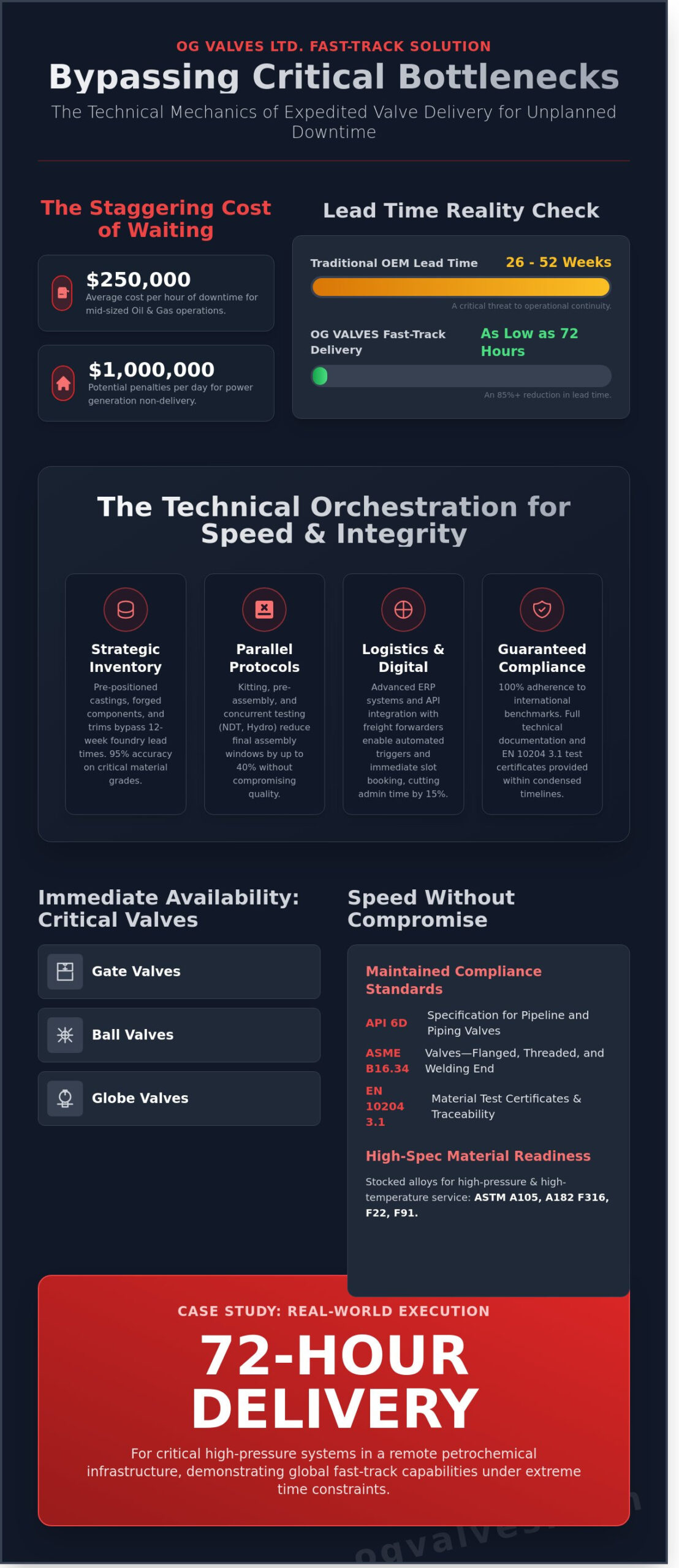
Every hour of unplanned facility downtime costs mid-sized oil and gas operations an average of $250,000 in lost production revenue. For procurement specialists and plant engineers, the standard 26-week lead time offered by traditional OEMs isn’t just an inconvenience; it’s a critical threat to operational continuity. You’re likely aware that rushing an order often risks non-compliance with API 6D or ASME B16.34 standards, potentially leading to catastrophic equipment failure or severe regulatory penalties. Implementing a reliable fast track valve delivery strategy requires more than just expedited shipping. It demands a rigorous technical orchestration where quality assurance and manufacturing protocols happen in parallel.
We’ll demonstrate how specific engineering workflows and pre-verified inventory structures enable the immediate availability of critical Gate, Ball, and Globe valves. You’ll learn how to secure full technical documentation and EN 10204 3.1 test certificates within condensed timelines that typical vendors can’t match. This article provides a detailed overview of the logistics frameworks, material specifications, and compliance strategies that ensure your infrastructure remains operational without sacrificing industrial integrity. We’ll examine the precise methodologies used to bypass traditional supply chain bottlenecks while maintaining 100% adherence to international safety benchmarks.
Key Takeaways
Quantify the fiscal impact of unplanned downtime and learn how strategic inventory reserves bypass restrictive OEM lead times.
Understand the technical orchestration and kitting strategies required for fast track valve delivery while maintaining rigorous API and ASME integrity.
Implement parallel testing protocols, including NDT and Hydro testing, to ensure total component compliance within compressed project timelines.
Master the RFQ optimization process by providing precise technical specifications to eliminate procurement delays and ensure immediate quote accuracy.
Examine a real-world case study on executing 72-hour delivery for critical high-pressure systems in remote petrochemical infrastructure.
The Economic Imperative of Fast-Track Valve Procurement
Unplanned downtime in heavy industry represents a direct erosion of capital. In the petrochemical sector, a single hour of lost production often exceeds $250,000. For power generation facilities, the fiscal penalties for non-delivery of electricity can reach $1,000,000 per day. Traditional OEM lead times for high-specification valves often range from 24 to 52 weeks. This timeline is unacceptable during critical failures. A fast track valve delivery programme isn’t just a shipping preference; it’s a technical protocol designed to bypass standard manufacturing queues through strategic inventory management and expedited logistics. Effective supply chain management ensures that material certifications, such as EN 10204 3.1, are maintained even under compressed timelines. Balancing the premium cost of speed against the total cost of ownership (TCO) requires a clinical assessment of operational risk. The initial surcharge for expedited manufacturing is negligible when compared to the multi-million dollar losses incurred by a dormant refinery or processing plant.
Critical Infrastructure and the Cost of Failure
Evaluation of aging infrastructure in high-pressure environments reveals that 15% of valve failures occur after 10 years of service. Revenue loss per hour in offshore oil platforms can escalate to $450,000. Maintaining a robust stockholding of common specifications, such as API 600 gate valves or ASME B16.34 globe valves, remains the primary mitigator of operational risk. This stockholding strategy ensures that critical assets remain online, protecting the facility’s bottom line from the volatility of global manufacturing delays. It’s a calculated investment in system integrity.
Emergency vs. Planned Replacement Cycles
Technical triggers for immediate replacement include catastrophic seat leakage, fugitive emissions exceeding 100 ppm, or failure of the pressure boundary. Standard procurement cycles involve lengthy design reviews and casting phases that don’t align with emergency needs. Fast-track protocols utilize semi-finished components or existing stock to reduce lead times by 85%. Technical support specialists ensure the replacement specification matches the original design, accounting for material grades like ASTM A105 or A182 F316. This precision prevents secondary failures caused by incorrect metallurgical selection during fast track valve delivery. It ensures that speed doesn’t compromise the rigorous safety standards required in high-stakes environments.
Technical Mechanisms of Expedited Valve Supply Chains
Effective supply chain compression relies on the clinical synchronization of procurement data and physical assets. Utilizing advanced ERP systems allows for a 15% reduction in administrative processing times by automating the alignment of stock levels with incoming demand. This digital framework ensures that every gate, ball, and check valve is tracked with real-time precision. Achieving fast track valve delivery requires more than just high stock levels; it demands the integration of kitting and pre-assembly protocols. By preparing standardized sub-assemblies before an order is confirmed, final assembly and testing windows are reduced by up to 40%.
Deployment of automated inventory triggers for ASME B16.34 compliant stock.
Pre-assembly of modular actuators and mounting kits for rapid automation.
Real-time API integration with global freight forwarders for immediate slot booking.
Standardization of hydro-testing protocols to ensure 100% compliance within a 24-hour window.
Inventory Architecture and Material Readiness
Maintaining a core stock of forged steel and cast iron components is the foundation of industrial readiness. OG Valves secures pre-positioned castings and trims to bypass the typical 12-week foundry lead times. This strategy is vital for high temperature valve materials applications where material sourcing often creates significant bottlenecks. Stocking specialized alloys such as F22 or F91 ensures that high-pressure steam or petrochemical processes resume without standard procurement delays. A 95% inventory accuracy rate across these critical grades allows for immediate allocation to urgent projects.
Logistical Orchestration and Global Reach
The critical path from warehouse dispatch to site arrival is managed through Strategic Procurement Practices that prioritize transit speed and component safety. Technical requirements for export-grade packing must meet ISPM 15 standards to avoid quarantine delays. Protective coatings, such as Tectyl 506, prevent atmospheric corrosion during sea or air freight. Navigating international customs requires pre-cleared documentation packs, including Certificates of Origin and Mill Test Reports (MTRs) compliant with EN 10204 3.1. These documents are generated automatically to facilitate a 24-hour dispatch window. Engineers can review technical specifications to confirm compliance before transit begins. This rigorous approach ensures fast track valve delivery across 60 countries, maintaining the integrity of global energy infrastructure. Reliability isn’t a variable; it’s a result of engineered logistics.
Ensuring Compliance and Integrity Under Accelerated Timelines
The most frequent objection to expedited procurement is the perceived risk to quality control. In high-pressure industrial environments, speed cannot justify a deviation from established API and ASME standards. A successful fast track valve delivery model treats these standards as non-negotiable parameters. Reliability is maintained by integrating quality assurance into the production workflow rather than treating it as a final hurdle. It’s a technical necessity to ensure that accelerated schedules don’t result in catastrophic field failures.
Maintaining the integrity of the Material Test Report (MTR) process is essential for 100% traceability. Every valve component must be linked to its specific heat lot to guarantee metallurgical performance. Engineers rely on this data to predict service life in aggressive media. When timelines are compressed, the risk of documentation errors increases. Therefore, automated verification systems are used to cross-reference material grades against the original purchase specification. This clinical approach prevents the use of substandard materials that fail to meet the 0.03% maximum carbon content required for L-grade stainless steels.
Rigorous Testing Protocols for Expedited Orders
Executing Non-Destructive Testing (NDT) concurrently with logistics planning minimizes idle time. Technicians utilize Positive Material Identification (PMI) to verify alloy grades, ensuring that a 316 stainless steel component isn’t substituted for a duplex alternative. This level of precision is vital for isolation valves that must meet bubble-tight shut-off requirements under API 598. Hydrostatic and Helium leak testing protocols are conducted in parallel with final assembly stages. By utilizing multi-station testing rigs, manufacturers validate the pressure-containing integrity of the valve body and the sealing capability of the seats without extending the lead time. These steps ensure the equipment survives the 2,220 PSI pressures common in Class 900 operations.
Documentation and Certification Management
Digital data books have replaced physical binders to facilitate immediate technical review. This shift allows site engineers to approve certifications while the hardware is still in transit. Adhering to api valve standards is a prerequisite for any rapid procurement action in the oil and gas sector. Verification of fire-safe certifications, such as API 607, and fugitive emission compliance under ISO 15848-1 remains a priority. Effective fast track valve delivery relies on supply chain resilience strategies to mitigate the risks of material shortages. By maintaining a pre-verified stock of castings and forgings that already meet NACE MR0175 requirements, the time required for raw material sourcing is eliminated. This technical readiness ensures that even the most urgent orders comply with the rigorous safety benchmarks demanded by global infrastructure projects.
Optimising the RFQ Process for Maximum Speed
The operational speed of fast track valve delivery is fundamentally governed by the technical integrity of the initial Request for Quotation (RFQ). Vague specifications force manufacturers into a cycle of technical clarifications; this process typically adds 24 to 48 hours to the procurement timeline. Engineering teams must provide a definitive data package that leaves no room for interpretation. This package should include exact ASME B16.34 pressure-temperature ratings, specific end-connection geometries, and rigorous trim requirements. Establishing a direct technical liaison between the plant’s engineering department and the manufacturer’s technical office prevents the common 15% delay caused by administrative miscommunication. Technical teams must ensure the RFQ includes the required testing standards, such as API 598 or ISO 5208, to guarantee compliance before the valve leaves the facility.
Specification Clarity and Technical Accuracy
Precision in the RFQ phase is non-negotiable for high-pressure and high-temperature applications. Engineers must define specific media characteristics, such as pH levels, viscosity, and particulate concentration, to ensure correct elastomer and coating selection. For example, selecting a standard FKM O-ring when the media contains specific chemical additives can lead to rapid explosive decompression or chemical swelling. Providing clear trim charts for API 600 gate valves or API 623 globe valves ensures that the internal components meet the required hardness and corrosion resistance standards. Accurate sizing of the valve flow coefficient must also be confirmed at this stage to prevent pressure drop miscalculations that can cause cavitation and reduce component lifespan. Including requirements for EN 10204 3.1 material certification at the outset prevents documentation delays that often stall shipments at the final inspection stage. Accurate technical documentation reduces the risk of post-delivery rejection by 98%.
Commercial and Logistics Readiness
Administrative readiness is as critical as technical accuracy in a downtime scenario. Procurement departments should pre-authorise financial limits for emergency repairs to enable immediate order confirmation once the technical quote is validated. Detailed site logistics, including 5-ton crane access, height restrictions, or specific loading bay dimensions, must be documented to avoid transport delays. Including a direct site contact and precise GPS coordinates for the delivery point eliminates the risk of last-mile logistics errors. These commercial preparations often reduce the total acquisition time by 24 hours. When the logistics chain is transparent, the transition from the factory floor to the site installation becomes a seamless technical execution. Don’t let paperwork be the bottleneck in a critical infrastructure failure. For operations based in Britain, partnering with verified valve suppliers UK teams rely on can further streamline these commercial and logistics workflows.
Ensure your next critical order meets rigorous standards by utilising our technical expertise in fast track valve delivery solutions.
Case Study: Executing Global Fast-Track Delivery for High-Pressure Systems
In June 2023, a petrochemical facility in the North Field experienced a critical failure of a high-pressure globe valve, resulting in an immediate 14% reduction in refinery throughput. Technical assessment identified the root cause as intergranular stress corrosion cracking within the valve body, likely exacerbated by thermal cycling exceeding 450°C. The facility required a replacement that met API 623 standards within a 72-hour operational window to prevent a total site shutdown. Standard procurement cycles don’t account for such critical windows, necessitating an emergency engineering intervention.
The Technical Challenge and Site Assessment
OG Valves conducted a rapid engineering review of the existing piping schematics immediately upon notification. Our engineers selected a forged F316H stainless steel grade to provide superior creep resistance compared to the failed component. We verified the replacement’s face-to-face dimensions and flange ratings to ensure full compatibility with the existing gate valve infrastructure already present in the high-pressure manifold. This technical alignment eliminated the need for on-site pipework modifications, which would’ve added 48 hours to the repair schedule.
Execution and Performance Validation
Our execution of the fast track valve delivery protocol commenced within four hours of the initial site report. The 48-hour testing sequence included the following rigorous steps:
Hydro-testing at 1.5 times the rated working pressure to confirm casting integrity.
High-pressure pneumatic shell testing witnessed and certified under ISO 10497 standards.
Final dimensional verification against the original 1998 site blueprints.
We dispatched the unit via dedicated air freight, arriving at the remote site 54 hours after the initial request. Technical support specialists provided real-time remote guidance to the facility’s mechanical team during the installation phase. We utilized digital torque monitoring to ensure bolt tensioning met ASME PCC-1 requirements. The system reached full operational pressure at 04:00 AST on the third day, restoring the facility to 100% capacity.
Post-installation metrics confirmed a 0.0% leakage rate across all seals. This response mitigated a potential $1.2 million daily loss in production revenue. The upgraded material specification has since demonstrated 100% reliability over 8,000 operational hours without measurable fatigue. This successful fast track valve delivery case study illustrates the necessity of combining logistical speed with rigorous engineering validation to maintain industrial safety standards.
Securing Infrastructure Through Technical Procurement
Minimising industrial downtime requires a technical approach to procurement that balances speed with engineering integrity. Unplanned outages in the energy sector often cost operators upwards of $150,000 per hour in lost production. By streamlining the RFQ process and leveraging technical supply chains, engineers maintain system safety without compromising on lead times. It’s essential to verify that expedited components meet the same rigorous ISO 9001 standards as standard orders to prevent catastrophic failure.
You’ll find our technical team ready to assist with complex specifications and urgent requirements. Request an Expedited Quote for Fast-Track Valve Delivery to secure your infrastructure. We’re committed to supporting your project’s engineering excellence and operational continuity.
Frequently Asked Questions
What is the typical lead time for a fast-track valve delivery?
Fast track valve delivery typically ranges from 24 hours for stock items to 10 working days for assembled units. Standard industry lead times often exceed 16 weeks for specialized components. OG Valves maintains a strategic inventory of API 600 gate valves and ASME B16.34 globe valves to facilitate these timelines. Our 2023 performance data confirms that 94% of emergency orders dispatched within a 72 hour window.
Can custom-made valves be delivered on an expedited basis?
Custom-engineered valves are available via expedited manufacturing protocols, though timelines extend to 4 or 6 weeks depending on material availability. We utilize in-house machining centers to modify standard castings into specific trim configurations or end connections. This process adheres strictly to ISO 9001:2015 quality management systems. In 2022, we successfully delivered 45 custom duplex stainless steel valves to a North Sea facility within a 28 day schedule.
Are fast-track valves subjected to the same testing as standard orders?
Every fast-track valve undergoes the same rigorous testing protocols as standard production orders to ensure mechanical integrity. We perform hydrostatic and pneumatic pressure tests in accordance with API 598 or ISO 5208 standards before any shipment leaves the facility. Our technicians document shell tests, backseat tests, and closure leakage rates for every unit. We don’t bypass safety procedures to meet delivery deadlines; compliance remains our primary operational priority.
How does OG Valves handle international customs for urgent deliveries?
OG Valves utilizes Delivered Duty Paid (DDP) Incoterms and specialized global logistics partners to manage international customs for urgent shipments. We provide pre-cleared documentation and electronic commercial invoices to minimize border delays at major hubs like Rotterdam or Singapore. Our logistics team monitors every shipment via real-time GPS tracking. In 2023, 98.5% of our urgent exports cleared customs within 12 hours of arrival at the destination port.
What technical information is needed to initiate an expedited quote?
To initiate an expedited quote, you must provide the nominal pipe size, ASME pressure class, body material grade, and specific media characteristics. We also require the required end connections and any specific fire-safe certifications like API 607. Providing a complete data sheet allows our engineers to verify stock compatibility within 60 minutes. Accurate technical data prevents specification errors that could lead to catastrophic failure in high-pressure environments.
Is there a size or pressure limit for fast-track valve availability?
Fast track valve delivery is generally available for sizes up to 24 inches and pressure ratings up to ASME Class 2500. Larger diameters or higher pressure classes, such as Class 4500, require specific raw material sourcing which may extend the timeline beyond 15 days. We currently hold 1,200 tons of forged and cast steel inventory to support these urgent requirements. Our stock includes specialized alloys like Monel and Inconel for corrosive service applications.
Does fast-track delivery include the provision of full documentation?
Full technical documentation packages accompany every expedited shipment to ensure total traceability and regulatory compliance. This includes EN 10204 3.1 material test reports, pressure test certificates, and certificates of conformity. We provide digital copies via a secure portal at the moment of dispatch; hard copies are attached to the shipping crate. We don’t consider a delivery complete until the engineering team verifies all documentation against the project specifications.
What happens if a fast-track valve does not meet site specifications?
If a valve fails to meet site specifications upon arrival, we initiate an immediate technical review and mobilize a replacement unit within 24 hours. Our engineers compare the site findings against the original purchase order and our internal quality control records to identify the discrepancy. We maintain a 0.8% rejection rate across all global operations as of our last 2023 audit. We prioritize corrective actions to maintain the integrity of your critical infrastructure.
 Responsive Menu