Pipeline Safety Regulations UK: A Technical Compliance Guide for 2026
March 22, 2026
Home+Pipeline Safety Regulations UK: A Technical Compliance Guide for 2026
The failure to align component specification with the exact parameters of the pipeline safety regulations uk results in more than just regulatory fines; it creates a critical vulnerability in infrastructure that often exceeds 40 years of service life. Most engineers acknowledge that deciphering the legal jargon within the PSR 1996 is a secondary challenge. The primary task remains maintaining 100% mechanical integrity under high-pressure conditions. You recognize that the cost of component failure in a high-hazard environment is non-negotiable, yet the path to compliance remains obscured by complex statutory language.
This technical guide provides the clinical analysis required to ensure that hardware selection, specifically for valves and fittings, meets the rigorous Maximum Allowable Hazard Potential (MAHP) standards for 2026. We’ll define the specific duties mandated by the PSR 1996 and establish a precise framework for selecting compliant materials such as forged steel or cryogenic service alloys. The following sections detail the necessary protocols for emergency safety inspections and long-term integrity management for ageing industrial assets.
Key Takeaways
Analyze the statutory requirements of the Pipelines Safety Regulations 1996 (PSR) and their specific application to infrastructure within Great Britain and territorial waters.
Identify the classification criteria for Major Accident Hazard Pipelines (MAHP) to effectively mitigate risks associated with the transport of hazardous fluids.
Evaluate how precise valve specification and adherence to API 6D and ISO 14313 standards ensure full technical compliance with pipeline safety regulations uk.
Implement rigorous operational maintenance protocols, including PIGging and systematic risk assessments, to verify internal pipeline integrity and long-term performance.
Understand the role of strategic procurement in sourcing high-performance components that meet the stringent engineering benchmarks required for critical industrial service.
The Statutory Framework: Understanding PSR 1996 in 2026
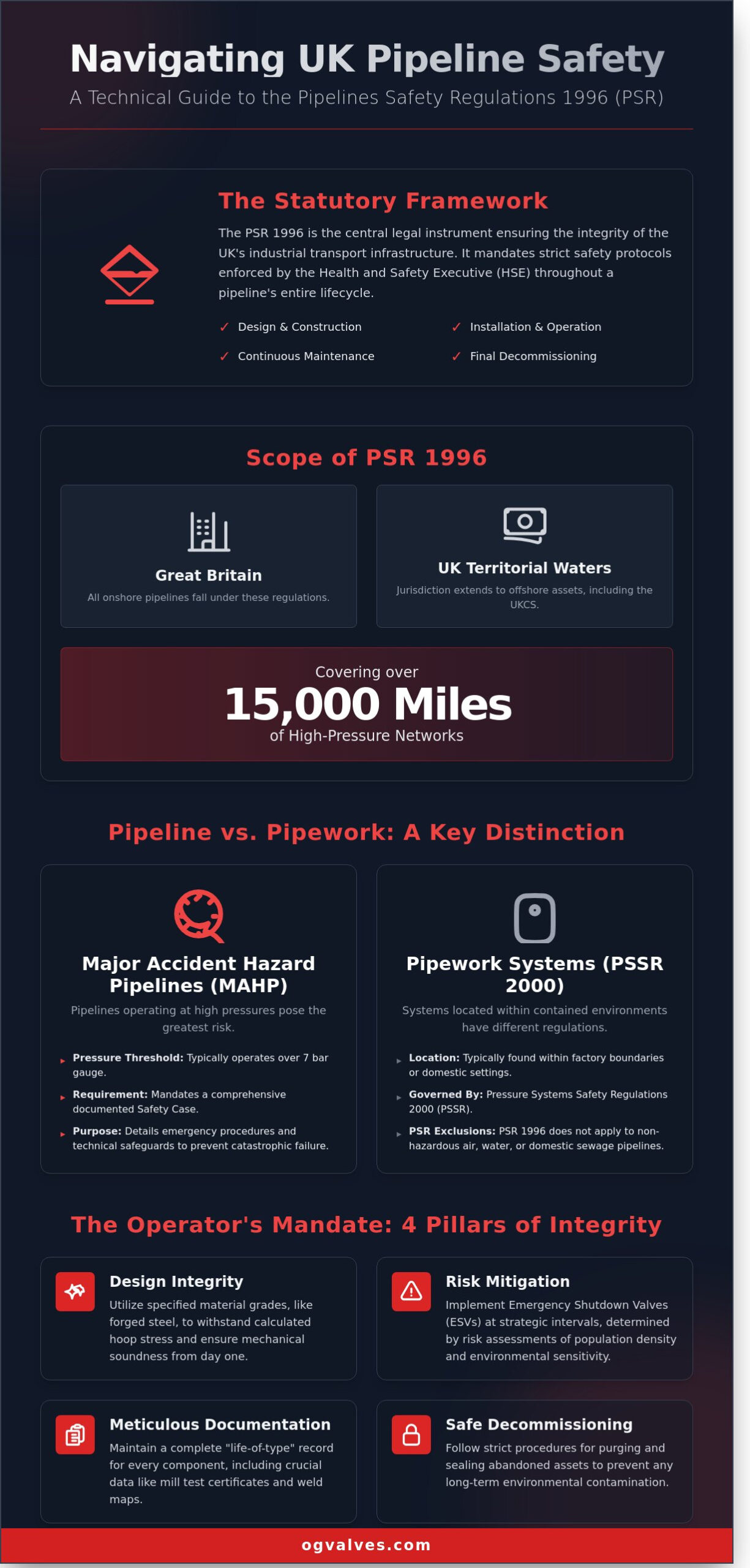
The Pipelines Safety Regulations 1996 (PSR) serve as the central statutory instrument governing the integrity of the United Kingdom’s energy and industrial transport infrastructure. These regulations apply to all pipelines within Great Britain and extend to those located in UK territorial waters. The Health and Safety Executive (HSE) acts as the primary enforcement body; it ensures that operators adhere to strict protocols throughout the entire asset lifecycle. This includes the initial design phase, construction, installation, continuous operation, and final decommissioning. Compliance with the pipeline safety regulations uk is not optional. It’s a fundamental requirement for maintaining industrial licenses and ensuring public safety across 15,000 miles of high-pressure networks. The HSE utilizes a combination of inspections and audits to verify that technical specifications meet the required safety margins.
Effective management of pipeline operations and safety requires a deep understanding of these legal mandates to mitigate risks associated with high-pressure fluid transport. Operators must demonstrate that they’ve accounted for every technical variable, from metallurgical properties to environmental stressors. The framework is designed to be goal-setting rather than prescriptive, which places the burden of proof on the operator to justify their engineering choices. This approach ensures that as technology evolves by 2026, the safety standards remain adaptable to new materials and digital monitoring systems. Failure to comply can result in significant legal penalties or the immediate suspension of operations under the Health and Safety at Work etc. Act 1974.
Defining a Pipeline under UK Law
The PSR 1996 distinguishes between a pipeline and a pipework system based on technical application and location. A pipeline is defined as a pipe or system of pipes used for the conveyance of any relevant fluid, including components like valves, pumps, and compressor stations. Conversely, pipework systems located within factory boundaries or domestic settings typically fall under the Pressure Systems Safety Regulations 2000 (PSSR). Specific exclusions apply to pipelines dedicated to the transport of air, water, or domestic sewage, provided these systems don’t contain hazardous concentrations of chemicals. The PSR 1996 extends its legal jurisdiction to include all pipelines within UK territorial waters and the UK Continental Shelf (UKCS) to ensure uniform safety standards across offshore assets.
General Duties of the Pipeline Operator
Operators must implement a robust Pipeline Integrity Management System (PIMS) to identify hazards and assess risks systematically. Regulation 13 of the PSR 1996 mandates that the operator ensures the pipeline is maintained in efficient working order and good repair. This requires a proactive maintenance schedule backed by non-destructive testing (NDT) and regular inspection intervals. For Major Accident Hazard Pipelines (MAHP), which often operate at pressures exceeding 7 bar gauge, the operator must prepare a comprehensive safety case. This document details the emergency procedures and technical safeguards in place to prevent catastrophic failure. Adherence to international standards like ISO 13623 or API 5L is often utilized to demonstrate compliance with these overarching pipeline safety regulations uk.
Design Integrity: Use of forged steel and specific material grades to withstand calculated hoop stress.
Risk Mitigation: Implementation of emergency shutdown valves (ESV) at intervals dictated by population density and environmental sensitivity.
Documentation: Maintenance of a “life-of-type” record for every component, including mill test certificates and weld maps.
Decommissioning: Procedures for purging and sealing abandoned assets to prevent long-term environmental contamination.
The role of the operator is a continuous commitment to engineering excellence. It’s not enough to install a system that meets 1996 standards; the system must be validated against current 2026 performance data. This involves rigorous testing of valve seals and actuator response times to ensure the system remains within its safe operating envelope (SOE). By maintaining a clinical focus on these technical requirements, operators build the trust necessary to manage critical national infrastructure.
Categorising Risk: Major Accident Hazard Pipelines (MAHP)
The classification of a pipeline as a Major Accident Hazard Pipeline (MAHP) is a critical distinction within the pipeline safety regulations uk framework. Under the official text of the Pipelines Safety Regulations 1996, a pipeline earns the MAHP designation if it transports dangerous fluids capable of causing a major accident. This isn’t a subjective assessment; it’s a technical determination based on the potential for fire, explosion, or toxic release that could result in multiple fatalities or significant environmental damage. The Health and Safety Executive (HSE) enforces stringent oversight for these assets due to their inherent risk profile.
Operators of MAHPs face significant regulatory burdens that standard pipeline operators don’t encounter. Notification requirements are precise and mandatory. You must notify the HSE at least six months before construction begins on a new MAHP. A second notification is required 14 days before the first fluid is introduced into the system. These 180-day and 14-day windows allow the regulator to review design specifications and emergency plans. Failure to adhere to these timelines can lead to legal intervention under the Health and Safety at Work etc. Act 1974. Compliance isn’t optional; it’s a prerequisite for industrial operation.
The technical integrity of the hardware, particularly the valves and actuators, must align with the risk level. High-integrity components are essential for maintaining the safety envelope. Engineering teams often specify industrial valve solutions that provide documented reliability in high-pressure environments. Every component in an MAHP system must have a verifiable pedigree, ensuring it can withstand the specific chemical and physical stressors of the transported fluid.
Fluid Classification and Hazard Assessment
Schedule 2 of the PSR defines five fluid categories, from Category A (minimal risk) to Category E (highly flammable gases). Classification depends on flash points, boiling points, and toxicity levels. For example, Category C fluids include flammable liquids with a flash point below 21°C. By 2026, the HSE expects updated technical guidance for the transport of Hydrogen and Carbon Dioxide (CO2). These fluids present unique challenges, such as hydrogen embrittlement in carbon steel, requiring advanced metallurgical assessments to maintain system integrity.
Safety Management Systems for MAHPs
Every MAHP operator must maintain a Major Accident Prevention Document (MAPD). This document details the safety management system, including hardware reliability data and emergency response protocols. It’s not a static filing. The MAPD requires a formal review every five years. If technical modifications occur, such as a change in operating pressure or fluid composition, the assessment must be updated immediately. This ensures that the pipeline safety regulations uk are consistently upheld through rigorous data-driven analysis and engineering precision.
Notification: 6 months prior to construction for all MAHP assets.
Fluid Categories: A through E based on toxicity and flammability.
MAPD: Mandatory safety documentation reviewed on a 5-year cycle.
Integrity: Hardware must meet specific SIL ratings for critical service.
Component Integrity: How Valve Specification Impacts Compliance
Valves function as Critical Safety Elements (CSEs) within the technical framework of pipeline safety regulations uk. Their performance directly influences the Performance Standards defined in a pipeline’s Safety Management System (SMS). Engineers must specify valves according to API 6D for pipeline service, ASME B16.34 for pressure-temperature ratings, and ISO 14313 for petroleum and natural gas industries. Failure to adhere to these benchmarks constitutes a breach of the Pipeline Safety Regulations 1996. Material selection dictates the asset’s operational lifespan. Utilizing low-carbon steels such as ASTM A350 LF2 or high-alloy duplex materials ensures the valve withstands corrosive media. This prevents the structural degradation that leads to containment loss. Precise alloy verification isn’t optional; it’s a foundational requirement for industrial safety.
The selection of valve architecture isn’t a logistical choice; it’s a regulatory mandate. High-stakes environments in the North Sea or UK onshore gas networks demand components that operate under extreme pressure differentials. When a valve fails, the financial and environmental costs are absolute. Therefore, technical specifications must prioritize durability over initial procurement costs. Engineering teams focus on the “zero-leakage” criteria defined by API 598 to ensure that every component serves as a reliable barrier against hazardous releases.
Isolation Valves and Emergency Shutdown (ESD)
Isolation valves, specifically full-bore ball valves and wedge gate valves, provide the primary method for sectionalizing high-pressure lines. In emergency scenarios, these units must operate within specified timeframes. Many systems require closure in under 60 seconds for large-bore applications to limit the volume of released product. Actuation systems must include fail-safe mechanisms, such as spring-return pneumatic cylinders, to ensure the valve defaults to a closed position during a power loss. This capability is vital for mitigating the impact of a breach. It ensures the infrastructure remains compliant with the rigorous safety standards expected by the HSE.
Check Valves and Backflow Prevention
Preventing reverse flow is a mandatory requirement for maintaining pressure stability and protecting upstream equipment. Engineers select swing check valves for low-pressure drop or dual-plate versions for compact installations and water hammer mitigation. Compliance requires strict material traceability. Every component must be accompanied by an EN 10204 3.1 certificate. This documentation confirms that the chemical and mechanical properties of the valve body meet the design specifications. The UK Onshore Pipeline Operators’ Association (UKOPA) emphasizes that such technical rigor is essential for the safe operation of the UK’s 22,000 km of high-pressure pipelines. Without verifiable traceability, a valve is a liability.
The Importance of PMI and Pressure Testing
Positive Material Identification (PMI) using X-ray fluorescence (XRF) verifies that the alloy composition matches the purchase order exactly. It’s a non-destructive method that prevents the installation of incorrect material grades in 100% of critical components. Before commissioning, every valve undergoes hydrostatic testing at 1.5 times the maximum allowable working pressure (MAWP). Pneumatic seat tests follow to identify even microscopic leaks. Documenting these results creates a permanent audit trail for the Health and Safety Executive. This data proves that the infrastructure meets the necessary safety thresholds required by pipeline safety regulations uk. It transforms raw engineering data into a record of regulatory compliance.
Operational Compliance: Risk Assessment and Emergency Planning
Operational compliance under the pipeline safety regulations uk requires a rigorous, data-driven approach to asset integrity. Operators must establish a systematic inspection and maintenance regime that prioritizes mechanical reliability over simple visual checks. This protocol isn’t a suggestion; it’s a statutory mandate under Regulation 13 of the Pipelines Safety Regulations 1996. Every component, from the forged steel valve body to the primary weld, must undergo scheduled assessments to ensure the system remains within its original design parameters.
Internal corrosion monitoring relies on Pipeline Inspection Gauges, commonly known as PIGs. These tools are essential for identifying wall loss and pitting that remain invisible to external surveys. Intelligent PIGging, utilizing Magnetic Flux Leakage (MFL) or Ultrasonic Testing (UT), provides the high-resolution data needed to map the internal condition of the line. According to the 2023 UKOPA (UK Onshore Pipeline Operators’ Association) report, internal corrosion accounts for a measurable percentage of integrity threats, though it’s often mitigated by effective pigging frequencies. Technical precision in interpreting these data sets allows engineers to calculate the remaining strength of the pipe and schedule repairs before a loss of containment occurs.
Reporting dangerous occurrences is a non-negotiable legal requirement. Under RIDDOR 2013 (Reporting of Injuries, Diseases and Dangerous Occurrences Regulations), operators must notify the Health and Safety Executive (HSE) of specific incidents. These include the uncontrolled release of flammable liquids or gases and any failure of a pipeline that could have resulted in a major accident. The timeframe for these reports is strict; most notifications must be submitted within 10 days of the event. Failure to report doesn’t just invite fines; it compromises the safety data used by the entire industry to prevent future failures.
Effective compliance also involves deep integration with local infrastructure. Operators don’t work in isolation. They must collaborate with local authorities to align their internal safety protocols with regional emergency response strategies. This ensures that in the event of a breach, the response is immediate, coordinated, and technically sound.
Developing an Emergency Plan
Operators of Major Accident Hazard Pipelines (MAHPs) have specific statutory requirements to produce comprehensive emergency plans. Under Regulation 25, these plans must be reviewed and tested at least every three years to ensure they remain fit for purpose. This cycle involves desktop exercises and live drills coordinated with Local Resilience Forums and emergency services. It’s a clinical process designed to identify gaps in communication or equipment availability before a real-world crisis occurs.
Integrity Monitoring and Maintenance
Non-destructive testing (NDT) techniques are the primary defense against structural failure. Radiographic testing and ultrasonic thickness gauging allow for the inspection of valves and welds without halting operations. These methods are vital because external interference remains the leading cause of pipeline failure in the UK, representing nearly 50% of all recorded incidents over the last 20 years. To combat this, operators establish strict exclusion zones and work with the HSE on land-use planning (LUP) to prevent unauthorized construction or excavation near critical infrastructure.
Maintain the highest safety standards in your infrastructure by specifying API-certified industrial valves designed for high-pressure environments.
Strategic Procurement: Ensuring Compliance with OG VALVES LTD.
OG VALVES LTD. acts as a critical technical partner for operators navigating the complexities of the pipeline safety regulations uk. Compliance isn’t a static goal; it’s a continuous requirement for mechanical integrity. Our role involves providing the high-specification hardware necessary to meet the Pipeline Safety Regulations 1996 (PSR). We maintain a deep inventory of Gate, Ball, Globe, and Check valves. These aren’t generic components. They’re precision-engineered units that adhere to API 600, API 602, and API 6D standards. Every valve we supply undergoes rigorous quality assurance protocols. This includes hydrostatic and pneumatic testing to verify shell and seat integrity before any unit leaves our facility.
The heavy industry sector relies on our ability to minimize infrastructure downtime. A single day of unplanned maintenance can cost an operator upwards of £50,000 in lost production. To mitigate this, we offer fast-track delivery options. Our logistics network ensures that critical replacement components reach the site within 24 to 48 hours for stock items. This speed doesn’t compromise safety. We treat every order as a high-stakes engineering project where precision is the only acceptable metric. Our global reach allows us to support complex supply chains while maintaining a clinical focus on the durability and performance of every component.
Technical Support and Specification Expertise
Our engineers don’t just process orders; they provide technical oversight. Selecting the correct valve grade is essential for maintaining compliance with the pipeline safety regulations uk. We assist procurement teams in evaluating material suitability for specific environments, such as sour service or high-temperature steam. We verify all material certificates, including EN 10204 3.1 and 3.2 documentation. This ensures that the forged steel or cast iron used in your pipeline meets the exact chemical and mechanical specifications required. From our Antrim base, we coordinate these technical reviews for international industrial sites, ensuring global standards are met consistently across all jurisdictions. We eliminate ambiguity in the procurement process by anchoring every recommendation in quantifiable engineering data.
Requesting a Technical Consultation
Obtaining a quote for high-integrity industrial valves requires a clinical focus on data. We provide customized solutions for the oil, gas, and power generation sectors. Our process begins with a review of your pressure ratings, temperature requirements, and flow media. We don’t use vague estimates; we provide quantifiable data points for every specification. This approach ensures that the valves you procure are fit for purpose and fully compliant with national safety mandates. You can Contact OG VALVES LTD. for professional valve procurement to begin the technical consultation process. Our team will ensure your infrastructure meets the highest benchmarks for durability and engineering excellence.
Achieving Technical Compliance for 2026 Infrastructure
Ensuring full alignment with the pipeline safety regulations uk requires a methodical approach to PSR 1996 and Major Accident Hazard Pipelines (MAHP) protocols. Operators must maintain rigorous documentation of risk assessments and emergency planning to meet the 100% compliance threshold mandated for the 2026 calendar year. Selecting high-performance components, specifically API 6D and ASME B16.34 compliant valves, is the primary method for mitigating mechanical failure in high-pressure environments. These technical specifications provide the necessary durability for long-term service in the oil, gas, and power sectors.
OG VALVES LTD. operates an ISO 9001:2015 certified quality management system to ensure every component meets these stringent industrial standards. We maintain an extensive inventory of API and ASME compliant valves, backed by a 20-year track record of delivery to critical infrastructure projects worldwide. Precision engineering isn’t a luxury; it’s the foundation of operational safety. Consult with our technical experts on your next pipeline project to secure your facility’s future. We’re ready to support your technical requirements with clinical accuracy and engineering excellence.
Frequently Asked Questions
What are the main requirements of the Pipelines Safety Regulations 1996?
The Pipelines Safety Regulations 1996 mandate that operators ensure a pipeline’s integrity throughout its lifecycle, including design, construction, and decommissioning. Regulation 5 requires the use of suitable materials and the implementation of safe operating limits. Every operator must prepare a Major Accident Prevention Document (MAPD) before operations begin. This document outlines the safety management system used to control risks to the 67 million people residing in the UK.
What qualifies as a Major Accident Hazard Pipeline (MAHP) in the UK?
A Major Accident Hazard Pipeline is defined by the hazardous nature of the fluid it transports, such as flammable gases or toxic liquids listed in Schedule 1. These pipelines typically operate at pressures above 7 bar gauge or carry substances with a flashpoint below 21°C. Under the pipeline safety regulations uk, MAHPs require rigorous oversight, including the preparation of both on-site and off-site emergency plans to mitigate industrial risks.
How often must pipeline emergency plans be reviewed under UK law?
Pipeline emergency plans must be reviewed and tested at intervals not exceeding 3 years. Regulation 25 of the PSR 1996 dictates this 36 month cycle for local authority off-site plans. Operators must also update their internal procedures if technical modifications occur or if new safety data becomes available. Regular testing ensures that the 15,000 kilometers of high-pressure pipelines in the UK remain manageable during a loss of containment event.
Are hydrogen pipelines covered under the same safety regulations as natural gas?
Hydrogen pipelines are subject to the same PSR 1996 requirements as natural gas infrastructure. The Health and Safety Executive (HSE) confirmed in 2021 that hydrogen’s high flammability requires strict adherence to Regulation 13 and Regulation 16. Technical specifications for valves and seals must account for hydrogen embrittlement. Engineers often specify API 6D valves with specialized elastomeric seals to maintain a 100% leak-tight integrity for hydrogen service.
Who is responsible for pipeline safety: the owner or the operator?
The pipeline operator is the primary duty holder responsible for compliance under UK law. Regulation 4 defines the operator as the person who has control over the pipeline’s daily function. While the owner provides the physical asset, the operator must manage the 24 hour monitoring and maintenance schedules. If an owner also manages the flow and pressure, they assume the legal liabilities of the operator role simultaneously.
What documentation is required to prove valve compliance for UK pipelines?
Valve compliance requires a comprehensive documentation package including BS EN 10204 Type 3.1 or 3.2 material certificates. You’ll need API 598 pressure test reports and API 607 fire-safe certification for critical isolation points. These records must prove the forged steel or cast iron meets ASTM A105 or A216 specifications. Traceability is vital, as 100% of pressure-retaining components must be linked to their original heat numbers. To manage this complexity, many operators now use digital platforms, and socweld.com provides software specifically for automating welding documentation and traceability.
What happens if a pipeline operator fails to comply with PSR 1996?
Operators who fail to comply with PSR 1996 face severe penalties including improvement notices, prohibition notices, or unlimited fines. The Health and Safety at Work etc. Act 1974 allows for the prosecution of individuals or corporations. In 2022, the HSE recorded average fines of over £100,000 for serious safety breaches. Severe incidents resulting in environmental damage or injury can lead to custodial sentences for the responsible directors.
How does the HSE monitor pipeline safety in the UK?
The HSE monitors the pipeline safety regulations uk through a combination of mandatory notifications and field inspections. Operators must submit a notification 180 days before constructing a new MAHP. HSE inspectors conduct targeted audits of the Major Accident Prevention Document and physical assets. They verify that the 10 core regulations of PSR 1996 are met, focusing on corrosion management and the functional reliability of safety-critical valves.
 Responsive Menu