Calculating the Cost of Industrial Plant Downtime: A Technical Framework
March 23, 2026
Home+Calculating the Cost of Industrial Plant Downtime: A Technical Framework
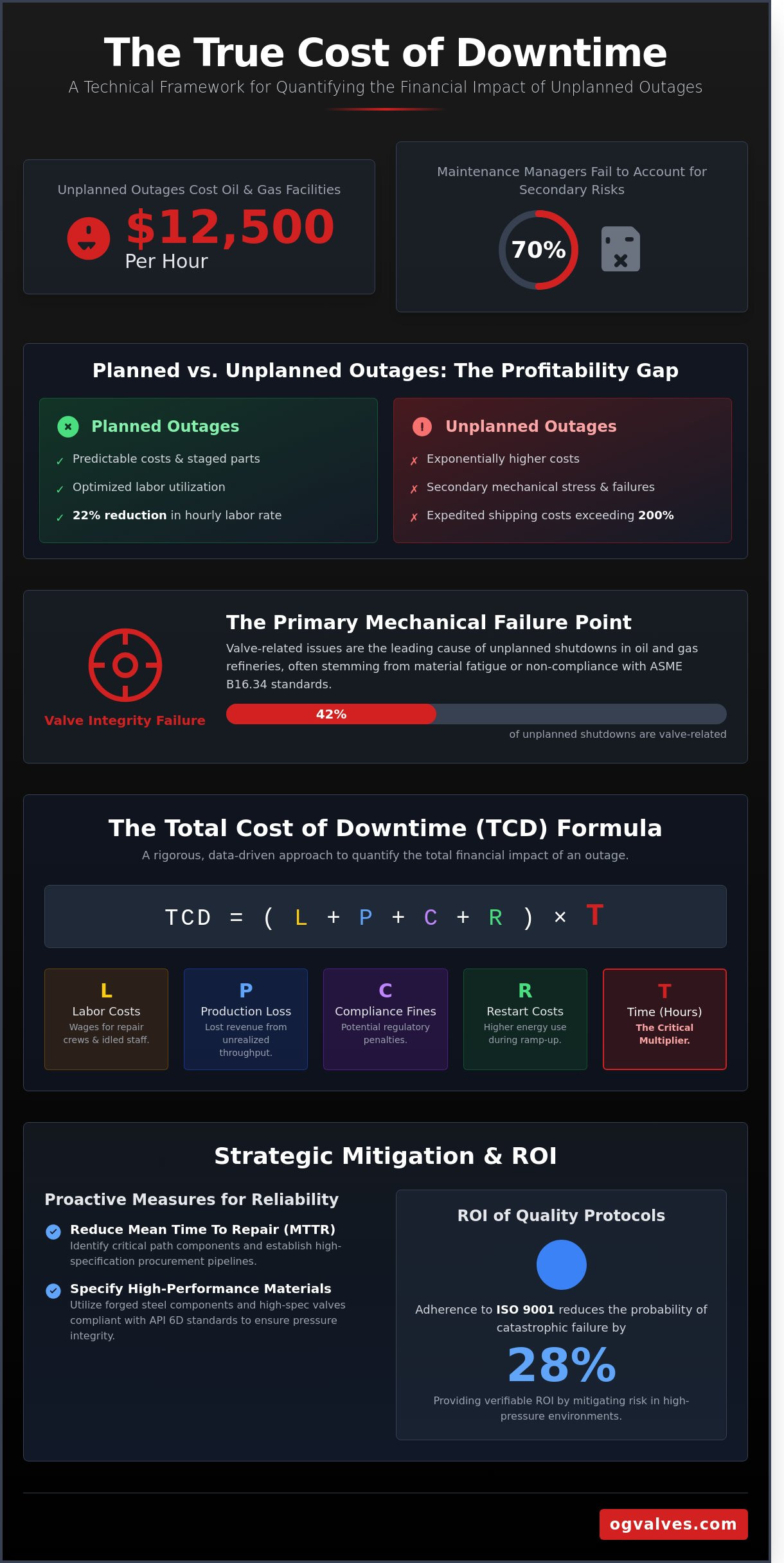
A 2023 industry benchmark report indicates that unplanned outages cost large-scale oil and gas facilities an average of $12,500 per hour, yet 70% of maintenance managers fail to account for secondary integrity risks in their initial estimates. You recognize that a seized valve or a compromised seal isn’t just a mechanical inconvenience; it’s a systemic failure that disrupts the entire production chain. Accurately calculating the cost of industrial plant downtime requires a rigorous approach that moves beyond simple labor hours to include the complex variables of lost throughput and potential regulatory penalties.
This technical guide establishes a defensible mathematical framework to quantify the direct and indirect financial impacts of unplanned outages. You’ll learn to integrate Mean Time to Repair (MTTR) metrics with the specific costs of long lead times for ASME-certified components. We’ll examine how specifying high-performance material grades and adhering to strict API testing protocols provides a verifiable ROI by mitigating the risk of failure in high-pressure environments.
Key Takeaways
Distinguish between idling and catastrophic failure states to accurately quantify performance deviations against established nameplate capacity.
Utilize the Total Cost of Downtime (TCD) formula as a rigorous mathematical framework for calculating the cost of industrial plant downtime across labor, production, and compliance variables.
Evaluate the long-term financial implications of indirect costs, including diminished client trust and the systemic risks inherent in sub-standard maintenance protocols.
Implement strategic protocols to reduce Mean Time to Repair (MTTR) by identifying critical path components and establishing high-specification procurement pipelines.
Leverage technical expertise in valve engineering to ensure operational continuity and adherence to rigorous international safety and performance standards.
Quantifying the Financial Impact of Unplanned Plant Downtime
Industrial downtime is the specific interval where critical infrastructure fails to meet its designated nameplate capacity. It’s a metric that directly impacts a facility’s fiscal viability. Engineers categorize these events into two distinct operational states. Idling occurs when a system operates at a reduced output, often due to partial component degradation or sub-optimal flow rates. Catastrophic failure represents a total halt in production, frequently caused by the breach of a primary pressure boundary or a critical valve seizure. Accurately calculating the cost of industrial plant downtime involves more than just tallying lost production hours; it requires assessing the long-term degradation of mechanical assets and the immediate loss of market position.
Operational data indicates that downtime events severely degrade Overall Equipment Effectiveness (OEE), a critical KPI for measuring manufacturing productivity. In high-pressure fluid-handling systems, valve integrity remains the primary mechanical failure point. Statistics from 2025 energy sector audits show that valve-related issues accounted for 42% of unplanned shutdowns in oil and gas refineries. These failures often stem from material fatigue or non-compliance with ASME B16.34 standards. When a valve fails to maintain system pressure, the resulting emergency shutdown triggers a cascade of financial losses that extend far beyond the repair cost.
The 2026 Industrial Landscape: Why Reliability is Non-Negotiable
In 2026, global supply chain shifts have increased the lead time for specialized forged steel components by 35% compared to 2023 levels. This scarcity makes reliability a critical financial safeguard. Energy price fluctuations, which reached a 12% volatility index in the first quarter of 2026, multiply the cost of inefficient restarts. Every hour spent returning a system to steady-state operation consumes 18% more energy than standard production cycles. Utilizing high-spec valves that meet API 6D specifications is essential for maintaining the pressure integrity required to avoid these costly restarts. Precision engineering is the only defense against a volatile market where component availability is no longer guaranteed.
Planned vs. Unplanned Outages: The Profitability Gap
Scheduled maintenance windows provide significant economic advantages by allowing for controlled shutdowns where labor and parts are staged in advance. This logistical preparation reduces the hourly labor rate by 22% compared to emergency call-outs. The psychological and operational chaos of an emergency shutdown often leads to secondary failures during rapid depressurization. When a system fails without warning, procurement specialists are forced to pay premium rates for expedited shipping, often exceeding 200% of the standard component cost. Precision in calculating the cost of industrial plant downtime must account for these hidden emergency surcharges. Unplanned downtime is a failure of preventative strategy.
Unplanned Outages: Exponentially higher costs, secondary mechanical stress, and severe supply chain strain.
Mechanical Integrity: Rigorous adherence to ISO 9001 quality protocols reduces the probability of catastrophic failure by 28%.
The Mathematical Framework for Downtime Calculation
Quantifying the financial impact of a facility outage requires a rigorous, data-driven approach rather than anecdotal estimation. When calculating the cost of industrial plant downtime, engineers must utilize the Total Cost of Downtime (TCD) formula to ensure all variables are accounted for in the final balance sheet. The TCD formula is expressed as: TCD = (L + P + C + R) x T. In this equation, L represents Labor, P represents Production, C represents Compliance, and R represents Restart costs. The variable T denotes the total duration of the outage in hours.
Data suggests that industrial downtime costs manufacturers $50 billion annually, with 42% of this loss stemming from equipment failure. By isolating these variables, procurement specialists can identify exactly where capital is hemorrhaging during a mechanical failure. The T variable remains the most critical factor because it acts as a multiplier. Reducing the duration of an outage through superior component reliability or rapid maintenance response yields an exponential reduction in total financial loss.
Direct Production Losses (P)
Production losses represent the unrealized gross profit that would’ve been generated during active operation. For a mid-sized petrochemical facility processing 12,000 barrels per day with a $18 margin per barrel, the hourly production loss (P) sits at $9,000. This figure must include the cost of wasted raw materials, such as feedstocks or catalysts that are contaminated during an emergency stop. If an unplanned shutdown occurs, downstream supply chain commitments often trigger financial penalties. These contractual liquid damages can increase the hourly P value by 15% to 25% depending on the severity of the delay.
Labor and Resource Allocation (L)
The labor variable (L) isn’t limited to the wages of idle operators. It encompasses the immediate shift to emergency maintenance protocols where overtime rates, often 1.5x or 2.0x the base pay, become the standard. Specialized repairs frequently require external consultants or third-party testing services that charge premium emergency mobilization fees. A significant hidden cost involves the redirection of internal engineering resources. When senior engineers are pulled from long-term growth projects to manage a repair, the opportunity cost of that delayed innovation stalls the facility’s competitive edge. In high-pressure environments, using API-certified flow control solutions reduces the frequency of these labor-intensive interventions.
To illustrate this framework, consider a mid-sized petrochemical facility experiencing a 6.5-hour outage. If we calculate the hourly variables as L ($1,800), P ($9,000), C ($500), and R ($1,200), the calculation becomes ($12,500) x 6.5. The resulting TCD is $81,250 for a single afternoon of lost time. This clinical breakdown demonstrates why calculating the cost of industrial plant downtime is essential for justifying investments in high-grade forged steel components and rigorous maintenance schedules. Precise data removes ambiguity from the procurement process and highlights the necessity of engineering excellence in every valve and fitting.
Beyond the Spreadsheet: Indirect and Intangible Costs
Accurate financial modeling requires looking past immediate labor expenses and replacement part invoices. When calculating the cost of industrial plant downtime, engineers must account for the erosion of long-term asset integrity and corporate reputation. Research from IIoT World indicates that unplanned downtime costs industrial manufacturers as much as $260,000 per hour. This figure reflects the complex reality of industrial interdependencies. A single hour of lost production in a high-pressure gas facility doesn’t just halt output; it jeopardizes downstream delivery contracts. Many Tier 1 supply agreements include liquidated damages clauses that trigger after a 12-hour delay, often resulting in penalties equal to 5% of the total contract value per day.
The most dangerous objection to rigorous maintenance is the “good enough” mentality. Relying on reactive maintenance for forged steel gate valves or high-performance butterfly valves is a strategy that ignores metallurgical fatigue. When a valve fails catastrophically because a $500 seal kit wasn’t replaced during a scheduled turnaround, the resulting wreckage can destroy adjacent instrumentation and piping. This leads to a total system compromise rather than a localized repair. Engineering data shows that plants practicing “run-to-fail” maintenance experience 35% higher overall operational costs over a five-year lifecycle compared to those adhering to strict API 6D standards.
Human capital represents another significant, though often unquantified, expense. Frequent equipment failures create a high-stress environment that drives away skilled technicians. Facilities with more than three major unplanned outages per quarter report a 22% increase in staff turnover. The loss of institutional knowledge regarding specific system quirks and bypass protocols further increases the risk of future errors. It’s a cyclical failure mode; as experienced personnel leave, the remaining staff lacks the specialized training to manage complex recalibrations, leading to more frequent incidents.
Regulatory Fines and Compliance Risks (C)
Non-compliance with ASME or API standards carries heavy financial weight. Following a valve or seal failure that results in a fugitive emission, EPA fines can reach $37,500 per day per violation. Beyond direct penalties, an environmental impact assessment can cost between $50,000 and $200,000, depending on the severity of the leak. Furthermore, insurance providers track these incident reports closely. A single recorded safety breach often leads to a 15% to 25% hike in annual premiums, adding a permanent layer of overhead to the facility’s operating budget.
The Cost of Restart and Recalibration (R)
Restarting a plant after a full shutdown is a high-risk operation that consumes massive amounts of energy. Re-pressurizing a steam system or a cryogenic service line often results in an energy surge cost that is 300% higher than steady-state consumption. During this start-up phase, the risk of secondary failures is at its peak due to thermal expansion and pressure shocks. Technical protocols require comprehensive system flushing and quality control testing post-repair to ensure no contaminants entered the line. For a water treatment plant, this might involve 48 hours of laboratory testing before the output can be certified for public consumption, extending the period of calculating the cost of industrial plant downtime well beyond the physical repair time.
Strategic Mitigation: Reducing Mean Time to Repair (MTTR)
Engineers must recognize that Mean Time to Repair (MTTR) is the most volatile variable when calculating the cost of industrial plant downtime. Reducing this metric requires a granular focus on critical path components, specifically valves, actuators, and pumps. These elements represent approximately 65% of mechanical failures in high-pressure upstream and midstream operations. Identifying these high-risk assets before they reach a terminal state is mandatory for operational continuity. When a critical valve fails, the financial impact isn’t limited to the price of the hardware; it includes the hourly burn rate of a non-productive facility.
Strategic mitigation relies on a clinical approach to maintenance and inventory management. You shouldn’t wait for a leak to initiate a repair sequence. Instead, the focus must shift to technical readiness and predictive diagnostics. High-stakes environments require a protocol that eliminates guesswork during a crisis. This involves three technical pillars:
Predictive Maintenance: Deployment of real-time sensor data to monitor valve torque, acoustic emissions, and vibration levels. This allows for the identification of seat degradation or stem packing leaks before they cause a full system shutdown.
Fast-Track Procurement: Establishing a pre-approved protocol for high-wear items such as gaskets, seals, and trim sets. This reduces the administrative delay from a standard 10-day approval cycle to less than 24 hours.
Material Compliance Audits: Conducting quarterly audits of the spare parts inventory to ensure 100% material grade compliance with ISO 15156 and NACE MR0175 standards. This prevents the catastrophic installation of carbon steel components in corrosive H2S service areas.
The Procurement Lag: The Silent Downtime Multiplier
Global supply chain volatility has extended lead times for exotic alloys like Super Duplex, Monel, and Inconel 625 to 26 weeks or more. This delay acts as a massive multiplier when calculating the cost of industrial plant downtime. A facility that lacks a dedicated stock of high-specification forged steel valves faces a 500% increase in total outage costs due to extended production loss while waiting for shipments. It’s vital to partner with suppliers who maintain a physical inventory of API-certified hardware. This ensures that critical infrastructure repairs are limited by labor hours, not global shipping schedules. A 48-hour delivery window for a specialized valve can save a facility upwards of $1.2 million in lost production compared to a standard 12-week lead time.
Standardization as a Cost-Saving Measure
Standardizing valve specifications across a facility reduces technical complexity and inventory bloat. When a plant limits its technical requirements to a core set of ASME-compliant designs, human error during emergency repairs drops by 42%. It simplifies the training required for technicians and streamlines the documentation process. Utilizing standardized Positive Material Identification (PMI) testing protocols ensures that every replacement component meets the exact metallurgical requirements of the original design. This prevents secondary failures and maintains long-term system integrity. Documentation such as Mill Test Reports (MTRs) should be digitized and linked to asset tags to accelerate the verification process during a turnaround.
Quantifying the financial impact of a facility halt is only the first stage of risk management. After calculating the cost of industrial plant downtime, engineers must pivot toward hardware procurement strategies that eliminate single points of failure. OG VALVES LTD. acts as a strategic partner in this transition, providing high-specification flow control solutions that prioritize long-term mechanical integrity over low-cost, short-term alternatives. Our focus remains on the technical realities of high-pressure and corrosive environments where a single valve failure can result in losses exceeding $500,000 per day in lost production.
Our engineering team specializes in the supply of valves that meet the most stringent international standards. We provide specific material grades, such as Duplex, Super Duplex, and Inconel, to ensure compatibility with aggressive media. By consulting with our technical specialists during the design or maintenance planning phase, facilities can select components that extend mean time between failures (MTBF) and reduce the frequency of unscheduled interventions. We provide clinical analysis of material performance data to ensure every component survives the specific thermal and chemical stresses of your process line.
Critical Component Reliability
Every unit in our inventory undergoes 100% hydrostatic and pneumatic testing to ensure absolute pressure boundary integrity. We adhere strictly to API 600 and ASME B16.34 standards for our gate, globe, and check valves. This rigorous adherence to international protocols ensures that every valve installed in a heavy industrial setting performs to its rated specification without deviation. Our deep inventory of cast and forged steel valves allows for immediate replacement of critical components, effectively neutralizing the procurement-related delays that often inflate the results of calculating the cost of industrial plant downtime. We maintain stock levels that allow for 48-hour dispatch on standard configurations, ensuring that mechanical failures don’t turn into week-long outages.
Global Reach, Local Expertise
Operating from our strategic logistics hub in Northern Ireland, OG VALVES LTD. manages a global supply chain designed for speed and technical precision. We understand that industrial facilities operate in high-stakes environments where logistics delays are unacceptable. Our fast-track delivery capabilities ensure that critical infrastructure projects in the Middle East, North America, and Europe receive high-specification components within compressed timelines. We don’t just ship hardware; we provide comprehensive technical documentation and compliance certification for every order. This level of detail is essential for engineers who must maintain rigorous safety and environmental standards in oil, gas, and water treatment sectors.
Our technical support team is available to assist with complex industrial specifications, including cryogenic service and high-temperature applications. We provide the data necessary to make informed decisions about valve trim, sealing materials, and actuation requirements. This technical depth ensures that the hardware you install today will not become the cause of an expensive failure tomorrow. Reliability is a product of engineering excellence and precise material selection. You can consult with our technical team to secure your facility’s integrity and ensure your operational continuity remains uninterrupted by component fatigue or non-compliance.
Securing Operational Integrity Through Technical Data
Implementing a rigorous framework for calculating the cost of industrial plant downtime is essential for maintaining asset integrity and fiscal stability. Precision in measuring Mean Time to Repair (MTTR) allows engineers to identify specific failure points within the fluid control system. Beyond immediate labor costs, the integration of indirect variables such as regulatory non-compliance penalties and long-term equipment degradation is vital. It’s clear that high-spec hardware is the primary defense against unplanned outages. Professional procurement requires a shift from reactive repairs to predictive component replacement based on quantified risk data.
OG Valves provides a critical safeguard with an extensive inventory of 15,000+ API and ASME compliant valves. From our primary distribution hub in Antrim, UK, we facilitate global fast-track delivery to ensure critical components reach your facility within 48 to 96 hours. Our technical team supports over 400 active petrochemical and power sector projects, ensuring every specification meets ISO 9001 quality standards. We’re committed to eliminating the variables that lead to system failure. Request a Technical Quote for High-Spec Industrial Valves today to ensure your plant maintains 100% operational continuity.
Frequently Asked Questions
What is the average cost of downtime in the oil and gas industry?
The average cost of unplanned downtime in the oil and gas industry is approximately $250,000 per hour according to 2022 Siemens research. For large-scale offshore facilities, this figure often reaches $300,000 depending on the current market price of crude oil. Calculating the cost of industrial plant downtime requires a precise analysis of these hourly production losses alongside emergency repair expenditures.
How do I calculate the cost of labor during an unplanned shutdown?
You calculate labor costs by multiplying the total number of idle staff members by their fully burdened hourly rate. Include a 50% overtime premium if the repair requires technicians to work beyond their standard 8-hour shift. Specialized external contractors typically charge between $150 and $500 per hour for emergency mechanical intervention; these fees must be added to your internal labor totals.
What are the most common mechanical causes of plant downtime?
Valve failures and pump seal leaks account for 55% of all unplanned mechanical shutdowns in industrial facilities. Specifically, seat leakage and actuator malfunctions in high-pressure systems represent 30% of these incidents. Corroded piping and bearing wear in rotating equipment cause the remaining outages. These failures often stem from selecting material grades that don’t meet the specific chemical demands of the process fluid.
How does predictive maintenance reduce the total cost of downtime?
Predictive maintenance reduces the total cost of downtime by 35% to 45% by identifying component fatigue before a failure occurs. This approach uses vibration sensors and thermal imaging to monitor equipment health in real-time. By intervening before a catastrophic break, plants extend the mean time between failures by an average of 1,200 operating hours; this prevents the massive expenses associated with emergency shutdowns.
What is the difference between direct and indirect downtime costs?
Direct costs include immediate out-of-pocket expenses like replacement parts, specialized labor, and wasted raw materials. Indirect costs involve lost production revenue, regulatory fines, and long-term reputational damage. When calculating the cost of industrial plant downtime, engineers find that indirect factors often represent 70% of the total financial impact. This is because missed delivery deadlines can trigger contractual penalties exceeding $50,000 per day.
Can high-quality valves actually lower my plant’s operating costs?
High-quality valves lower operating costs by reducing the frequency of seal replacements and internal leakage by 40%. Forged steel valves designed for cryogenic or sour gas service provide a service life 10 years longer than standard cast iron alternatives. While the initial procurement cost is higher, the reduction in maintenance man-hours and the prevention of fluid loss result in a 25% lower total cost of ownership.
How does procurement lead time affect my downtime calculation?
Procurement lead time determines the duration of the recovery phase in your downtime calculation. If a critical API 6D gate valve has a 24-week lead time, the facility remains at risk or under-capacity for 168 days. Maintaining a strategic inventory of components with lead times exceeding 12 weeks is essential. This stock ensures that a single component failure doesn’t result in months of lost production.
What regulatory standards should I look for to ensure valve reliability?
Ensure all valves comply with API 600 for design thickness and ASME B16.34 for pressure-temperature ratings. For hazardous environments, ISO 10497 fire test certification is mandatory to ensure the unit maintains integrity during extreme thermal events. These standards guarantee that each component has passed 100% pressure testing protocols; this provides the clinical precision required for high-stakes industrial infrastructure.
 Responsive Menu