Industrial Valve Maintenance Checklist 2026: A Technical Protocol for Heavy Industry
March 19, 2026
Home+Industrial Valve Maintenance Checklist 2026: A Technical Protocol for Heavy Industry
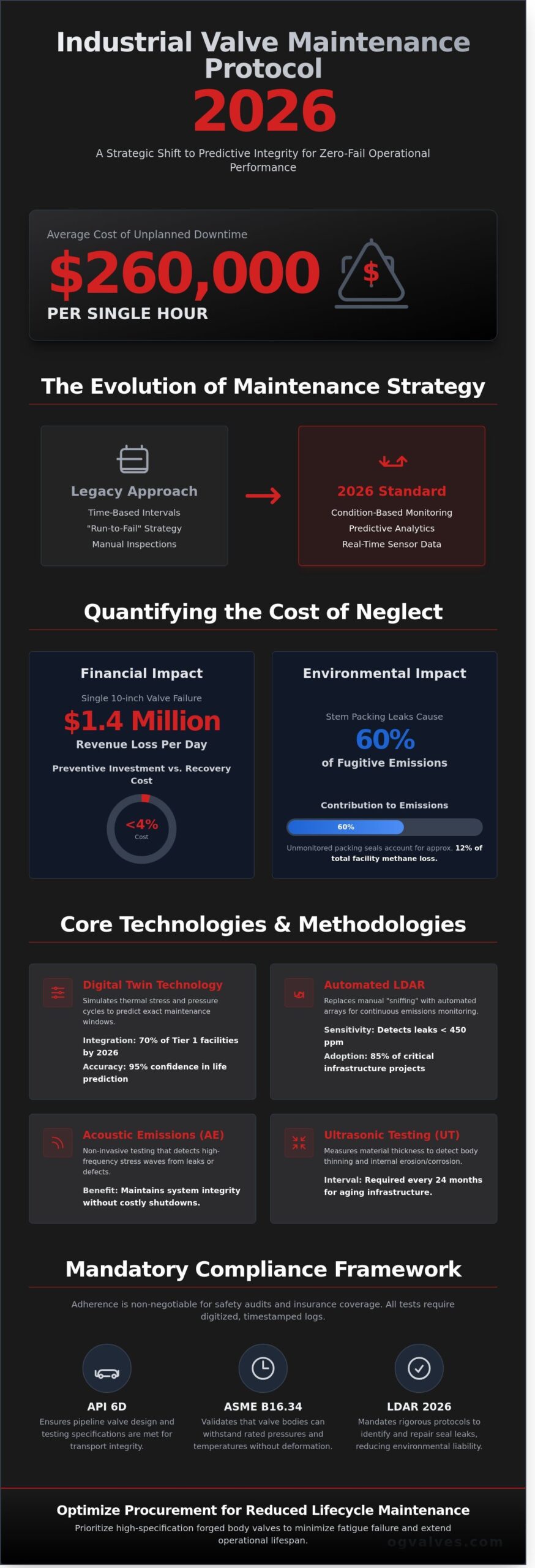
Recent sector analysis indicates that a single hour of unplanned downtime in high-pressure heavy industry environments now averages $260,000 in lost revenue. This fiscal reality dictates that operational integrity isn’t just a safety requirement; it’s a financial imperative. You recognize that maintaining complex systems involving forged steel and cryogenic service components requires a level of precision that exceeds standard visual inspections. Adhering to this industrial valve maintenance checklist 2026 ensures your facility maintains strict compliance with API 6D and ASME B16.34 standards while mitigating the risks of material degradation in corrosive environments.
We’ve engineered this technical protocol to provide a clinical framework for achieving zero-fail operational performance across your entire asset portfolio. You’ll gain access to a structured breakdown of rigorous testing procedures and documentation requirements designed for high-stakes safety audits. This guide details the specific inspection intervals, lubrication specifications, and ultrasonic testing protocols necessary to extend the lifecycle of your critical valve systems through 2026 and beyond.
Key Takeaways
Transition from time-based protocols to condition-based monitoring to ensure rigorous compliance with 2026 leak detection and repair (LDAR) regulations.
Identify and mitigate critical failure modes, such as seat erosion and stem packing leaks, through material-specific analysis of Super Duplex and forged steel components.
Utilize the standardized industrial valve maintenance checklist 2026 to facilitate precise visual inspections and full-stroke cycling for verified operational integrity.
Integrate Acoustic Emissions (AE) testing for non-invasive leak detection to maintain system performance without necessitating costly infrastructure shutdowns.
Optimize long-term procurement by selecting high-specification forged body valves that minimize fatigue failure and reduce the frequency of maintenance interventions.
The Evolution of Industrial Valve Maintenance in 2026
The 2026 standard for industrial valve maintenance has shifted from rigid, time-based intervals to dynamic, condition-based monitoring. This evolution utilizes real-time sensor data to identify degradation before a component fails. In high-pressure petrochemical environments, the legacy “run-to-fail” strategy isn’t viable because it ignores the 38% increase in operational liability costs recorded since 2024. Engineers now prioritize the integrity of forged steel and alloy components through continuous diagnostic feedback. For a foundational industrial valve overview, professionals must first understand the mechanical limits of specific gate and globe designs before applying these advanced monitoring protocols.
Digital twin technology is a cornerstone of the industrial valve maintenance checklist 2026. By creating a virtual replica of a physical asset, operators simulate thermal stress and pressure cycles to predict exact maintenance windows. By January 2026, over 70% of Tier 1 oil and gas facilities have integrated digital twins into their asset management suites. This precision allows for the tracking of every valve’s performance history, ensuring that maintenance is performed only when the data indicates a deviation from the baseline specification. It’s a clinical approach that eliminates the waste of premature part replacement while preventing the catastrophic risks of neglect.
Environmental regulations have also reached a new level of stringency. The 2026 mandate for Leak Detection and Repair (LDAR) requires facilities to detect and mitigate fugitive emissions as low as 450 parts per million. Automated sensing arrays now replace manual sniffing in 85% of critical infrastructure projects. These systems provide the rigorous performance data required to prove compliance with global decarbonization targets. Every industrial valve maintenance checklist 2026 must account for these sensors to avoid the heavy fines associated with environmental non-compliance.
Regulatory Compliance: API and ASME Standards
Adherence to API 6D and API 598 remains the primary benchmark for verifying pressure-containing integrity. API 598 defines the rigorous leakage rates allowed during high-pressure closure tests, while ASME B16.34 mandates specific wall thicknesses and pressure-temperature ratings. Documentation must be precise; every test result is a critical data point for safety audits. Insurance providers in 2026 won’t cover assets that lack digitized, timestamped logs proving compliance with these international engineering standards.
The High Cost of Maintenance Neglect
Quantifying the impact of neglect reveals that a single 10-inch isolation valve failure can result in a $1.4 million revenue loss per day in a standard refinery setting. Safety is the ultimate priority. Preventing catastrophic blowouts requires a commitment to preventive investment, which typically costs less than 4% of the potential recovery expenses. Fugitive emissions from unmonitored packing seals account for roughly 12% of total facility methane loss. The Maintenance Gap is the delta between theoretical asset life and actual performance under neglect.
API 6D Compliance: Ensures pipeline valves meet design and testing specifications for long-distance transport.
ASME B16.34 Integrity: Validates that valve bodies can withstand rated pressures without structural deformation.
LDAR Protocols: Reduces environmental liability by identifying seal leaks before they exceed 500 ppm thresholds.
Digital Twin Accuracy: Provides a 95% confidence interval for predicting the remaining useful life of cryogenic service valves.
Technical Pillars of Valve Integrity: Material and Mechanical Analysis
Predictive failure analysis serves as the technical foundation for a robust industrial valve maintenance checklist 2026. Engineering teams must prioritize the detection of seat erosion, which typically accounts for a 12% reduction in sealing efficiency when high-velocity particulates are present in the flow stream. Body thinning, particularly in aging infrastructure, requires ultrasonic thickness testing every 24 months to ensure wall thickness remains within the safety margins defined by ASME B16.34. Stem packing leaks are responsible for 60% of fugitive emissions in chemical processing plants. Identifying these leaks early prevents the escalation of mechanical failure and ensures the facility meets stringent environmental compliance protocols.
Material-specific maintenance protocols are mandatory for specialized alloys like Super Duplex and forged steel. Super Duplex stainless steel components, frequently used in desalination and offshore oil rigs, require rigorous monitoring for chloride-induced pitting. Technicians should verify the Pitting Resistance Equivalent Number (PREN) remains above 40 during material audits. Forged steel valves, such as those meeting ASTM A105 specifications, require thermal stress assessments if they operate in environments exceeding 425°C. Adhering to federal valve maintenance regulations provides a legal framework for these inspections, ensuring that every critical asset is documented and tested according to standardized safety intervals.
Fluid media characteristics directly dictate the frequency of maintenance. Corrosive media containing 500 ppm of hydrogen sulfide requires NACE MR0175 compliant materials and semi-annual integrity checks. Cryogenic services operating at -196°C demand specialized seal inspections to prevent brittle fracture. Mechanical stressors like thermal cycling in power generation or pressure surges in water treatment also accelerate wear. A pressure surge reaching 150% of the nominal rating can deform a valve disc in less than one second. For operators managing high-pressure systems, reviewing technical specifications for severe service valves helps in selecting components that withstand these extreme mechanical loads.
Stem and Packing Gland Integrity
Maintaining stem integrity requires a clinical approach to packing gland adjustment. Technicians shouldn’t over-torque gland bolts; instead, they must use calibrated tools to apply pressure in 10% increments. It’s essential to check for stem scoring, as surface defects deeper than 0.01mm will compromise the seal within 100 cycles. High-temperature service requires API 622 certified graphite packing to ensure long-term performance under thermal load. Including these specific torque values in your industrial valve maintenance checklist 2026 prevents premature stem seizure.
Seat and Seal Degradation Monitoring
Differentiating between soft-seated and metal-seated wear is critical for accurate diagnosis. Soft seats, often made of PTFE, show signs of cold flow or extrusion when subjected to excessive pressure. Metal-seated valves require lapping when bypass rates exceed API 598 Class IV standards. Internal bypass testing should be performed using acoustic leak detection to identify early-stage seat degradation. Compatibility checks are vital; replacing a Viton O-ring with an inferior elastomer in high-pressure gas service often leads to explosive decompression. Verifying material grades against original specifications is a mandatory step in the industrial valve maintenance checklist 2026 to ensure operational safety.
Predictive vs. Preventive: Choosing the Right Maintenance Strategy
Selecting a maintenance framework for an industrial valve maintenance checklist 2026 requires a transition from calendar-based schedules to data-driven interventions. Traditional preventive maintenance relies on fixed intervals, often leading to the premature replacement of viable components. Predictive maintenance utilizes real-time sensor data to identify specific degradation patterns. Data from 2024 industrial audits indicates that predictive strategies reduce total maintenance expenditure by 25% compared to rigid preventive cycles.
Predictive methodologies rely on quantifiable metrics rather than temporal estimates. This shift ensures high-integrity valves, such as those used in cryogenic or high-pressure steam service, maintain performance without unnecessary mechanical disturbance. The Valve Manufacturers Association provides the framework for these evolving standards, ensuring that diagnostic protocols align with API and ASME requirements.
Acoustic Emissions (AE) testing represents a critical advancement in non-invasive diagnostics. Technicians use AE sensors to detect high-frequency stress waves generated by internal leaks. This process occurs while the valve remains in service, eliminating the need for system depressurization. Similarly, thermography uses infrared imaging to identify internal flow bypass in steam systems. A temperature differential of 10 degrees Celsius across a valve seat typically signals a seal failure. These tools provide an empirical basis for maintenance decisions, ensuring that resources focus on verified mechanical issues.
Smart actuators provide the necessary infrastructure for these diagnostic feedback loops. Modern units track torque profiles, cycle counts, and travel times. By analyzing these data points, engineers can predict packing failure or stem binding before a functional loss occurs. The ROI of these systems is measurable; plants utilizing real-time feedback loops report a 15% increase in valve longevity and a marked reduction in emergency shutdowns. Integrating these metrics into your industrial valve maintenance checklist 2026 is no longer optional for high-stakes infrastructure.
Acoustic and Ultrasonic Testing Protocols
Ultrasonic sensors identify high-frequency turbulence caused by internal leaks in the 20 kHz to 100 kHz range. This frequency band is distinct from standard ambient plant noise, allowing for precise detection. Technicians monitor decibel levels at specific test points on the valve body. A 10 dB spike above the baseline signature indicates primary seat failure or internal bypass. These non-invasive methods are essential for isolation valves in continuous process lines where an unscheduled shutdown costs upwards of $50,000 per hour.
Condition-Based Monitoring (CBM) Implementation
Integrating valve diagnostics into existing SCADA or DCS systems allows for continuous oversight. Operators set threshold alerts for torque increases in automated ball valves. A 15% deviation from nominal torque often indicates scale buildup or seat degradation. A 2024 refinery case study demonstrated that CBM implementation reduced maintenance man-hours by 40% through targeted intervention. This strategy replaces generalized inspections with specific, data-backed repairs, ensuring every maintenance action addresses a documented technical requirement.
The 2026 Industrial Valve Maintenance Checklist
Adhering to a standardized industrial valve maintenance checklist 2026 is mandatory for facilities targeting zero-unscheduled downtime. Technical precision during these intervals prevents the 18% average efficiency loss documented in aging fluid systems. This checklist prioritizes mechanical integrity and adherence to updated ASME and ISO safety standards.
Step 1: Visual Inspection. Technicians must examine the external valve body and yoke for atmospheric pitting or coating degradation. Use the ISO 12944-2 classification to determine if the environment’s corrosivity category has changed since the January 2025 audit. Verify all bolt tensions using calibrated hydraulic torque wrenches to meet ASTM A193 specifications. Misaligned actuators cause 22% of premature stem seal failures; therefore, confirm axial alignment with laser precision tools to ensure the stem travels without lateral stress.
Step 2: Operational Testing. Execute full stroke cycling on all automated units. Measure the elapsed time from the signal initiation to the full open or closed position. If the response time deviates by more than 0.5 seconds from the manufacturer’s 2025 baseline data, it indicates internal friction or pneumatic supply degradation. It’s vital to verify that the valve reaches its dead-stop without mechanical chatter or hunting in modulating services.
Step 3: Leak Detection. Monitor for fugitive emissions using the EPA Method 21 protocol. Any detection exceeding 100 parts per million (PPM) for VOCs requires immediate packing adjustment or replacement. Perform a soap bubble test on all flange connections and the bonnet gasket area according to MSS SP-61 standards. This identifies minor leaks that don’t yet trigger electronic sensors but indicate a breakdown in the 316SS or Monel 400 sealing surfaces.
Step 4: Lubrication and Cleaning. Clear all debris from the stem threads and yoke bushings. Apply NLGI Grade 2 molybdenum disulfide grease to the grease nipples until the lubricant emerges clean from the relief ports. This prevents galling in high-pressure environments exceeding 3,000 PSI. Don’t over-lubricate, as excess grease attracts industrial grit that acts as an abrasive during the next cycle.
Step 5: Documentation. Every maintenance action must be logged into the centralized Asset Management System. Update the digital asset tag via the 2026 cloud-integrated RFID interface to provide a real-time audit trail. This step ensures compliance with ISO 9001 quality management requirements and provides the data necessary for predictive failure modeling in the next fiscal year.
Quarterly Routine Inspection Protocol
Routine quarterly checks focus on mechanical play in the gland nuts and yoke bushings. Technicians must verify positioner calibration on modulating control valves to ensure the 4-20mA signal corresponds exactly to the physical disc position. Clean all external surfaces to prevent atmospheric pitting, especially in coastal facilities where salt spray accelerates the oxidation of forged steel components by 35% compared to inland sites.
Annual Major Overhaul Procedures
The annual overhaul requires strict depressurization and isolation using LOTO protocols. Once isolated, perform an internal inspection of the wedge, disc, or ball to identify cavitation damage or wire-drawing. Conduct Positive Material Identification (PMI) testing to verify alloy integrity, particularly for valves in high-heat service exceeding 450°C. This ensures that the metallurgical properties haven’t been compromised by thermal fatigue or chemical leaching during the previous 12 months of operation.
For high-performance components that meet these rigorous standards, view our industrial valve solutions.
Optimizing Procurement for Reduced Maintenance Lifecycle
Procurement isn’t merely a logistical function; it’s the foundational stage of a successful maintenance strategy. Specifying high-specification valves from OG VALVES LTD. ensures that the industrial valve maintenance checklist 2026 remains a proactive document rather than a record of reactive failures. High-quality components reduce the frequency of manual interventions by 30% in high-pressure environments. This reliability stems from rigorous adherence to international metallurgical standards and precision machining.
Forged body construction is a critical factor in extending the mean time between failures (MTBF). Unlike cast bodies, which may contain internal porosities or inclusions, forged components possess a refined grain structure. This structural integrity leads to a 22% reduction in fatigue failure during thermal cycling. Engineers must prioritize forged steel for high-cycle applications to ensure the pressure boundary remains intact over a projected 20-year service life. Selecting the incorrect valve type for specific media is a primary cause of premature wear. Gate valves are the standard for full-flow isolation, yet using them for throttling leads to seat erosion within 500 operating hours. Ball valves provide rapid 90-degree shut-off for clean fluids, while globe valves are necessary for precise flow regulation despite their higher pressure drop. Matching the valve architecture to the fluid dynamics of the system is essential for minimizing mechanical degradation.
Fast-track delivery serves as a vital safeguard against extended facility outages. When a critical component fails, the cost of downtime often exceeds 15,000 USD per hour in the petrochemical sector. OG VALVES LTD. maintains a supply chain capable of 48-to-72-hour turnarounds for standard specifications. This rapid response capability allows procurement teams to replace failing units before they trigger a total system shutdown, maintaining the integrity of the industrial valve maintenance checklist 2026.
Specifying for Durability
Adherence to API 600 standards for gate valves is a prerequisite for heavy-industrial reliability. These standards mandate thicker wall sections and larger stem diameters, which provide the mechanical margin needed for 15 years of continuous service in refinery settings. For offshore and desalination assets, specifying Super Duplex materials like UNS S32750 is mandatory. This alloy offers a Pitting Resistance Equivalent Number (PREN) above 40, effectively neutralizing chloride-induced stress corrosion cracking. Consulting with OG VALVES LTD. specialists ensures that material selection aligns with the chemical concentrations and temperature profiles of your 2026 operations.
Conclusion: Building a Resilient Infrastructure
The transition toward technical, material-focused maintenance is the only viable path for modern industrial operations. By prioritizing high-specification hardware and precise material grades, engineering teams can eliminate the root causes of leakage and seizure. It’s time for technical directors to audit their 2026 protocols to ensure they aren’t just managing failure, but actively preventing it through superior procurement. High-quality infrastructure is the most effective way to lower the total cost of ownership.
Securing Operational Integrity through 2026 Technical Standards
Adhering to a rigorous industrial valve maintenance checklist 2026 is mandatory for maintaining zero-fail operations in high-stakes infrastructure. Data from 2025 technical field audits indicates that transitioning from reactive to predictive maintenance protocols reduces unplanned downtime by 30% across global oil and gas assets. This protocol prioritizes the mechanical analysis of components and the validation of material integrity, particularly for systems utilizing Super Duplex and exotic alloys. Strict compliance with updated API 6D and ASME B16.34 standards remains the primary benchmark for engineering safety in high-pressure environments.
OG Valves provides the technical expertise required to support these advanced maintenance strategies. We maintain an extensive inventory of API and ASME compliant components to ensure immediate availability for critical repairs. Our fast-track global delivery system is engineered to minimize downtime, providing specialized support for complex specifications including cryogenic service and high-temperature applications. If your facility requires components that meet the most stringent ISO certifications, we’re ready to assist with your technical procurement.
While the focus here is on the technical precision of industrial maintenance, appreciating the standards of quality in other sectors can offer a fresh perspective. For those interested in the meticulous process behind gourmet culinary products, you can read more.
Frequently Asked Questions
How often should industrial gate valves be cycled to prevent sticking?
Industrial gate valves require full cycling at minimum 90 day intervals to prevent scale buildup and seat seizing. This 4 cycle per year schedule ensures the stem remains lubricated and the wedge moves freely within the body guides. Sticking occurs most frequently in valves left static for 180 days or longer. Adhering to this frequency is a core component of an industrial valve maintenance checklist 2026 to maintain operational readiness in emergency shutdown scenarios.
What are the primary signs of fugitive emissions in a valve gland?
Fugitive emissions manifest as visible crystalline oxidation on the packing nut or audible hissing at 85 decibels or higher. Technicians utilizing Method 21 sniffers identify leaks when concentrations exceed 500 parts per million at the seal interface. These leaks often stem from a 15% loss in packing compression. Regular monitoring prevents environmental non-compliance under EPA Subpart VV regulations and preserves the integrity of the pressure boundary.
Can I perform maintenance on a valve while the system is under pressure?
You shouldn’t perform internal maintenance or component replacement while the system remains pressurized above 0 psi. Standard safety protocols like OSHA 1910.147 require total isolation and depressurization before opening any valve bonnet. The only exception involves high pressure sealant injection into the packing gland via a button-head fitting. This temporary measure addresses leaks at up to 2,500 psi but doesn’t replace a full mechanical repair during a scheduled outage.
What is the difference between API 598 and API 6D testing standards?
API 598 defines the testing requirements for general purpose valves, while API 6D specifies more rigorous standards for pipeline valves used in oil and gas transmission. API 598 allows for 0 visible leakage in resilient seated valves during a 60 second test. Conversely, API 6D mandates longer hold times and includes specific requirements for Double Block and Bleed functionality. This distinction ensures the valve meets the 100% reliability threshold required for its specific service environment.
How does cavitation affect the maintenance frequency of globe valves?
Cavitation increases the required maintenance frequency by 300% due to the rapid erosion of the plug and seat surfaces. Vapor bubbles collapsing at velocities exceeding 1,000 feet per second cause localized pitting that compromises the Class VI shut-off rating within 6 months of service. To mitigate this, check for noise levels exceeding 100 decibels. Frequent inspection of the trim ensures the valve remains compliant with the industrial valve maintenance checklist 2026 standards for high-pressure drop applications.
What lubricants are recommended for high-temperature steam valves?
High-temperature steam valves require graphite-based or nickel-based anti-seize lubricants rated for 1,200 degrees Fahrenheit. Don’t use petroleum-based greases as they carbonize at 400 degrees; this leads to stem seizing. Applying a thin coat of MIL-PRF-907F compliant lubricant to the stem threads every 12 months prevents galling. This specific lubrication regimen maintains the 25 year design life of forged steel components in supercritical steam service.
Why is PMI testing critical during a major valve overhaul?
Positive Material Identification testing confirms that replacement components match the original 316L stainless steel or Chrome-Moly specifications. Using the wrong alloy can lead to a 50% reduction in corrosion resistance or premature rupture under thermal stress. X-ray fluorescence analyzers provide 99.9% accuracy in identifying element concentrations within 10 seconds. This verification is a mandatory step in ISO 9001 certified overhauls to prevent catastrophic failure in 2026.
How can I reduce the maintenance requirements for valves in corrosive environments?
You can reduce maintenance by 40% by specifying NACE MR0175 compliant materials and applying Stellite 6 overlays to seating surfaces. These hard-facing treatments provide a 45 Rockwell C hardness that resists abrasive wear and chemical attack. Installing weather shields on actuators protects against salt spray in offshore environments. These upgrades extend the mean time between failures from 2 years to over 5 years in aggressive sour gas service.
 Responsive Menu