Engineering Guide: How to Choose the Right Industrial Valve Type (2026)
April 20, 2026
Home+Engineering Guide: How to Choose the Right Industrial Valve Type (2026)
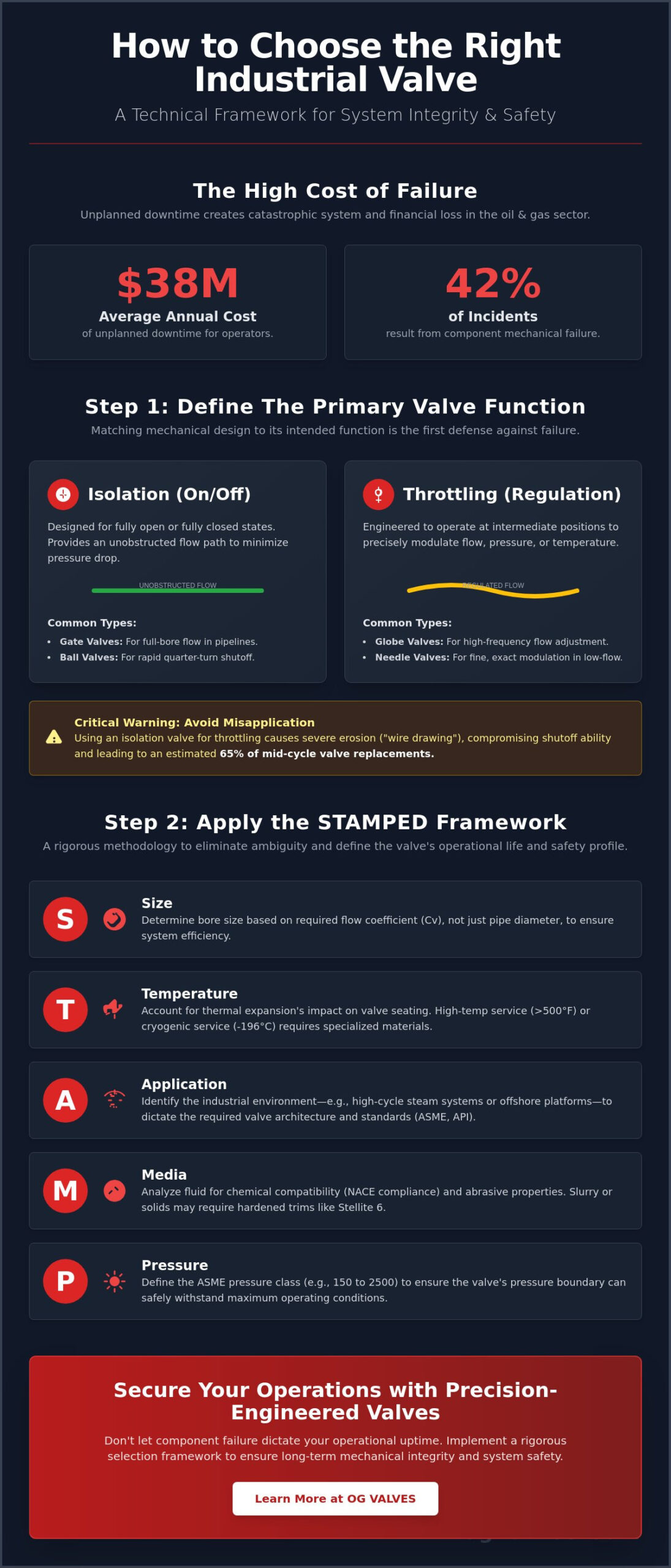
Unplanned downtime in the oil and gas sector costs operators an average of $38 million annually, and research from Kimberlite indicates that 42% of these incidents result from component mechanical failure. You’re aware that a single miscalculated specification in a high-pressure system creates immediate risk to both personnel and operational continuity. It’s a reality where technical precision serves as the only safeguard against catastrophic system loss.
This guide presents a rigorous framework for how to choose the right industrial valve type by prioritizing material integrity, API compliance, and functional requirements. We’ll define the technical parameters necessary to ensure long-term mechanical integrity and system safety. The following sections detail the selection criteria for gate, globe, and check valves, specifically examining the performance metrics required for Super Duplex alloys and cryogenic service under ASME B16.34 standards.
Key Takeaways
Define the primary valve function by distinguishing between on/off isolation and precise throttling to maintain system integrity.
Utilize the STAMPED methodology to calculate precise bore sizes and assess thermal expansion effects on valve seat performance.
Select optimal material grades and ensure compliance with international standards such as ASME and NACE for demanding industrial environments.
Understand how to choose the right industrial valve type through a rigorous comparison of configuration footprints and in-line maintenance requirements.
Secure project timelines by implementing quality assurance protocols, including the verification of Mill Test Reports and hydrostatic testing data.
Establishing the Primary Valve Function: Isolation vs. Throttling
Selecting the correct component requires a rigorous assessment of the valve’s primary duty within the piping architecture. Understanding industrial valve fundamentals prevents premature component failure and ensures system integrity. Every engineering specification must define whether a valve serves as a binary isolation point or a continuous flow regulator. Determining how to choose the right industrial valve type begins with this functional distinction.
Isolation valves, or on/off valves, are designed to remain in a fully open or fully closed state. When open, they provide an unobstructed path for the media; when closed, they must ensure a positive seal. Throttling valves, however, are engineered to operate at intermediate positions to modulate flow, pressure, or temperature. Attempting to use an isolation valve for throttling leads to severe internal wear. High-velocity flow across a partially open gate or ball causes “wire drawing,” which erodes the seating surfaces and compromises the valve’s ability to achieve a bubble-tight shutoff in the future.
Secondary functions also dictate selection. These include:
Backflow Prevention: Check valves allow unidirectional flow and prevent reverse surges that damage upstream pumps.
Pressure Relief: Safety valves protect the system by venting excess pressure when it exceeds the ASME-rated set point.
Diverting: Multi-port valves redirect flow between different process lines without the need for multiple isolation points.
Failure to match the valve’s mechanical design to its intended function accounts for approximately 65% of mid-cycle valve replacements in high-pressure oil and gas applications.
Isolation Valves: Gate and Ball Configurations
In systems requiring a full-bore, unobstructed flow path, gate valves are the standard. Their design minimizes pressure drop, which is critical in long-distance pipelines where pumping energy efficiency is a priority. For applications demanding rapid operation, ball valves provide a quarter-turn shutoff capability. These are preferred for hazardous media where immediate isolation is necessary to maintain site safety. Engineers must evaluate if the media requires a soft-seated ball for bubble-tight integrity or a metal-seated configuration for abrasive or high-temperature service.
Regulation and Throttling: Globe and Needle Valves
Globe valves are the primary choice for high-frequency flow adjustment. Their internal geometry forces the media to change direction twice, creating a deliberate pressure drop that allows for precise control over the flow rate. While this design increases turbulence, it protects the plug and seat from the erosive forces typical in throttling. For instrumentation and low-flow scenarios, needle valves offer even finer resolution. These utilize a tapered stem to provide exact modulation; however, the trade-off is a significantly higher flow resistance compared to isolation designs.
The STAMPED Methodology for Technical Valve Specification
Engineering teams utilize the STAMPED methodology to eliminate ambiguity during the procurement phase. This rigorous framework is essential when determining how to choose the right industrial valve type for critical infrastructure in the oil, gas, and water sectors. Each letter represents a technical boundary that defines the valve’s operational life and safety profile.
Size: Engineers must determine the correct bore size relative to the required flow coefficient rather than simply matching the pipe diameter.
Temperature: Thermal expansion significantly impacts valve seating. High-temperature service requires materials that maintain mechanical properties at 500°F and above.
Application: Identifying the specific industrial environment, such as cryogenic service at -196°C or high-cycle steam systems, dictates the necessary valve architecture.
Media: Analyzing chemical compatibility and abrasive properties prevents premature erosion. Slurry media often requires hardened trims like Stellite 6.
Pressure: Defining the ASME pressure class, ranging from 150 to 2500, ensures the pressure boundary can withstand maximum operating conditions.
Calculating Flow Coefficient (Cv) and Sizing
Precision in sizing is the primary defense against system inefficiency. Cv is the gallons per minute of water at 60°F with a 1 psi drop. This metric defines the relationship between pressure drop and flow rate. Engineers must avoid the risks of oversized valves in throttling applications. When a valve is too large for the required flow, the closure element operates too close to the seat. This creates a high-velocity flow path that causes “hunting” and accelerated seat erosion. Accurate Cv calculation is a fundamental step in how to choose the right industrial valve type for long-term performance. Professionals seeking high-integrity industrial valve solutions should always verify Cv data against peak and minimum flow requirements.
Pressure and Temperature (P-T) Ratings
The mechanical integrity of a valve is a function of its material grade and its operating environment. Consulting ASME B16.34 tables is mandatory to identify material-specific pressure limits at varying temperatures. Temperature fluctuations directly affect the structural stability of soft seats. Elastomers like PTFE or RPTFE provide bubble-tight shutoff but degrade rapidly if temperatures exceed 200°C. For extreme thermal service, specifying metal-to-metal seats is necessary to maintain seal integrity. Rigorous adherence to API valve standards ensures that the assembly survives the stresses of high-pressure hydrocarbon processing. It’s vital to remember that as temperature increases, the allowable working pressure of the valve body decreases. Ignoring this inverse relationship risks catastrophic shell failure during thermal transients.
Material Selection and Adherence to International Standards
Selecting the correct metallurgy is a fundamental technical requirement when determining how to choose the right industrial valve type for high-integrity systems. Carbon steel, specifically ASTM A216 WCB, serves as the industrial standard for non-corrosive applications at temperatures up to 425°C. Stainless steel grades like ASTM A351 CF8M provide essential resistance against oxidation and organic acids. For sour gas environments containing hydrogen sulfide, compliance with NACE MR0175/ISO 15156 is mandatory. This standard defines the metallurgical requirements to prevent sulfide stress cracking and stress corrosion cracking in oil and gas production.
Quality assurance protocols must include Positive Material Identification (PMI) to ensure the integrity of the alloy. PMI utilizes X-ray fluorescence (XRF) or Optical Emission Spectroscopy (OES) to verify that the chemical composition of the valve body and trim matches the Mill Test Report (MTR). This prevents the installation of incorrect alloys that could lead to catastrophic failure in corrosive service. Engineering specifications often require 100% PMI for high-alloy components to maintain system safety and regulatory compliance.
Metallurgy for Corrosive and High-Stress Service
Offshore platforms and specialized petrochemical plants frequently require exotic alloys such as Super Duplex or Monel. Super Duplex (ASTM A890) offers a Pitting Resistance Equivalent Number (PREN) above 40, making it suitable for high-chloride seawater environments. Engineers must specify forged bodies (ASTM A105 or A182) rather than cast bodies for high-pressure service exceeding Class 1500. Forged components provide a more uniform grain structure and higher fatigue resistance. To prevent galvanic corrosion, the trim material must be compatible with the body material. A common specification for steam service involves using a 13% Chromium trim (API Trim 8) with a carbon steel body to ensure thermal stability and wear resistance.
Critical Standards: API 600, API 6D, and ASME B16.34
Adherence to international standards provides a framework for safety and performance. API 600 is the primary benchmark for heavy-duty steel gate valves used in refinery operations. It stipulates wall thicknesses and stem diameters that are more robust than general-purpose standards. There’s a clear distinction between API 6D, which governs pipeline valves with specific requirements for full-bore flow and cavity relief, and refinery-focused standards. ASME B16.34 serves as the foundational standard for pressure-temperature ratings, wall thickness, and hydrostatic testing. When handling flammable media, the valve must hold an API 607 fire-safe certification. This ensures the valve maintains its seal during a fire, even if the primary soft seals are destroyed. These certifications are vital data points when evaluating how to choose the right industrial valve type for critical infrastructure projects.
Comparative Analysis of Common Industrial Valve Configurations
Mechanical footprint and total weight are primary constraints in modern plant design. For piping systems exceeding DN250 (10 inches), a standard gate valve can weigh five times more than a wafer-style butterfly valve. This mass difference requires reinforced pipe supports and increases installation labor hours. Effective system design depends on understanding how to choose the right industrial valve type based on these physical parameters and the structural integrity of the piping rack.
Maintenance protocols also dictate selection. In-line repairability is a critical factor for API 6D ball valves. While top-entry designs carry a higher initial purchase price, the ability to replace internal seals without removing the valve body reduces downtime by approximately 45% compared to total valve replacement. Engineers must perform a cost-benefit analysis between resilient-seated valves and high-performance metal-seated designs. Resilient seats provide bubble-tight shutoff (ISO 5208 Rate A) in water systems, but metal-seated configurations are mandatory for hydrocarbon service exceeding 200°C to maintain fire-safe compliance.
Selecting the appropriate check valve is vital to prevent water hammer and reverse flow. Nozzle check valves with spring-assisted closures offer faster response times than traditional swing checks. This speed prevents pressure surges that can exceed 200% of the system’s nominal operating pressure, protecting sensitive pumps and instrumentation from hydraulic shock.
Butterfly Valves: High-Performance vs. Triple Offset
In large diameter applications, butterfly valves minimize the face-to-face dimension, saving up to 60% of the space required by gate or globe valves. Resilient seats are standard for water treatment due to their chemical resistance and lower torque requirements. However, triple offset designs are necessary for high-pressure, zero-leakage service in steam or gas. The triple offset geometry ensures the disc only contacts the seat at the final point of closure. This reduces seat wear and maintains seal integrity over 10,000 cycles in abrasive environments.
Plug Valves vs. Ball Valves
Plug valves provide superior durability in slurry and high-solids media. The large seating area remains protected from the flow stream when the valve is open, preventing the accumulation of solids that typically jams ball valve cavities. When determining how to choose the right industrial valve type for automation, torque requirements are a major factor. Plug valves generally require 30% to 50% more torque than ball valves, which necessitates larger actuators and increases the cost of the automated package. Lubricated plug valves outperform standard ball designs in corrosive chemical services where the sealant film acts as an additional barrier against body erosion.
Strategic Procurement: Delivery Lead Times and Quality Assurance
The final stage in determining how to choose the right industrial valve type involves aligning technical requirements with procurement logistics. Lead times for specialized components, such as duplex stainless steel or cryogenic service valves, often exceed 26 weeks. These durations directly influence project commissioning schedules. Delays in valve delivery can stall entire midstream or downstream operations. Procurement specialists must prioritize suppliers capable of providing verified Mill Test Reports (MTRs) and documented hydrostatic testing results. These documents confirm that the chemical composition and pressure-retaining capabilities meet ASME and API standards.
Fast-Track Logistics for Critical Infrastructure
Rigorous Testing and Inspection Protocols
Integrity assurance requires comprehensive non-destructive testing (NDT). For high-stakes projects involving hazardous media, engineers must specify X-ray or ultrasonic testing to detect internal casting defects. Third-party inspection (TPI) agencies often oversee these processes to provide an unbiased verification of compliance with ISO 10423 or API 6D. Final verification of end connections is a critical step. Whether the system requires flanged, butt-weld (BW), or threaded connections, the dimensions must adhere strictly to ASME B16.5 or B16.25. This ensures leak-free integration into the existing piping infrastructure.
To finalize how to choose the right industrial valve type, use the following technical procurement checklist for RFQ submission:
Design Standard: Specify API 600, API 602, or ASME B16.34 requirements.
Material Grade: Define the exact alloy, such as ASTM A216 WCB or A351 CF8M.
Pressure Class: State the required ASME class, ranging from Class 150 to Class 2500.
Testing Requirements: List mandatory API 598 hydrostatic and air tests.
Certification: Require EN 10204 3.1 or 3.2 certification for all pressure-containing parts.
Actuation: Detail if the valve requires manual, electric, or pneumatic operation.
Strategic procurement functions as a safeguard for engineering integrity. By focusing on rigorous inspection and logistical reliability, operators ensure that the selected hardware performs reliably over its intended lifecycle.
Securing Infrastructure Integrity with Precision Engineering
Achieving operational safety in 2026 requires a methodical approach to fluid control. Engineers must utilize the STAMPED methodology to ensure every component meets the exact thermal and chemical requirements of the process. Adherence to ASME B16.34 and API 6D standards provides the necessary framework for preventing failure in high-pressure environments. Selecting between gate, globe, and ball configurations depends on whether the system requires absolute isolation or precise throttling. Don’t overlook the importance of verifying that metallurgy, such as ASTM A216 WCB or 316L stainless steel, matches the media’s corrosivity.
Mastering how to choose the right industrial valve type simplifies procurement and reduces total cost of ownership. OG VALVES LTD maintains an extensive inventory of API-compliant and ASME-certified components. Our technical team offers specialist expertise in heavy industry metallurgy to resolve complex specification challenges. We’ve established global fast-track delivery systems to minimize facility downtime during critical maintenance windows. We look forward to partnering with your team to ensure long-term system reliability.
What is the most important factor in industrial valve selection?
The process fluid’s chemical properties and the system’s pressure-temperature envelope are the most important factors. Engineers must analyze ASME B16.34 pressure-temperature ratings to ensure the valve body maintains its integrity under maximum service loads. This technical evaluation is the foundation of how to choose the right industrial valve type for high-stakes oil and gas applications. Selecting materials based on 100% compatibility prevents premature corrosion and catastrophic containment loss.
How do I choose between a ball valve and a gate valve for isolation?
Choose a ball valve when 90-degree quick-acting shut-off is required for emergency isolation. Ball valves provide a bubble-tight seal but can suffer seat damage if they’re left partially open. In contrast, API 600 gate valves are preferred for main steam lines or high-pressure hydrocarbons where a straight-through flow with minimal pressure drop is required. Gate valves offer a robust mechanical seal and are utilized in 75% of full-flow isolation scenarios.
What does NACE MR0175 compliance mean for valve materials?
NACE MR0175 compliance specifies that materials used in valve construction must resist sulfide stress cracking in H2S-containing environments. This standard, also known as ISO 15156, dictates strict hardness limits, such as a maximum of 22 HRC for carbon steels. Adhering to these metallurgical requirements is mandatory for 100% of upstream oil and gas installations where sour gas concentrations exceed 0.05 psi partial pressure to ensure long-term integrity.
When should I specify a triple offset butterfly valve over a standard design?
Specify a triple offset butterfly valve when your application requires zero-leakage performance in temperatures exceeding 400 degrees Celsius. Standard concentric or double offset designs rely on soft seats that fail under extreme thermal stress. The triple offset design utilizes a metal-to-metal seal and a non-rubbing geometry to maintain API 598 sealing standards. This specialized design reduces torque requirements by 30% compared to traditional gate valves in large diameter pipelines.
How does temperature affect the pressure rating of an industrial valve?
Temperature inversely affects the allowable working pressure of a valve according to ASME B16.34 tables. For example, a Class 300 carbon steel valve rated for 740 psi at 38 degrees Celsius drops to a 410 psi rating once the temperature reaches 425 degrees Celsius. Engineers must consult material-specific pressure-temperature charts to ensure the selected valve doesn’t exceed its yield strength during thermal excursions. This prevents deformation of the valve’s internal sealing components.
What is the difference between API 600 and API 6D standards?
API 600 focuses on heavy-duty bolted bonnet steel gate valves used primarily in refinery services where wall thickness and stem diameter are critical for longevity. API 6D is the specification for pipeline valves, including ball, gate, and check types, emphasizing full-bore passage and piggability. While API 600 valves prioritize structural mass for corrosion allowance, API 6D valves prioritize specific pressure testing protocols and cavity relief mechanisms for long-distance transport.
Why is the flow coefficient (Cv) critical for valve sizing?
The flow coefficient (Cv) is critical because it quantifies the volume of 15 degree Celsius water that flows through a valve per minute with a 1 psi pressure drop. Incorrect Cv calculations lead to oversized valves, which cause 60% of control loop instabilities, or undersized valves that create excessive cavitation. Proper sizing ensures the valve operates within its linear or equal percentage flow characteristic range for optimal process control and reduced mechanical wear.
Can I use a gate valve for throttling fluid flow?
Gate valves shouldn’t be used for throttling because high-velocity fluid causes severe erosion on the gate and seat surfaces when they’re partially open. This leads to “wire-drawing” and prevents the valve from achieving a tight seal during future isolation attempts. Additionally, the resulting turbulent flow can cause mechanical vibration and noise levels exceeding 85 decibels. This turbulence often leads to premature stem packing failure and structural fatigue over time.
 Responsive Menu