Selecting Control Valves for Abrasive Slurry: A Technical Specification Guide
May 04, 2026
Home+Selecting Control Valves for Abrasive Slurry: A Technical Specification Guide
The integrity of a slurry system hinges on the technical reality that kinetic energy will eventually destroy any material not specifically engineered for sacrificial wear or extreme hardness. With the global industrial valve market projected to reach $77.8 billion by 2026, the technical burden of selecting control valves for abrasive slurry has shifted from basic procurement to complex material science. You’re likely aware that rapid erosion of valve seats and inaccurate flow control aren’t just maintenance nuisances; they’re systemic failures that compromise plant safety and operational performance.
This article delivers a clinical engineering analysis of trim design and velocity management to ensure your systems achieve an extended Mean Time Between Failures (MTBF). We’ll evaluate how emerging technologies, including zirconia alumina components and patented flow-centralizing trims, mitigate the impact of high-velocity particulates. By adhering to rigorous ASME B16.34 and ISO 5208 standards, you’ll gain the precise throttling capabilities required for high-stakes industrial environments. This guide prioritizes functional reality and long-term durability over theoretical performance metrics.
Key Takeaways
Identify how specific particle impingement patterns dictate internal valve geometry to prevent localized erosion in heterogeneous flow paths.
Apply clinical engineering criteria for selecting control valves for abrasive slurry based on sacrificial elastomer performance or hardened metallic trim specifications.
Evaluate the performance trade-offs between pinch valve linear control and ball valve durability in high-pressure throttling scenarios.
Implement rigorous velocity management and Flow Coefficient (Cv) calculations to minimize kinetic damage in high-solids mixtures.
Verify total system integrity by ensuring adherence to ASME B16.34 and API 598 testing protocols for severe service applications.
Technical Challenges of Abrasive Slurry in Flow Control
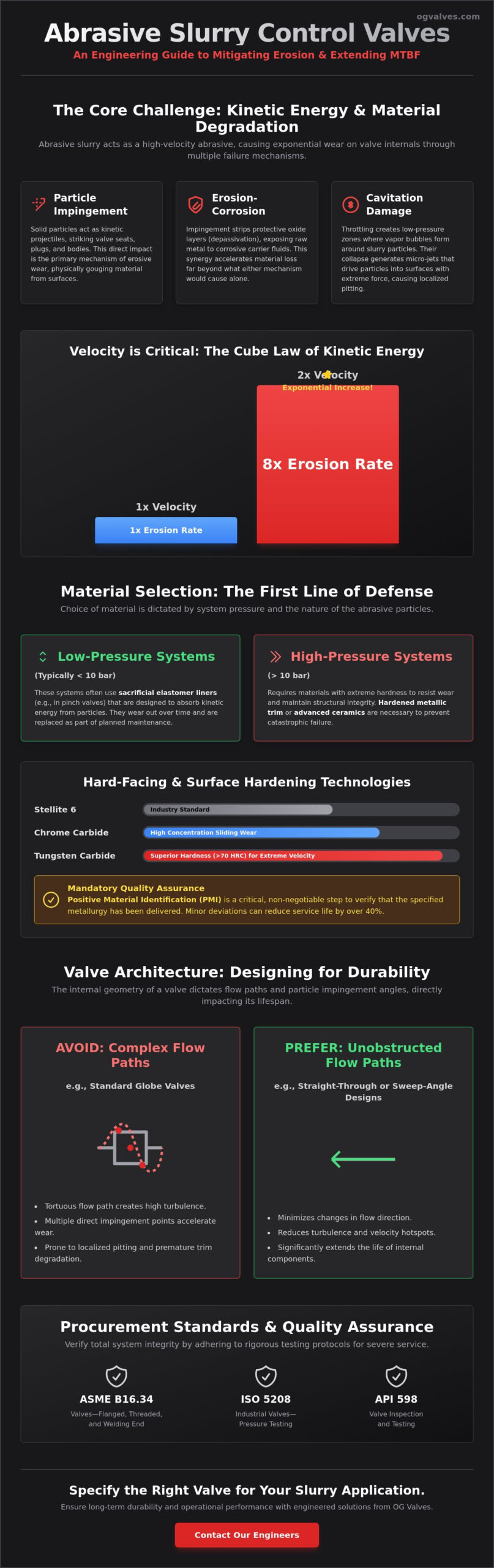
Selecting control valves for abrasive slurry necessitates a granular understanding of fluid dynamics and material science. Slurry is defined as a heterogeneous mixture of insoluble solid particles transported within a liquid carrier. In industrial flow control, these particles represent kinetic projectiles that continuously impact internal valve components. The primary failure mechanism is particle impingement, where the angle and velocity of the solids dictate the rate of material loss across the valve seat, plug, and body walls.
Erosion rates aren’t linear. They scale exponentially with flow velocity. In many slurry applications, doubling the fluid velocity can increase the erosion rate by a factor of eight, following the cube law of kinetic energy. This makes velocity management the most critical factor when control valve specifications are established. Engineers must distinguish between abrasive wear, which involves material displacement through sliding contact, and erosive wear, which results from high-velocity kinetic impacts at the vena contracta.
Erosion-Corrosion Synergy in Slurry Service
The degradation of metallic valve components in slurry service is rarely a purely mechanical process. Mechanical impingement constantly strips the protective oxide layer from metallic surfaces, a process known as depassivation. This exposes the raw base metal to the carrier fluid, triggering rapid chemical oxidation. This synergy between mechanical wear and chemical attack accelerates failure rates far beyond what either mechanism would achieve independently. Factors such as a pH shift below 6.0 or temperatures exceeding 60°C significantly increase these degradation rates, requiring specific material grades like duplex stainless steel or specialized hard-facings.
Cavitation and Turbulence in Throttling Applications
Throttling inherently creates high-velocity zones and pressure drops that invite cavitation. In slurry applications, solid particles serve as nucleation sites for vapor bubbles, increasing the frequency of cavitation events within the valve body. When these bubbles collapse near the valve trim, the resulting micro-jets drive abrasive particles into the material surface with extreme force. High-turbulence zones, typically found downstream of the seat, exacerbate this damage by creating unpredictable impingement angles. This turbulence compromises control precision and leads to:
Trim Degradation: Loss of the engineered flow characteristic due to seat profile deformation.
Localized Pitting: Accelerated material loss in non-sacrificial areas of the valve body.
Seal Failure: Penetration of fine particulates into packing sets and secondary seals.
Effective management of these challenges requires a clinical approach to valve architecture. Standard globe valves often fail prematurely in these conditions because their complex flow paths create multiple high-impact zones. Transitioning to straight-through or sweep-angle designs is often the first step in mitigating these technical risks.
Material Specifications for Erosion Resistance
Material selection is the primary defense against the kinetic energy and impingement damage identified in our previous analysis. When selecting control valves for abrasive slurry, engineers must categorize the application by pressure class and particle angularity. Low-pressure systems, typically operating below 10 bar, often utilize sacrificial elastomer liners to absorb impact energy. High-pressure systems require hardened metallic trim or advanced ceramics to maintain structural integrity. Positive Material Identification (PMI) is a mandatory quality assurance protocol to verify that delivered components meet the specified metallurgy. Even minor deviations in chromium or tungsten content can reduce service life by 40% in severe service environments.
Hard-Facing and Surface Hardening Technologies
Hard-facing provides a critical barrier for valve seats and plugs. Stellite 6, a cobalt-chromium alloy, remains the industry standard for general erosion resistance. For applications involving extreme velocities or high pressure drops, High-Velocity Oxy-Fuel (HVOF) applied Tungsten Carbide offers superior bond strength and hardness values exceeding 70 HRC. This application method ensures a dense, low-porosity coating that resists the micro-pitting common in high-concentration slurries. While boronizing creates a hard surface layer, it’s often too brittle for high-impact scenarios; chrome carbide remains the preferred choice for high-concentration mixtures where sliding abrasion is the dominant wear mechanism. Consulting with an industrial valve specialist ensures material grades align precisely with your specific abrasive grain profiles.
Elastomer Selection and Performance Limits
Sacrificial elastomers provide a cost-effective solution for low-pressure slurry control. Natural rubber (NR) offers excellent resilience and “rebound” characteristics for large, jagged particles but is generally limited to 70°C. Styrene Butadiene (SBR) provides enhanced heat resistance and mechanical toughness for more demanding thermal profiles. For fine particle slurries where impingement angles are consistently low, polyurethane-lined components offer a significant durability advantage. Engineers must cross-reference chemical compatibility with the carrier fluid to prevent elastomer swelling, which can lead to catastrophic trim seizure. Recent 2026 developments in enhanced elastomer formulations have extended the service life of these liners by 15% in mining and tailings applications.
In the most extreme abrasive environments, such as those involving ceramic or zirconia alumina grains, metallic hard-facing may still prove insufficient. Ceramic inserts, specifically partially stabilized zirconia (PSZ), provide the ultimate wear resistance. These inserts are capable of maintaining a precise throttling edge far longer than metallic counterparts, though they require careful housing design to mitigate their inherent brittleness and sensitivity to thermal shock. Adhering to these rigorous material specifications ensures that your control valve maintains its performance integrity throughout its projected service life.
Evaluating Valve Architectures for Slurry Control
Selecting control valves for abrasive slurry requires matching the mechanical architecture of the valve to the specific kinetic profile of the media. While material selection provides the primary defense, the valve’s internal geometry determines the impingement angles that drive erosion. Pinch valves represent a preferred solution for low-pressure, high-solids applications because they maintain a full-bore flow path and offer nearly linear control characteristics. By eliminating internal obstructions, pinch valves minimize the turbulence that leads to localized wear in the valve body. However, their pressure limitations often necessitate a transition to more robust metallic architectures as system demands increase.
Standard globe valves typically fail in slurry service because their tortuous flow paths force the media through 180-degree turns. This causes severe impingement at the bridge wall and seat area. Modified globe designs, such as sweep-angle valves, mitigate this by providing a more direct discharge path. Even with these modifications, ball valves remain the superior choice for high-pressure isolation and throttling in abrasive environments. Their ability to provide a clear flow path when open and a robust sealing surface when closed makes them indispensable in heavy industrial sectors.
Slurry Ball Valves: Trunnion vs. Floating Design
The choice between trunnion-mounted and floating ball designs depends on the operating pressure and the risk of particle ingress. Trunnion-mounted valves are essential for high-pressure slurry lines because they isolate the sealing force from the ball itself, reducing the torque required for operation. To maintain seal integrity, these valves often incorporate scraper seat designs. These seats mechanically clear solid particulates from the ball surface during rotation, preventing the entrapment of abrasives between the ball and the seat. For a detailed breakdown of these mechanical configurations, engineers should refer to our Technical Engineering & Specification Guide for Ball Valves.
High-Performance Butterfly Valves in Slurry
High-performance butterfly valves, specifically triple offset designs, offer a compelling alternative for large-diameter slurry lines where space and weight are critical factors. The triple offset geometry ensures the disc only contacts the seat at the final point of closure, which significantly reduces friction-induced wear from abrasive particles. Material selection for the disc’s leading edge is vital; using hardened alloys like Chrome Carbide prevents the premature thinning that leads to seat leakage. Engineers can find comprehensive data on these configurations in our Engineer’s Guide to Industrial Butterfly Valves. While butterfly valves provide excellent shut-off, their throttling range is more limited than ball or pinch designs, often restricted to the 20 to 70 degree opening range to avoid cavitation at the disc edges.
Each architecture presents distinct advantages for managing abrasive media. The final selection must account for the required Flow Coefficient (Cv) and the specific pressure drop across the valve. This ensures the chosen geometry doesn’t inadvertently create high-velocity zones that bypass the protection offered by your material specifications.
Engineering Criteria for Sizing and Velocity Management
The technical process of selecting control valves for abrasive slurry requires a departure from standard liquid flow calculations. Precise sizing isn’t merely a matter of meeting flow requirements; it’s a critical strategy for managing the kinetic energy that drives material degradation. When calculating the Flow Coefficient (Cv), engineers must incorporate the specific gravity (SG) of the total mixture, which often exceeds 1.5 in mining and mineral processing applications. Failure to account for the increased density and solids concentration results in undersized valves that operate at higher-than-intended velocities, leading to premature trim failure.
Standard sizing formulas should be adjusted for non-Newtonian fluid behavior, as high solids content significantly alters the Reynolds number. Viscosity corrections are mandatory when the slurry exhibits Bingham plastic or pseudoplastic characteristics. If the valve is sized too small, the resulting pressure drop across the seat creates a high-velocity jet that can erode even the most robust Tungsten Carbide trim in less than 500 operating hours. Conversely, oversizing a valve leads to operation at low lift, where the narrow flow path increases the ‘sandblasting effect’ on the seat and plug surfaces.
Velocity Limits and Piping Geometry
Velocity management is the most effective method for extending the service life of slurry control components. For non-settling slurries, the recommended velocity range is typically between 1.5 and 3.0 meters per second. Velocities below 1.5 m/s risk particle dropout and line plugging, while velocities exceeding 3.5 m/s trigger exponential increases in erosive wear. Piping geometry also plays a vital role in system integrity. Engineers should ensure a minimum of 10 pipe diameters of straight run upstream and 5 diameters downstream of the valve to minimize turbulence. Sharp elbows located immediately downstream of a control valve are high-risk zones, as the turbulent discharge from the valve can cause rapid pipe wall thinning.
Actuation and Automation Requirements
Actuator sizing for slurry service must account for the mechanical resistance of settled solids. Breakaway torque requirements in a slurry valve can be 1.5 to 2.0 times higher than those for clean liquid service, especially after a period of stagnation where ‘de-watering’ occurs in the valve cavity. Sizing pneumatic or electric actuators based on clean-water torque values leads to incomplete closure or stalled cycles. Precise throttling requires high-performance positioners capable of handling the heavy friction loads of slurry-specific packing and seals. For comprehensive data on selecting the correct drive units, refer to our Technical Guide to Automation and Control.
The final stage in selecting control valves for abrasive slurry involves the verification of engineering specifications through rigorous procurement standards. In high-stakes industrial environments, technical compliance isn’t optional. It’s the primary safeguard against catastrophic component failure. Procurement specialists must prioritize valves that adhere to ASME B16.34, which defines the pressure and temperature ratings essential for maintaining pressure boundary integrity. This standard ensures that the valve body wall thickness and material properties are sufficient to withstand the combined stresses of system pressure and the erosive forces identified in earlier sections.
Quality assurance protocols must include API 598 seat leakage testing as a baseline requirement. While zero-leakage is often difficult to maintain in abrasive service, establishing a known leakage class according to ANSI/FCI 70-2 or IEC 60534-4 provides a clinical benchmark for performance. Every critical valve assembly requires a comprehensive documentation package, including Mill Test Reports (MTRs). These reports provide the necessary material traceability to confirm that the hardened trims and specialized alloys, such as the Tungsten Carbide or Stellite coatings discussed in section two, meet the exact chemical and mechanical specifications ordered.
Compliance and Certification Frameworks
Operational safety in severe service depends on adherence to global certification frameworks. Manufacturing facilities must operate under ISO 9001 quality management systems to ensure consistent production tolerances. In applications where the carrier fluid contains hydrogen sulfide, compliance with NACE MR0175/ISO 15156 is mandatory to prevent sulfide stress cracking in metallic components. For high-risk infrastructure projects, third-party inspections by entities like Lloyd’s Register or Bureau Veritas provide an additional layer of technical validation, ensuring that the valve’s functional reality matches its theoretical specification.
Selecting a Specialist Industrial Valve Supplier
A dependable partner in critical infrastructure must offer more than just a product catalog. Engineers should identify suppliers who maintain a deep inventory of high-specification components and provide documented technical support for complex sizing and material selection. Given the high cost of downtime in the oil, gas, and mining sectors, global logistics capabilities and fast-track delivery options are essential for maintaining plant MTBF. For a deeper analysis of the regulatory landscape, consult the Engineer’s Comprehensive Guide to Selection and Standards. This resource provides the necessary framework for aligning procurement decisions with international safety benchmarks and project-specific performance data.
By anchoring the selection process in these clinical standards, procurement teams move beyond the role of mere vendors. They become essential partners in ensuring the long-term integrity of heavy industrial flow control systems. This methodical approach to quality assurance ensures that every valve installed is capable of meeting the rigorous demands of abrasive slurry service without compromise.
Securing Infrastructure Integrity Through Technical Precision
The technical requirement for selecting control valves for abrasive slurry demands a clinical transition from general procurement to rigorous engineering specification. Managing kinetic impingement through established velocity limits and the application of HVOF-applied Tungsten Carbide ensures your infrastructure resists the cube law of erosion. System integrity is only verified when the mechanical architecture, such as triple offset or scraper seat designs, aligns with the specific gravity and solids concentration of your media.
OG VALVES LTD. maintains an extensive inventory of API and ASME compliant valves designed for these severe service environments. Our global fast-track delivery systems ensure that critical industrial operations receive high-specification material grades without the risk of project delays. We provide specialist expertise in material science to guarantee your components exceed the performance limits of standard hardware. It’s a commitment to industrial safety that eliminates the ambiguity of generic valve selection.
What is the best valve type for high-concentration abrasive slurry?
Pinch valves are the preferred architecture for high-concentration mixtures at low pressures because they eliminate internal flow obstructions. For high-pressure applications, trunnion-mounted ball valves with HVOF-applied Tungsten Carbide provide the necessary structural integrity. Selecting control valves for abrasive slurry requires matching these architectures to the specific kinetic energy and particle angularity of the media to ensure long-term performance.
How do I calculate the Cv for a control valve in slurry service?
Calculate the Flow Coefficient (Cv) by incorporating the specific gravity of the total mixture, which frequently exceeds 1.5 in mineral processing operations. You must also apply viscosity correction factors if the solids concentration causes the fluid to exhibit non-Newtonian behavior. Failure to account for these density shifts leads to undersizing, which results in high-velocity erosion across the valve seat.
Can a standard butterfly valve be used for abrasive slurry?
Standard butterfly valves shouldn’t be used due to rapid leading-edge erosion of the disc and liner. High-performance triple offset configurations are required for these environments. These specialized designs ensure the disc only contacts the seat at the final point of closure. This mechanism minimizes the friction-induced wear that typically destroys standard resilient-seated butterfly valves in less than 1,000 operating hours.
What is the role of Stellite hard-facing in slurry control valves?
Stellite hard-facing provides a cobalt-chromium protective layer that resists both mechanical impingement and chemical oxidation. This material maintains its engineered hardness at elevated temperatures and prevents the depassivation of the base metal. It’s the industry benchmark for protecting seats and plugs in severe service environments where the protective oxide layer is constantly stripped by particle impact.
How does flow velocity affect the lifespan of a slurry valve?
Flow velocity impacts valve lifespan exponentially according to the cube law of kinetic energy. Doubling the fluid velocity can increase the material erosion rate by 800% in high-concentration lines. Maintaining transport velocities between 1.5 and 3.0 meters per second is critical for balancing particle suspension with component durability. Exceeding these limits triggers rapid thinning of the valve body and downstream piping.
What are the common failure modes of valves in abrasive applications?
Common failure modes include localized pitting from turbulence and trim deformation that compromises engineered flow characteristics. Fine particulates also penetrate packing sets, causing stem seizure or catastrophic external leakage. These failures are often accelerated by the synergy between mechanical wear and chemical corrosion, where the base metal is exposed to acidic carrier fluids following the removal of protective coatings.
Is a pinch valve better than a ball valve for slurry control?
Pinch valves offer superior abrasion resistance in low-pressure lines, while ball valves provide better throttling control at higher pressure classes. Pinch valves maintain a full-bore flow path that minimizes turbulence during operation. Ball valves are more suitable when selecting control valves for abrasive slurry that requires precise flow modulation in systems exceeding 10 bar or where tight shut-off is mandatory.
How do I prevent slurry from settling inside the valve body?
Prevent settling by maintaining a minimum transport velocity of 1.5 meters per second throughout the valve body. Straight-through valve architectures, such as pinch or full-port ball valves, eliminate the dead zones where solids typically accumulate during low-flow conditions. Using these designs reduces the risk of de-watering and subsequent valve seizure, ensuring the system remains operational after periods of stagnation.
 Responsive Menu