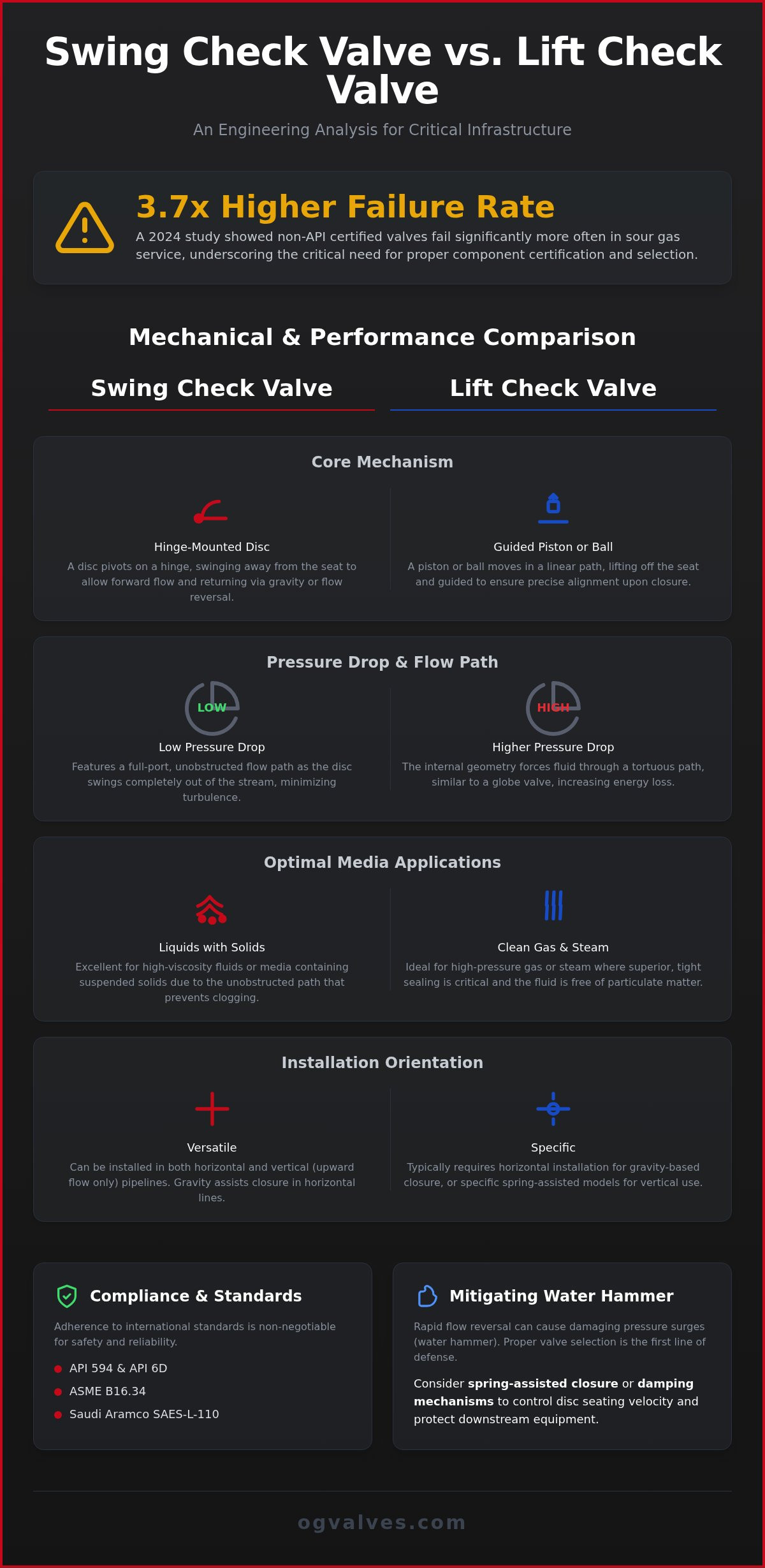
A 2024 study revealed that non-API certified valves failed at a rate 3.7 times higher than certified units in sour gas service. This data highlights the severe consequences of improper component specification in high-pressure environments where equipment integrity is non-negotiable. You understand that the technical decision between a swing check valve vs lift check valve directly impacts your facility’s energy consumption and long-term structural safety. Unscheduled downtime and water hammer aren’t just operational inconveniences; they’re indicators of a fundamental mechanical mismatch that threatens critical infrastructure.
This report offers a definitive engineering analysis of mechanical configurations and performance metrics to facilitate precise industrial valve selection. We’ll evaluate pressure drop characteristics, orientation constraints, and compliance with the 2025 Saudi Aramco SAES-L-110 revision and API 594 standards. By examining sealing precision against flow capacity, we provide the technical data necessary to ensure your procurement meets international safety benchmarks. Our focus remains on achieving operational reliability in corrosive media while minimizing the energy losses associated with excessive turbulence.
Key Takeaways
- Understand the mechanical distinctions between hinge-mounted discs and guided pistons to ensure unidirectional flow integrity in high-pressure systems.
- Analyze the energy loss and pressure drop profiles of a swing check valve vs lift check valve to maximize long-term operational efficiency.
- Determine the correct installation orientation requirements for each valve type to prevent premature mechanical wear and gravity-related failure.
- Verify compliance with international safety standards, including API 594 and ASME B16.34, to maintain rigorous regulatory adherence.
- Select the appropriate damping or spring-assist options to mitigate water hammer and protect expensive downstream infrastructure from structural damage.
Fundamentals of Backflow Prevention: Swing and Lift Mechanisms
Industrial infrastructure relies on the mechanical integrity of unidirectional flow control. Preventing backflow is essential to protect high-value assets like centrifugal pumps and reciprocating compressors from catastrophic damage caused by reverse fluid kinetic energy. To understand what is a check valve, engineers must analyze the specific mechanical obstruction used to block reverse flow. The primary distinction in a swing check valve vs lift check valve comparison lies in the movement path of the closure element. While the swing design utilizes a rotational arc, the lift design relies on linear displacement.
Every check valve requires a specific differential pressure, known as cracking pressure, to overcome internal friction and gravity. In swing designs, the disc’s weight and the hinge’s position dictate this requirement. Lift designs often incorporate springs to ensure positive closure. This increases the cracking pressure but provides faster response times. Gravity plays a decisive role in horizontal versus vertical installations. Selecting the wrong orientation often leads to valve chatter or failure to seal. It’s a technical reality that fluid inertia must be managed to prevent structural piping fatigue.
The Swing Check Valve Architecture
The swing check valve features a disc attached to a hinge or pivot pin. This disc swings off the seat to allow forward flow and returns to the seat when flow ceases. Engineers often specify full-port swing valves to minimize turbulence and pressure drop. Because the disc swings almost entirely out of the flow stream, these valves are suitable for media containing suspended solids or high-viscosity fluids. The lack of internal obstructions prevents debris accumulation that might otherwise foul the mechanism. These components typically adhere to API 594 standards for face-to-face dimensions and wall thickness.
The Lift Check Valve Architecture
Lift check valves function through a piston or ball that moves vertically within the valve body. This mechanism requires an internal guide to maintain precise alignment with the seat. The internal flow path typically follows a tortuous route, mirroring the geometry of globe valves. This design provides superior sealing capabilities in high-pressure gas or steam applications. However, the complex internal path makes them unsuitable for fluids containing significant particulate matter. Precise machining of the piston and guide ensures the valve remains functional under high-duty cycles. It’s a design that prioritizes seat integrity over flow volume.
Mechanical Design and Operational Principles
The mechanical efficiency of a swing check valve vs lift check valve depends on the specific kinematics of the closure member. In swing designs, the disc travels along a rotational arc. This movement creates high impact velocity during rapid flow reversal, which can stress the hinge pin and seat. Conversely, lift check valves utilize linear vertical displacement. This motion is governed by gravity or spring tension, ensuring a more controlled seating process. Choosing between these designs requires an understanding of how disc inertia affects system longevity.
Hinge and Pivot Dynamics in Swing Designs
The pivot pin serves as the primary stress point in swing configurations. During high-velocity flow, the disc remains suspended, putting constant shear force on the hinge mechanism. If the disc weight isn’t calibrated correctly, the valve may fail to open fully at low flow rates, leading to increased turbulence. Maintenance protocols must prioritize the inspection of the hinge pin for erosion or fatigue. For facilities requiring high-durability components, reviewing a technical inventory of check valves can help identify robust hinge designs that meet API 6D standards. This is especially relevant given the 2025 Saudi Aramco SAES-L-110 update, which mandates specific sealing configurations for hydrocarbon injection lines.
Guide and Seat Precision in Lift Designs
Lift mechanisms rely on tight tolerances between the guide and the piston. If these tolerances are too loose, the piston may tilt, causing uneven seat wear or sticking. In high-velocity gas streams, the seating surfaces are prone to wire-drawing if the valve doesn’t close instantaneously. Spring-loaded variants address this by providing an assisted closure force. This mechanical assistance reduces the travel time of the disc, effectively mitigating the risks of backflow-induced damage. The internal geometry ensures the disc remains centered, which is vital for maintaining a bubble-tight seal in critical gas applications.
Wear patterns differ significantly between these two architectures. Swing valves often experience hinge pin thinning due to constant oscillation in turbulent flow. Lift valves are more susceptible to guide rail friction and potential binding if the media contains particulates. Regarding sealing integrity, lift valves typically outperform swing valves at low differential pressures. The vertical alignment ensures a more uniform contact pressure across the entire seating surface. This is particularly critical in systems where zero-leakage is a regulatory requirement under API 641 fugitive emission standards, which became mandatory for VOC service in 2024.

Flow coefficient (Cv) serves as the primary metric for quantifying the hydraulic efficiency of unidirectional flow components. When evaluating a swing check valve vs lift check valve, the disparity in pressure drop is a direct consequence of internal geometry. Swing check valves generally feature a straight-through flow path. This configuration yields a higher Cv, making them the preferred choice for large-bore piping where maintaining flow velocity is critical. Lift check valves, however, utilize a globe-style body that requires the fluid to make two 90-degree turns. This redirection inherently increases turbulence and energy loss, which must be factored into the total cost of ownership for high-volume systems.
Flow Efficiency and Turbulence
The energy loss associated with lift check valves is particularly pronounced in high-duty cycle systems. Because the disc remains in the flow stream, it creates a constant obstruction. In large-scale industrial facilities, these cumulative pressure drops necessitate higher pump discharge pressures, directly increasing electrical or fuel consumption. Swing designs mitigate this by allowing the disc to reside in a recessed area of the valve body during full-flow conditions. This reduces the friction factor and prevents the “wire-drawing” effect often seen in restricted-port valves. Selecting a valve with an optimized Cv is essential for meeting international energy efficiency standards and reducing operational overhead.
Orientation and Gravity Constraints
Installation orientation is a non-negotiable technical constraint. Standard lift check valves rely on gravity and fluid back-pressure to reseat the piston. Consequently, they’re restricted to vertical lines with upward flow. If a lift valve’s installed in a horizontal line without a spring-assist mechanism, the piston may fail to return to the seat, leading to bypass. Swing check valves offer more flexibility, functioning effectively in horizontal lines and vertical lines with upward flow. However, they’re strictly prohibited in vertical downward flow applications. In such cases, the disc would remain open due to gravity, rendering the backflow prevention mechanism useless.
The “slam” phenomenon is another critical performance factor related to disc travel. Swing check valves have a longer disc travel distance, which can lead to high impact velocities upon closure. This rapid deceleration of the fluid column often results in water hammer, which causes structural damage to piping. Lift check valves, with their shorter linear travel, close more rapidly. This makes them inherently better suited for systems where rapid flow reversal is expected. For compact piping skids where space is limited, the shorter face-to-face dimensions of lift valves often provide a logistical advantage over bulkier swing alternatives.
Material Selection and Standards Compliance
The technical evaluation of a swing check valve vs lift check valve extends beyond mechanical movement to the metallurgical integrity of the pressure-containing envelope. Adherence to ASME B16.34 is the baseline requirement for determining pressure-temperature ratings. This standard ensures that the valve body and bonnet maintain structural soundness under peak operational loads. For heavy industrial service, manufacturers must comply with the 5th edition of API 594, published in 2021, and API 6D. These standards define the minimum wall thickness and face-to-face dimensions required for global interchangeability. In sour gas environments, materials must strictly conform to NACE MR0175/ISO 15156 to mitigate the risk of sulfide stress cracking and hydrogen-induced cracking.
Metallurgical Considerations for High-Pressure Service
Erosion resistance remains a primary concern in steam and high-velocity gas applications. To counter this, engineers often specify Stellite hard-facing on the seating surfaces. This cobalt-chromium alloy provides the hardness necessary to resist wire-drawing and particulate abrasion. Trim material selection is equally critical. While standard carbon steel suffices for many hydrocarbon applications, the 2026 trend shows an increased adoption of duplex and super-duplex stainless steels for offshore assets. These high-alloy materials are specified to extend service life beyond 25 years in salt-laden environments. Thermal expansion must also be accounted for; significant temperature fluctuations can cause the disc to seize or lose its seal if the expansion coefficients of the trim and body aren’t properly matched.
Regulatory Standards and Testing Protocols
Verification of material properties and performance is achieved through standardized testing protocols. Fire-safe certifications are mandatory for refinery and petrochemical installations where valve failure during a fire could lead to catastrophic fluid release. Every component must pass hydrostatic and pneumatic seat leakage tests as defined by API 598. This ensures the valve meets the required leakage class before it leaves the factory. Procurement specialists should also require Positive Material Identification (PMI) during the inspection phase. This process uses X-ray fluorescence to confirm that the alloy composition matches the project specifications. For critical infrastructure, you can procure high-alloy check valves that have undergone these rigorous quality control processes to ensure long-term reliability.
Specifying the Right Check Valve for Critical Infrastructure
The technical selection between a swing check valve vs lift check valve is a decisive factor in the operational safety of global infrastructure. Engineering teams must prioritize mechanical suitability over generic vendor recommendations. A decision matrix for these components is typically governed by fluid velocity, media composition, and piping orientation. Swing designs are favored for large-diameter lines where high flow coefficients (Cv) are required to minimize pumping costs. Conversely, lift designs are the standard for high-pressure gas and steam services where positive, rapid closure is necessary to protect downstream compressors. Integrating these valves into Safety Instrumented Systems (SIS) requires a clinical focus on failure modes, ensuring that passive backflow prevention aligns with active safety protocols.
Application-Specific Recommendations
Upstream oil and gas operations often handle media with entrained solids. In these environments, the swing mechanism’s ability to move the disc out of the flow path reduces the risk of debris accumulation. However, as established in previous sections regarding the Saudi Aramco SAES-L-110 standard, dual swing checks are essential for hydrocarbon injection. For high-pressure boiler feed water in power generation, lift check valves are superior due to their ability to handle high-velocity liquid without the hinge fatigue common in swing designs. Cryogenic and oxygen services require specialized material classifications and degreasing protocols to prevent ignition or metallurgical embrittlement at extreme temperatures.
Global Supply and Technical Support
Procurement strategy is as critical as technical specification. In large-scale industrial projects, the cost of a delayed valve often exceeds the component’s purchase price by several orders of magnitude. Reducing operational risk requires a partner capable of fast-track delivery for high-specification components. Maintaining a high-availability inventory of API-certified valves allows facilities to mitigate the impact of unscheduled downtime. When project requirements involve complex metallurgical needs or adherence to specific international standards, leveraging deep technical expertise is the only way to ensure regulatory compliance. You can Consult with OG VALVES LTD. for technical check valve specifications to ensure your procurement aligns with the rigorous demands of heavy industry. Our global supply chain and commitment to engineering excellence provide the reliability required for critical infrastructure projects.
Strategic Selection for Long-Term System Integrity
The technical trade-off between a swing check valve vs lift check valve is defined by the specific operational demands of the piping architecture. As analyzed throughout this report, the selection process must synthesize flow coefficient requirements with orientation constraints and metallurgical suitability. While the swing mechanism provides the low pressure drop necessary for large-scale transport, the lift mechanism offers the seating precision essential for high-pressure gas service. Adherence to API 594 and ASME B16.34 standards ensures that these components function reliably within their defined pressure-temperature envelopes, preventing the catastrophic backflow events that lead to unscheduled facility downtime.
As a seasoned partner in critical infrastructure, OG VALVES LTD. provides the technical precision required for high-stakes procurement. Our organization acts as a dependable authority for facilities in the oil, gas, and power generation sectors, offering an extensive inventory and global fast-track delivery. We anchor every specification in rigorous testing and quality control, ensuring that your facility meets international safety benchmarks. Request a Technical Quote for Industrial Check Valves to secure components engineered for durability and regulatory compliance. Trusting your infrastructure to OG VALVES LTD. ensures long-term operational reliability in the most demanding industrial environments.
Frequently Asked Questions
Can a swing check valve be installed in a vertical position?
Yes, a swing check valve is suitable for vertical installations provided the flow direction is upward. Gravity assists the disc in returning to the seat during flow cessation. However, vertical downward flow is prohibited; the disc would remain open due to its own weight. This orientation would fail to prevent backflow, potentially causing catastrophic damage to upstream pumps. Engineers must verify line orientation during the initial piping design phase.
What is the primary advantage of a lift check valve over a swing check valve?
The primary advantage of a lift design in the swing check valve vs lift check valve debate is superior sealing integrity in high-pressure gas applications. The linear travel of the piston ensures precise alignment with the seat. This mechanism is inherently more effective at preventing leakage in steam or air systems. Short disc travel also allows for faster closure, which is critical for protecting high-speed reciprocating compressors.
Which check valve type is best for high-viscosity fluids?
Swing check valves are the technical standard for high-viscosity fluids or media containing entrained solids. The full-port design allows the disc to swing almost entirely out of the flow stream, creating minimal resistance. This reduces the risk of clogging or particulate buildup that would foul the guided piston of a lift valve. Maintaining a high flow coefficient (Cv) is vital for energy efficiency in these heavy-duty applications.
How do I prevent water hammer in a swing check valve system?
Mitigating water hammer requires reducing the disc’s closing time to prevent high-velocity flow reversal. You can achieve this by specifying spring-assisted closure or utilizing dual-plate check valve designs. Some industrial facilities also employ external dashpots or dampers to control the disc’s impact velocity. Proper system design, including the installation of air chambers or surge tanks, provides additional protection for the structural integrity of the piping.
Are lift check valves suitable for systems with low flow rates?
Lift check valves are highly effective in systems with low or fluctuating flow rates. Because the piston is lighter than a large swing disc, it reaches its full-open position at lower cracking pressures. This prevents valve chatter and premature seat wear associated with partially open discs. In low-flow gas services, the guided piston remains stable, ensuring a consistent seal when the flow stops or reverses.
What are the common failure modes for industrial check valves?
Industrial check valves typically fail due to mechanical wear or particulate interference. In swing designs, hinge pin erosion and disc misalignment are frequent issues. Lift designs are more prone to piston sticking if guide rail friction increases or if the media contains abrasive particulates. Seat leakage, often caused by wire-drawing in high-velocity streams, remains a universal concern that requires regular hydrostatic testing and seat inspection.
Does a lift check valve require more maintenance than a swing check valve?
Generally, yes. The internal guides and pistons in lift designs have tighter tolerances that are susceptible to fouling. While the maintenance profile depends on the media, the swing check valve vs lift check valve comparison shows that lift designs require more frequent guide cleaning. Swing valves feature a simpler hinge mechanism that’s more forgiving in dirty services. Both types require periodic inspections of seating surfaces to ensure compliance with API 598 standards.
What is the difference between a piston lift check and a ball lift check?
Piston lift checks use a guided cylinder to ensure a bubble-tight seal, making them ideal for high-pressure gas and steam. Ball lift checks utilize a free-rotating sphere as the closure element. The ball design is less susceptible to sticking and is often specified for viscous liquids or systems where debris might be present. While the piston offers better sealing precision, the ball provides greater mechanical reliability in contaminated media.
 Responsive Menu