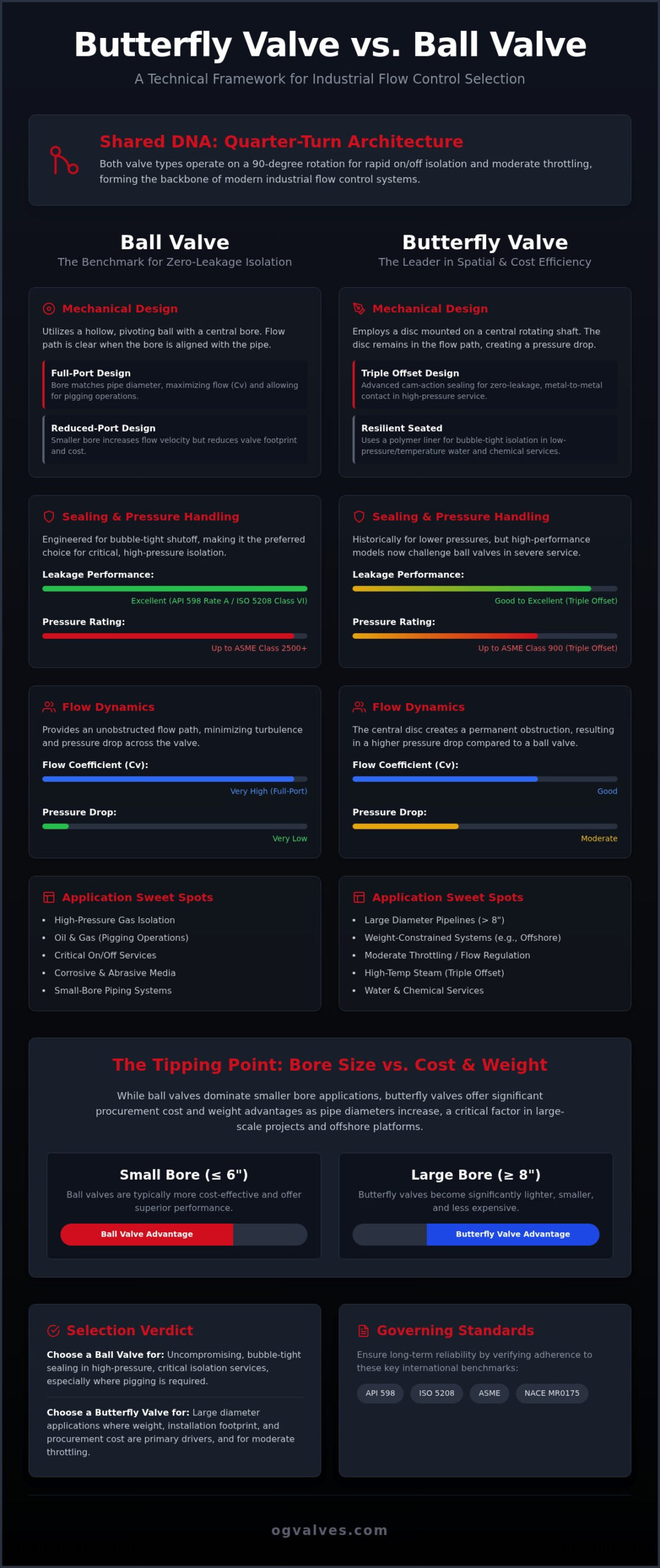
Selecting a valve based solely on initial procurement cost often guarantees systemic failure in high-pressure industrial environments. Engineering teams recognize that the technical debate of butterfly valve vs ball valve isn’t a search for a superior component, but a rigorous assessment of mechanical trade-offs between seal integrity and spatial efficiency. It’s established that incorrect specifications lead to costly downtime from seal failure or excessive pressure drops that compromise system efficiency. These risks are particularly critical in offshore platforms where weight constraints dictate strict design limits.
This authoritative analysis provides a definitive technical framework for valve selection, ensuring your specifications meet stringent ASME and API 598 standards for bubble-tight isolation. We’ll examine the mechanical differences between these two primary flow control solutions, focusing on torque requirements, lifecycle costs, and material durability in corrosive environments. By the end of this comparison, you’ll have the technical data required to optimize procurement for long-term reliability. We’ll also preview the 2026 market shift toward high-performance triple-offset designs and why ball valves remain the clinical benchmark for zero-leakage isolation in high-pressure, small-bore applications.
Key Takeaways
- Identify the critical mechanical trade-offs in a butterfly valve vs ball valve comparison to select the optimal quarter-turn architecture for your flow dynamics.
- Assess seal integrity requirements against API 598 and ISO 5208 standards to ensure bubble-tight performance in high-pressure isolation services.
- Determine the specific bore size break-even point where butterfly valves offer superior weight-to-torque ratios and procurement cost-efficiency over ball valves.
- Match valve specifications to heavy industry demands, including pigging capabilities for oil and gas or high-temperature steam handling in power generation.
- Validate long-term reliability by enforcing strict adherence to international benchmarks such as ASME, NACE MR0175, and Positive Material Identification protocols.
Mechanical Architecture: Quarter-Turn Similarities and Differences
Both components belong to the quarter-turn rotary valve family. The primary mechanical function relies on a 90-degree rotation of an internal closure element to modulate or obstruct flow. This shared architecture allows for rapid operation and simplifies the mounting of pneumatic or electric actuators. While both serve on/off isolation and moderate throttling roles, the structural differences in a butterfly valve vs ball valve comparison dictate their suitability for specific pressure classes and media types. Understanding these mechanical fundamentals is essential for maintaining system integrity and avoiding premature component failure.
The Ball Valve Mechanism
The ball valve utilizes a hollow, pivoting ball with a central bore. When aligned with the pipeline, it provides a clear flow path. Full-port designs maintain a bore diameter equal to the pipe size, maximizing the flow coefficient (Cv) and permitting pigging operations. Conversely, reduced-port designs utilize a smaller bore, which increases flow velocity and pressure drop but reduces the physical footprint of the valve body. Sealing relies on two primary configurations:
- Floating Ball: The ball is supported by two valve seats. Upstream pressure pushes the ball against the downstream seat to create a seal. It’s the standard for lower pressure, smaller bore applications where torque requirements remain manageable.
- Trunnion Mounted: The ball is fixed by a shaft at the top and bottom. This design handles higher pressures and larger sizes by reducing the load on the seats and lowering operating torque, preventing seat deformation under extreme stress.
The Butterfly Valve Mechanism
Butterfly valves employ a disc mounted on a central rotating shaft. Unlike the ball valve, the disc remains within the flow path even when fully open, which introduces a permanent pressure drop. Mechanical complexity increases with the offset design. Concentric models are standard for low-pressure services, while double offset designs reduce seat friction. Triple offset valves utilize a cam-action seal for metal-to-metal contact. As of 2026, high-performance triple-offset models are increasingly specified for ASME Class 600 and Class 900 ratings, challenging the traditional dominance of ball valves in high-pressure steam and hydrocarbon services. Sealing principles include:
- Resilient Seated: Uses a flexible polymer liner to achieve bubble-tight isolation in low-temperature water or chemical services.
- High-Performance Metal-to-Metal: Essential for extreme industrial environments where soft seats would succumb to thermal degradation or abrasive media.
Evaluating technical performance requires a clinical assessment of sealing efficiency and fluid dynamics. In a butterfly valve vs ball valve comparison, the sealing mechanism determines the component’s suitability for critical isolation. Ball valves are engineered to meet Rate A (zero-leakage) performance, often classified as Class VI or bubble-tight, according to ISO 5208 standards. This is achieved through the mechanical force of the ball against the seats, making them the industry standard for high-pressure gas isolation up to ASME Class 2500. While butterfly valves were historically limited to lower pressure classes, 2026 manufacturing standards for triple-offset models now allow for reliable operation in ASME Class 600 and Class 900 services.
Seal Integrity and Leakage Standards
Ball valves remain the preferred choice for high-stakes isolation due to their bubble-tight sealing capabilities under API 598. High-performance triple-offset butterfly valves achieve zero leakage through a torque-seated, cam-action mechanism that eliminates seat rubbing. Material selection is critical for maintaining these standards. Soft seats utilizing PTFE or PEEK provide excellent chemical resistance and low-temperature sealing, while metal-seated configurations are mandatory for high-heat environments where thermal expansion would compromise polymer seals. For facilities requiring rigorous technical support for high-stakes procurement, verifying material compatibility is a primary safety protocol.
Flow Coefficient (Cv) and Cavitation Risks
Flow efficiency is quantified by the Flow Coefficient (Cv). Full-bore ball valves provide an unobstructed path, resulting in a Cv that nearly matches the straight pipe section. This minimizes pressure drop (Delta P) and allows for pigging. Conversely, the disc of a butterfly valve remains in the flow stream even when fully open. This obstruction creates turbulence and increases the risk of cavitation, especially in high-velocity media. It’s a significant factor when deciding between a butterfly valve vs ball valve for high-velocity liquid transport. Cavitation occurs when local pressure drops below the fluid’s vapor pressure, leading to vapor bubble formation and subsequent implosion that erodes the valve body and downstream piping. Selection must account for these dynamics to prevent premature systemic degradation.
Size, Weight, and Cost Considerations in Valve Selection
The selection between a butterfly valve vs ball valve is frequently determined by the economic and structural break-even point associated with bore size. For pipe diameters between 2 inches (DN50) and 6 inches (DN150), ball valves dominate due to their superior sealing and minimal pressure drop. However, as diameters reach 8 inches (DN200) and above, the material volume required for a ball valve body and the precision machining of the sphere lead to exponential cost increases. By the 12-inch (DN300) threshold, a high-quality flanged ball valve can exceed the cost of a comparable butterfly valve by a factor of four to eight. Engineering teams must weigh these capital expenditures against the performance requirements of the specific media.
Bore Size Thresholds
Ball valves maintain structural dominance in high-pressure, small-bore applications where zero-leakage is non-negotiable. In larger diameters, the mechanical mass of the ball introduces logistical challenges, including increased shipping costs and the need for heavy-duty lifting equipment during installation. Butterfly valves become the practical choice for diameters exceeding 8 inches, particularly in water treatment and large-scale industrial fluid transport. While ball valves provide a piggable flow path, the cost-to-performance ratio for large-diameter units often favors high-performance butterfly designs in 2026 procurement cycles.
Installation Footprint and Weight
Offshore platforms and modular skids prioritize weight reduction to maintain structural integrity. A 24-inch ball valve is a massive component that requires substantial pipe supports and dedicated floor space. In contrast, a triple offset butterfly valve utilizing a wafer or lug design offers a fraction of the weight and a significantly narrower face-to-face dimension. This reduced mass directly impacts actuator sizing. Butterfly valves generally require lower operating torque in larger sizes compared to trunnion-mounted ball valves, allowing for smaller, less expensive pneumatic or electric actuators. Total Cost of Ownership (TCO) must account for these ancillary factors:
- Structural Reinforcement: Heavier ball valves require reinforced piping supports that increase overall project costs.
- Actuation Efficiency: Lower torque requirements in butterfly valves reduce the size and energy consumption of automated systems.
- Logistical Constraints: The compact nature of butterfly valves simplifies global logistics and fast-track delivery to international facilities.
For facilities with restricted space, the compact profile of the butterfly valve is a critical design advantage. It’s essential to analyze the weight-to-torque ratio before finalizing a specification, as this determines the long-term reliability of the automated assembly.
Industrial Applications: Matching Valves to Heavy Industry Sectors
The operational environment dictates the final parameters of a butterfly valve vs ball valve selection. Beyond the mechanical architecture and pressure ratings discussed previously, environmental stressors like abrasive media, thermal cycling, and regulatory safety protocols define the component’s lifecycle. Heavy industry sectors don’t prioritize generic utility; they require clinical adherence to application-specific standards to prevent catastrophic systemic failure. To maintain operational output in these high-stakes environments, procurement specialists rely on fast-track delivery for international industrial facilities to replace critical components before downtime occurs.
Critical Isolation in Oil and Gas
Upstream and midstream operations necessitate valves manufactured to API 6D specifications. In these sectors, ball valves are the primary choice for pipeline isolation due to their full-port design. This architecture is mandatory for pigging operations, as the internal bore must allow the passage of cleaning and inspection tools without obstruction. Furthermore, high-pressure gas transport requires the Double Block and Bleed (DBB) capability inherent in trunnion-mounted ball valves. This feature allows for the safe venting of the body cavity while the valve is in the closed position, providing a verifiable seal that butterfly valves cannot replicate in high-pressure hydrocarbon service. The structural soundness of the ball valve ensures it withstands the surge pressures common in long-distance transmission lines.
Throttling and Control in Power Plants
Power generation facilities utilize high-performance butterfly valves for large-scale thermal management and cooling water circulation. Seawater cooling systems, in particular, demand material specifications that resist chloride-induced pitting and galvanic corrosion. In these applications, the weight-to-torque advantages of the butterfly design allow for more efficient actuation in large-diameter piping. Triple offset butterfly valves provide reliable steam isolation in compliance with ASME B16.34 standards. For abrasive slurries found in coal-fired plants or mineral processing, specialized liners are employed to protect the valve body from erosive wear.
Petrochemical processing and municipal water treatment represent the two extremes of the selection spectrum. Petrochemical facilities handle volatile chemicals that require the zero-leakage assurance of ball valves, often with NACE MR0175 compliance for sour gas service. Conversely, when deciding between a butterfly valve vs ball valve for municipal water or wastewater treatment, the economic benefits of the butterfly valve are undeniable. For pipe diameters exceeding 24 inches, the cost and weight of a ball valve become prohibitive, making the butterfly valve the only practical solution for managing massive volumetric flow rates in infrastructure projects.
Procurement and Quality: Ensuring Regulatory Adherence
Industrial procurement demands rigorous verification of material integrity to prevent catastrophic systemic failure. Technical experts prioritize Positive Material Identification (PMI) as a mandatory protocol for components destined for corrosive or high-pressure environments. This process ensures the alloy composition precisely matches the engineering design specification. Without verified documentation, even the most robust butterfly valve vs ball valve selection remains a systemic liability. This clinical focus on material science is what separates long-term reliability from premature component degradation.
Quality assurance is anchored in comprehensive technical documentation. Material Test Reports (MTRs) and pressure test certificates provide the essential audit trail for regulatory compliance. These records verify that every unit within a shipment adheres to specified pressure ratings and chemical properties. In high-stakes sectors, this data is critical for validating the safety envelope of the infrastructure and ensuring that every valve performs to its theoretical design limits.
Sourcing High-Specification Valves
Evaluating valve suppliers requires a clinical focus on technical inventory and engineering expertise. A dependable partner must demonstrate deep familiarity with global benchmarks, including API 6D for pipeline service, ASME B16.34 for pressure-temperature ratings, and NACE MR0175 for sour gas environments. Selecting the correct component in the butterfly valve vs ball valve debate depends on this technical expertise. For detailed technical specifications on specific architectures, engineers should consult The Engineer’s Guide to Industrial Butterfly Valves or our comprehensive Industrial Ball Valves: A Technical Engineering & Specification Guide.
The OG VALVES Advantage in Industrial Supply
OG VALVES LTD. operates as a global partner in critical infrastructure, specializing in the procurement of high-specification gate, globe, and check valves alongside quarter-turn solutions. Our focus on technical support for high-stakes procurement ensures that every component meets international safety and engineering standards. We understand the high cost of downtime. Our global logistics network is engineered for fast-track delivery to international industrial facilities, providing a reliable supply chain when project timelines are critical. Every shipment is backed by rigorous testing and quality control processes to ensure long-term operational output and adherence to global regulatory bodies.
Reliability isn’t just a product feature; it’s a result of precise engineering and strict regulatory adherence. It’s essential to partner with an organization that understands the cost of failure and the necessity of quality. If you’re ready to optimize your pipeline efficiency with components built for durability, contact OG VALVES for a technical consultation and quote.
Optimizing Pipeline Infrastructure for 2026 and Beyond
The selection process for critical flow control requires a clinical assessment of mechanical trade-offs. As established, the butterfly valve vs ball valve debate is ultimately resolved by the specific operational output and pressure class requirements of the facility. High-performance triple-offset designs now provide a viable alternative for high-pressure services, yet the ball valve remains the benchmark for zero-leakage isolation in small-bore hydrocarbon transport. Prioritizing strict adherence to API and ASME standards is the only way to ensure long-term reliability and safety in heavy industrial environments.
Managing global infrastructure demands a partner who understands the cost of failure. OG VALVES LTD. provides specialist technical support to help engineering teams navigate complex material specifications and regulatory benchmarks. Our extensive inventory and global fast-track delivery capabilities ensure that your procurement process is optimized for efficiency and minimal downtime. If you’re ready to secure high-specification components for your next project, Request a Technical Quote from OG VALVES. We look forward to supporting your industrial requirements with precision and engineering excellence.
Frequently Asked Questions
Can butterfly valves be pigged?
Butterfly valves cannot be pigged because the disc remains permanently positioned in the flow stream, even when fully open. This internal obstruction prevents the passage of pipeline inspection gauges (PIGs) used for cleaning or integrity testing. In contrast, full-bore ball valves provide a clear, unobstructed path that’s essential for midstream oil and gas operations. Selecting a ball valve is mandatory for any pipeline requiring regular mechanical pigging protocols.
Which valve type offers a tighter seal, ball or butterfly?
The primary technical distinction in a butterfly valve vs ball valve assessment involves seal integrity. Ball valves traditionally offer superior performance, meeting Rate A zero-leakage standards under ISO 5208. The mechanical force of the ball against the seats ensures a bubble-tight shutoff in high-pressure isolation. While triple-offset butterfly valves can achieve similar results, they require more precise installation. For critical gas isolation, the ball valve remains the industrial clinical benchmark for reliability.
What is the pressure limit for a standard butterfly valve?
Standard concentric butterfly valves aren’t suitable for high-pressure services, as they’re often limited to applications below 150 PSI. However, high-performance triple-offset models are engineered to handle ASME Class 600 and Class 900 ratings as of 2026 manufacturing standards. These advanced designs allow butterfly valves to operate in environments previously reserved for ball valves. Precise pressure limits depend on the specific material classifications and the offset geometry employed in the valve body architecture.
Why are ball valves preferred for high-pressure gas applications?
Ball valves are preferred for high-pressure gas applications due to their ability to provide a verifiable bubble-tight seal and support Double Block and Bleed (DBB) configurations. The trunnion-mounted design manages high operating torques while allowing the body cavity to be vented. This safety feature is critical for ensuring isolation during maintenance. The robust construction of ball valves also resists the high-velocity erosion common in high-pressure gas transport systems.
How does the weight of a ball valve compare to a butterfly valve in large diameters?
In large diameters, such as 24 inches and above, a ball valve is significantly heavier than a comparable butterfly valve. The mass of the hollow ball and the bulk of the valve body require substantial structural supports. A triple-offset butterfly valve utilizing a wafer or lug design can weigh up to 70% less than a flanged ball valve. This weight disparity directly impacts the cost of structural engineering and global logistics.
Are triple offset butterfly valves suitable for high-temperature service?
Triple offset butterfly valves are specifically engineered for high-temperature service where soft-seated valves would fail. By utilizing metal-to-metal sealing surfaces, these valves maintain integrity in thermal environments exceeding 400 degrees Celsius. The cam-action disc rotation eliminates seat rubbing, which reduces wear during thermal expansion cycles. This makes them a reliable choice for steam isolation and high-heat industrial processing where polymer seals succumb to thermal degradation.
Which valve is better for throttling, ball or butterfly?
When comparing the butterfly valve vs ball valve for flow control, the butterfly valve is generally better suited for basic throttling applications. The disc rotation allows for more linear flow modulation compared to a standard ball valve, which is primarily designed for on/off isolation. While neither replaces a dedicated globe valve for precision control, the butterfly valve provides a more predictable response in large-scale fluid transport and cooling water systems.
What are the typical maintenance requirements for industrial ball valves?
Maintenance for industrial ball valves focuses on seat integrity and seal replacement to prevent internal leakage. Routine inspections should include checking for stem packing leaks and ensuring the actuator is correctly calibrated to reach full closure. In trunnion-mounted designs, periodic lubrication of the seats may be required to maintain low operating torque. Proactive maintenance is essential to avoid the high cost of downtime associated with valve failure in critical infrastructure.
 Responsive Menu