High-Pressure Ball Valve Applications: A Technical Engineering Guide
March 20, 2026
Home+High-Pressure Ball Valve Applications: A Technical Engineering Guide
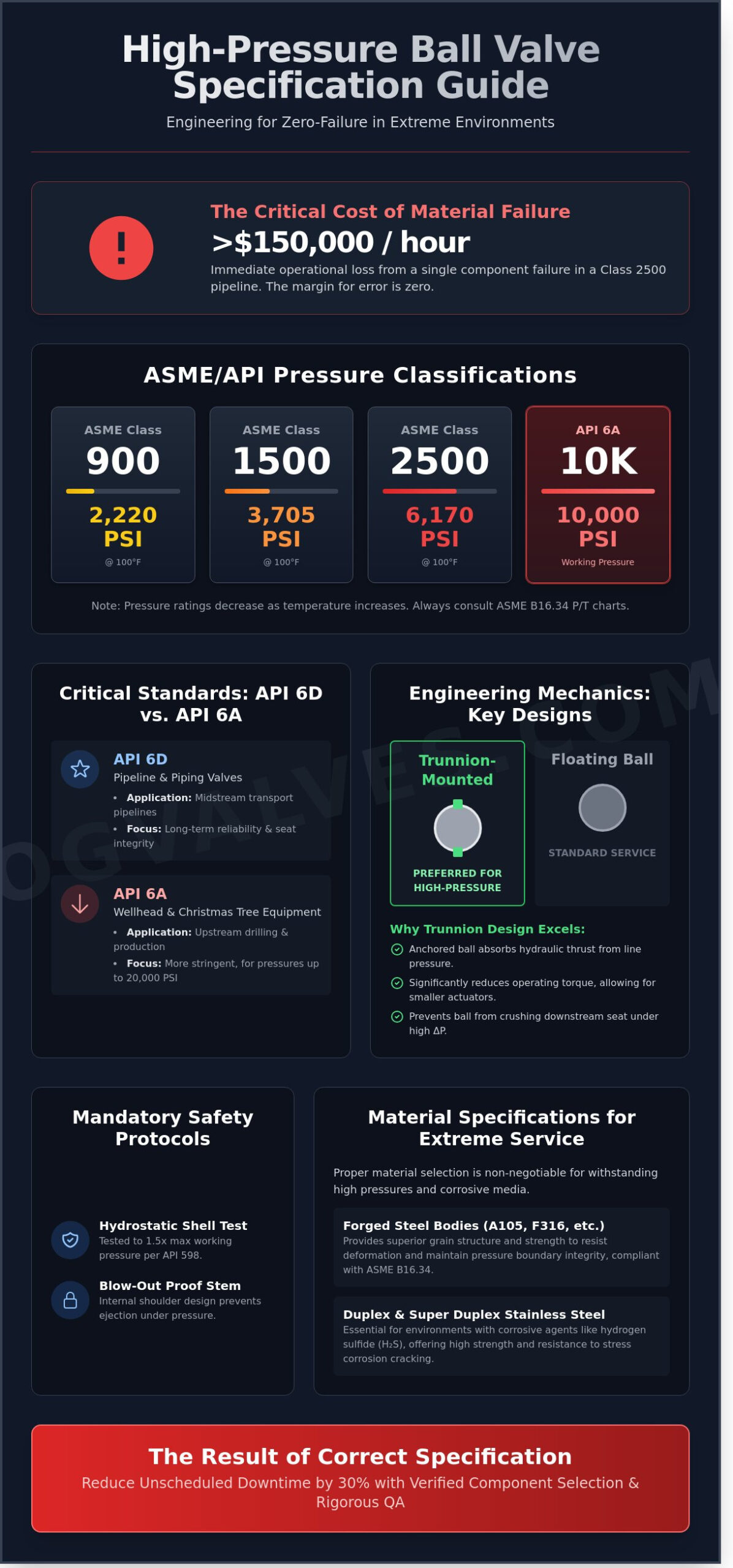
A single material failure in a Class 2500 pipeline often results in immediate operational losses exceeding $150,000 per hour. For engineers managing volatile fluids, the margin for error is effectively zero. It’s well understood that standard components can’t withstand the 15,000 PSI loads or the corrosive hydrogen sulfide environments found in midstream processing. Maintaining system integrity under these conditions isn’t just a preference; it’s a non-negotiable safety mandate requiring total adherence to material science and mechanical precision.
This technical guide analyzes the most demanding high pressure ball valve applications, providing the data necessary to eliminate specification errors and avoid the 12-week lead times often associated with incorrect orders. You’ll gain a comprehensive understanding of the metallurgical requirements and seat configurations essential for performance under extreme stress. We’ll examine specific technical benchmarks for API 6D and ASME B16.34 compliance to ensure your infrastructure meets the highest international safety protocols. This analysis provides the framework to reduce unscheduled downtime by 30% through verified component selection and rigorous quality assurance standards.
Key Takeaways
Identify the specific ASME/ANSI pressure class thresholds-including Class 900, 1500, and 2500-to ensure precise valve selection for high-stress systems.
Evaluate critical high pressure ball valve applications within upstream oil and gas and power generation sectors where uncompromising sealing integrity is required for safety.
Analyze the engineering mechanics of trunnion-mounted versus floating designs to optimize torque management and minimize seat wear under extreme differential pressures.
Specify the appropriate forged steel and Duplex material grades necessary to withstand the rigorous demands of high-pressure and corrosive industrial media.
Establish a procurement strategy that prioritizes technical compliance and global fast-track delivery for high-specification infrastructure projects.
Defining High-Pressure Parameters in Industrial Valve Selection
Industrial systems categorize a Ball valve as high-pressure when its operating requirements exceed the standard Class 150 to Class 600 range. While Class 600 valves handle up to 1,440 PSI at 100°F, high-pressure service typically begins at ASME Class 900. These environments demand forged body constructions and specialized seat materials to prevent deformation under extreme mechanical stress. Engineers must distinguish between standard utility service and the rigorous demands of high pressure ball valve applications where system failure carries catastrophic risks.
Standardized classifications from the American Society of Mechanical Engineers (ASME) provide the technical framework for these selections. Class 900, 1500, and 2500 represent the upper tiers of industrial valve ratings. A Class 2500 valve, for example, is engineered to withstand 6,170 PSI at ambient temperatures. Material selection follows the ASME B16.34-2020 standard, which dictates the minimum wall thickness and carbon content for forged steel bodies. This precision ensures the valve maintains its structural integrity when internal forces attempt to expand the housing.
Technical specifications often pivot between API 6D and API 6A standards depending on the specific high pressure ball valve applications involved. API 6D governs pipeline valves used in midstream transport, focusing on long-term reliability and seat integrity. API 6A is more stringent, covering wellhead and Christmas tree equipment that operates at pressures reaching 20,000 PSI. These standards aren’t interchangeable; choosing the wrong specification can lead to premature seal failure or compliance violations in regulated sectors like offshore drilling.
Performance metrics favor ball valves engineered to industrial specification standards for rapid, bubble-tight shut-off in high-stress systems. The quarter-turn operation allows for faster isolation than gate or globe valves, which is vital during emergency shutdown (ESD) scenarios. Trunnion-mounted designs are preferred in these settings because they anchor the ball at the top and bottom. This configuration absorbs the hydraulic thrust, reducing operating torque and preventing the ball from crushing the downstream seat under full line pressure. It’s a matter of mechanical leverage and safety.
Pressure Class vs. Working Pressure (PSI)
Pressure classes don’t represent a static PSI limit across all environments. An ASME Class 1500 valve is rated for 3,705 PSI at 100°F, but this capacity drops to 2,500 PSI as temperatures reach 800°F. Designers must consult the Pressure-Temperature charts in ASME B16.34 to ensure the valve body doesn’t yield during thermal expansion. Delta-P defines the differential pressure across the closure member that dictates the required torque and the resultant mechanical stress on the valve’s seating interface.
Safety Factors and Burst Pressure Compliance
Safety protocols require every high-pressure unit to undergo hydrostatic shell testing at 1.5 times the rated working pressure. API 598 and ISO 5208 standards define these rigorous leak detection tests to ensure zero visible leakage. Blow-out proof stems are mandatory, using an internal shoulder design that prevents the stem from ejecting if the packing gland fails. Compliance with these 2024 industrial standards ensures the valve maintains its pressure boundary during unforeseen system surges or mechanical impacts.
ASME Class 900: Rated for 2,220 PSI at 100°F.
ASME Class 1500: Rated for 3,705 PSI at 100°F.
ASME Class 2500: Rated for 6,170 PSI at 100°F.
API 6A 10K: Rated for 10,000 PSI working pressure.
Critical Industrial Applications for High-Pressure Ball Valves
Industrial infrastructure relies on specific valve architectures to maintain pressure boundary integrity in volatile environments. In upstream oil and gas production, high pressure ball valve applications center on wellhead control and high-pressure injection manifolds where pressures frequently exceed 10,000 PSI. These systems demand zero-leakage performance to prevent environmental contamination and protect personnel. Engineers specify forged steel bodies to ensure the grain structure can withstand the cyclical loading inherent in secondary recovery operations. Adherence to API Spec 6D, Specification for Valves is the baseline requirement for ensuring these components function reliably during midstream transport and high-stakes isolation maneuvers.
Oil and Gas Production Environments
Managing sour service involving H2S requires strict NACE MR0175/ISO 15156 compliance. This standard dictates material hardness and chemistry to prevent sulfide stress cracking in high-pressure pipelines. On offshore platforms, Emergency Shutdown Valves (ESDV) act as the final defense line; they’ve got to actuate in under 10 seconds to isolate high-pressure reservoirs during a blowout event. Subsea applications at depths of 3,000 meters necessitate trunnion-mounted designs. These designs utilize a mechanical anchor for the ball, which prevents seat deformation under extreme hydrostatic loads and ensures a consistent seal even when line pressure fluctuates.
Power Plant Steam and Water Cycles
Supercritical power plants operating at temperatures reaching 600°C and pressures above 3,200 PSI require precise steam isolation. High-pressure ball valves manage boiler feed water systems where thermal expansion often leads to seat binding in lesser valve types. Metal-seated designs with Tungsten Carbide or Chromium Carbide coatings are mandatory here to resist the abrasive nature of high-velocity steam. Bypass valves in high-pressure steam headers allow for controlled warm-up sequences. This prevents thermal shock to the main turbine components, which can cost millions in unplanned downtime if damaged. It’s a matter of maintaining the structural integrity of the entire steam loop.
Chemical and petrochemical processing involves managing volatile media under extreme process pressures. Forged steel ball valves are the preferred choice for these applications due to their superior resistance to high-pressure fatigue compared to cast alternatives. When handling hazardous chemicals, fugitive emission compliance per ISO 15848-1 is a critical specification. These valves must maintain a bubble-tight seal at 5,000 PSI to prevent the release of toxic vapors into the atmosphere. Engineers can review our technical specifications for forged ball valves to verify material compatibility and pressure-temperature ratings for specific chemical process conditions.
Hydraulic Power Units (HPUs) utilize high-pressure ball valves to control fluid power for heavy machinery, including 500-ton industrial presses and large-scale mining equipment. The rapid cycling in HPUs requires valves that resist cavitation and internal erosion. Standard 3,000 PSI or 6,000 PSI SAE flanged connections are common in these setups. The ball valve’s quarter-turn operation provides the quick response time necessary for emergency stops in hydraulic circuits. Every component undergoes rigorous hydrostatic testing at 1.5 times the rated working pressure to ensure it won’t fail under peak load conditions.
Reliability in these sectors isn’t a preference; it’s a regulatory and safety mandate. The selection of a valve for high pressure ball valve applications involves a clinical assessment of the media, pressure spikes, and environmental factors. Using components that meet ASME B16.34 and API 607 fire-safe standards ensures that the infrastructure remains secure even during catastrophic system failures. This technical rigor defines the difference between a functional asset and a significant operational liability.
Engineering Challenges: Sealing Integrity and Torque Management
High-pressure environments demand mechanical precision to maintain zero-leakage performance. In floating ball valve configurations, the upstream pressure forces the ball against the downstream seat to create a positive seal. This mechanism remains effective for lower pressure classes, but as differential pressures exceed 100 bar, the resulting load on the seat increases significantly. For demanding high pressure ball valve applications, engineers specify trunnion-mounted designs. These valves utilize a fixed ball supported by bearings; this prevents the ball from shifting and isolates the seat from the full force of the line pressure. This architecture reduces seat wear during cycling and lowers operating torque by up to 40% compared to floating designs at equivalent pressures. A detailed technical breakdown of these mechanical differences is available in our floating vs trunnion ball valve engineering comparison, which covers torque calculations and sealing performance across ASME Class 150 to Class 2500 specifications.
Managing breakout torque is a critical factor in automated systems. Breakout torque is the force required to initiate movement from a fully closed position. High differential pressures (Delta-P) compress the seats, increasing friction coefficients. If an actuator isn’t sized with a safety factor of at least 25% above the maximum expected torque, the valve won’t open. Compliance with ASME B16.34 valve standards ensures that the pressure-boundary components meet the structural requirements for these high-stress cycles. Additionally, fugitive emission control is mandatory under ISO 15848-1 standards. These protocols require stem packing sets to maintain integrity through 1,500 to 2,500 cycles at rated pressures to prevent hazardous gas leaks into the atmosphere.
Advanced Seat Material Science
Material selection dictates the longevity of the seal under extreme stress. Thermoplastics like PEEK (Polyether ether ketone) provide high mechanical strength for pressures reaching 15,000 psi. Devlon V-API is a preferred grade for its low moisture absorption and impact resistance in offshore environments. For cryogenic high-pressure service, PCTFE is the standard due to its dimensional stability at -196°C. Metal-to-metal sealing, often utilizing tungsten carbide or chrome carbide coatings, is required when media contains abrasive particulates or temperatures exceed 250°C. Seat creep is a primary failure mode in high-pressure soft-seated valves because the sustained mechanical load causes the thermoplastic to permanently deform into the valve port over time.
Actuation Requirements for High-Pressure Service
Sizing actuators for high pressure ball valve applications requires accounting for running torque and end-to-close torque. Pneumatic actuators are common for fail-safe operations; however, hydraulic actuators are preferred for torques exceeding 50,000 Nm due to their higher power density. Safety-critical systems integrate Partial Stroke Testing (PST) to verify valve movement without interrupting the process flow. This diagnostic tool moves the valve by 10% or 15% of its stroke at scheduled intervals to ensure the stem hasn’t seized. By monitoring the torque signature during PST, operators can predict maintenance needs before a functional failure occurs in a high-pressure line.
Material Specifications for Extreme Pressure Environments
High pressure ball valve applications require materials that maintain structural integrity under extreme hoop stress and volatile thermal cycles. Forged steel, such as ASTM A105 for carbon steel or ASTM A182 F316 for stainless steel, remains the engineering standard for these environments. Unlike cast bodies, forged components undergo a mechanical working process that refines the grain structure and eliminates internal porosity. This grain alignment is critical for preventing fatigue failure when operating at pressures exceeding 6,000 PSI. Castings, while cost-effective for low-pressure utilities, present a higher risk of subsurface defects that can propagate into cracks under the intense loads found in midstream and downstream high-pressure systems.
Wall thickness and flange ratings under ASME B16.5 and ASME B16.34 standards dictate the physical footprint and weight of the assembly. As the pressure class increases from ASME Class 600 to Class 2500, the valve weight often triples. For instance, a 4-inch Class 2500 ball valve can weigh approximately 1,200 pounds, whereas a Class 150 equivalent weighs less than 150 pounds. This 800% weight increase necessitates robust pipe support systems and specialized installation protocols. Engineers must account for these mass differentials during the FEED (Front-End Engineering Design) stage to ensure the piping infrastructure can handle the static and dynamic loads of the valve assembly.
While these heavy-duty alloys are essential for industrial integrity, other engineering disciplines solve challenges like weather resistance and durability with different materials. In architectural applications, for instance, creating robust outdoor structures often involves high-quality aluminum, expertly handled by specialists like Pergola2Go.
Selecting Alloys for High-Pressure Corrosive Media
Selecting the correct alloy for high pressure ball valve applications involves a clinical analysis of the media’s chemical composition and the ambient environment. Super Duplex grades, specifically F53 and F55, are essential for subsea installations and high-pressure desalination plants. These materials provide a Pitting Resistance Equivalent Number (PREN) above 40, offering superior protection against chloride-induced stress corrosion cracking. While carbon steel is 40% more economical for high-pressure dry gas transport, it doesn’t withstand wet H2S (sour gas) environments. In these cases, compliance with NACE MR0175 is mandatory, often requiring the use of Inconel 625 or Monel 400 for internal components to prevent hydrogen embrittlement. Engineers seeking a data-backed framework for these decisions can consult our technical guide to ball valve material selection for industrial service, which provides performance metrics for 316SS, Monel, and Inconel 625 across corrosive and high-pressure media.
Inconel 718 and other nickel-based alloys are reserved for the most extreme chemical and pressure combinations, such as those found in deepwater injection wells. When full alloy bodies aren’t financially viable, internal cladding and overlay techniques are employed. Applying a Stellite 6 overlay to the ball and seat surfaces creates a hardness layer that resists erosion from high-velocity particulates. This technique extends the service life of the valve by 300% in abrasive slurry or high-pressure steam applications where standard stainless steel would suffer from wire-drawing and seat leakage within months of commission.
Quality Assurance: PMI and NDT Testing
Rigorous verification protocols are the only way to ensure that a valve meets its theoretical design specifications. Positive Material Identification (PMI) using X-ray fluorescence is a non-negotiable step in our quality control process; it confirms that the alloy chemistry matches the Mill Test Report (MTR) exactly. Non-Destructive Testing (NDT), including Radiographic Testing (RT) and Ultrasonic Testing (UT), is used to detect subsurface inclusions or cracks that could lead to catastrophic failure. For valves in high-pressure service, these tests ensure the pressure-containing boundary is 100% sound before it leaves the factory floor.
API 598 defines the industry standards for high-pressure leakage rates and testing durations. For a 6-inch Class 1500 valve, the high-pressure hydrostatic shell test is performed at 5,560 PSI. This test requires zero visible leakage through the body or the stem seals to achieve compliance. High-pressure gas testing with nitrogen is even more stringent, as gas molecules are smaller than water molecules and more likely to escape through microscopic leak paths. Achieving a bubble-tight seal at these pressures requires precision machining of the ball valve ball and seat components to tolerances within 0.001 inches.
Procurement Strategy: Sourcing High-Spec Valves with OG VALVES LTD.
OG VALVES LTD. operates as a specialized technical partner rather than a conventional distributor. Our core competency lies in the provision of high-specification flow control solutions for demanding environments. We maintain a rigorous quality management system that ensures every component meets ASME B16.34 and API 6D standards. This technical depth is critical for high pressure ball valve applications where component failure results in catastrophic downtime or environmental hazards. We maintain a permanent stock of forged steel, stainless steel, and duplex alloys to meet immediate project requirements. It’s our policy to eliminate the standard 12-week lead time often associated with specialty alloys by keeping high-demand units ready for dispatch. Every valve undergoes 100% hydrostatic and pneumatic testing before it leaves our facility. This commitment to engineering excellence ensures that the integrity of your pressurized system remains uncompromised.
Our inventory isn’t limited to a single category. We house a comprehensive range of gate, ball, and check valves, including Class 150 through Class 2500 ratings. By adhering to ISO 9001:2015 protocols, we provide full traceability for every casting and forging. This level of detail is necessary for high-stakes industries where safety and performance are non-negotiable. We don’t just sell hardware; we provide the technical assurance that your infrastructure will perform under extreme stress.
Technical Support and Global Supply Chain
Engineers in Antrim and international industrial hubs rely on our logistical infrastructure. We’ve reduced project lead times by 35% on average through strategic inventory positioning. Our facility houses an extensive range of valves ready for dispatch within 24 to 48 hours. By managing complex procurement specifications for the oil, gas, and power sectors, we eliminate the ambiguity often found in global supply chains. Our team validates every material test report (MTR) to ensure absolute compliance with project-specific data sheets. We understand that a single day of delayed production costs thousands. Our logistics team coordinates fast-track delivery to remote sites, ensuring that critical infrastructure projects stay on schedule regardless of geographical constraints.
Requesting a Technical Quote
Precision in procurement begins with an accurate Request for Quotation (RFQ). When evaluating high pressure ball valve applications, procurement specialists must provide exact parameters. This includes the specific media composition, operating temperatures ranging from -196°C to 500°C, and maximum working pressures that often reach 15,000 PSI. We also require details on end connections, such as NPT, socket weld, or flanged interfaces according to ASME B16.5. Our technical specialists consult on bespoke material requirements for corrosive environments, including Inconel 625 or Monel 400 overlays. We provide documentation packages that include pressure test certificates and material traceability as standard. Contact OG VALVES LTD. for a technical consultation on your high-pressure requirements to ensure your infrastructure meets global safety benchmarks and operational demands.
Securing Operational Integrity in Extreme Pressure Environments
Success within high pressure ball valve applications hinges on strict adherence to international engineering standards. Engineers must prioritize API 600 and ASME B16.34 compliance to ensure structural integrity under extreme mechanical stress. Material selection remains the primary defense against system failure; utilizing Super Duplex and Inconel alloys provides the necessary resistance to localized corrosion and high-velocity erosion. Effective torque management and sealing protocols aren’t just preferences; they’re mandatory requirements for maintaining safety in 10,000+ PSI systems. OG VALVES LTD facilitates these critical requirements through our specialized logistics hub in Antrim, providing fast-track global delivery to meet demanding project deadlines. We’ve built our reputation on providing the precise technical specifications that modern infrastructure demands. It’s essential to partner with a supplier that understands the clinical necessity of zero-leakage performance. We invite you to Request a Technical Specification Quote from OG Valves to secure your project’s performance. Let’s build a safer industrial future together.
Frequently Asked Questions
What is the difference between a high-pressure ball valve and a standard ball valve?
High-pressure valves are engineered for ratings exceeding ASME Class 600, while standard valves typically operate below Class 300. They utilize forged steel bodies and reinforced seals to withstand pressures reaching 15,000 psi safely. In high pressure ball valve applications, material integrity is vital to prevent structural deformation under heavy mechanical stress. Standard valves use cast bodies and PTFE seats that often fail at these elevated pressure thresholds.
When should I choose a trunnion-mounted ball valve for high-pressure applications?
You’ll choose a trunnion-mounted design when operating pressures exceed 1,500 psi or pipe diameters surpass 4 inches. This configuration utilizes a fixed stem and bottom support to absorb hydraulic thrust, which prevents the ball from shifting into the downstream seat. It reduces operating torque by 40% compared to floating designs. For a comprehensive analysis of how these two architectures compare across pressure classes and torque requirements, review our floating vs trunnion ball valve technical engineering comparison. This mechanism ensures reliable sealing and prevents seat damage during high-frequency cycling in oil and gas pipelines.
Which standards govern the manufacturing of high-pressure ball valves?
Manufacturing follows API 6D for pipeline valves and ASME B16.34 for specific pressure-temperature ratings. These standards dictate precise wall thickness, material grades, and testing protocols like the API 598 hydrostatic test. Compliance with ISO 17292 is mandatory for metal-seated valves in heavy industrial service. Every valve must undergo a shell test at 150% of the rated working pressure to verify structural integrity before deployment in the field.
What are the best seat materials for high-pressure chemical processing?
PEEK (Polyether ether ketone) and reinforced PTFE are the superior choices for high-pressure chemical environments. PEEK offers a temperature threshold of 480°F and maintains its structural stability at pressures of 6,000 psi. For highly abrasive media, metal-seated designs with Tungsten Carbide coatings provide a surface hardness of 70 HRC. These materials prevent erosion and chemical degradation in 95% of specialized acid or caustic processing applications.
How do high-pressure ball valves handle fugitive emissions?
High-pressure valves mitigate fugitive emissions through live-loaded stem packing and dual-seal configurations that meet ISO 15848-1 Class A requirements. These systems utilize Belleville springs to maintain constant pressure on the graphite packing, which reduces leakage to less than 10 ppm. In high pressure ball valve applications, this prevents the loss of volatile organic compounds. Standard designs lack the precision-engineered seals needed for this level of environmental compliance.
Can high-pressure ball valves be used in cryogenic service?
Yes, high-pressure ball valves work in cryogenic service when they’re equipped with extended bonnets and specialized PCTFE seals. These bonnets move the stem packing away from the cryogenic liquid, which maintains temperatures above -50°F at the seal interface. Materials like 316L stainless steel are required to prevent brittle fracture at temperatures reaching -320°F. Performance is strictly verified through BS 6364 testing protocols to ensure operational safety.
What is the typical lead time for specialized high-pressure valves?
Typical lead times for specialized high-pressure valves range from 14 to 26 weeks depending on material availability. Standard carbon steel units often ship in 12 weeks, but exotic alloys like Inconel 625 require 22 weeks for forging and precision machining. Project schedules must account for the 7-day hydrostatic and pneumatic testing phase required for API 608 certification. Custom engineering for specific flange dimensions typically adds 4 weeks to the production timeline.
 Responsive Menu