Industrial Valve Commissioning Plan: A Technical Guide to Operational Integrity
May 03, 2026
Home+Industrial Valve Commissioning Plan: A Technical Guide to Operational Integrity
A single non-compliant valve can compromise an entire facility’s operational integrity, especially as the global industrial valve market expands toward a USD 101.56 billion valuation in 2026. Executing a rigorous industrial valve commissioning plan is the only technical safeguard against the catastrophic costs of start-up failure. You recognize that adherence to ASME and API standards is not a choice but a requirement for high-stakes infrastructure.
This technical guide delivers a comprehensive engineering framework designed to ensure zero-leakage performance and total regulatory compliance. It’s built to eliminate the delays often caused by improper material verification or the 25% tariff-related supply chain shifts seen in early 2026. We’ll analyze the essential protocols for verifying ISO 5211:2026 actuator attachments and ISO 22109:2026 gearbox classifications to guarantee that your system’s performance aligns with its design specifications. By following these clinical quality assurance protocols, engineers can mitigate the risks of quality fade and ensure that bulk orders meet the rigorous standards required for the oil, gas, and water treatment sectors.
Key Takeaways
Establish a systematic industrial valve commissioning plan to verify mechanical integrity and prevent infant mortality failures in high-pressure systems.
Implement rigorous Positive Material Identification (PMI) and visual flange inspections to ensure material specifications match field requirements before installation.
Execute standardized operational cycling and installation verification to confirm that flow direction and flange alignment adhere strictly to project P&IDs.
Monitor packing gland integrity and differentiate between debris-based or mechanical seat leakage during the critical first 24 hours of operation.
Optimize project timelines by selecting technical suppliers who offer fast-track delivery and engineering support to minimize field-level commissioning errors.
Fundamentals of an Industrial Valve Commissioning Plan
An industrial valve commissioning plan serves as the definitive technical protocol for verifying that every valve assembly operates according to its original design intent. It isn’t merely a final inspection. It’s a rigorous engineering process that bridges the gap between mechanical completion and full-scale operation. The Fundamentals of Commissioning dictate that success depends on a structured transition where technical data meets field reality.
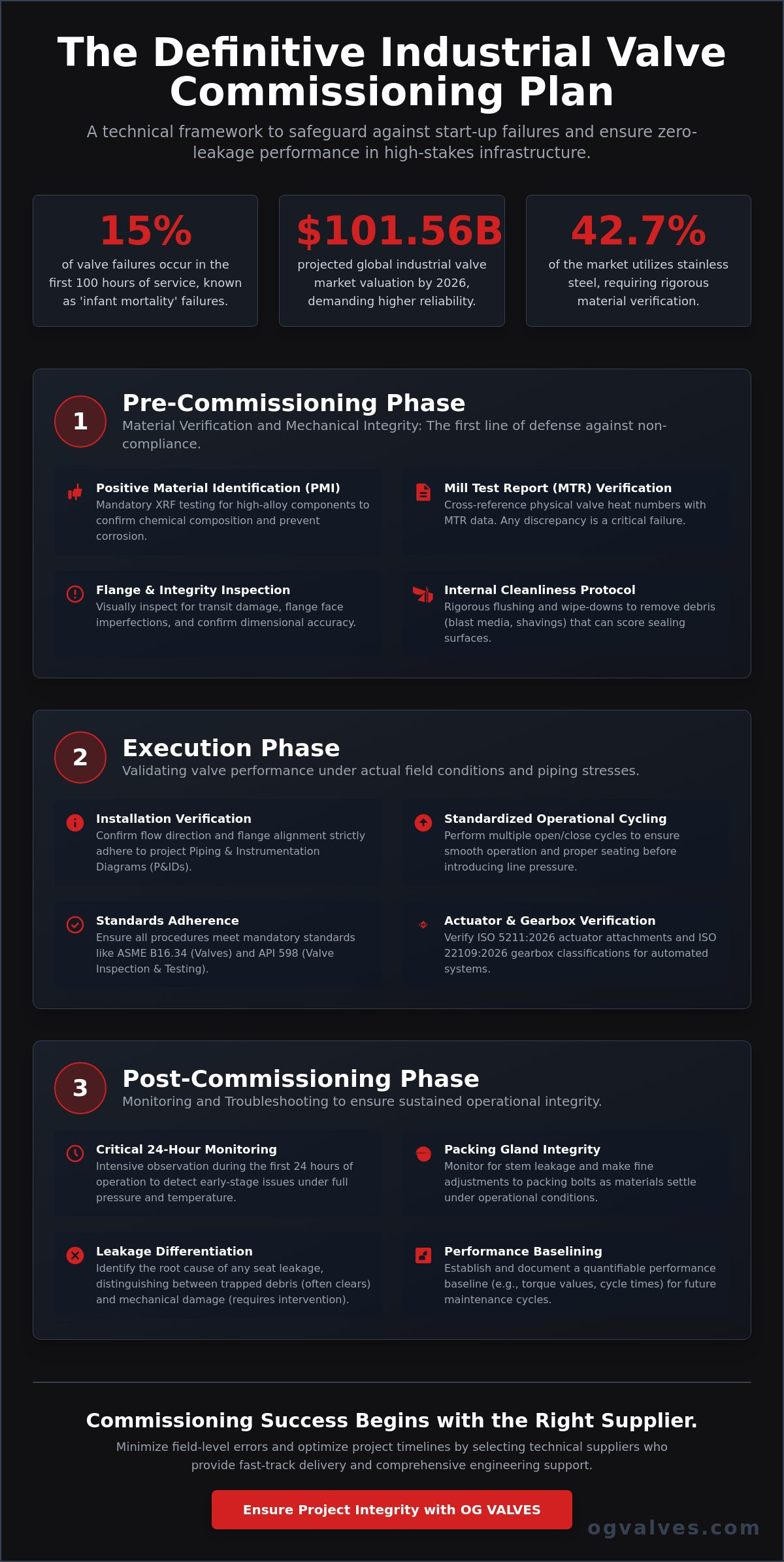
A primary role of this plan is the mitigation of ‘infant mortality’ failures. In high-pressure systems, approximately 15% of valve failures occur within the first 100 hours of service due to installation debris, misalignment, or improper torque. A robust commissioning framework identifies these vulnerabilities before they lead to unplanned downtime. This clinical approach ensures that the 2026 market standards for reliability are met without compromise.
Adherence to ASME B16.34 and API 598 standards is mandatory for all industrial valve commissioning plan executions. There’s a critical distinction between Factory Acceptance Testing (FAT) and site commissioning procedures. FAT confirms that a valve meets specifications in a controlled, manufacturer-led environment. In contrast, site commissioning validates performance under actual piping stresses, vibration, and thermal conditions present in the field.
Primary Objectives of the Commissioning Framework
The framework prioritizes absolute seat integrity. Achieving zero-leakage performance under operational pressure is the benchmark for industrial safety. Commissioning teams must focus on these specific goals:
Verification of material suitability for cryogenic or corrosive service environments.
Confirmation that industrial valves haven’t suffered transit-related deformation.
Establishing a quantifiable performance baseline for future maintenance cycles.
This stage ensures that the 42.7% of the market utilizing stainless steel components maintains the integrity required for chemical processing.
Regulatory Compliance and Safety Standards
Compliance requires mapping the plan to ISO 5208 for precise leakage rates and pressure testing. Detailed documentation is critical for environmental audits and safety inspections. In automated systems, Safety Instrumented Systems (SIS) play a vital role. They ensure that emergency shutdown valves (ESV) respond within the millisecond thresholds defined by the project’s safety integrity level (SIL) ratings. Without a logged commissioning report, a facility cannot demonstrate its adherence to international safety protocols during its first 24 hours of operation.
Pre-Commissioning: Material Verification and Mechanical Integrity
Mechanical completion isn’t synonymous with operational readiness. Within a professional industrial valve commissioning plan, the pre-installation phase serves as the primary filter for material non-compliance. While many field guides focus solely on final lubrication, our engineering standards demand a clinical verification of metallurgical integrity before a valve assembly ever meets the pipe. This phase ensures that the physical hardware matches the digital and paper specifications exactly.
The verification of Mill Test Reports (MTRs) against physical valve heat numbers is a binary requirement. There’s no room for ambiguity. Any discrepancy between the MTR data and the physical casting indicates a failure in the supply chain that must be addressed before the valve is positioned. Internal cleanliness is equally vital. Debris such as blast media, metal shavings, or construction dust can compromise seat integrity during the very first cycle. A rigorous flushing protocol or mechanical wipe-down of the internal bore is necessary to prevent permanent scoring of the sealing surfaces.
Positive Material Identification (PMI) Testing
Utilizing handheld X-ray fluorescence (XRF) technology is mandatory for high-alloy components like Super Duplex or 316L stainless steel. This non-destructive testing confirms that the chemical composition aligns with the technical specifications of the project. Material verification is the first line of defense against stress corrosion cracking and localized pitting in corrosive environments. All PMI data must be logged and integrated into the final commissioning report to provide a complete traceability chain for the asset’s lifecycle. If you’re managing high-stakes infrastructure, you can review our technical specifications for specific material grades and testing protocols.
Storage and Handling Protocols Prior to Installation
Protective end caps must remain in place until the moment of installation. For valves destined for oxygen or high-purity service, environmental controls are even more stringent; the ingress of microscopic particulate matter can result in catastrophic ignition or contamination. Integration of the actuator commissioning sequence should occur only after the mechanical integrity of the valve body and the condition of the stem are verified. Stems require specific lubrication and protection from atmospheric corrosion, especially during long-term site storage. Failure to maintain these barriers leads to packing leaks and operational resistance during the initial start-up phase.
Execution of the Industrial Valve Commissioning Procedure
Execution of the industrial valve commissioning plan demands a methodical progression from physical verification to functional validation. While generic guides often over-emphasize control valve signal tuning, a professional framework prioritizes the mechanical integrity of isolation components including gate, globe, and check valves. The first critical step involves installation verification. Engineers must confirm that flow direction arrows on the valve body align perfectly with the project P&IDs and that flange faces are parallel to prevent uneven gasket loading. Misalignment by even a few millimeters can lead to flange stress and premature seat failure once the system is pressurized.
Operational cycling follows under no-load conditions. This involves performing three to five full open and close strokes to ensure the assembly moves without obstruction. For check valves, this requires manual verification of the disc or clapper movement to ensure it isn’t seized or restricted by internal debris. Pressure testing is the ultimate validation of seat integrity. Adhering to API 598 or ISO 5208 standards, this stage involves low-pressure air tests (typically 60 to 100 psi) to detect minor gas leaks and high-pressure hydrostatic tests (1.1 times the maximum rated pressure) to confirm the mechanical strength of the shell and seat under load.
Final execution steps include synchronizing the actuator limit switches with the physical valve position. Documentation must record specific torque values and stroke times to provide a clinical data point for the asset’s initial state. For emergency shutdown valves, stroke times must be logged to the tenth of a second to ensure compliance with the safety integrity level (SIL) requirements of the facility.
Cycling and Functional Testing
High-performance butterfly valves often exhibit ‘stick-slip’ behavior if the seat-to-disc interface isn’t properly calibrated. Functional testing identifies these irregularities early. Manual overrides must also be engaged to verify that the valve can be operated during a total loss of power or pneumatic signal. This ensures that the mechanical drive train is robust enough to handle emergency manual intervention without stripping the gears or stem threads.
Actuator and Control System Integration
Calibration of pneumatic or electric actuators ensures 100% closure and prevents seat damage from over-torquing. Fail-safe positions, whether Fail Open (FO) or Fail Closed (FC), must be tested by simulating a total loss of air or electrical power. Every signal feedback loop must be verified against the Distributed Control System (DCS). This ensures that the control room receives accurate positional data within the required millisecond parameters, eliminating the risk of ‘ghost’ signals during critical plant start-up phases.
Post-Commissioning Monitoring and Troubleshooting
A successful industrial valve commissioning plan concludes with a transition into active monitoring. The initial 24-hour operational window is the most critical period for detecting latent mechanical discrepancies. During this time, engineers must differentiate between debris-related seat leakage and mechanical-related failures. Debris-related leakage often results from inadequate flushing during the pre-commissioning phase, leading to seat scoring. Conversely, mechanical leakage typically signals a failure in flange alignment or improper torque application during the execution phase. Clinical observation of these symptoms prevents minor issues from escalating into full system shutdowns.
Monitoring packing gland integrity is a primary requirement for environmental compliance. Thermal expansion during the first heat cycle can alter the compression of the packing material, necessitating precise adjustments. For valves in high-velocity steam or gas service, vibration analysis is mandatory. Excessive harmonics can lead to stem fatigue or actuator decouple events. If vibration levels exceed the thresholds defined in the project’s technical specifications, mechanical bracing or flow stabilization measures must be implemented immediately. To ensure your infrastructure meets these rigorous standards, you can consult with our technical engineering team regarding high-performance valve assemblies.
Leakage Detection and Integrity Assurance
Acoustic emission testing provides a non-invasive method for verifying seat integrity under full operational pressure. This technology detects the high-frequency signals generated by fluid turbulence across a leaking seat, allowing for quantifiable data without breaking the pressure boundary. Troubleshooting check valves that fail to prevent backflow requires verifying the disc’s freedom of movement and the condition of the hinge pin. In many cases, backflow issues during startup are traced back to improper orientation or the presence of construction debris that restricts the disc’s travel. For live-loaded packing systems, adjustments must follow a calibrated torque sequence to maintain the seal without over-compressing the stem.
Performance Documentation and Data Handover
The final handover process involves compiling a comprehensive Valve Data Sheet (VDS) for every asset. This record must include hydro-test certificates, PMI reports, and the specific torque values recorded during the execution phase. As-built drawings are indispensable; they provide the definitive reference for the facility’s future Asset Integrity Management (AIM) programme. By establishing this baseline, operators can track performance degradation over time, ensuring that the 4.3% projected market growth in valve efficiency is realized through data-driven maintenance rather than reactive repairs. This documentation serves as the final validation of the asset’s operational integrity.
Procurement Strategy: Why Commissioning Success Depends on the Supplier
Procurement strategy functions as the final logistical pivot for an industrial valve commissioning plan. A failure at the supply chain level often manifests as a critical delay during the site-readiness phase. If a supplier provides inaccurate Mill Test Reports (MTRs) or fails to protect stem integrity during transit, the commissioning process cannot proceed. In 2026, where the global industrial valve market is valued up to USD 101.56 billion, procurement precision is a primary risk mitigation strategy. OG VALVES LTD. supplies high-specification gate valves and ball valves that arrive site-ready, ensuring that hardware meets design intent immediately upon delivery.
Lead time management becomes a critical variable during the final stages of plant construction. Project schedules are frequently compressed, leaving little margin for error in valve delivery. When procurement teams prioritize fast-track delivery from a technical partner rather than a commodity vendor, they eliminate the 15% to 20% delay factor typically caused by missing documentation or shipping damage. Global logistics expertise ensures that valves destined for remote oil and gas fields or water treatment facilities arrive with all required API and ASME certifications verified and attached to the assembly.
Technical supplier expertise serves as a secondary layer of quality control. Access to engineering specialists during the procurement phase allows for the resolution of complex specification queries before the valves are even manufactured. This proactive approach reduces field-level errors by ensuring that the industrial valve commissioning plan is supported by hardware that is purpose-built for the intended service environment, whether it involves cryogenic temperatures or high-pressure steam. Every valve must be viewed as a critical asset in a larger infrastructure network rather than a standalone component.
Fast-Track Delivery for Critical Commissioning Windows
Reducing project downtime requires strategic stockholding of high-specification components. By maintaining inventory of forged steel and alloy valves, suppliers can support narrow commissioning windows that would otherwise be missed due to standard manufacturing lead times. Managing complex logistics for international industrial sites involves navigating the 25% tariff adjustments seen in early 2026 and ensuring that “quality fade” does not occur during bulk transit. Every valve must be ‘commissioning-ready’ upon arrival, with end caps intact and lubrication applied to the manufacturer’s specification.
Technical Support and Material Certification
Comprehensive material certification is the only technical safeguard for passing regulatory audits during the handover phase. Engineers need absolute certainty that the valves in their system meet the chemical and mechanical properties required by ISO and ANSI standards. OG VALVES LTD. provides a complete data package with every order, including hydrostatic test certificates and PMI reports. This level of transparency positions the supplier as a technical partner in heavy industry infrastructure, facilitating a seamless transition from the planning phase to full operational status.
Securing Operational Integrity Through Technical Precision
Operational integrity is the result of methodical engineering, not chance. Successful plant start-ups require a rigorous industrial valve commissioning plan that prioritizes metallurgical traceability and clinical execution. By verifying material integrity through PMI and adhering to the pressure testing standards established during the execution phase, engineers eliminate the vulnerabilities that compromise high-pressure systems. The transition from mechanical completion to full operation is secured only when field documentation matches design specifications exactly.
OG VALVES LTD. maintains an extensive inventory of API and ASME compliant valves designed for the most demanding environments in the oil, gas, and power sectors. We provide global fast-track delivery for critical infrastructure projects, ensuring that site-ready hardware arrives with full certification to prevent commissioning delays. Our technical expertise ensures that your facility operates within its design parameters from the first minute of service. Take the next step in securing your facility’s long-term performance and regulatory compliance.
What is the difference between valve testing and valve commissioning?
Valve testing, such as Factory Acceptance Testing (FAT), focuses on the performance of a standalone component in a controlled manufacturer environment. Commissioning is the process of verifying the valve’s operation within its specific piping system under actual field conditions. It ensures the valve interacts correctly with actuators, control systems, and process media as part of an integrated industrial valve commissioning plan.
Why is PMI testing essential in an industrial valve commissioning plan?
Positive Material Identification (PMI) confirms that the alloy composition of the valve body and trim matches the technical specification exactly. This is a critical safeguard against stress corrosion cracking in high-stakes environments like oil and gas. Using X-ray fluorescence (XRF) technology ensures that 316L or Super Duplex materials are verified before installation, providing a documented traceability chain for the facility’s asset integrity.
How do I troubleshoot a valve that fails its initial seat leakage test?
Troubleshooting begins with a thorough internal flush to remove construction debris that often scores the sealing surfaces. If leakage persists, engineers must verify that the flange alignment is parallel and that bolting torque follows the specified pattern. Debris-related issues account for approximately 15% of initial seat failures. Mechanical adjustments to the packing gland should only occur after confirming the bore is free of contaminants.
What standards govern the pressure testing of valves during commissioning?
Pressure testing protocols are primarily governed by API 598 for valve inspection and ISO 5208 for industrial valve pressure testing. These standards define the allowable leakage rates for different seat materials and specify the durations for high-pressure hydrostatic and low-pressure pneumatic tests. Compliance with ASME B16.34 is also required to ensure the valve shell maintains its structural integrity under the maximum rated pressure of the system.
Can a valve be commissioned if the actuator is not yet installed?
A valve can undergo mechanical installation and shell testing without an actuator, but it cannot be fully commissioned for operational service. Functional commissioning requires the actuator to be installed and calibrated per ISO 5211:2026 standards. This ensures that limit switches, fail-safe positions, and signal feedback to the Distributed Control System (DCS) are verified. Without the actuator, the valve’s response time and closure torque remain unvalidated.
How often should a valve be cycled during the commissioning process?
A valve should be cycled three to five times during the commissioning process. These strokes must be performed under no-load conditions to verify that the stem and gate or ball assembly move without obstruction. This cycling identifies ‘stick-slip’ behavior or mechanical interference before the system is pressurized. Recording the stroke time during these cycles provides a baseline for the facility’s future predictive maintenance schedule.
What are the most common causes of valve failure during plant start-up?
The most common causes of failure include the presence of construction debris, flange misalignment, and improper material specification. Debris scoring the seat surfaces is a frequent issue during the first 24 hours of operation. Additionally, 2026 market data indicates that ‘quality fade’ in bulk orders can lead to non-compliant components. Rigorous pre-commissioning checks are the only way to mitigate these risks before they cause unplanned downtime.
How does fast-track valve delivery affect the commissioning schedule?
Fast-track delivery ensures that high-specification valves arrive with all required MTRs and certifications before the commissioning window opens. This prevents project delays that often occur when documentation is missing or incorrect. By securing valves through a technical partner with global logistics expertise, procurement teams can maintain the project timeline and ensure that the industrial valve commissioning plan proceeds without administrative or logistical interruptions.
 Responsive Menu