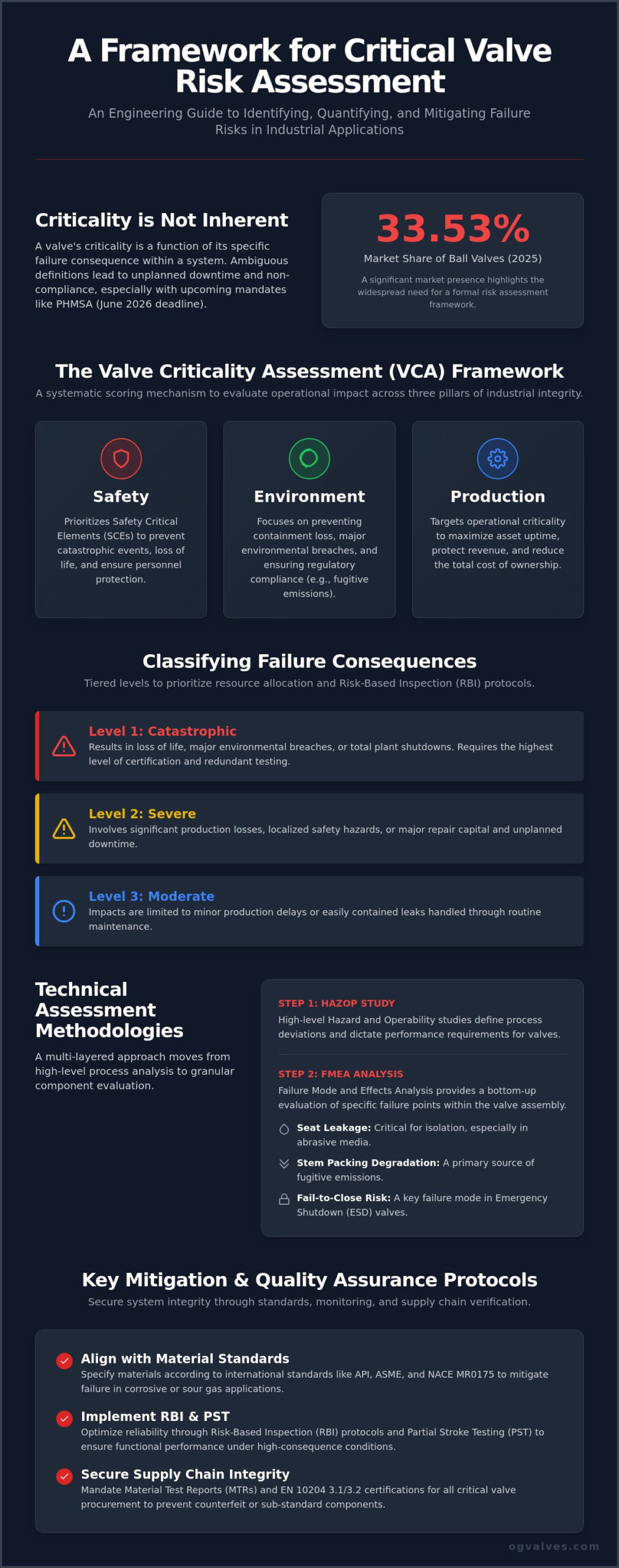
Criticality is not an inherent property of a valve; it’s a function of its specific failure consequence within a quantified industrial system. In high-stakes sectors where ball valves held a 33.53% market share in 2025, technical experts often struggle with ambiguous definitions that lead to unplanned downtime or regulatory non-compliance. Implementing a formal risk assessment for critical valves is essential to navigate the latest PHMSA mandates and the June 2026 deadlines for hazardous liquid pipeline inspections. A clinical approach to asset integrity ensures that material selection and maintenance schedules are based on quantifiable data rather than prescriptive guesswork.
This article delivers a comprehensive engineering guide to identifying, quantifying, and mitigating failure risks across industrial applications. You’ll gain access to a repeatable Valve Criticality Analysis (VCA) framework that aligns specific risk levels with hardware specifications for gate, globe, and check valves. We’ll examine the application of API 520 11th Edition and EN ISO 4126-10:2024 standards to ensure your infrastructure meets global benchmarks for safety and durability. This methodical progression from risk identification to quality assurance protocols is designed to reduce total cost of ownership through uncompromising reliability.
- Implement a structured Valve Criticality Assessment (VCA) framework to score operational impacts across Safety, Environment, and Production (SEP) categories.
- Execute a technical risk assessment for critical valves utilizing Failure Mode and Effects Analysis (FMEA) to isolate vulnerabilities in seat leakage and stem packing.
- Align material specifications with international standards such as API, ASME, and NACE MR0175 to mitigate failure risks in sour gas and corrosive applications.
- Optimize reliability through Risk-Based Inspection (RBI) protocols and partial stroke testing (PST) to ensure functional performance under high-consequence conditions.
- Secure supply chain integrity by mandating Material Test Reports (MTRs) and EN 10204 3.1/3.2 certifications for all critical valve procurement.
A Valve Criticality Assessment (VCA) serves as a systematic scoring mechanism to evaluate the operational impact of valve failure within a complex industrial system. It moves beyond the simplistic view that only Motor Operated Valves (MOV) or Air Operated Valves (AOV) require rigorous oversight. A comprehensive risk assessment for critical valves must account for any component whose failure disrupts the three pillars of industrial integrity: Safety, Environment, and Production (SEP). While Safety Critical Elements (SCE) are prioritized to prevent catastrophic events, Operational Criticality focuses on asset uptime and revenue protection. Manual valves, such as gate valves, often constitute a significant portion of the pressure boundary; they must be integrated into the risk scope to avoid blind spots in the integrity management plan. Failure to include manual isolation points in a VCA often leads to containment loss during emergency shutdowns.
Classifying Failure Consequences
Engineers categorize failure outcomes into distinct tiers to prioritize resource allocation effectively. Establishing these levels allows technical teams to apply the Risk-Based Inspection (RBI) methodology with precision.
- Level 1: Catastrophic. These failures result in loss of life, major environmental breaches, or total plant shutdowns. Such valves require the highest level of certification and redundant testing.
- Level 2: Severe. These involve significant production losses or localized safety hazards. While not immediately life-threatening, they necessitate major repair capital and unplanned downtime.
- Level 3: Moderate. These impacts are limited to minor production delays or easily contained leaks handled through routine maintenance. They don’t compromise the primary safety loop.
Quantifying Probability of Failure (PoF)
Determining the PoF requires a clinical analysis of historical data and Mean Time Between Failures (MTBF) indicators. It’s not a static value. Environmental factors like extreme temperature cycles, pressure spikes, and media corrosivity dictate the degradation rate of internal components. For example, a valve in sour gas service faces a higher PoF due to sulfide stress cracking. Design complexity also plays a role; a simple check valve might have a lower PoF compared to a complex actuated ball valve assembly due to fewer moving parts and failure modes. Accurate risk assessment for critical valves relies on mapping these variables against the specific material classifications of the valve body and trim. By quantifying these probabilities, procurement specialists can justify the selection of higher-grade alloys or specialized coatings that extend the asset’s functional life and reduce the total cost of ownership.
Technical risk assessment requires a multi-layered analytical approach to ensure that every potential failure point is identified before it impacts the process loop. A robust risk assessment for critical valves begins with Hazard and Operability (HAZOP) studies to define the process deviations that demand specific valve responses. This high-level analysis dictates the performance requirements for individual components. Once these parameters are established, engineers employ more granular methodologies to quantify the reliability of the pressure boundary and control mechanisms.
Failure Mode and Effects Analysis (FMEA) for Valves
FMEA provides a bottom-up evaluation of specific failure points within the valve assembly. Engineers must isolate vulnerabilities such as stem packing degradation or seat leakage, which vary significantly by valve type. For instance, high-performance ball valves are often analyzed for their seat integrity in abrasive media, while butterfly valves are scrutinized for disc seal wear. In emergency shutdown (ESD) applications, the analysis focuses on the ‘fail-to-close’ risk, where mechanical obstructions or internal corrosion might prevent a complete seal. Fugitive emissions are also evaluated as a long-term environmental risk factor, necessitating the use of bellows seals or live-loaded packing in high-cycle services. Structural integrity under thermal shock is a critical metric for cryogenic or high-temperature steam services, where rapid temperature deltas can lead to body cracking or trim binding.
Safety Integrity Levels (SIL) and Reliability
For automated systems, the selection of industrial valve actuators is governed by Safety Integrity Level (SIL) ratings. These ratings correlate directly to the Probability of Failure on Demand (PFD), providing a quantifiable benchmark for reliability. A clinical focus on SIL ensures that the entire final element, consisting of the valve, actuator, and solenoid, meets the required safety loop performance. Redundancy is a primary strategy for risk mitigation. Implementing 1oo2 (one-out-of-two) or 2oo3 (two-out-of-three) voting logic configurations significantly reduces the PFD in critical loops. This ensures that even if one actuator fails to respond, the system remains protected. Actuators must be fully compatible with SIL-rated safety instrumented systems (SIS) to maintain the integrity of the safety loop. Ensuring your industrial valve procurement aligns with these calculated SIL requirements is essential for long-term operational safety.

Material selection serves as the primary barrier against containment loss in high-pressure hydrocarbon and steam services. A robust risk assessment for critical valves must transition from theoretical scoring to the clinical application of global regulatory benchmarks. While general industrial standards often focus on water distribution, heavy industrial integrity requires adherence to API, ASME, and ISO protocols that account for aggressive media and extreme thermal gradients. Standardizing these design choices ensures that the pressure boundary remains intact under conditions that would cause standard-grade hardware to fail. Engineering teams must verify that every component, from the valve body to the smallest trim element, aligns with the calculated risk profile of the process loop.
Critical Standards for Heavy Industry
Global regulatory bodies provide the technical baseline for valve construction and performance. Adherence to these standards isn’t optional for high-stakes applications.
- API 600 and API 603: These specifications govern heavy-duty steel and corrosion-resistant gate valves. They mandate specific wall thicknesses and stem diameters that provide the structural margin needed for high-temperature service.
- API 6D: This is the definitive benchmark for pipeline valves used in high-pressure transport. It requires rigorous testing of the closure mechanism to ensure bubble-tight isolation in gas and liquid hydrocarbons.
- ASME B16.34: This standard defines the pressure-temperature ratings for valve bodies. It ensures that the selected material classification can withstand the maximum allowable working pressure (MAWP) at peak operating temperatures.
Material Integrity and Corrosion Control
Technical risk is often tied to the chemical interaction between the media and the valve internals. In sour gas environments, compliance with NACE MR0175/ISO 15156 is mandatory to prevent sulfide stress cracking (SSC). Engineers must choose between Duplex and Austenitic stainless steels based on the chloride concentration and the risk of Stress Corrosion Cracking (SCC). Positive Material Identification (PMI) serves as a critical quality control step, utilizing X-ray fluorescence to verify alloy composition before the valve enters service. Beyond the body material, trim selection is vital to combat erosion in high-velocity flows. Hard-facing materials like Stellite are frequently specified for seat rings and discs to maintain seal integrity over thousands of cycles.
A final layer of risk mitigation involves standardizing testing protocols. Every critical valve must undergo pressure, shell, and seat leakage tests per API 598 before deployment. These tests provide the quantifiable data needed to validate the risk assessment for critical valves, ensuring that the hardware meets the performance claims of the manufacturer. By anchoring procurement in these rigorous design and testing standards, organizations eliminate the ambiguity often found in ‘fast-track’ or non-compliant supply chains.
Operational integrity depends on the transition from reactive repair cycles to a structured Risk-Based Inspection (RBI) framework. This methodology utilizes the data generated during the initial risk assessment for critical valves to determine the optimal frequency and depth of maintenance activities. Instead of applying uniform schedules across an entire plant, technical teams focus resources on Safety Critical Elements (SCE) where the consequence of failure is highest. This precision reduces unnecessary intervention. It ensures that high-stakes assets receive the clinical oversight required to maintain structural soundness throughout their design life.
Risk-Based Inspection (RBI) Strategies
Prioritizing inspection frequency based on criticality scores ensures that Level 1 assets undergo rigorous non-destructive testing (NDT) at shorter intervals. It’s essential to refine Mean Time Between Failures (MTBF) estimates by documenting detailed maintenance history, transforming static risk models into dynamic integrity profiles. Common NDT methods for in-situ assessment include:
- Ultrasonic Thickness Gauging: Detecting wall thinning due to erosion or corrosion in the valve body.
- Radiographic Testing: Identifying internal casting defects or structural cracks in high-pressure service.
- Acoustic Emission Testing: Monitoring for high-frequency signatures that indicate internal seat leakage.
This data-driven approach allows for the early detection of mechanical fatigue before it escalates into a containment breach.
Predictive Maintenance and Smart Systems
The integration of diagnostic data from smart actuators provides a real-time window into valve health. For high-performance ball valves, real-time torque monitoring is a primary indicator of seat wear or media buildup. A sudden increase in the torque required to break the seal often signals the onset of internal degradation. Digital twins further enhance this capability by simulating wear patterns based on actual process conditions. Managing the lifecycle risk of legacy valve infrastructure requires a hybrid approach, where retrofitted sensors provide data for components that lack native smart capabilities. Integrating these sensors into your risk assessment for critical valves allows for a holistic view of plant integrity.
Partial stroke testing (PST) significantly improves the reliability of emergency shutdown valves by exercising the moveables without interrupting the process flow. It identifies potential ‘stuck-at-open’ failures that would otherwise remain hidden until a real demand occurs. Monitoring fugitive emissions and packing integrity is equally vital in critical service, especially where hazardous media is present. Utilizing live-loaded packing systems and leak detection sensors ensures compliance with environmental regulations while protecting the surrounding infrastructure. To secure long-term reliability for your high-consequence systems, source high-performance valves from a partner committed to technical excellence.
Procurement represents the final stage where the theoretical risk assessment for critical valves is translated into physical assets. A failure in this phase negates the technical rigor of the entire design and analysis process. The pressure to meet project deadlines often leads to ‘fast-track’ procurement strategies that inadvertently compromise technical compliance. High-stakes industrial environments can’t tolerate the ambiguity of unverified hardware. Ensuring traceability through Material Test Reports (MTRs) and EN 10204 3.1 or 3.2 certification is a non-negotiable requirement for critical service. These documents provide the objective evidence that the chemical and mechanical properties of the valve body and trim meet the engineering specifications defined during the risk analysis. For high-consequence applications, 3.2 certification is frequently mandated, requiring an independent third party to witness material testing and verify the heat numbers against the mill certificates.
Verifying Technical Compliance
Technical Bid Evaluations (TBE) must prioritize quality and regulatory adherence over initial capital expenditure. A clinical focus on manufacturer credentials and international certifications ensures that the supplier possesses the technical capability to handle large-scale industrial demands. Third-party inspection (TPI) provides an additional layer of verification, conducting witness tests and document reviews at the point of manufacture. This process anchors the procurement cycle in rigorous quality control, positioning the resulting infrastructure as a benchmark for industrial safety. Standardizing the TBE process allows procurement specialists to identify deviations from the risk assessment for critical valves before orders are finalized, preventing the introduction of non-compliant alloys into corrosive or high-pressure process loops.
Supply Chain Reliability and Fast-Track Delivery
Mitigating the risk of prolonged facility downtime requires a strategic approach to inventory management and global logistics. Critical replacement valves, such as gate or globe valves, must be accessible through a dependable partner that understands the cost of failure. Strategic inventory reduces the lead time for high-specification hardware, allowing operators to address integrity issues identified during routine monitoring. Global supply chain resilience is maintained through comprehensive project management and localized sourcing capabilities. For organizations seeking to bridge the gap between technical requirements and delivery speed, it’s essential to partner with experts who offer both engineering depth and logistical precision. Contact OG VALVES LTD. for technical expertise and fast-track valve supply to secure your facility’s long-term operational output.
Industrial safety and operational continuity depend on the clinical application of the VCA framework and the rigorous adherence to international material standards. A successful risk assessment for critical valves transitions from theoretical scoring to a practical integrity management plan that includes Risk-Based Inspection and partial stroke testing. By prioritizing technical compliance over short-term procurement savings, organizations protect their infrastructure from the catastrophic consequences of containment loss and unplanned downtime. Tracing material integrity through EN 10204 3.1 or 3.2 certification ensures that every final element performs to its specified safety integrity level.
Achieving this level of reliability requires a partner with specialized technical expertise and a global reach. We maintain a specialist industrial valve inventory and provide global fast-track delivery to meet the most demanding project schedules. Our team offers deep expertise in API and EN standards to ensure your hardware meets every regulatory benchmark. Request a Technical Specification Review for Your Critical Valves to validate your system design and secure your facility’s future. Implementing these engineering protocols today builds a foundation for unwavering operational excellence.
What is a Valve Criticality Assessment (VCA)?
A Valve Criticality Assessment (VCA) is a systematic scoring process used to determine the impact of valve failure on safety, environment, and production (SEP). It classifies assets into a technical hierarchy to prioritize maintenance and procurement efforts. This assessment moves beyond simple automation status to evaluate the actual consequence of a containment breach or process interruption within a specific industrial loop, ensuring resources target the highest risk areas.
How does FMEA apply to industrial valve failure?
Failure Mode and Effects Analysis (FMEA) isolates specific physical failure points within a valve assembly, such as stem packing degradation or seat leakage. It evaluates the severity and probability of each failure mode to identify high-risk components. By analyzing how individual parts fail, engineers can implement targeted design improvements or specify higher-grade materials to mitigate identified risks before they cause catastrophic system-level downtime.
What are the most common failure modes for critical valves in oil and gas?
The primary failure modes include ‘fail-to-close’ in emergency shutdown systems, internal seat leakage, and fugitive emissions through the stem packing. In abrasive or sour service, sulfide stress cracking and erosive wear are also prevalent. These modes are often exacerbated by high-pressure cycles and corrosive media, necessitating a rigorous risk assessment for critical valves to ensure material compatibility and structural integrity under peak load conditions.
How do API standards help in risk mitigation?
API standards provide the technical benchmarks for valve design, wall thickness, and testing protocols. Adherence to specifications like API 6D for pipeline valves or API 598 for leakage testing ensures that hardware meets a defined safety margin. These standards eliminate ambiguity in procurement by providing quantifiable performance criteria that manufacturers must validate through rigorous pressure and shell testing before the asset enters active service.
What is the difference between a Safety Critical Element (SCE) and a critical valve?
A Safety Critical Element (SCE) is a broad system component essential for preventing or mitigating major accidents, whereas a critical valve is a specific piece of hardware identified via VCA. While all SCE valves are critical, not all critical valves are SCEs. Some valves are classified as critical due to their impact on production revenue or localized environmental hazards rather than their specific role in a safety loop.
Why is PMI testing essential for critical valve procurement?
Positive Material Identification (PMI) is a non-destructive testing method used to verify the elemental composition of valve alloys. It ensures that the material delivered matches the engineering specification, such as Duplex or 316 stainless steel. This verification is vital in corrosive environments where the installation of an incorrect alloy could lead to rapid failure through stress corrosion cracking or localized pitting, compromising the entire pressure boundary.
Can automated valves be more risky than manual valves?
Automated valves introduce additional failure modes related to actuator performance, control signals, and power supply. While they offer remote operation, their complexity increases the Probability of Failure on Demand (PFD) compared to a simple manual isolation valve. A comprehensive risk assessment for critical valves must account for these actuator-specific risks, such as solenoid failure or pneumatic supply loss, to maintain the safety loop’s functional integrity.
How does Risk-Based Inspection (RBI) reduce operational costs?
RBI reduces costs by shifting resources from time-based maintenance to criticality-based intervention. It extends inspection intervals for low-risk valves while focusing intensive monitoring on high-consequence assets. This strategy minimizes unnecessary downtime and reduces the labor costs associated with blind maintenance cycles. By identifying degradation early in critical service, RBI prevents expensive emergency repairs and avoids the revenue losses associated with unplanned facility shutdowns.
 Responsive Menu