Triple Offset Butterfly Valve: Technical Comparison and Engineering Guide
March 31, 2026
Home+Triple Offset Butterfly Valve: Technical Comparison and Engineering Guide
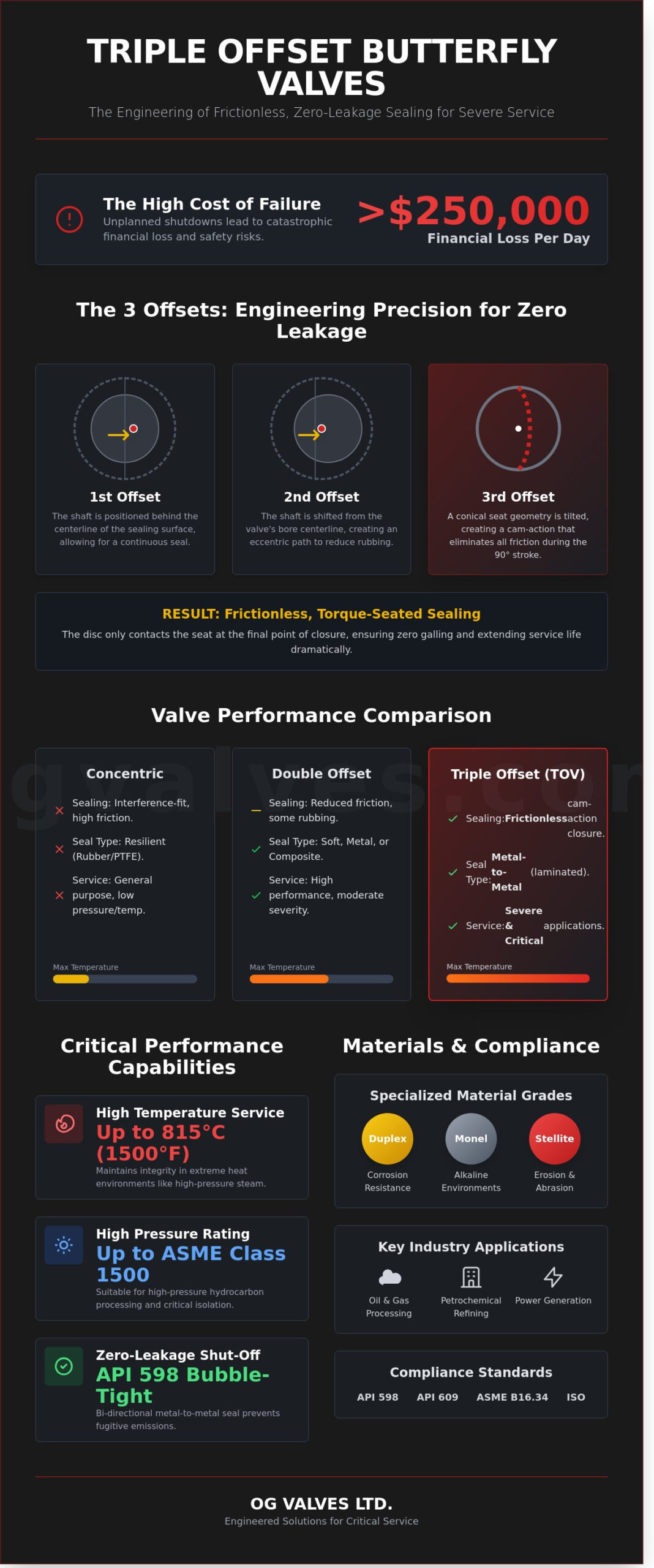
An unplanned shutdown in a high-pressure hydrocarbon processing facility can result in financial losses exceeding $250,000 per day. You recognize that accelerated valve seat wear in high-cycle applications remains a primary catalyst for these costly interruptions and fugitive emission violations. This engineering guide provides a clinical analysis of the triple offset butterfly valve, examining how its unique geometry eliminates the friction-induced degradation found in concentric or double-offset designs. We’ll define the technical parameters required to achieve zero-leakage, bubble-tight isolation according to API 598 standards even in environments reaching 815 degrees Celsius.
You’ll gain access to a performance comparison framework that evaluates material integrity and torque requirements for severe service. We’ll detail the specific design features that ensure compliance with API 609 and ASME B16.34 specifications to minimize downtime and maximize operational safety. This overview covers everything from seat-to-seal contact mechanics to the rigorous testing protocols necessary for cryogenic and high-temperature service.
Key Takeaways
Analyze the engineering precision of the triple offset butterfly valve to understand how its unique cone-shaped geometry facilitates frictionless, bubble-tight sealing in extreme conditions.
Establish clear performance benchmarks to determine when severe service applications require an upgrade from high-performance double offset valves to triple offset technology.
Navigate the complexities of international compliance by reviewing essential API, ASME, and ISO standards for material integrity in corrosive environments.
Evaluate specialized material grades, such as Duplex and Monel, to ensure long-term durability and safety in high-pressure industrial infrastructure.
Implement strategic procurement and quality assurance protocols to minimize lead times and maintain technical compliance for large-scale industrial valve replacements.
The triple offset butterfly valve is a precision-engineered isolation component designed for critical service environments. It represents the final stage in the engineering evolution of the Butterfly valve, moving beyond the inherent limitations of concentric and double offset designs. While concentric valves rely on interference-seated resilient liners, the triple offset (TOV) architecture utilizes a unique geometry to achieve a frictionless, metal-to-metal seal. This design is essential for maintaining bubble-tight shut-off in applications exceeding 427°C or pressures reaching ASME Class 1500. Industrial sectors requiring this level of technical precision include:
Upstream and downstream Oil and Gas processing
Petrochemical and chemical refining
High-pressure steam and power generation
The Geometry of Frictionless Sealing
The TOV operates through a cam-action mechanism facilitated by three distinct offsets. The first two offsets involve the shaft position relative to the centerline of the bore and the seat. The third offset is the conical axis of the seat geometry. This configuration ensures the disc only contacts the seat at the final point of closure. It eliminates the rubbing and friction that degrade seals in other valve types. Unlike position-seated valves that rely on travel limits, the triple offset butterfly valve is torque-seated. The sealing force increases as more torque is applied, ensuring a zero-leakage seal that remains consistent across thousands of cycles. This non-rubbing rotation is critical for extending the service life of metal seats in abrasive or high-heat media.
Key Components and Material Integrity
The TOV’s integrity depends on its laminated metal seal ring and hardened seat. Typical construction involves a forged or cast body, a high-strength stem, and a disc often overlaid with Stellite 6 to resist erosion. Laminated seals usually consist of alternating layers of 316 stainless steel and graphite. These materials must meet rigorous standards like ASME B16.34 for pressure-temperature ratings. According to API 598 testing standards, a ‘bubble-tight’ seal is defined as a zero-leakage condition where no visible bubbles are detected during a specified duration of high-pressure pneumatic or hydrostatic testing. This level of performance is mandatory for hazardous fluid management where even minor fugitive emissions pose significant safety risks.
The Three Offsets: Engineering Precision for Zero Leakage
The triple offset butterfly valve represents the pinnacle of rotary valve engineering, designed specifically to address the limitations of soft-seated and high-performance double-offset designs. Achieving a bi-directional, bubble-tight seal requires a geometry that eliminates friction between the sealing elements. This mechanical integrity is essential in high-pressure steam, hydrocarbon processing, and cryogenic applications where seat degradation leads to catastrophic failure. The design relies on three distinct geometric displacements that transform the disc’s movement from a rotational sweep into a camming action.
Offset 1 and 2: Shaft and Centerline Positioning
The first offset involves positioning the shaft behind the centerline of the sealing surface. This displacement allows for a continuous, uninterrupted sealing surface around the entire circumference of the disc. The second offset shifts the shaft centerline away from the vertical bore centerline of the valve. Together, these two offsets create an eccentric path. As the valve opens, the disc lifts away from the seat immediately; this reduces the contact duration and minimizes the torque required to overcome initial breakout friction. These initial offsets define the standard high-performance profile, yet they still involve some rubbing during the final degrees of closure.
Offset 3: The Conical Seating Geometry
The third offset is the defining technical characteristic of the triple offset butterfly valve. It involves tilting the axis of the seat cone geometry so that it’s no longer parallel with the bore centerline. This creates a right-angled conical profile where the apex of the cone is offset from the shaft centerline. The resulting geometry ensures that the disc only contacts the seat at the final point of closure. Friction is eliminated throughout the 90-degree stroke, which prevents seat galling and extends the valve’s operational life. Sealing is achieved through mechanical compression rather than the interference-fit common in resilient seated valves.
This torque-seated mechanism is vital for maintaining integrity during thermal transients. In extreme services ranging from -196°C to 815°C, material expansion can alter the dimensions of the sealing components. The conical design compensates for these changes by allowing the disc to wedge deeper into the seat to maintain a seal. However, precise actuator sizing is mandatory. A Nuclear Regulatory Commission report from 2014 detailed how improper calculations of unseating loads can impact valve performance in critical safety systems. Engineers must account for these dynamic forces. For detailed torque data across various pressure classes, you may review our technical specifications guide to ensure system compatibility.
Triple Offset vs. Double Offset Butterfly Valves: A Comparative Analysis
Engineers must distinguish between high-performance double offset designs and the advanced geometry of the triple offset butterfly valve to ensure system integrity. While double offset valves utilize a dual-eccentric shaft to reduce seat friction, they rely on resilient or reinforced PTFE seats that typically fail when process temperatures exceed 230 degrees Celsius. In contrast, the triple offset design incorporates a third angular offset that eliminates all rubbing between the seat and seal ring during the entire stroke. This mechanical sealing principle ensures that contact only occurs at the final point of closure.
Performance Benchmarks and Limitations
Double offset valves generally meet FCI 70-2 Class VI leakage standards, which allows for a specific volume of bubbles per minute. High-criticality applications in the oil and gas sector demand the zero-leakage performance defined by API 598 or ISO 5208 Rate A. The metal-to-metal lamination of a triple offset butterfly valve provides this bi-directional, bubble-tight shutoff. In abrasive services, soft-seated double offset valves experience seat erosion within 5,000 to 10,000 cycles. TOVs regularly exceed 100,000 cycles in high-frequency throttling environments because their non-rubbing, cam-like action prevents material degradation. For a comprehensive overview of industrial butterfly valve design, mechanism, and selection criteria, engineers should review the full spectrum of concentric and offset architectures before finalizing specifications.
Selection Framework for Procurement
The transition to triple offset technology is mandatory when operating temperatures surpass 250 degrees Celsius or when pressure ratings reach ASME Class 600 and Class 900. While double offset valves are cost-effective for Class 150 and 300 utility services, they lack the structural rigidity for high-pressure steam or volatile hydrocarbon transport. When evaluating actuation, the torque requirements of TOVs are approximately 40% lower than traditional gate valves, allowing for smaller, more efficient pneumatic or electric actuators.
Procurement specialists should consider the Total Cost of Ownership (TCO) rather than the initial capital expenditure. Although the TOV carries a 25% higher upfront cost, it reduces maintenance-related downtime by 50% over a five-year operational window. This efficiency stems from the following technical advantages:
Seat Integrity: Stellite-faced hard seating prevents wire-drawing and galling.
Compliance: Strict adherence to API 609 and ASME B16.34 standards for pressure-temperature ratings.
Fire Safety: Inherent fire-safe design due to the absence of soft polymers in the primary seal.
By specifying TOVs for services exceeding 250 degrees Celsius, facilities mitigate the risk of seat blowout and fugitive emissions. The clinical precision of the triple-offset geometry ensures that the valve remains a dependable barrier in the most rigorous industrial environments.
Material Selection and Compliance Standards for Severe Service
Global Regulatory Standards for TOVs
Compliance with fugitive emission standards is mandatory for hydrocarbon processing plants aiming to reduce environmental impact. ISO 15848-1 defines the testing procedures for stem seal integrity. It classifies valves based on their leakage rates during thermal cycling. For fire-risk environments, API 607 certification is a non-negotiable requirement. This standard verifies that the valve maintains a reliable seal even after the soft components are destroyed by fire. OG Valves ensures every triple offset butterfly valve intended for high-risk zones meets these rigorous fire-safe criteria.
Advanced Material Grades for Longevity
The selection of alloys directly impacts the lifecycle of a valve in corrosive or abrasive media. While carbon steel (WCB) or stainless steel (CF8M) suffices for standard applications, severe service environments demand higher performance alloys.
Duplex and Super Duplex: These grades provide superior pitting and crevice corrosion resistance in seawater and desalination plants.
Monel 400: Essential for hydrofluoric acid service and marine environments where standard stainless steels fail.
Stellite Hard-facing: Applying Stellite 6 or 21 to the seat and seal ring surfaces provides a hardness rating of 40 to 45 HRC. This protects the sealing interface from high-velocity steam erosion and abrasive slurry wear.
Material traceability is maintained through EN 10204 3.1 certification. This document confirms that the chemical composition and mechanical properties of the heat lot meet the project specification. Quality assurance protocols include Positive Material Identification (PMI) to prevent alloy mix-ups. Every unit undergoes hydrostatic and pneumatic pressure testing according to API 598. This process verifies zero-leakage performance before the valve leaves the facility.
Procuring Triple Offset Valves: Quality Assurance and Global Logistics
Large-scale industrial projects demand zero-tolerance for technical non-compliance. OG Valves manages this through a rigorous verification process that aligns every triple offset butterfly valve with API 609 and ASME B16.34 standards. For projects exceeding $500,000 in valve requirements, we provide comprehensive Material Test Reports (MTRs) and Positive Material Identification (PMI) to ensure metallurgical integrity. Our logistics framework is designed to bypass common supply chain bottlenecks; we utilize a centralized distribution network to maintain a 98% on-time delivery rate across international borders. This precision ensures that engineering specifications are met without deviation, maintaining the structural integrity of high-pressure piping systems.
Inventory and Fast-Track Supply
Facility downtime costs an average of $22,000 per hour in the petrochemical sector. To mitigate these losses, we maintain a $15 million inventory of ready-to-ship components. Every unit undergoes hydrostatic and pneumatic testing per API 598 protocols before dispatch. This ensures that fast-track orders don’t compromise safety or performance benchmarks. We manage complex logistics for high-specification alloys, including Duplex and Inconel, ensuring that even specialized requirements meet project timelines. Our 48-hour dispatch protocol for stock items provides a critical buffer for emergency facility repairs and scheduled turnarounds.
Technical Consultation and Quoting
Engineering firms require precise data for seamless system integration. We provide native CAD files, 3D STEP models, and detailed data sheets for every triple offset butterfly valve configuration. Our technical team assists in specifying actuation packages, bypass valve assemblies, and specialized coatings for corrosive environments. These consultations prevent costly field modifications and ensure that torque requirements match actuator capabilities perfectly.
Provision of full dimensional drawings and weight specifications for structural calculations.
Customization of face-to-face dimensions to meet ISO 5752 or ASME B16.10 standards.
Integration of limit switches, positioners, and solenoid valves from leading global brands.
Securing Critical Infrastructure with Precision Engineering
The integration of a triple offset butterfly valve is essential for industrial systems requiring zero-leakage performance and frictionless operation. Engineering the third offset eliminates mechanical wear during rotation; this ensures long-term seat integrity in environments exceeding 815 degrees Celsius. Compliance with API 609 and ASME B16.34 standards confirms that these valves withstand extreme thermal cycling and high-pressure differentials without failure. Selecting specific material grades like Duplex or Hastelloy provides the necessary corrosion resistance for severe service applications.
OG Valves maintains an ISO 9001:2015 Certified Quality Management system to ensure every component meets rigorous safety benchmarks. We offer comprehensive technical support and Positive Material Identification (PMI) testing to verify chemical compositions before installation. Our global fast-track delivery capabilities allow us to support urgent project timelines across the oil and gas sectors. It’s our commitment to provide the technical precision required for high-stakes engineering environments.
What is the primary advantage of a triple offset butterfly valve over other types?
The primary advantage is the frictionless sealing achieved through the third offset geometry, which eliminates seat wear during operation. This design allows for a service life exceeding 50,000 cycles in high-pressure environments. By removing contact until the final point of closure, the valve reduces maintenance costs by 25% compared to high-performance double offset designs. It’s the standard for longevity in severe service.
Are triple offset butterfly valves truly zero-leakage?
Yes, a triple offset butterfly valve provides bi-directional zero-leakage shutoff in accordance with API 598 or ISO 5208 Rate A standards. The torque-seated metal-to-metal interface ensures a bubble-tight seal even at pressures reaching 1,500 PSI. It’s a reliable choice for critical isolation where zero-leakage integrity is non-negotiable. This performance is verified through rigorous factory acceptance testing before any unit is deployed to the field.
Can triple offset valves be used for throttling applications?
Triple offset valves are effective for throttling applications, particularly within the 20 to 70 degree disc opening range. The non-rubbing seat design prevents erosion that typically compromises other valve types during high-velocity flow. Engineers can achieve control accuracy within 1.5% of the total flow range in most 600 class systems. This versatility allows a single valve to handle both isolation and modulation duties efficiently.
What are the common materials used for triple offset valve seats?
Seat materials for a triple offset butterfly valve typically involve laminated 316L stainless steel with graphite or solid Stellite 6 overlays. These materials handle temperatures from -196°C to 815°C without losing structural integrity. For corrosive environments, 22% chromium duplex steel is the standard specification for maximum durability. Each material choice is selected to meet the specific chemical compatibility requirements of the process medium.
How does the torque requirement of a TOV compare to a gate valve?
Torque requirements for a TOV are approximately 40% lower than those of a comparable gate valve due to the quarter-turn mechanism. This reduction allows for smaller, more cost-effective pneumatic or electric actuators. In a 24-inch pipeline, switching to a TOV can reduce the total footprint of the valve assembly by 35%. It’s a strategic choice for weight-sensitive offshore installations where deck space is limited.
What standards govern the design of triple offset butterfly valves?
The design of these valves is governed by international standards including API 609, ASME B16.34, and ISO 5752. Testing protocols must adhere to API 598 to ensure pressure integrity and seat tightness. Compliance with these standards ensures the valve meets the 100% safety requirements of global industrial projects. We maintain full traceability for all components to satisfy the rigorous documentation needs of modern engineering firms.
Is fire-safe certification necessary for all triple offset applications?
Fire-safe certification is required for any application involving flammable media, as dictated by API 607 or ISO 10497 standards. These tests prove the valve can maintain a seal for 30 minutes while exposed to temperatures of 760°C. Roughly 90% of offshore oil and gas platforms mandate this certification for all critical line components. It’s an essential safety feature that prevents catastrophic leaks during an emergency event.
How do I determine the correct size and pressure class for a TOV?
You determine the correct size by calculating the required flow coefficient (Cv) and matching it to the ASME B16.34 pressure-temperature ratings. Engineers should select a pressure class, such as Class 150 or 300, based on the maximum operating pressure of the process. Always include a 15% safety margin above the peak system pressure to ensure operational safety. Accurate sizing prevents cavitation and extends the service life of the internal components.
 Responsive Menu