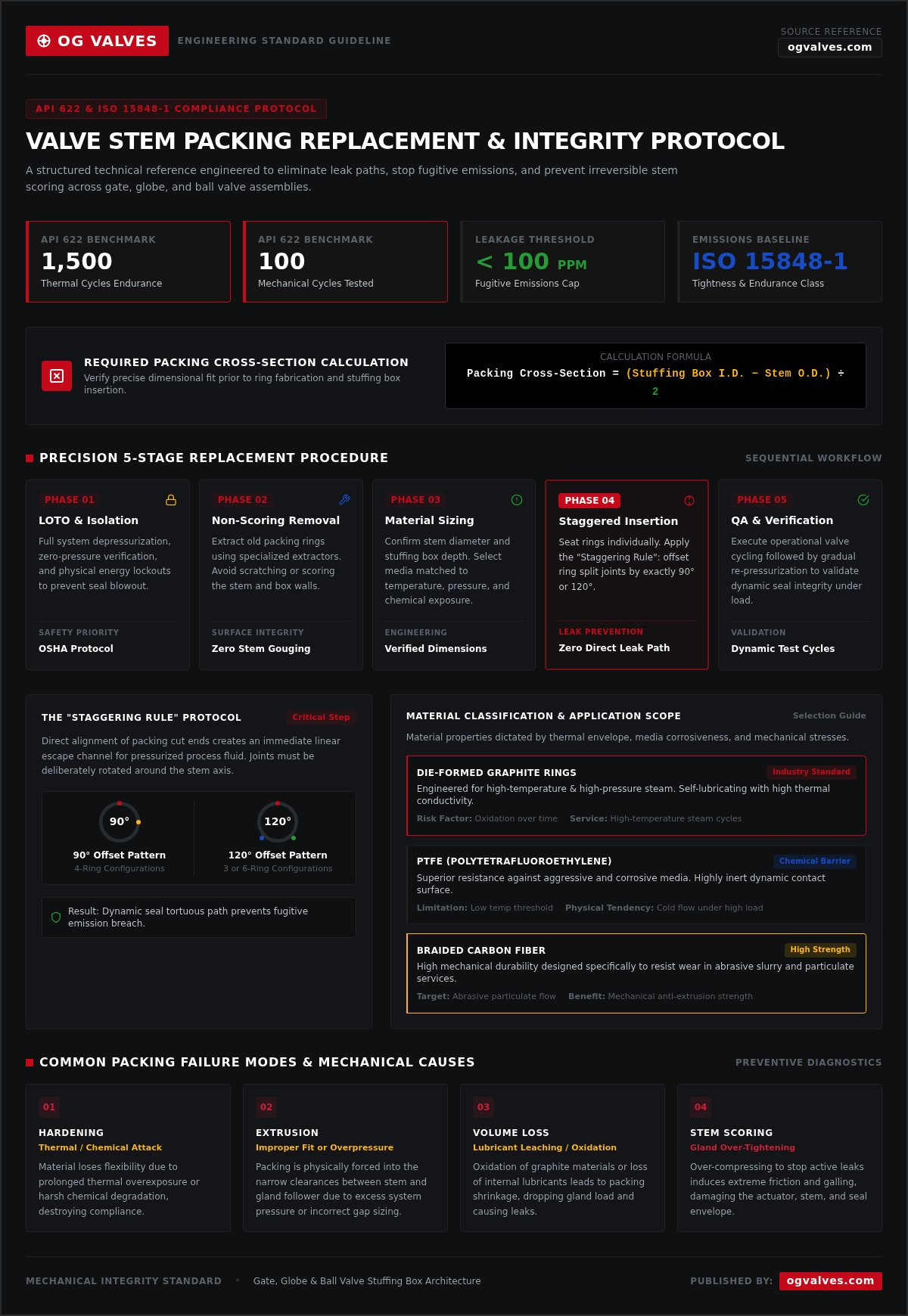
A single instance of stem scoring during maintenance can transition a routine seal refresh into a total asset failure. In high-pressure industrial sectors, the margin for error in fugitive emission control has narrowed to nearly zero. You recognize that unplanned downtime and regulatory penalties under ISO 15848-1 are unacceptable risks to operational continuity. This guide outlines a rigorous valve stem packing replacement procedure engineered to eliminate leak paths and extend the service life of critical infrastructure. We provide a comprehensive technical walkthrough for maintenance engineers tasked with upholding structural integrity in gate, globe, and ball valve assemblies. You’ll gain a detailed understanding of advanced extraction techniques, material classifications for 2026 environmental standards, and precise torque application protocols. This methodical approach ensures that your maintenance cycles result in verifiable zero-leakage performance and total regulatory adherence. By prioritizing engineering precision over speed, you’ll prevent the mechanical degradation that leads to costly valve replacements and environmental non-compliance.
Key Takeaways
- Implement rigorous safety protocols, including system depressurization and Lockout/Tagout (LOTO), to ensure a secure environment before initiating mechanical disassembly.
- Execute a precise valve stem packing replacement procedure that prioritizes stem surface integrity by utilizing specialized extraction tools to prevent scoring.
- Apply the “Staggering Rule” during ring installation, offsetting joints by 90 or 120 degrees to eliminate direct leak paths and achieve zero-leakage performance.
- Select packing materials such as die-formed graphite or PTFE based on specific pressure and temperature requirements to maintain compliance with ISO 15848-1 emission standards.
- Validate seal integrity through operational cycling and gradual re-pressurization to ensure long-term durability and structural soundness under load.
The Engineering Significance of Proper Valve Stem Packing
Industrial valve stem packing serves as the primary dynamic seal designed to isolate process media from the external environment. This seal is critical in both rising and non-rising stem architectures. It sits within the stuffing box assembly, where it’s compressed to create a barrier against system pressure. In high-stakes environments like Oil & Gas and Petrochemical processing, the integrity of this seal directly impacts plant safety. Fugitive emissions aren’t just environmental hazards; they’re indicators of mechanical inefficiency that can lead to catastrophic failure. Adopting a rigorous valve stem packing replacement procedure is the only way to ensure these seals meet modern performance benchmarks and maintain structural soundness.
When packing isn’t maintained correctly, the resulting stem friction leads to galling. This physical damage compromises the smooth operation of the valve. Over time, the increased torque required to actuate the valve can damage the actuator or the stem itself. This leads to unplanned downtime and expensive component replacement. Engineers must view packing not as a simple consumable, but as a precision-engineered component essential for structural integrity. Reliability in critical infrastructure depends on the clinical application of these maintenance standards.
Common Failure Modes in Industrial Packing Systems
Identifying the visual signs of packing degradation is the first step in preventive maintenance. Hardening of the material often indicates thermal overexposure or chemical attack. Extrusion, where the packing is forced into the clearances between the stem and the gland, suggests improper fit or excessive pressure. Volume loss is another common issue, often caused by the leaching of lubricants or the oxidation of graphite materials. High-pressure cycles and thermal fluctuations accelerate these wear patterns. A common error is “over-tightening” the gland to stop a visible leak. This temporary measure increases friction and can lead to immediate stem scoring, making a full valve stem packing replacement procedure necessary to restore the asset’s functional reality.
Adherence to Global Standards (API 622 & ISO 15848)
Modern industrial operations require adherence to strict international certifications. API 622 specifies the testing requirements for fugitive emission performance of packing materials. It ensures that the material can withstand 1,500 thermal cycles and 100 mechanical cycles while maintaining a leak rate below 100 ppm. ISO 15848-1 provides a classification system for industrial valve tightness, categorizing valves based on their emission levels and endurance. In 2026, these standards define the baseline for engineering excellence. Using non-compliant materials or outdated procedures isn’t an option for facilities aiming for ISO certification or regulatory compliance. Precision in material selection and installation technique is the only path to achieving a zero-leakage performance profile.
Preparation: Material Selection and Safety Protocols
Safety is the primary consideration before initiating any mechanical intervention. Maintenance engineers must confirm the complete isolation of the valve from the process stream. Adhering to OSHA lockout/tagout safety protocols is the mandatory baseline for any valve maintenance activity. This involves the physical locking of energy isolation devices and the verification of zero-pressure states. System depressurization and thermal stabilization are equally vital. Attempting a valve stem packing replacement procedure on a pressurized or high-temperature line risks catastrophic seal blowout and personnel injury. Once the system is verified as safe, the selection of replacement materials begins.
Material selection depends on the process media, operating temperature, and pressure rating. Die-formed graphite rings are the industry standard for high-temperature and high-pressure steam applications due to their thermal conductivity and self-lubricating properties. PTFE (Polytetrafluoroethylene) offers superior chemical resistance for corrosive media but is limited by its lower temperature threshold and tendency for cold flow. Braided carbon fiber provides high mechanical strength for abrasive services. Engineers must calculate the required packing cross-section by subtracting the stem diameter from the stuffing box internal diameter and dividing by two. If your existing units show signs of irrecoverable body damage, sourcing high-specification industrial valves from established global suppliers is necessary to maintain system integrity.
Tooling Requirements for Precision Replacement
Precision execution requires specialized tooling. Flexible packing extractors and corkscrew-style pullers are necessary for removing deep-seated rings without contacting the stuffing box walls. You should use calibrated torque wrenches for the final gland nut adjustment to ensure uniform compression across the packing set. Stem cleaning requires non-metallic abrasive pads. Metal scrapers often cause longitudinal scoring, which creates permanent leak paths. Maintaining a clean, debris-free environment prevents the introduction of contaminants that compromise the seal’s functional reality.
Inspection Criteria for Valve Stems and Stuffing Boxes
A successful seal depends on the condition of the metal interface. Inspect the valve stem for straightness and signs of pitting or galling. Industrial applications typically require a stem surface finish between 16 and 32 RMS. Optimal graphite packing performance requires a stem surface roughness (Ra) between 0.4 and 0.8 micrometers to ensure a consistent dynamic seal. Stuffing box walls must be checked for corrosion or erosion that could allow process media to bypass the packing rings. Any deviation from these engineering benchmarks necessitates component resurfacing or replacement to avoid premature seal failure.
Step-by-Step Valve Stem Packing Replacement Procedure
Mechanical disassembly begins with the controlled loosening of the gland nuts. It’s vital to back these off in a cross-pattern to prevent the gland follower from binding against the stem. Once the gland flange and follower are retracted, the stuffing box cavity becomes accessible. The extraction phase requires a methodical approach to ensure that the internal surfaces remain pristine. Any deviation from a clinical extraction technique can introduce longitudinal scoring, which permanently compromises the seal’s functional reality. Protecting the stem during this phase is the highest priority for maintaining structural soundness. Following a standardized valve stem packing replacement procedure ensures that the mechanical integrity of the asset is preserved.
Extraction tools must be selected based on the packing material and depth. Flexible, corkscrew-style extractors allow for the removal of rings without applying lateral force to the stem. Each ring should be extracted individually. You must verify that the stuffing box floor is completely clear of carbonized residue or old PTFE fragments. This internal cleaning ensures that the new packing set will seat flat against the bottom of the box, preventing uneven compression. A final inspection of the stem for localized corrosion or pitting is mandatory before proceeding with the installation of new components.
Removing Legacy Packing Safely
Removing rings sequentially prevents the packing from jamming within the stuffing box. If the valve configuration includes a lantern ring, its exact depth and orientation must be recorded for precise re-installation. This is critical for valves utilizing external lubrication or leak-off ports. In chemical or petrochemical service, spent packing often contains hazardous process media residues. Personnel must handle these materials according to site-specific safety protocols and EPA Leak Detection and Repair guidelines to prevent environmental contamination and ensure regulatory adherence. Failure to remove every fragment of the old seal will result in a compromised interface for the replacement rings.
Cleaning and Stem Polishing Protocols
Stuffing box hygiene requires the use of approved solvents that leave no residue. These solvents effectively dissolve old lubricants and loosen bonded graphite or PTFE particles. After cleaning, the stem should be polished using a non-metallic abrasive pad to restore the required micro-finish. This step removes minor surface oxidation and ensures a smooth dynamic interface. You should also inspect the gland follower for signs of deformation, such as “mushrooming” or uneven wear on the contact face. A distorted follower cannot apply the uniform axial load necessary for a high-performance seal. If the follower or stem shows signs of irrecoverable mechanical degradation, maintenance engineers should evaluate the necessity of a complete valve replacement.
Precision Installation and Compression of New Packing
Installation requires exact material preparation to ensure a high-performance seal. Cutting packing rings from bulk spools involves either a 45-degree skive cut or a 90-degree butt cut. A skive cut provides a larger surface area for sealing but requires higher precision to avoid ring overlap. A butt cut is standard for many industrial applications where ease of installation is prioritized. Once rings are sized, the “Staggering Rule” is the most critical mechanical protocol during the valve stem packing replacement procedure. Joints must be offset by 90 or 120 degrees to eliminate direct leak paths through the packing stack. This orientation prevents the formation of a continuous leak channel that could bypass the entire seal assembly.
Seating each ring individually ensures uniform density throughout the stuffing box cavity. You shouldn’t install the entire set and then attempt a single compression. Instead, use the gland follower to seat each ring firmly before adding the subsequent layer. This method prevents the bottom rings from remaining uncompressed, which would lead to localized voids and premature failure. If the valve utilizes a lantern ring, it must be positioned precisely adjacent to the lubrication or leak-off port. Misalignment here renders external ports useless and can lead to thermal buildup or lubrication failure. Verifying the depth of the lantern ring against the original disassembly notes is a mandatory step for structural soundness.
Calculating and Applying Gland Torque
Determining the correct axial load is a function of packing material, stem diameter, and system pressure. You must consult manufacturer torque tables rather than relying on manual “feel.” The initial squeeze involves compressing the packing to approximately 25-30% of its height to ensure the rings deform against the stem and stuffing box wall. During this process, monitoring gland follower parallelism is mandatory. An angled follower creates uneven loading, leading to localized stem wear and seal bypass. Once the initial compression is achieved, the operational set is finalized by cycling the valve several times to allow the packing to conform to the stem’s dynamic profile.
The Role of Live-Loading (Spring Washers)
Live-loading utilizes Belleville spring washers to maintain a constant load on the packing set. It’s essential for valves subject to frequent thermal cycling, where material expansion and contraction can loosen gland nuts. These spring stacks compensate for packing volume loss over time, extending the interval between maintenance cycles. You should upgrade to live-loading if a valve shows consistent leakage after thermal excursions or high-frequency actuation. Visual indicators, such as the compression height of the spring stack, allow for non-intrusive monitoring of seal health. If your current hardware cannot support these precision upgrades, browse the selection of high-specification gate and globe valves to ensure your infrastructure meets 2026 performance standards.
Post-Maintenance Testing and Quality Assurance
Validation of the valve stem packing replacement procedure requires a methodical return to service. System re-pressurization must be conducted gradually to avoid shocking the newly installed rings. During this phase, maintenance engineers perform operational cycling, actuating the valve between five and ten times. This process seats the packing under actual service load, ensuring the material conforms to the stem’s dynamic profile. Initial leak detection utilizes soap bubble tests for gross leakage, followed by electronic sniffer probes for precise fugitive emission quantification. Every data point, including the packing material batch number, final torque values, and the credentials of the testing personnel, must be logged to maintain an exhaustive audit trail for critical infrastructure.
Rigorous documentation ensures that any future seal degradation can be analyzed against the baseline installation data. You’ll find that recording the exact number of compression turns and the resulting gland gap provides a reference for future minor adjustments. This clinical approach to quality assurance distinguishes professional engineering from standard maintenance. It’s the only way to guarantee that the valve’s functional reality aligns with its design specifications under high-pressure conditions.
Fugitive Emission Verification (ISO 15848-2)
Field verification of low-emission performance often references ISO 15848-2. This standard defines the tightness classes for industrial valves post-maintenance. Class A represents the highest level of tightness, typically reserved for critical toxic or hazardous services, while Class B and C allow for marginally higher leak rates in less sensitive applications. Integrating these results into the plant’s Leak Detection and Repair (LDAR) program ensures ongoing compliance with environmental mandates. Field technicians must replicate factory-level precision to ensure that the refurbished seal maintains its performance classification throughout the next operational cycle. Failure to meet these benchmarks necessitates immediate reassessment of the packing compression or material compatibility.
When Replacement Fails: Selecting New Industrial Valves
Successful maintenance isn’t always possible. If the stem exhibits excessive pitting, ovality, or longitudinal scoring beyond the 16-32 RMS threshold, the valve must be slated for replacement. Excessive wear in the stuffing box walls or severe body corrosion also renders the valve stem packing replacement procedure ineffective. In these instances, consulting with OG VALVES LTD. provides access to high-specification replacement units designed for severe service. Selecting new Butterfly Valves or Gate Valves with factory-certified low-E packing ensures that the asset meets current 2026 regulatory benchmarks from day one. Choosing quality components for critical infrastructure reduces the frequency of unplanned interventions and upholds the plant’s structural soundness.
Advancing Operational Reliability Through Precision Engineering
Maintaining the structural integrity of industrial valve assemblies requires clinical adherence to established sealing standards. You’ve seen that success depends on the meticulous selection of compliant materials and the elimination of leak paths through precise ring orientation. Executing a standardized valve stem packing replacement procedure ensures that your assets meet the rigorous demands of ISO 15848-1 emission protocols and prevents costly stem degradation. When mechanical wear exceeds repairable limits, the focus must shift to total asset replacement to uphold plant safety and operational output.
If your current infrastructure requires specialized support, you can Request a Technical Quote for High-Specification Industrial Valves to secure API 600 and ISO 15848 compliant components. Our global fast-track delivery and deep technical expertise in heavy industry provide the reliability your critical infrastructure demands. Prioritizing these engineering benchmarks today guarantees the long-term durability and safety of your facility.
Frequently Asked Questions
Can valve stem packing be replaced while the valve is under pressure?
No. Attempting a valve stem packing replacement procedure while the system is under pressure is a violation of safety protocols and risks a catastrophic blowout. Always depressurize the system and follow OSHA lockout/tagout (LOTO) procedures to ensure a zero-energy state. Even valves equipped with back-seats shouldn’t be repacked under full system pressure in high-stakes industrial environments. Safety and structural integrity remain the primary priorities for any mechanical intervention.
How many rings of packing should be installed in a standard industrial stuffing box?
Most industrial stuffing boxes utilize between five and seven packing rings. This quantity provides sufficient sealing surface area while minimizing the friction that leads to stem galling. Adding too many rings increases the torque required for actuation and can prevent the gland follower from applying a uniform axial load. Maintenance engineers must verify specific manufacturer design specifications to ensure the packing stack height matches the intended stuffing box volume.
What is the difference between a skive cut and a butt cut in valve packing?
A skive cut is an angled 45-degree cut that allows the ring ends to overlap, creating a more robust seal against fugitive emissions. A butt cut is a 90-degree straight cut where the ends meet flush. While skive cuts offer superior sealing performance in high-pressure applications, they require higher precision during installation. Butt cuts are easier to size and install correctly in the field, reducing the risk of improper ring seating.
How do I know if a valve stem needs to be replaced instead of just repacked?
Stem replacement is mandatory if you identify longitudinal scoring, deep pitting, or ovality in the stem’s cross-section. A stem with a surface finish exceeding the 16-32 RMS range will quickly degrade new packing, leading to immediate seal failure. Use micrometers to check for straightness and diameter consistency. If the metal interface is mechanically compromised, repacking is only a temporary fix that won’t achieve long-term zero-leakage performance.
Why is my new valve packing leaking immediately after installation?
Immediate leakage often results from improper joint staggering or insufficient initial compression. If the ring joints are aligned rather than offset by 90 or 120 degrees, a direct leak path is created. Other causes include debris remaining on the stuffing box floor or using a valve stem packing replacement procedure that didn’t seat each ring individually. Ensure the gland nuts are tightened to the specified torque using a calibrated wrench to achieve the necessary operational set.
What are the advantages of die-formed graphite rings over braided packing?
Die-formed graphite rings provide superior thermal conductivity and a higher density than traditional braided materials. They’re engineered to withstand extreme temperatures and corrosive media while maintaining a low friction coefficient. These rings are often used in high-specification gate and globe valves to meet ISO 15848-1 Class A tightness standards. Braided packing is typically reserved for the top and bottom of the stack to act as wiper rings that protect the graphite from extrusion.
How often should industrial valve packing be inspected in high-cycle applications?
High-cycle valves require inspection intervals based on the frequency of actuation and the severity of the service. In many petrochemical facilities, critical valves are inspected quarterly as part of a formal Leak Detection and Repair (LDAR) program. You should monitor for visual signs of hardening, volume loss, or gland follower misalignment. Automated systems may require more frequent checks to ensure the actuator isn’t compensating for increased friction caused by packing degradation.
Does every valve need a lantern ring in the stuffing box?
No. Lantern rings are only necessary for valves that require external lubrication, cooling, or leak-off monitoring. They’re common in high-temperature services or applications involving hazardous chemicals where a buffer fluid is injected to prevent process media from reaching the atmosphere. If the valve wasn’t originally designed with a lantern ring or an associated port in the stuffing box, installing one will disrupt the compression of the packing stack and compromise the seal.
 Responsive Menu