Industrial Ball Valves: A Technical Engineering & Specification Guide
March 30, 2026
Home+Industrial Ball Valves: A Technical Engineering & Specification Guide
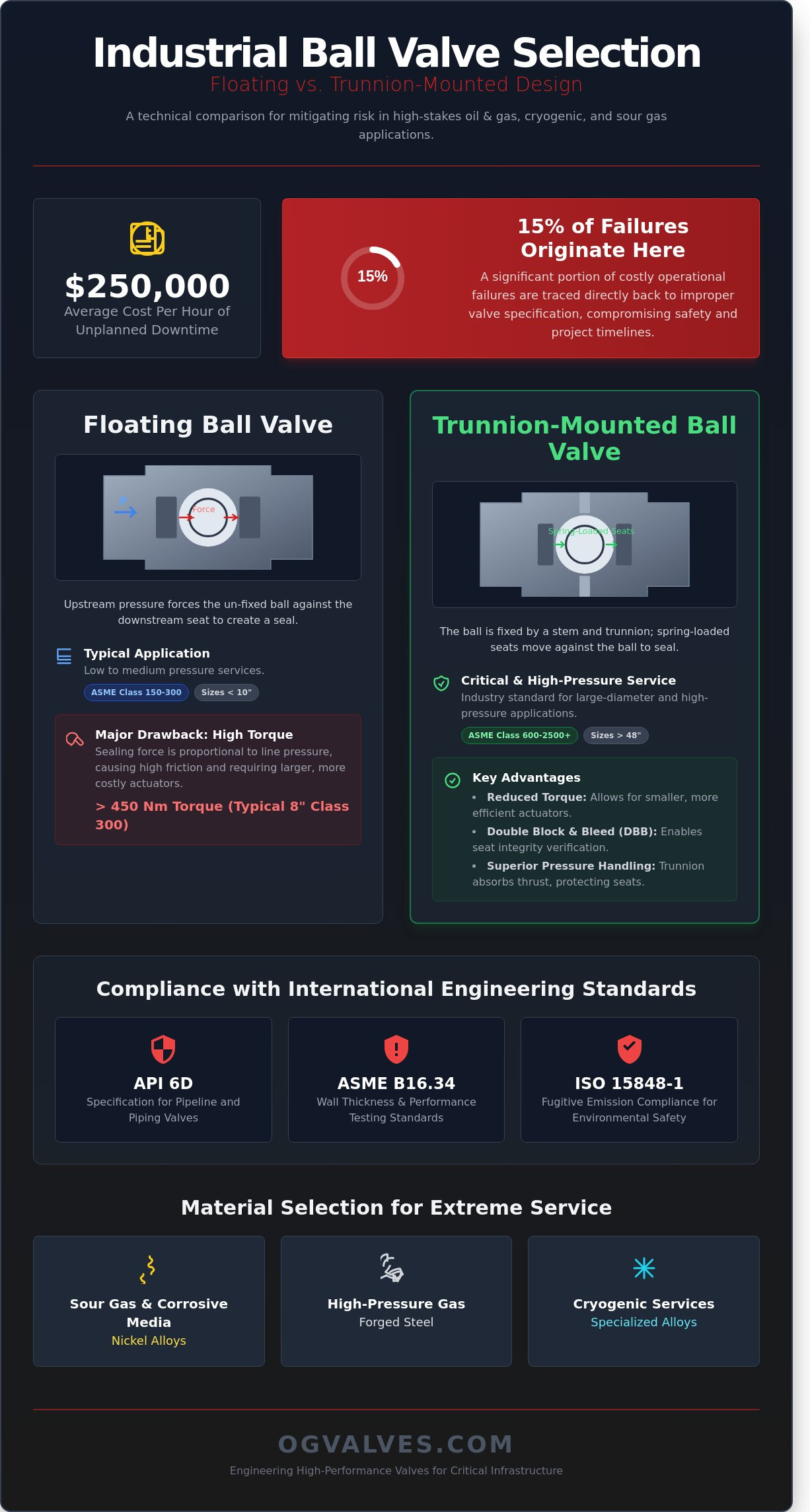
Unplanned downtime in high-pressure oil and gas operations costs an average of $250,000 per hour according to 2023 industry benchmarks, with 15% of these failures originating from improper valve specification. You recognize that the mechanical integrity of a critical infrastructure project depends on the precise selection of a high-performance ball valve capable of withstanding extreme thermal cycles and corrosive media. Failure to adhere to rigorous engineering standards doesn’t just increase maintenance costs; it compromises site safety and environmental compliance.
This technical guide provides an authoritative analysis of industrial ball valve design, material compliance, and selection criteria for heavy industry. You’ll gain the data necessary to differentiate between floating and trunnion-mounted configurations while ensuring strict adherence to API 6D and ASME B16.34 standards. We’ll examine the specific metallurgical properties of forged steel and nickel alloys required for sour gas and cryogenic services, providing a clear roadmap for procurement specialists and engineers to mitigate the risk of mechanical failure in high-stakes environments.
Key Takeaways
Analyze how mechanical design variations between floating and trunnion-mounted configurations dictate application suitability and pressure-bearing capacity.
Evaluate the necessity of international regulatory compliance, specifically regarding ASME and API standards for wall thickness and performance testing.
Determine the appropriate metallurgical selection for a ball valve to ensure component integrity across extreme temperature ranges and corrosive media.
Optimize procurement strategies by integrating comprehensive technical documentation and Material Test Reports (MTRs) into large-scale project delivery packages.
What is an Industrial Ball Valve? Definition and Function
An industrial ball valve is a quarter-turn rotary motion component utilizing a spherical disc to regulate or isolate media flow within a piping network. These units provide definitive, bubble-tight shutoff through a 90-degree rotation of the internal bore. Unlike standard commercial plumbing components found in residential applications, industrial-grade valves adhere to rigorous engineering standards such as ASME B16.34 and API 6D. This ensures structural integrity under extreme thermal cycles and pressures exceeding 6,000 PSI in Class 2500 service environments. The primary engineering advantage of this design is its ability to maintain a high flow capacity while providing a low pressure drop across the valve body.
The Anatomy of a High-Performance Ball Valve
Industrial assemblies consist of a pressure-retaining body, a precision-ground ball, a blowout-proof stem, and high-integrity seat inserts. The stem seal design remains critical for environmental compliance; modern systems utilize live-loaded packing to meet ISO 15848-1 fugitive emission standards. For automated process control, an integrated ISO 5211 mounting pad allows for the direct installation of pneumatic or electric actuators. It’s a design choice that eliminates the need for external bracketry, reducing mechanical hysteresis and improving overall system reliability in critical infrastructure.
Fundamental Flow Characteristics
Bore configuration directly dictates hydraulic performance. Full port (Full Bore) designs feature an internal diameter equal to the pipe’s internal diameter, which effectively eliminates turbulence. Reduced port designs feature a smaller bore, typically one pipe size smaller than the connection. This introduces a higher pressure drop but offers a more compact footprint. Engineers calculate these variables using the flow coefficient (Cv). This value represents the volume of 60°F water in gallons per minute that passes through a ball valve with a 1 PSI pressure drop. Selecting the correct bore size is vital for maintaining system efficiency and preventing cavitation in high-velocity gas or liquid applications.
Reliability in heavy industry stems from material selection and adherence to international testing protocols. Whether utilizing forged steel for high-pressure gas or specialized alloys for corrosive chemical processing, the industrial ball valve serves as the primary safety barrier in complex fluid systems. It’s the standard for engineers who prioritize long-term performance over initial procurement costs.
Mechanical Design Variations: Floating vs. Trunnion Mounted
Engineering specifications for a ball valve prioritize seat integrity and operational torque. The choice between floating and trunnion mounted configurations depends on the pipeline diameter and the maximum differential pressure. These variables dictate how the internal components manage hydraulic thrust. Selecting the wrong design leads to premature seat failure or actuator stalls during critical operations.
Floating Ball Valve Design and Seating Physics
In a floating ball valve, the ball isn’t fixed to the valve body. It’s suspended between two seats. The upstream pressure pushes the ball against the downstream seat to create a tight seal. This design is highly effective for low to medium pressure applications. It’s standard for ASME Class 150 and 300 ratings in pipe sizes under 10 inches.
The sealing force is directly proportional to the line pressure. While this ensures a leak-proof seal at high pressures, it creates significant friction. In an 8-inch Class 300 valve, the torque required to rotate the ball can exceed 450 Nm. This high torque often necessitates larger, more expensive actuators. Continuous high-pressure operation also accelerates seat wear, as the polymer material must absorb the full force of the ball’s displacement.
Trunnion Mounted Ball Valves for Critical Service
Trunnion mounted valves utilize a fixed axis. A stem at the top and a trunnion plate at the bottom hold the ball in a permanent position. The ball doesn’t move toward the seat. Instead, the seats are spring-loaded and move against the ball to maintain the seal. This configuration is essential for ASME Class 600 through Class 2500 applications. It’s the industry standard for large diameter pipelines, often exceeding 48 inches.
Reduced Torque: Because the ball is fixed, the operating torque remains low and predictable. This allows for the use of smaller actuators for pneumatic and electric valve automation even in high-pressure environments.
Double Block and Bleed (DBB): These valves facilitate DBB functionality. Operators can vent the body cavity while the valve is in the closed position to verify seat integrity.
Pressure Handling: The trunnion absorbs the hydraulic thrust, preventing seat deformation.
For high-stakes infrastructure, engineers should review our technical specifications for trunnion designs to ensure compliance with API 6D standards. These valves include secondary sealant injection ports. These ports allow for emergency lubrication if the primary seat is damaged by debris. In environments where the cost of failure is high, the mechanical stability of a trunnion design provides the necessary safety margin. For a detailed engineering analysis of torque calculations and sealing performance across ASME pressure classes, review this technical comparison of floating vs trunnion ball valve configurations.
Industrial Standards and Engineering Compliance
Adherence to international regulatory frameworks ensures the mechanical integrity of high-pressure systems. These standards aren’t optional suggestions; they’re the technical foundation for industrial safety. Engineering protocols dictate precise wall thickness calculations, material composition, and pressure-temperature ratings. This level of standardization eliminates the design variability that leads to catastrophic system failure. Compliance with ISO 14313 and related frameworks provides a measurable benchmark for performance under extreme stress.
Procurement specialists often question why certified components carry a 15% to 30% price premium over non-certified alternatives. This cost isn’t a surcharge for paperwork. It’s an investment in risk mitigation. A single seal failure in a high-pressure ball valve can result in environmental remediation costs exceeding $1.2 million per incident. Certified hardware undergoes rigorous non-destructive testing (NDT), such as ultrasonic and radiographic inspections, to guarantee that internal casting defects don’t exist. It’s a strategy that prioritizes long-term operational uptime over initial capital expenditure.
API 6D and ASME B16.34 Specifications
API 6D serves as the primary standard for pipeline valves, focusing on the design, manufacturing, and testing requirements for long-distance transport systems. It defines the specific requirements for full-bore and reduced-bore configurations to ensure piggability and flow efficiency. ASME B16.34 complements this by providing strict pressure-temperature tables and dimensional requirements for flanged, threaded, and welding ends. API 6D compliance for industrial pipeline service by the 2026 update dictates a mandatory transition toward digitized material traceability and standardized design validation for all high-pressure configurations.
Fire-Safe Design and Certification (API 607/6FA)
Fire-safe testing is essential for any ball valve deployed in hydrocarbon or flammable fluid service. API 607 and API 6FA protocols verify that a valve can maintain its seal even after the primary soft-seating materials have been destroyed by intense heat. When temperatures exceed 400°C, soft seals like PTFE or PEEK typically sublimate or melt. Fire-safe designs incorporate a secondary metal-to-metal seating mechanism that engages automatically during soft-seal failure. Laboratory verification involves 30 minutes of direct flame exposure followed by a rapid quench, ensuring the valve maintains seat tightness and prevents fuel-fed fires in critical infrastructure.
Material Selection for Corrosive and High-Pressure Service
Engineers must verify the metallurgical compatibility of every component to prevent catastrophic failure in the field. NACE MR0175 compliance is mandatory for sour gas service where H2S partial pressures exceed 0.05 psi. This standard dictates strict hardness limits, often 22 HRC maximum, to mitigate sulfide stress cracking. Temperature extremes dictate material ductility; cryogenic applications require 300-series stainless steels to maintain impact strength at -196°C. Conversely, high-heat services reaching 538°C necessitate materials that resist creep and oxidation.
Corrosion allowance isn’t just a safety margin; it’s a calculated engineering requirement. Technical specifications often define a 3mm to 6mm allowance for carbon steel bodies in mildly corrosive environments. To enhance durability without the cost of solid alloys, engineers specify 75-micron Electroless Nickel Plating (ENP) or Stellite 6 hardfacing. These coatings provide a Vickers hardness exceeding 600 HV, protecting the ball valve internals against high-velocity erosion and galling in steam or abrasive slurry cycles.
Carbon Steel and Stainless Steel Grades
ASTM A216 WCB serves as the primary standard for non-corrosive hydrocarbons at temperatures up to 425°C. It’s the default choice for general industrial utility due to its weldability and cost-efficiency. For chemical processing involving chlorides, ASTM A351 CF8M provides the necessary resistance to pitting through its 2% to 3% molybdenum content. Forged A105 materials offer superior grain structure for high-pressure integrity compared to castings; this effectively eliminates the risk of subsurface porosity in Class 1500 or higher specifications.
Exotic Alloys and Super Duplex Materials
Offshore environments demand Super Duplex (UNS S32750) or Inconel 625 to resist Stress Corrosion Cracking (SCC). These alloys provide a Pitting Resistance Equivalent Number (PREN) above 40, ensuring longevity in salt-laden atmospheres. Procurement protocols must include 100% Positive Material Identification (PMI) testing. This verifies that the chemical heat analysis matches the Mill Test Report (MTR) before the ball valve enters assembly. Using these high-performance materials prevents the premature degradation of critical subsea infrastructure. For a comprehensive framework covering alloy compatibility, hardness limits, and performance metrics for 316SS, Monel, and Inconel 625, refer to this technical guide to ball valve material selection for industrial service.
Procurement Strategy and Global Supply Chain Integration
Procuring a high-specification ball valve for Tier 1 industrial projects requires more than a standard purchase order. It demands a rigorous evaluation of the global supply chain to mitigate risks associated with material defects or logistical delays. Large-scale infrastructure projects often involve 500 or more unique tag numbers; each unit must meet strict ASME B16.34 standards. Managing these complexities involves vetting foundries and forge shops to ensure consistency across the entire production run. Procurement specialists must prioritize vendors who can demonstrate a 98% on-time delivery rate while maintaining strict adherence to engineering specifications.
Technical Documentation and Quality Assurance
Technical integrity is verified through a comprehensive documentation package. Every ball valve must be accompanied by Material Test Reports (MTRs) that confirm chemical composition and mechanical properties. Compliance with EN 10204 3.1 is standard for most industrial applications; however, critical service environments often necessitate EN 10204 3.2 certification, which requires an independent third-party inspector to witness the testing process. Standard testing protocols follow API 598 or ISO 5208. These protocols include a hydrostatic shell test at 1.5 times the rated pressure and a pneumatic seat leakage test. By 2026, comprehensive material traceability from the raw melt stage to the final valve assembly will be a mandatory requirement for all high-pressure industrial projects.
Fast-Track Delivery and Logistics Management
Unplanned downtime in a refinery can cost $25,000 per hour. Reducing this risk requires a procurement strategy that prioritizes lead-time optimization through strategic inventory management. OG Valves maintains a stock of forged and cast bodies in common pressure classes, including Class 150, 300, and 600. We’ve managed complex international logistics for heavy industrial sites across 40 countries, ensuring that critical components arrive on-site with all customs and technical clearances pre-verified. It’s an approach that eliminates the 12 to 16-week lead times often seen with bespoke orders. Complementing your ball valve specification with properly selected industrial check valves is equally critical to preventing backflow damage and water hammer in the same high-pressure pipeline systems.
Contact OG VALVES LTD. for a technical consultation on your ball valve requirements.
Optimizing Flow Control Integrity and Procurement Efficiency
Selecting the correct ball valve configuration requires a precise evaluation of operational parameters, specifically comparing trunnion mounted designs against floating variations for high-pressure service. Engineering teams must prioritize compliance with API 6D and ASME B16.34 standards to ensure structural integrity in corrosive environments. OG Valves maintains a comprehensive inventory of over 5,000 API-certified units, supporting immediate project requirements across the oil and gas sectors. Our global logistics network facilitates fast-track delivery to industrial sites, often reducing lead times by 15% compared to standard procurement cycles. Technical specialists with 20 years of field experience provide direct support for complex specifications, ensuring every material grade meets the rigorous demands of high-stakes infrastructure. It’s essential to align procurement strategies with proven engineering expertise to maintain long-term system reliability. We look forward to supporting your next infrastructure project with precision-engineered solutions that stand up to the most demanding industrial conditions.
What is the difference between a floating and a trunnion ball valve?
Floating ball valves utilize upstream line pressure to compress the ball against the downstream seat to create a seal. This design suits lower pressure applications under Class 300 and sizes below DN150. In contrast, trunnion valves secure the ball at the top and bottom with a fixed stem. This configuration manages high-pressure loads up to Class 2500 and reduces operating torque by 40% compared to floating designs. Engineers evaluating the full mechanical and cost implications of each architecture can reference this in-depth analysis of floating vs trunnion ball valve performance across ASME pressure classes.
Why is API 6D certification important for industrial ball valves?
API 6D certification ensures the ball valve meets the rigorous design and testing standards required for pipeline service. It mandates a hydrostatic shell test at 1.5 times the pressure rating and a seat test at 1.1 times the rated pressure. Compliance with this standard guarantees the valve’s structural integrity and performance in critical oil and gas transport systems. It provides a standardized framework for quality assurance across global infrastructure.
When should a full-bore ball valve be specified over a reduced-bore design?
Specify a full-bore ball valve when pipeline pigging is necessary or when the system requires a pressure drop near zero. These valves maintain an internal diameter equal to the pipe’s bore, preventing flow turbulence. Reduced-bore designs are 25% lighter and more cost-effective for applications where a 10% pressure loss doesn’t impact process efficiency. Engineers prioritize full-bore models in suction lines to prevent pump cavitation.
Can ball valves be used for throttling or control applications?
Standard ball valves aren’t engineered for precise throttling because high-velocity flow causes seat erosion when the ball is partially open. Operating a standard valve at less than 20% open results in cavitation and localized wear. For control applications, engineers specify V-port or characterized balls. These modifications provide a linear flow characteristic and allow for accurate flow modulation within 1% of the set point.
What materials are best suited for ball valves in corrosive chemical service?
Austenitic stainless steels like 316SS or high-performance nickel alloys such as Hastelloy C276 are optimal for corrosive service. ASTM A890 Duplex stainless steel is frequently selected for its resistance to chloride-induced stress corrosion cracking. It provides 2 times the yield strength of standard 316 grades. Selecting the correct alloy prevents material degradation in environments with pH levels below 4.0 or high hydrogen sulfide concentrations.
What does it mean for a ball valve to be “fire-safe” to API 607?
An API 607 fire-safe rating confirms a ball valve maintains its pressure-containing integrity during and after a fire. The test involves exposing the valve to temperatures between 761°C and 980°C for 30 minutes. If the primary soft seats fail, a secondary metal-to-metal seat must engage to limit external leakage. This standard ensures the valve prevents fuel from feeding a fire in refinery or chemical plant environments.
How does NACE MR0175 compliance affect ball valve material selection?
NACE MR0175 compliance dictates material selection to prevent sulfide stress cracking in sour gas environments. The standard limits the hardness of carbon and low-alloy steels to a maximum of 22 HRC. It requires specific heat treatment processes like normalizing or tempering to ensure metallurgical stability. These requirements are mandatory for any infrastructure handling fluids with a hydrogen sulfide partial pressure above 0.05 psi.
What are the typical maintenance requirements for high-pressure industrial ball valves?
High-pressure valves require seat sealant injection and stem lubrication every 6 to 12 months to ensure smooth operation. Technicians must perform periodic cavity venting to check for seat bypass and internal leakage. Monitoring the torque required for actuation helps identify scale buildup or seat degradation before a failure occurs. Following these protocols extends the service life of Class 900 and Class 1500 valves by 15 years.
 Responsive Menu