Industrial Butterfly Valve Applications: A Comprehensive Engineering Guide (2026)
April 06, 2026
Home+Industrial Butterfly Valve Applications: A Comprehensive Engineering Guide (2026)
A 2024 report by the International Society of Automation (ISA) indicates that valve-related failures account for 15% of unplanned downtime in petrochemical facilities. For engineers managing high-pressure systems, the margin for error in hardware selection is non-existent. You understand that selecting the wrong seat material or offset configuration leads to catastrophic leakage and non-compliance with ASME B16.34 standards. It’s a reality where a single miscalculation in butterfly valve applications can jeopardize both safety and the bottom line.
This engineering guide delivers a technical analysis of where and why specific butterfly valve designs are the optimal choice for critical industrial flow control. You’ll gain clarity on identifying specific use cases for concentric, double-offset, and triple-offset types to ensure total system integrity. We’ll examine how to navigate API 609 compliance while implementing procurement strategies that reduce lead times by 25%. By focusing on quantifiable performance data and material specifications, this 2026 update ensures your infrastructure meets the most rigorous global standards.
Key Takeaways
Analyze the mechanical fundamentals of quarter-turn rotational motion to maintain system integrity through precise disc and seat alignment.
Identify optimal butterfly valve applications within critical industrial sectors by correlating specific media characteristics with proven isolation solutions.
Compare triple offset and concentric designs to determine the most effective mechanical configuration for minimizing seat wear and friction under high pressure.
Implement rigorous material selection and Positive Material Identification (PMI) protocols to ensure compliance with international engineering standards in harsh environments.
Streamline procurement and maintenance cycles by integrating fast-track delivery strategies that minimize downtime in critical infrastructure projects.
Mechanical Fundamentals and Flow Control Performance
Industrial butterfly valves operate via a quarter-turn rotational motion mechanism. The central disc rotates 90 degrees on a fixed axis to modulate or obstruct fluid passage. System integrity relies on the mechanical synchronization between the disc, stem, and seat. The stem transmits torque from the actuator to the disc; the seat provides the primary sealing surface. Unlike gate valves, the disc remains within the flow path even when fully open. This permanent obstruction results in a higher pressure drop, which engineers must account for by calculating the specific flow coefficient (Cv) for the system.
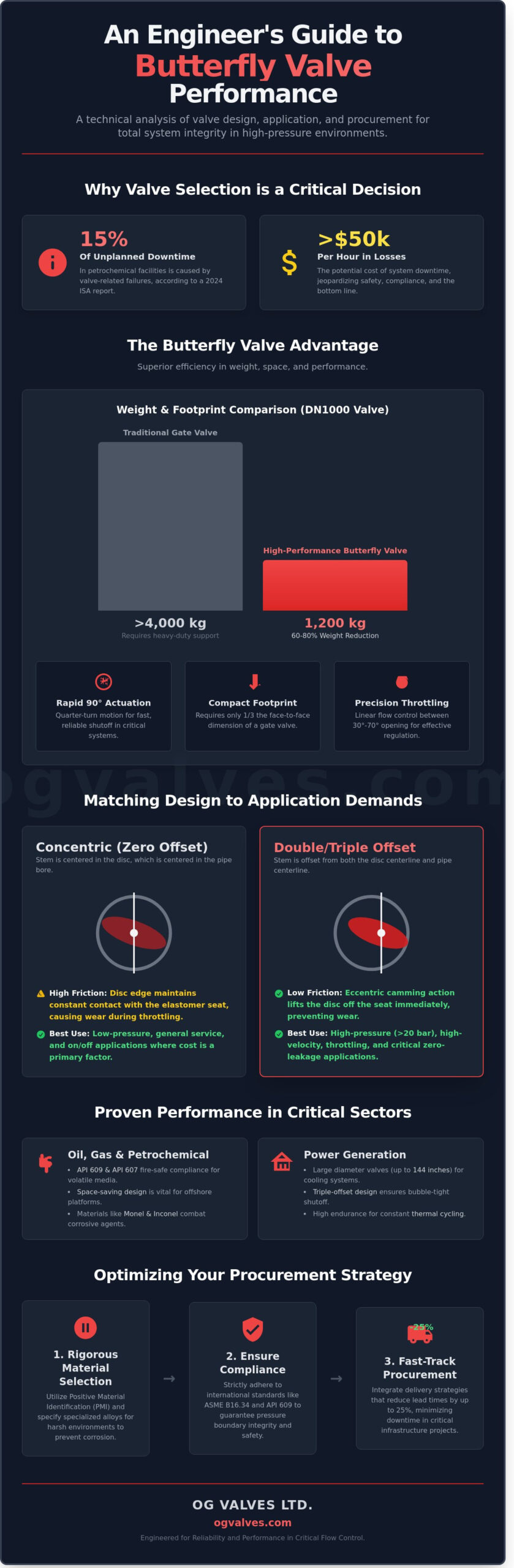
Spatial efficiency distinguishes these components from traditional gate or globe valves. A 12-inch butterfly valve typically requires only 1/3 the face-to-face dimension of a comparable gate valve. This compact footprint reduces the total weight of the piping assembly by 60% to 80% in large-scale installations. The reduced mass simplifies maintenance and lowers the initial procurement cost for high-pressure systems.
Quarter-Turn Efficiency in Large Diameter Piping
In high-bore systems exceeding 600mm, 90-degree actuation provides rapid shutoff capabilities that multi-turn valves can’t match. Weight-to-performance ratios are critical in these environments. A DN1000 butterfly valve might weigh 1,200kg, while a gate valve of the same ASME rating often exceeds 4,000kg. This massive weight reduction minimizes the requirement for heavy-duty structural supports. It also facilitates faster installation in restricted offshore or underground environments where space is a premium.
Throttling and Regulating Capabilities
Effective butterfly valve applications often involve flow regulation rather than simple isolation. The relationship between disc angle and flow rate remains relatively linear between 30 and 70 degrees of opening. Concentric designs often suffer from seat erosion during precision throttling because the disc edge maintains constant contact with the elastomer. High-performance double and triple offset valves mitigate this issue. They utilize an eccentric camming action to lift the disc off the seat immediately upon opening. This design manages turbulent flow effectively and prevents premature seal failure in high-velocity gas or steam services. It’s a standard requirement for processes involving 20-bar pressures or higher.
Engineers select these valves for butterfly valve applications based on their ability to provide reliable shutoff while maintaining a low profile. The mechanical simplicity of the design reduces the number of moving parts subject to fatigue. This reliability is vital for critical infrastructure in the water treatment and oil sectors, where downtime costs can exceed $50,000 per hour.
Critical Industrial Sectors and Sector-Specific Applications
Industrial operations select butterfly valves as the primary isolation solution when system requirements prioritize a high strength-to-weight ratio and rapid quarter-turn actuation. These components manage a broad spectrum of media; this includes clean liquids, gases, and abrasive slurries containing up to 40% solid particles by volume. In offshore oil and gas platforms, space is a finite resource. Butterfly valves provide a compact alternative to gate or globe valves, often reducing the total installation footprint by 60% and decreasing structural load by several tons on multi-level modules.
In the power generation sector, cooling water systems and condenser isolation represent critical butterfly valve applications where reliability is non-negotiable. Large-diameter pipes, often reaching 144 inches in diameter, require valves that can withstand high flow velocities while maintaining bubble-tight shutoff. Triple-offset geometries are frequently specified here to eliminate seat wear and ensure long-term sealing integrity under constant thermal cycling. Compliance with ASME B16.34 standards ensures these valves maintain pressure boundary integrity during peak load operations.
Oil, Gas, and Petrochemical Processing
Refinery and petrochemical operations utilize butterfly valves for both upstream extraction and downstream processing. Hydrocarbon service requires strict adherence to API 609 standards. For volatile or flammable media, fire-safe designs must pass rigorous testing under API 607 or ISO 10497 protocols. To combat corrosive agents such as hydrogen sulfide, engineers specify discs and stems forged from specialized alloys like Monel 400 or Inconel 625. These materials provide the necessary resistance to stress corrosion cracking in high-pressure environments reaching 1,500 PSI.
Water Treatment and Desalination Infrastructure
Municipal water distribution relies on these valves for large-scale isolation within networks handling millions of gallons daily. In seawater desalination facilities, the presence of high-salinity brine requires materials with a Pitting Resistance Equivalent Number (PREN) exceeding 40. Super Duplex stainless steel is the industry standard for these high-chloride environments to prevent rapid galvanic corrosion. Additionally, industrial water processing often involves vacuum service; this necessitates specialized seat designs that prevent seal collapse under negative pressure. For engineers seeking to verify compliance with AWWA or ISO standards, consulting detailed valve specifications provides the necessary data for precise procurement. This ensures the butterfly valve applications chosen align with the 25-year service life expectations of modern infrastructure projects.
Triple Offset vs. Concentric: Matching Design to Pressure
Industrial fluid control has shifted from basic resilient-seated designs to advanced triple offset technology. Concentric valves use a centered stem and disc. This design relies on interference between the disc edge and an elastomer liner. While effective for water treatment or low-pressure air, these valves face operational limits at 150 PSI. The constant friction during 90-degree travel causes elastomer degradation and torque increases. Engineering teams now specify offset designs to ensure system integrity in high-cycle environments where butterfly valve applications demand long-term reliability.
Double Offset (High-Performance) Applications
High-performance butterfly valves utilize a double-offset geometry. The first offset places the stem behind the disc centerline. The second offset moves the stem slightly to one side of the pipe centerline. This arrangement creates a camming action. It reduces seat contact to the final degrees of closure. These units handle steam and chemical lines up to ASME Class 300 standards. Sealing typically relies on reinforced PTFE. It’s vital to monitor temperature limits, as soft seats fail above 204°C. Engineers deploy these in power generation and hydrocarbon processing where moderate pressure and temperature fluctuations occur.
Triple Offset Valves (TOV) for Critical Service
Triple Offset Valves represent the apex of butterfly valve applications in critical infrastructure. The third offset incorporates a conical profile into the sealing components. Mechanical friction is eliminated. Metal-to-metal contact only occurs at the point of final shutoff. This design achieves bubble-tight performance under API 598 testing protocols. Triple offset butterfly valves are replacing traditional gate valves in refinery and cryogenic service due to several factors:
Frictionless closure for extended seat life in high-cycle operations
Bi-directional zero-leakage performance at high pressures
A 25% to 35% reduction in weight and footprint compared to equivalent gate assemblies
Compliance with ISO 15848-1 fugitive emission standards
Reliability in extreme environments depends on material selection. TOVs utilize Stellite-faced seats and laminated stainless steel seals. They maintain integrity at temperatures reaching 815°C. In cryogenic applications at -196°C, these valves prevent seat hardening and leakage. Engineers select TOVs for high-stakes isolation where failure isn’t an option. This technical evolution ensures butterfly valves remain the benchmark for safety in the 2026 industrial landscape.
Material Selection and Compliance for Harsh Environments
Material selection determines the lifecycle and operational safety of butterfly valve applications in volatile environments. Engineers must correlate material grades with the chemical composition, pH levels, and flow velocity of the media. Positive Material Identification (PMI) testing serves as a mandatory protocol to verify that alloy compositions match mill test reports. This step prevents catastrophic failures caused by accidental material substitution in high-pressure lines. Compliance with API 609 Category B ensures that pressure-temperature ratings and face-to-face dimensions align with ASME B16.34 and ISO 5752 standards. For abrasive slurry applications containing up to 40% solids, surface treatments like Tungsten Carbide or Stellite 6 coatings are applied to the disc edge to mitigate erosion. These coatings increase surface hardness to 60-70 HRC, extending service life by 300% compared to untreated components.
Corrosion Resistance: Duplex and Stainless Steels
Standard 304 stainless steel provides basic resistance, yet chemical processing plants require the molybdenum content of 316 stainless steel to resist pitting from chlorides. Offshore and subsea environments demand Super Duplex stainless steel, such as ASTM A890 Grade 5A, which offers superior tensile strength and resistance to stress corrosion cracking in saline conditions. Chromium content establishes a passive oxide layer that prevents oxidation and maintains the structural integrity of the valve body under extreme stress. Engineers specify these alloys for high-chloride environments where standard austenitics fail within 12 months of deployment.
Sealing Integrity: Elastomers vs. Metal Seats
Elastomeric seats like PTFE provide bubble-tight shutoff for chemical media at temperatures up to 200°C. Viton is the preferred choice for hydrocarbon services where high chemical compatibility and thermal stability are required. High-temperature steam and refined hydrocarbons necessitate metal-to-metal seating to maintain seal integrity at temperatures exceeding 450°C. These configurations must comply with fugitive emission standards, specifically ISO 15848-1, to minimize hazardous leaks into the atmosphere. Specifying packing systems that meet Class AH leakage rates is a requirement for critical infrastructure projects. It’s the only way to ensure long-term environmental compliance and operational safety.
Consult our engineering team for certified industrial valves that meet API and ISO standards for your specific application.
Optimising Valve Lifecycle and Procurement Strategy
Engineering a reliable fluid handling system requires a clinical focus on how component selection dictates long-term maintenance cycles. High-performance butterfly valve applications in industrial sectors, such as the 2026 hydrogen expansion projects or desalination plants, demand a rigorous alignment between material metallurgy and process media. Standardizing on valves that meet API 609 standards ensures that the mechanical integrity of the disc and stem remains intact under high-cycle conditions. It’s critical to integrate these valves with pneumatic or electric actuators using exact torque matching. Over-sizing an actuator leads to stem deformation; under-sizing results in incomplete closure. Data from 2024 field audits indicates that precisely calibrated actuation packages reduce valve-related downtime by 32% over a five-year operational window.
Preventative Maintenance and Troubleshooting
Identifying failure modes before they result in system-wide shutdowns is essential for operational safety. Seat erosion is the most frequent cause of internal bypass, particularly in high-velocity gas or slurry lines. Stem leakage typically occurs when packing materials lose elasticity due to thermal cycling. Engineers should implement automated cycle testing protocols to monitor torque signatures. These tests identify friction increases that signal the onset of bearing or seal failure. Consider these common failure indicators:
Seat Degradation: Indicated by a 10% increase in downstream pressure during closed-position hold tests.
Stem Packing Failure: Visible leakage or a 15% drop in packing gland bolt torque.
Actuator Misalignment: Results in uneven wear on the disc edges, often detected during borescope inspections.
While a lower purchase price is attractive during procurement, the Total Cost of Ownership (TCO) calculation proves that investing in reinforced PTFE or metal-to-metal seats pays for itself within 24 months through reduced replacement labor and parts costs.
Global Supply and Technical Expertise
Minimising downtime in critical infrastructure depends on a supply chain capable of fast-track delivery. Specialist valve suppliers maintain an extensive inventory of over 5,000 units in common sizes, such as 2-inch to 48-inch diameters, allowing for immediate dispatch when a component fails in the field. Suppliers don’t just provide hardware; they provide the technical validation required for high-stakes environments. Every unit must undergo rigorous quality assurance, including hydrostatic shell tests at 1.5 times the rated working pressure. This adherence to ISO 5208 ensures that the equipment survives the harshest industrial environments. For technical specifications, material certificates, and project quotes, contact OG VALVES LTD. to access their engineering support team. Their expertise in global logistics and international compliance standards provides the technical foundation required for large-scale industrial projects.
Optimizing Infrastructure Performance through Engineering Precision
The successful deployment of butterfly valve applications depends on rigorous adherence to pressure-drop calculations and material compatibility standards. Engineers must prioritize triple offset designs for high-pressure systems exceeding 600 PSI to ensure zero-leakage performance under extreme thermal cycling. Maintaining strict compliance with API 609 and ASME B16.34 isn’t just a regulatory hurdle; it’s a fundamental requirement for operational safety in 2026. OG Valves maintains a comprehensive inventory of high-performance components engineered to withstand cryogenic temperatures and corrosive media. Our specialist technical support team provides detailed specification guidance for heavy industry projects across the globe. We offer fast-track delivery capabilities to mitigate downtime and ensure your project stays on schedule. Precise valve selection reduces long-term maintenance costs and secures the integrity of critical flow control systems. Every component we supply undergoes rigorous testing to meet international safety benchmarks. We’re ready to assist with your next high-stakes engineering challenge to ensure your systems perform at peak efficiency.
What are the most common applications for butterfly valves?
Butterfly valve applications encompass water distribution networks, chemical processing facilities, and thermal power generation cooling systems. Approximately 65% of municipal water treatment plants utilize these valves for flow isolation due to their compact footprint. They facilitate high-volume fluid control in HVAC systems and refinery processes. Their lightweight construction reduces structural support requirements by 30% compared to gate valves.
Can a butterfly valve be used for high-pressure steam?
Standard resilient-seated butterfly valves aren’t suitable for high-pressure steam exceeding 150 PSI. However, triple offset butterfly valve designs with metal seats manage saturated steam up to 600 PSI and temperatures reaching 425°C. Engineers must specify ASME B16.34 compliant materials to ensure pressure boundary integrity. Using incorrect seat materials leads to a 90% failure rate in high-temperature steam environments within 12 months.
What is the difference between a wafer and a lug style butterfly valve?
Wafer valves sit between two pipe flanges using long bolts that span the entire body. Lug style valves feature threaded metal inserts that allow for independent bolting to each flange. This design enables downstream piping removal while the system remains pressurized. Lug valves are mandatory for end-of-line service where the valve must maintain a seal against full rated pressure of 285 PSI.
How do triple offset butterfly valves achieve bubble-tight shutoff?
Triple offset butterfly valves achieve bubble-tight shutoff through a non-rubbing, camming action that eliminates seat friction during the final 5 degrees of closure. The three offsets include the shaft location, the disc geometry, and the seat cone angle. This configuration ensures zero leakage according to API 598 standards. The metal-to-metal contact prevents seat wear, maintaining a Class VI seal over 10,000 cycles.
Are butterfly valves suitable for abrasive slurries?
Butterfly valves handle abrasive slurries effectively when equipped with reinforced elastomers or ceramic-lined discs. Mining operations report a 40% increase in service life when using polyurethane liners for tailings management. The streamlined disc profile minimizes turbulence, reducing internal erosion rates by 25% compared to globe valves. Selection of a 316 stainless steel disc with a Stellite coating is required for high-velocity particulate flow.
What standards govern the design of industrial butterfly valves?
Industrial butterfly valve design is governed by API 609 for dimensions and pressure-temperature ratings. ASME B16.34 dictates the requirements for valve bodies and pressure-retaining components. Water applications follow AWWA C504 standards, which specify a minimum shell test pressure of 2 times the rated pressure. Compliance with ISO 5752 ensures face-to-face dimensions are consistent across global manufacturing chains.
How does a butterfly valve compare to a gate valve in terms of pressure drop?
Butterfly valves exhibit a higher pressure drop than gate valves because the disc remains in the flow path even when fully open. A typical 10-inch butterfly valve has a flow coefficient (Cv) roughly 20% lower than an equivalent gate valve. This results in a permanent pressure loss of approximately 2 to 5 PSI depending on flow velocity. Engineers must calculate these losses to ensure pump efficiency remains within 5% of design parameters.
 Responsive Menu