Technical Guide to API 600 Gate Valves: Design Standards and Industrial Applications (2026)
April 05, 2026
Home+Technical Guide to API 600 Gate Valves: Design Standards and Industrial Applications (2026)
A single deviation from API 600 wall thickness requirements can lead to catastrophic pressure vessel failure in systems operating above 1,500 PSI. Engineers and procurement specialists recognize that the integrity of a high-pressure system depends entirely on the rigorous adherence to material specifications and trim configurations. You likely understand that selecting the wrong standard isn’t just a compliance error; it’s a direct risk to the entire facility’s operational lifespan.
This technical reference provides the data required to specify api 600 gate valves with absolute precision for your 2026 infrastructure projects. You’ll gain a clear understanding of the design mandates and material requirements necessary to ensure long-term performance in volatile environments. We will analyze the critical technical distinctions between API 600, 602, and 603 standards while providing a framework for selecting corrosion-resistant alloys that mitigate the 15% average increase in lead times currently impacting global supply chains. This guide moves from fundamental design criteria to advanced material selection and final quality assurance protocols.
Key Takeaways
Identify the engineering rationale behind the API 600 heavy wall mandate and its impact on structural integrity compared to standard ASME B16.34 requirements.
Analyze critical design specifications for api 600 gate valves, including minimum stem diameters and wedge configurations optimized for high-torque and thermal-cycling environments.
Distinguish between API 600, API 603, and API 6D standards to ensure precise valve selection for corrosion-resistant or pipeline-specific applications.
Evaluate material selection criteria and API Table 14 trim configurations to ensure long-term performance in severe service industrial conditions.
Establish rigorous procurement protocols by verifying API Monogram compliance and mandatory documentation requirements like EN 10204 3.1 certification.
Fundamentals of the API 600 Standard for Cast Steel Gate Valves
API 600 serves as the definitive specification for heavy-duty cast steel gate valves used primarily in petroleum and natural gas refineries. Unlike lighter industrial valves, api 600 gate valves are engineered for high-pressure, high-temperature environments where mechanical failure presents severe safety risks. The standard covers bolted bonnet designs with nominal pipe sizes (NPS) ranging from 1 to 42 and ASME pressure classes 150 through 2500. This rigorous framework ensures that every component, from the wedge to the seating surfaces, meets exact dimensional and material tolerances.
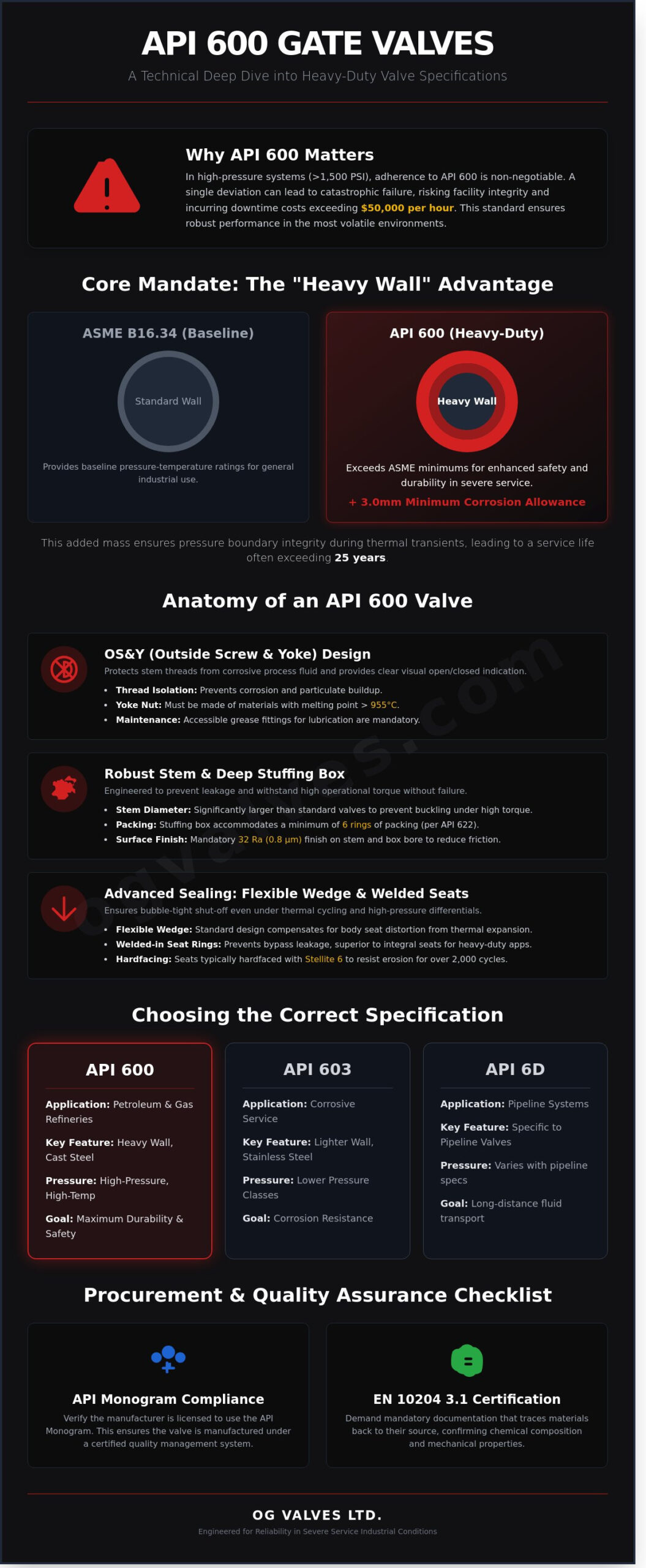
The primary distinction of API 600 is its “heavy wall” requirement. While ASME B16.34 provides a baseline for pressure-temperature ratings, API 600 mandates wall thicknesses that exceed those minimums. This additional material is critical for maintaining pressure boundary integrity during thermal transients, where rapid temperature fluctuations could otherwise cause structural deformation. By prioritizing mass and rigidity, the standard provides a robust safety factor against piping stresses and mechanical fatigue. It’s a standard built for the reality of 24/7 industrial operations where downtime costs can exceed $50,000 per hour.
Corrosion Allowance and Wall Thickness Requirements
API 600 utilizes specific thickness formulas to determine the minimum structural requirements for the valve body and bonnet. These calculations ensure that the valve maintains its pressure-containing capability even after years of internal erosion. API 600 mandates a minimum corrosion allowance of 3.0 mm for carbon steel valve bodies to provide a predictable service life in corrosive hydrocarbon environments. This design choice results in a valve that’s significantly heavier than those built to ASME B16.34 alone, directly translating to a service life often exceeding 25 years in continuous operation. Engineers specify api 600 gate valves when the cost of replacement outweighs the initial capital expenditure of a heavier, more durable casting.
OS&Y (Outside Screw and Yoke) Design Mandates
The standard requires an Outside Screw and Yoke (OS&Y) configuration for all compliant gate valves. In this design, the stem threads remain external to the valve body, preventing contact with the process fluid. This isolation protects the threads from corrosion and particulate buildup. Maintenance teams benefit from the OS&Y design because the stem position provides an immediate visual indication of whether the valve is open or closed. API 600 also specifies that yoke nuts must be made from materials with a melting point above 955 degrees Celsius, such as specific copper alloys, and must include accessible grease fittings for routine lubrication of the drive threads. Compliance with these mandates ensures the valve remains operable even after long periods of inactivity in harsh outdoor environments.
Critical Design Features and Component Specifications
The mechanical integrity of api 600 gate valves relies on strict adherence to dimensional requirements that exceed standard industrial valve benchmarks. API 600 mandates minimum stem diameters that are significantly larger than those found in API 603 or ASME B16.34 designs. This extra material prevents stem buckling when operating torque exceeds 150% of the nominal requirement. The stuffing box design is equally rigorous; it must accommodate a minimum of six rings of packing to meet API 622 fugitive emission standards. A surface finish of 32 Ra (0.8 μm) on the stem and stuffing box bore is mandatory to reduce friction and prevent packing degradation during high-cycle operations.
Seat ring integration plays a vital role in long-term sealing performance. While integral seats are permitted in some configurations, heavy-duty applications utilize welded-in seat rings. These rings are seal-welded to the body using automated processes to prevent bypass leakage. In high-pressure Class 900 or 1500 services, these rings are typically hardfaced with Stellite 6 to resist the erosive effects of high-velocity flow. This construction ensures that the valve maintains a bubble-tight shut-off even after 2,000 or more cycles in abrasive environments. Understanding the specific gate valve failure modes that compromise seat integrity and sealing performance is essential for specifying the correct hardfacing and construction method for your service conditions.
Wedge and Seat Sealing Mechanisms
Flexible wedges are the standard for api 600 gate valves because they feature a machined groove that allows the two seating faces to move independently. This flexibility enables the wedge to compensate for body seat distortion caused by thermal expansion or external piping loads. To prevent galling between the wedge and seat, API 600 specifies hardfacing requirements, often using CoCr-A alloys. This material provides the necessary hardness differential to ensure tight shut-off at temperatures reaching 538°C (1000°F). Self-aligning features in the wedge-to-stem connection further ensure the wedge seats evenly against high-pressure differentials.
Stem and Backseat Integrity
The stem-to-wedge connection uses a T-head design where the strength of the T-head must be at least 110% of the stem’s root area strength. This safety margin ensures the stem doesn’t shear under extreme torque. Every valve includes a mandatory backseat, a tapered surface on the stem that seals against the bonnet. This design allows for the isolation of the stuffing box, which is a critical safety feature for emergency packing adjustments. You can examine our detailed engineering specifications to see how these safety factors are verified through rigorous hydro-testing and shell expansion analysis. Stems are precision-ground to minimize wear on the packing set, ensuring compliance with ISO 15848-1 low-emission protocols.
API 600 vs. API 603 and API 6D: Selecting the Correct Specification
Selecting the correct standard involves evaluating the mechanical stress, chemical composition of the media, and the specific location of the valve within the plant infrastructure. While api 600 gate valves serve as the heavy-duty benchmark for refinery service, engineers must distinguish them from lighter or specialized alternatives to ensure both safety and cost-efficiency. The choice between these specifications often dictates the long-term integrity of the pressure boundary in high-cycle environments.
API 600 vs. API 603: The Wall Thickness Debate
API 600 mandates a heavy wall thickness that exceeds the minimum requirements of ASME B16.34. This design provides a robust corrosion allowance for carbon and low-alloy steels. API 603 covers corrosion-resistant alloys, such as 316 stainless steel or Hastelloy, where the material’s inherent resistance allows for a thinner wall. API 603 valves typically weigh 18% to 25% less than their API 600 counterparts. This weight reduction lowers material costs in utility services or low-pressure chemical lines. However, for high-pressure process lines where mechanical erosion or thermal shock is a factor, the structural mass of API 600 remains the safer engineering choice. Pressure-temperature ratings for both standards align with ASME B16.34, but API 600 provides superior rigidity for larger diameters above 24 inches.
Pipeline vs. Process: API 6D and API 600
The distinction between API 6D and API 600 centers on the application environment. API 6D governs pipeline valves, emphasizing through-conduit designs that permit pigging operations. These valves frequently feature Double Block and Bleed (DBB) capabilities for safety during maintenance. API 600 uses a flexible or solid wedge design optimized for absolute isolation in refinery process units. Testing protocols also differ significantly. API 598, the standard for api 600 gate valves, requires shorter pressure hold times compared to the more rigorous duration and leakage requirements of API 6D. In refinery “inside battery limits” (ISBL) zones, API 600 is the preferred specification because it handles the frequent cycling and high-temperature fluctuations common in cracking and reforming units better than pipeline-standard valves.
The decision to specify API 600 involves a 12% to 20% price premium due to the increased casting weight. This cost is technically justified when the valve must survive a 25-year service life in hydrocarbon service. The added wall thickness prevents premature failure from localized erosion or external mechanical loads. Key economic considerations include:
Service Life: API 600 valves often last 30% longer in high-temperature sulfurous environments.
Maintenance: The robust stem and wedge design reduces the frequency of packing adjustments.
Compliance: Most major oil gas companies mandate API 600 for all ISBL hydrocarbon lines to meet strict safety insurance requirements.
It’s essential to recognize that API 603 is frequently relegated to Outside Battery Limits (OSBL) or water treatment sections where the risk of catastrophic fire or explosive decompression is lower. For critical process units, the mass and durability of the API 600 standard provide the necessary safety margins that thinner-walled valves can’t match. Engineers evaluating isolation valve technologies for these environments should also review the gate valve vs ball valve industrial selection criteria to ensure the wedge-based design is the optimal choice for their specific flow and sealing requirements.
Material Selection and Trim Configurations for Severe Service
Material selection dictates the operational envelope and longevity of api 600 gate valves. Engineers typically specify ASTM A216 WCB for standard hydrocarbon service where temperatures don’t exceed 425°C. When service conditions involve high-temperature steam reaching 593°C, ASTM A217 WC6 and WC9 alloy steels provide the necessary creep resistance and structural stability. For cryogenic applications operating at -196°C, ASTM A351 CF8M stainless steel remains the technical requirement due to its superior impact toughness at sub-zero scales. Sour gas environments necessitate strict compliance with NACE MR0175/ISO 15156; this standard limits material hardness to a maximum of 22 HRC to mitigate the risks of sulfide stress cracking and hydrogen-induced brittle failure.
Navigating the API Trim Chart
API 600 Table 14 categorizes internal component materials into 18 distinct trim configurations to ensure chemical and mechanical compatibility. Selecting the correct trim is vital for preventing premature seat degradation:
Trim 8 (Stellite/13Cr): This is the universal industry standard for general process service, featuring 13Cr stainless steel components with Stellite-faced seat rings.
Trim 5 (Full Stellite): Specified for high-pressure, high-temperature steam and oil service exceeding 100 bar; it utilizes cobalt-based hard-facing on both the wedge and seat surfaces.
Differential Hardness: For trims without hard-facing on both surfaces, API 600 requires a minimum 50 HB hardness differential between the wedge and seat to prevent galling and erosion.
Aligning these specifications with your pressure-temperature ratings is a critical step in procurement.
Maintaining the integrity of api 600 gate valves requires rigorous NDT protocols to detect subsurface and surface-level flaws. Radiographic testing (RT) performed per ASME B16.34 is a mandatory requirement for valves used in critical high-pressure service to identify internal casting defects like porosity or inclusions. Positive Material Identification (PMI) utilizes X-ray fluorescence technology to verify the elemental composition of alloy bodies and stems before final assembly. Dye Penetrant (DP) testing provides a surface-level inspection of weld ends to identify linear indications or cracks that could compromise pressure containment. These clinical testing measures ensure that every valve body meets the 100% integrity threshold required for high-stakes industrial infrastructure.
Procurement and Quality Assurance for Global Infrastructure
Procuring api 600 gate valves demands rigorous verification of manufacturer credentials. Compliance isn’t optional; it’s the baseline for safety in high-pressure environments. The API Monogram program serves as a critical audit mechanism, ensuring the manufacturer maintains a quality management system that meets Specification Q1. ISO 9001:2015 certification provides an additional layer of process control, but the monogram remains the gold standard for oil and gas applications. For critical service, documentation must include Material Test Reports (MTRs) and EN 10204 3.1 certification. These documents provide 100% traceability from the foundry to the final assembly, confirming the chemical and mechanical properties of the pressure-retaining parts.
Managing lead times for non-standard alloy specifications requires proactive planning. Standard carbon steel units often feature lead times of 12 weeks. Specialized alloys like Monel 400 or Hastelloy C276 can push schedules to 30 weeks due to forge availability. OG Valves utilizes a vetted network of foundries to compress these timelines, ensuring that technical supply meets project milestones. The approach focuses on technical precision over marketing promises, prioritizing the delivery of valves that meet the exact metallurgical requirements of the process media.
Inspection and Hydrostatic Testing
Every valve undergoes testing per API 598 protocols. This includes shell tests at 1.5 times the pressure rating and closure tests at 1.1 times. For a Class 600 valve, the shell test pressure is typically 2225 psi. Test durations are strictly mandated:
Shell test: 15-second minimum for sizes under 2 inches; 60 seconds for sizes 2 to 6 inches.
Backseat test: Required for valves with a backseat feature to ensure integrity when the valve is fully open.
Allowable leakage: Metal-seated gate valves allow zero visible leakage during shell and backseat tests. Closure leakage rates are defined by valve size, with larger diameters allowing a calculated number of drops per minute.
Third Party Inspection (TPI) coordination ensures that personnel from agencies like Bureau Veritas or SGS verify performance before shipment, reducing the risk of site rejection.
Global Logistics and Technical Support
Inventory management focuses on high-demand specifications to reduce downtime. Engineering teams provide technical consultation for valve sizing and material cross-referencing, ensuring the selected trim matches the chemical profile of the media. This technical precision prevents premature failure in the field. Logistics teams manage the complexities of international shipping, handling the specialized packaging required to prevent flange face damage during transit.
Optimizing Industrial Infrastructure with API 600 Compliance
Securing long-term operational integrity in refinery and offshore environments depends on the rigorous application of the API 600 standard. Engineers must prioritize the heavy-wall design and increased stem diameters defined by this specification to mitigate the risks of mechanical failure in Class 150 through Class 2500 services. Selecting api 600 gate valves over lighter alternatives like API 603 ensures the structural durability required for 2026 infrastructure projects. Proper trim selection, specifically Trim 5 or Trim 8 configurations, remains the primary defense against erosion in high-temperature service conditions.
OG Valves maintains a comprehensive, API 600 and ASME B16.34 compliant inventory to support critical energy sectors. Our technical team provides specialized expertise in high-alloy material selection, ensuring every component meets the precise requirements of your project specification. We provide 72-hour fast-track delivery options for offshore and refinery projects to minimize downtime and maintain construction schedules. You’ll find our engineering support is grounded in quantifiable performance data and international safety benchmarks. We look forward to facilitating your next high-stakes installation with precision and reliability.
What is the difference between API 600 and API 602 gate valves?
API 600 gate valves specify heavy-duty cast steel constructions for sizes ranging from NPS 1 to NPS 42, while API 602 covers compact forged steel valves typically limited to NPS 4 and smaller. The API 600 standard requires thicker wall sections and larger internal clearances to withstand high-stress industrial environments. These design differences ensure that API 600 units provide a 20 year service life in heavy-duty refinery applications.
Can an API 600 gate valve be used for throttling service?
You shouldn’t use an API 600 gate valve for throttling service because it’s engineered exclusively for full-open or full-closed isolation. Operating the valve in a partially open position causes high-velocity flow to erode the seating surfaces and induces mechanical vibration. This turbulence leads to seat leakage and structural fatigue within 500 cycles if used for flow regulation instead of isolation. Engineers requiring flow control capabilities should review the engineering differences between gate valves and ball valves to determine whether an alternative valve type better suits their throttling application.
What does Trim 8 mean in an API 600 specification?
Trim 8 refers to a specific material combination consisting of a 13% Chromium (F6) stem and a Hardfaced (Stellite) seat surface. This configuration provides a Brinell hardness of 250 HB for the wedge and 350 HB for the seat. It’s the industry standard for steam and hydrocarbon service where temperatures reach 800°F (427°C) and requires 100% compliance with API 600 Table 3 requirements.
Why is wall thickness so critical in the API 600 standard?
Wall thickness is critical because API 600 mandates a heavy-duty corrosion allowance that exceeds ASME B16.34 minimums by 10% to 15%. This extra material ensures the valve body maintains structural integrity during high-pressure surges and long-term chemical erosion. A standard 8-inch Class 300 valve must meet these precise thickness benchmarks to pass rigorous safety audits and pressure tests.
What are the pressure-temperature limits for a WCB API 600 gate valve?
A WCB api 600 gate valves rated for Class 150 has a maximum working pressure of 285 psi at 100°F (38°C). As temperatures increase to 800°F (427°C), the allowable pressure drops to approximately 80 psi. Engineers must reference ASME B16.34 Table 2-1.1 to ensure the valve operates within these 100% verified safety limits during continuous operation.
How do I identify an API 600 valve on-site?
You can identify an API 600 valve by inspecting the stainless steel nameplate for the specific “API 600” designation and the manufacturer’s heat code. The valve body will also feature cast markings indicating the pressure class, such as 150 or 300, and the material grade like WCB or LCC. These markings follow MSS SP-25 standards to ensure 100% traceability for maintenance teams.
Is NACE compliance mandatory for all API 600 valves?
NACE MR0175 compliance isn’t mandatory for all api 600 gate valves unless the process fluid contains hydrogen sulfide (H2S) levels exceeding 0.05 psi partial pressure. When sour service is specified, the valve must undergo rigorous hardness testing to ensure all components remain below 22 HRC. This prevents sulfide stress cracking in critical oil and gas infrastructure where safety is the priority.
What is the standard lead time for a 12-inch Class 600 API 600 gate valve?
The standard lead time for a 12-inch Class 600 API 600 gate valve is currently 16 to 22 weeks from the date of technical approval. This timeline includes 14 days for casting, 30 days for precision machining, and 5 days for hydrostatic and pneumatic testing per API 598. Custom alloy requirements or third-party inspections can add 4 to 6 weeks to the final delivery schedule. Engineers managing long-term asset reliability programs should also consult a comprehensive analysis of industrial gate valve failure modes to anticipate the mechanical and chemical degradation mechanisms that affect service intervals and replacement schedules.
 Responsive Menu