Gate Valve vs Ball Valve: Industrial Selection Criteria and Engineering Differences (2026)
April 10, 2026
Home+Gate Valve vs Ball Valve: Industrial Selection Criteria and Engineering Differences (2026)
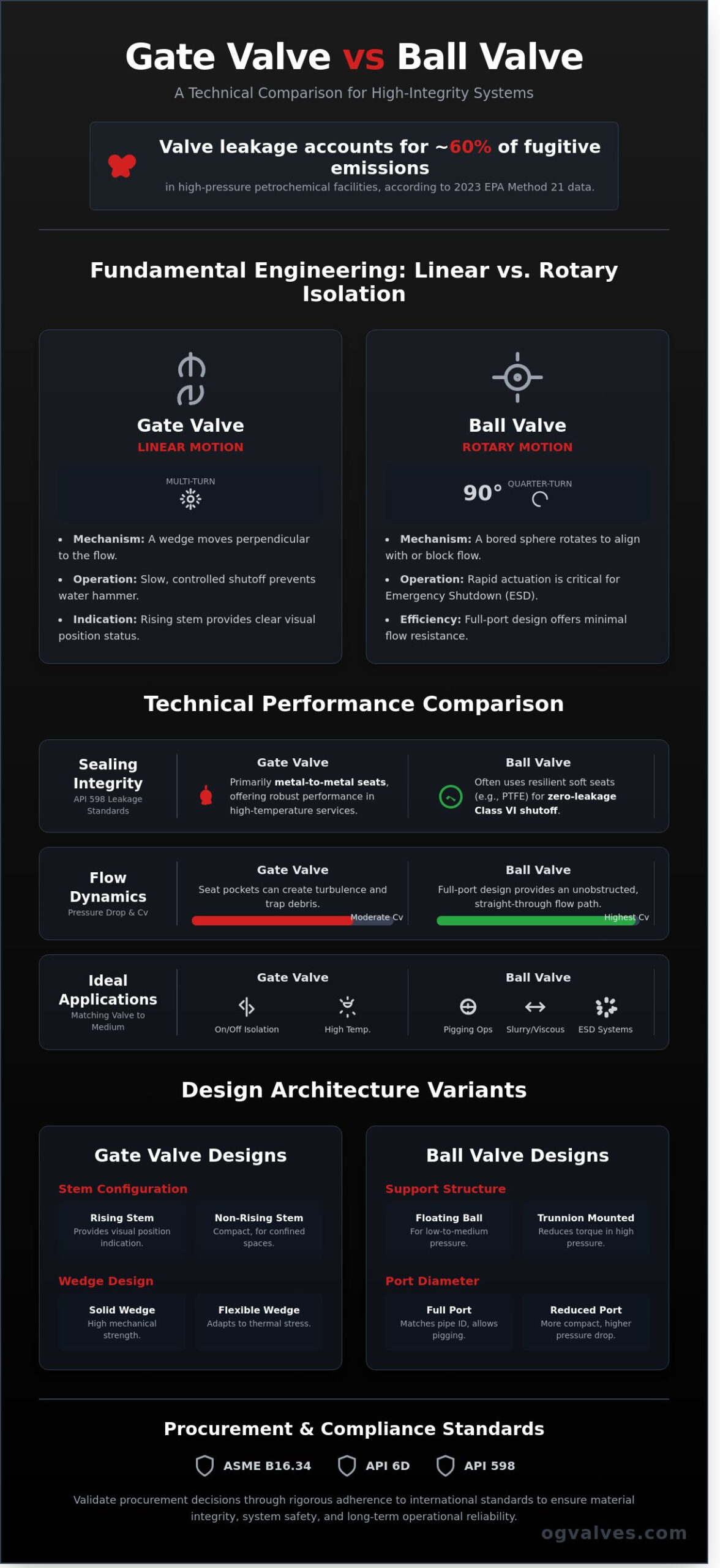
According to 2023 industry data from the Environmental Protection Agency (EPA) Method 21 audits, valve leakage accounts for approximately 60% of fugitive emissions in high-pressure petrochemical facilities. Engineers recognize that the technical evaluation of a gate valve vs ball valve isn’t merely a matter of preference; it’s a critical decision affecting system integrity and long-term operational costs. You’ve likely experienced how a misapplied specification leads to premature seat erosion or catastrophic packing failure in volatile environments. This technical analysis provides a rigorous comparative framework for evaluating these mechanisms based on ASME B16.34 and API 6D standards. Our objective is to ensure your infrastructure meets the strictest safety benchmarks while minimizing maintenance cycles. We’ll examine flow coefficients, sealing mechanics, and material performance in cryogenic and high-temperature services to facilitate an informed procurement strategy for 2026 projects. By focusing on quantifiable performance data, this guide assists in identifying the most durable isolation solution for your specific medium and pressure class.
Key Takeaways
Differentiate between linear-motion wedge isolation and rotary-motion bored sphere mechanisms to ensure mechanical alignment with specific process requirements.
Evaluate sealing integrity under high-pressure differentials and analyze flow resistance through Cv value comparisons to optimize system efficiency.
Determine the optimal isolation solution by conducting a technical comparison of gate valve vs ball valve operational torque and component wear profiles.
Align valve selection with specific media characteristics, including slurry handling and extreme temperature services such as cryogenic or high-pressure steam environments.
Validate procurement decisions through rigorous adherence to API, ASME, and ISO standards, ensuring material integrity through MTR and PMI verification.
Fundamental Engineering: Linear vs. Rotary Isolation Mechanisms
The selection process for a gate valve vs ball valve begins with an analysis of their mechanical actuation and flow obstruction methods. High-pressure industrial systems require precise isolation capabilities to maintain operational integrity and safety. A Gate Valve functions as a linear-motion component. It moves a wedge or slab perpendicular to the flow path. This multi-turn operation requires several 360-degree rotations of the handwheel to achieve full closure. It’s a design that prevents water hammer by ensuring a slow, controlled shutoff.
In contrast, the ball valve is a rotary-motion component. It employs a bored sphere that rotates 90 degrees to align or obstruct the flow. This quarter-turn mechanism allows for rapid actuation, which is critical in emergency shutdown (ESD) scenarios. Engineers categorize both designs primarily as isolation valves. They aren’t intended for throttling service. High-velocity flow against a partially open disc or ball causes rapid erosion and seat degradation, compromising the valve’s ability to maintain a bubble-tight seal.
Gate Valve Architecture: Design and Components
The stem configuration determines the valve’s footprint and maintenance requirements. Rising stems move upward during opening, providing a clear visual indicator of the valve position. Non-rising stems remain stationary, making them suitable for underground installations or space-constrained offshore platforms. The wedge design is critical for the seal. Solid wedges offer high mechanical strength. Flexible wedges incorporate a groove to allow the seating faces to adapt to temperature-induced pipe stresses. For high-pressure containment, the bonnet design, typically bolted or pressure-sealed according to ASME B16.34 standards, ensures the integrity of the valve body under extreme tensile loads. Proper gate valve sizing is equally critical, as a single 2% deviation can trigger a 15% increase in localized turbulence and premature seat erosion within the first 12 months of high-pressure service.
Ball Valve Architecture: Floating vs. Trunnion Designs
The internal support structure defines the application range for ball valves. Floating ball designs rely on upstream pressure to push the sphere against the downstream seat, creating a seal. This is effective for low-to-medium pressure applications. For high-pressure or large-diameter service exceeding 12 inches, trunnion-mounted designs are mandatory. These utilize a fixed shaft to support the ball, reducing torque requirements and seat wear.
Flow efficiency depends on the port diameter. A full-port design matches the pipe’s internal diameter, resulting in a flow coefficient (Cv) nearly identical to a straight pipe. This is vital for systems requiring pigging operations. Reduced-port designs are more compact but introduce a measurable pressure drop across the valve. When evaluating a gate valve vs ball valve for high-viscosity media, the unobstructed path of a full-port ball valve often provides superior performance over the seat pockets found in gate designs.
Technical Performance: Sealing Integrity and Flow Dynamics
The mechanical efficiency of a piping system depends on the precise selection of isolation components. Engineers must evaluate how internal geometries influence fluid behavior and pressure retention. The comparison of a gate valve vs ball valve reveals distinct operational characteristics that dictate their suitability for high-pressure industrial applications. While both designs serve as isolation valves, their internal mechanics respond differently to the physical stresses of flow velocity and thermal cycling.
Sealing Integrity and Leakage Rates (API 598)
Sealing performance is governed by international standards, specifically API 598, which defines the acceptable leakage rates for hydrostatic and pneumatic testing. Gate valves typically utilize metal-to-metal seats. This configuration provides a robust seal in high-temperature environments, though it may require higher torque to achieve a bubble-tight shutoff. In contrast, ball valves often employ resilient soft seats, such as PTFE or Devlon, which facilitate a zero-leakage Class VI seal at lower operating pressures. For abrasive media, metal-seated ball valves are utilized to maintain integrity without the degradation common in soft materials. Sealing integrity represents the capability of the valve assembly to prevent the unintended release of process media into the atmosphere through stem packing or flange gaskets. Adherence to these rigorous testing protocols ensures that industrial valve specifications meet the safety requirements of critical infrastructure projects.
Flow Efficiency and Pressure Drop Analysis
Flow efficiency is quantified by the flow coefficient, or Cv value, which measures the volume of water that passes through a valve with a pressure drop of 1 psi. A gate valve provides a straight-through flow path. When the wedge is fully retracted into the bonnet, the flow path is unobstructed, resulting in minimal turbulence and a negligible pressure drop. Full-bore ball valves offer a similar advantage, as the internal diameter of the ball matches the pipe diameter. However, standard port ball valves introduce a restriction that increases flow resistance and energy consumption. High-velocity media can cause localized erosion on the seating surfaces of a gate valve if it’s left in a partially open position. This phenomenon, known as wire-drawing, compromises the valve’s ability to provide a tight seal during future closures. Engineers must calculate the resulting pressure drop to ensure pump performance remains within the designed hydraulic parameters.
The risk of hydraulic shock, or water hammer, is a critical safety consideration in rapid-closure scenarios. Ball valves operate with a 90-degree turn. This quick actuation can cause a sudden cessation of flow, leading to pressure surges that damage pipe supports and instrumentation. Gate valves are inherently safer in this regard. Their multi-turn operation ensures a gradual closure, allowing the fluid momentum to dissipate safely. Selecting the correct gate valve vs ball valve configuration requires a clinical assessment of these flow dynamics to prevent catastrophic system failure.
Gate Valve: Recommended for infrequent operation and minimal flow restriction.
Ball Valve: Preferred for applications requiring frequent cycling and bubble-tight shutoff.
Media Velocity: Must be limited to 15 feet per second for liquid service to prevent seat erosion.
Comparison Framework: Operational and Maintenance Factors
Selecting between a gate valve vs ball valve requires a rigorous evaluation of cycle frequency and mechanical torque transmission. Gate valves, typically manufactured to API 600 or API 603 specifications, are engineered for infrequent isolation. High-frequency cycling in these units accelerates seat wear because of the sliding friction between the wedge and seat rings. Ball valves utilize a 90-degree rotation, which minimizes mechanical fatigue during high-cycle applications in oil and gas processing. Engineers must calculate the required torque based on the maximum differential pressure to ensure actuator sizing aligns with ISO 5211 standards.
Actuation and Response Times
Quarter-turn ball valves are the established industry standard for Emergency Shut Down (ESD) systems. Their design allows for rapid response times, often achieving full closure in less than 2.0 seconds in critical 10-inch pipeline segments. Automating large-diameter gate valves presents significant engineering challenges. A 24-inch gate valve requires a multi-turn actuator to manage long stem travel, which can exceed 600 millimeters. This results in slower operation and higher energy consumption compared to the direct torque transfer of a ball valve. Pneumatic and hydraulic actuators integrate more seamlessly with ball designs for high-speed isolation requirements.
Service Life and Wear Patterns
Gate valve integrity is compromised when the component is used for throttling. This practice leads to “wire-drawing,” a phenomenon where high-velocity media erodes the seating surfaces, making a bubble-tight shutoff impossible. Ball valves demonstrate superior resilience in debris-laden media. The wiping action of the ball against the seat cleans the sealing surface during every operation, preventing particulate buildup. Common failure modes differ by design. Gate valves are prone to stem packing leaks and wedge sticking, while ball valves typically face seat degradation or internal leakage if soft seals fail under extreme thermal cycles. Engineers seeking to understand the root causes of these degradation mechanisms should review the technical analysis of gate valve failure modes, which details the specific mechanical, chemical, and systemic factors that compromise ASME B16.34 compliant hardware.
In-line Repairability: Top-entry gate valves allow for the replacement of internal components without removing the valve body from the piping system, reducing labor hours by 40% during scheduled turnarounds.
Torque Requirements: Ball valves require consistent torque throughout the stroke, whereas gate valves experience a torque peak during the final seating and initial unseating phases.
TCO Analysis: While gate valves offer a lower procurement price, the total cost of ownership (TCO) for ball valves is often lower over a 15-year period due to reduced seal maintenance and lower actuation costs.
A comprehensive TCO analysis must account for the 20% higher initial investment of high-performance ball valves against the long-term reliability of the system. In high-pressure water treatment facilities, the reduction in downtime often justifies the premium for ball valve technology. Reliable infrastructure depends on matching the valve’s mechanical limits to the specific demands of the process environment.
Application-Specific Selection: Matching Valve to Medium
Selecting the correct valve requires a rigorous analysis of the media’s physical state. Engineers must evaluate whether the system transports liquids, gases, steam, or abrasive slurries. The gate valve vs ball valve decision often hinges on how these substances interact with the internal sealing surfaces over long-term operation cycles. Failure to align valve geometry with media characteristics leads to premature seat degradation and costly system downtime. Precision in selection ensures adherence to safety protocols and operational longevity.
High-Pressure and High-Temperature (HPHT) Environments
In steam power plants and boiler feed systems, gate valves remain the primary choice for isolation. Their design accommodates thermal expansion without compromising the seal. Standard soft-seated ball valves typically fail in environments exceeding 200°C as polymer seals lose structural integrity and deform. For high-performance requirements in these thermal ranges, metal-seated ball valves serve as a viable alternative. These specialized components utilize hardened face coatings like Tungsten Carbide to maintain ISO 5208 leakage rates under extreme stress. ASME B16.34 specifications provide the necessary framework for pressure-temperature ratings in these critical applications.
Slurry, Viscous, and Corrosive Media
Ball valves are the preferred choice for viscous fluids and media containing suspended solids. The smooth, unobstructed flow path of a full-bore ball valve prevents sediment buildup that causes mechanical interference. In contrast, gate valves face significant challenges in “dirty” service. Solids often settle in the bottom groove of the body, preventing the wedge from seating fully and resulting in persistent leaks. When managing corrosive chemical processing, material selection is paramount. Engineers specify advanced metallurgy to ensure long-term performance:
Duplex and Super Duplex Stainless Steel: Provides high resistance to pitting and crevice corrosion in chloride-rich environments.
Inconel 625 or 718: Utilized for extreme oxidation resistance in chemical refining and high-acid environments.
Stellite Hardfacing: Applied to seating surfaces to mitigate erosive wear from high-velocity slurries and particulates.
The strategic placement of valves within a piping manifold also dictates selection. Compact manifolds favor ball valves due to their 90-degree actuation, which requires less overhead clearance than the rising stems of gate valves. This spatial efficiency is critical in offshore platforms where deck space is limited. Rigorous adherence to API 6D and API 600 standards ensures that the chosen gate valve vs ball valve configuration meets the safety requirements of the specific industrial medium. For technical assistance with complex specifications, consult with the engineering team at OG VALVES LTD. to ensure compliance with international standards.
Procurement and Compliance: International Standards
Procurement of industrial flow control components requires a rigorous assessment of international certifications to ensure system safety. Engineers and procurement managers must verify that every unit meets the specific operational demands of the project. The decision between a gate valve vs ball valve often hinges on the governing design codes that dictate wall thickness, seat leakage rates, and bolt torque requirements. Relying on standardized manufacturing protocols ensures that components from different vendors remain interchangeable and perform predictably under pressure.
API and ASME Standards for Valve Design
Industrial applications rely on distinct standards to ensure mechanical consistency across global projects. API 600 specifies the design criteria for heavy-duty steel gate valves, focusing on the robustness of the stem and wedge assembly for refinery services. In contrast, API 6D governs pipeline valves, setting the performance benchmarks for ball valves used in midstream transport and high-pressure transmission lines. ASME B16.34 provides the mandatory framework for pressure-temperature ratings across various material groups like A216 WCB or A351 CF8M. Compliance with these standards is non-negotiable for safety-critical systems because it provides a verified baseline for structural integrity and operational reliability under extreme thermal and hydraulic stress.
Quality Assurance and Material Traceability
Maintaining the integrity of the pressure boundary requires strict material traceability and rigorous testing protocols. Every component must be accompanied by a Material Test Report (MTR) that confirms the chemical composition and mechanical properties of the alloy. For high-pressure environments, forged steel bodies like A105 or F316 offer superior grain structure compared to cast iron alternatives, significantly reducing the risk of porosity or internal defects. Positive Material Identification (PMI) testing provides a final layer of verification, ensuring that the delivered hardware matches the project’s metallurgy specifications exactly before installation. Engineers seeking a comprehensive methodology for specifying these components should reference a technical selection checklist for gate valve sizing to validate flow coefficients and material grades against ASME B16.34 and API 600 requirements.
Successful project execution depends on the capability of the specialist supplier to manage complex logistics and deep inventory. OG VALVES LTD. maintains a robust stock of high-specification components, facilitating fast-track delivery for critical outages or scheduled maintenance where every hour of downtime results in substantial production loss. By providing comprehensive technical support and on-site testing capabilities, the firm ensures that facility downtime is minimized. Selecting a partner with an established global supply chain allows for the seamless integration of compliant hardware into existing infrastructure. This approach guarantees that the final selection in the gate valve vs ball valve debate isn’t just an engineering choice, but a procurement strategy built on reliability and international compliance.
Optimizing Infrastructure Integrity through Precise Valve Selection
The technical distinction between a gate valve vs ball valve centers on the mechanical movement of the closure element and its subsequent impact on fluid dynamics. Gate valves, engineered under API 600 and ASME B16.34 standards, remain the industry benchmark for isolation in high-pressure pipelines where full-bore flow is required to minimize friction loss. Ball valves provide an efficient solution for rapid quarter-turn operation and bubble-tight sealing in accordance with API 6D protocols. Engineering teams should evaluate specific media, such as corrosive gas or high-viscosity crude, to determine the appropriate material grade like A105 forged steel or 316 stainless steel. OG Valves leverages specialist technical expertise in the oil, gas, and power sectors to provide components that withstand extreme thermal cycling. Our extensive inventory of API and ASME compliant valves ensures your facility maintains compliance with international safety regulations. We’ve established a global fast-track delivery network to support heavy industry projects that can’t afford delays. Selecting the correct valve isn’t just a procurement decision; it’s a critical step in ensuring long-term operational safety. Request a technical specification and quote for your industrial valve requirements to secure your facility’s future performance. We’re here to support your engineering goals with precision.
Frequently Asked Questions
Is a ball valve better than a gate valve for gas isolation?
Ball valves are superior for gas isolation because they provide a bubble-tight seal that meets API 598 leakage standards. The 90 degree rotation ensures a positive seal under high pressure gas conditions. Gate valves often rely on metal-to-metal contact which allows minor gas migration. Engineers specify ball valves for 100% shut-off integrity in volatile gas applications.
Can gate valves be used for throttling flow?
Gate valves shouldn’t be used for throttling because partial opening creates high velocity flow that erodes the wedge and seat. This turbulence causes mechanical vibration and eventual seat failure within 500 hours of operation in high pressure systems. For flow regulation, globe valves or specialized control valves are the industry standard. Using a gate valve vs ball valve for throttling results in premature component degradation.
Which valve type is more prone to leaking over time?
Gate valves exhibit higher leakage rates over time because the bottom cavity collects solids and debris. This accumulation prevents the wedge from seating fully, leading to a 15% increase in fugitive emissions in older installations. Ball valves feature a self-cleaning action as the ball rotates against the seats. This mechanism maintains seal integrity during 10,000 cycles in standard industrial environments.
Why are ball valves typically more expensive than gate valves?
Ball valves carry higher costs due to the precision machining required for the spherical plug and the integration of specialized PTFE or PEEK seals. The multi-component assembly involves more labor hours compared to the simpler cast design of a gate valve. While the initial investment is higher, the reduced maintenance requirements often justify the capital expenditure in critical infrastructure projects.
When should a trunnion-mounted ball valve be specified over a floating design?
Engineers specify trunnion-mounted ball valves for systems operating at ASME Class 600 or above to manage high torque requirements. The trunnion design uses fixed bearings to support the ball, preventing it from shifting under pressure. Floating designs are restricted to smaller diameters and lower pressures where the upstream pressure pushes the ball into the downstream seat to create a seal.
Are gate valves bi-directional?
Most gate valves are bi-directional and provide an effective seal regardless of the flow orientation. This symmetry allows for installation flexibility in complex piping layouts. However, certain high pressure parallel slide gate valves feature a preferred flow direction to optimize sealing performance. Always verify the manufacturer’s flow arrow on the valve body to ensure compliance with specific project requirements.
How does a full-port ball valve affect pressure drop?
A full-port ball valve creates a negligible pressure drop because the internal diameter matches the pipe diameter exactly. This configuration results in a high flow coefficient (Cv) value, often exceeding 5,000 for a 10 inch valve. This efficiency reduces pumping energy costs by 10% compared to reduced-port alternatives. Choosing the correct gate valve vs ball valve configuration ensures optimal system hydraulics.
What are the main causes of gate valve failure in industrial systems?
The primary causes of gate valve failure are stem packing leaks and internal seat erosion. If a valve isn’t cycled every 6 months, scale buildup can seize the stem or prevent the wedge from reaching the bottom seat. In 40% of industrial failures, the cause is traced back to using the valve for throttling, which causes irreversible seat scoring and loss of integrity. A detailed breakdown of these industrial gate valve failure modes and mitigation strategies provides engineers with the preventative maintenance protocols required to maintain ISO 15848-1 compliance and avoid unplanned downtime.
 Responsive Menu