High Temperature Valve Materials: A Technical Specification Guide
March 18, 2026
Home+High Temperature Valve Materials: A Technical Specification Guide
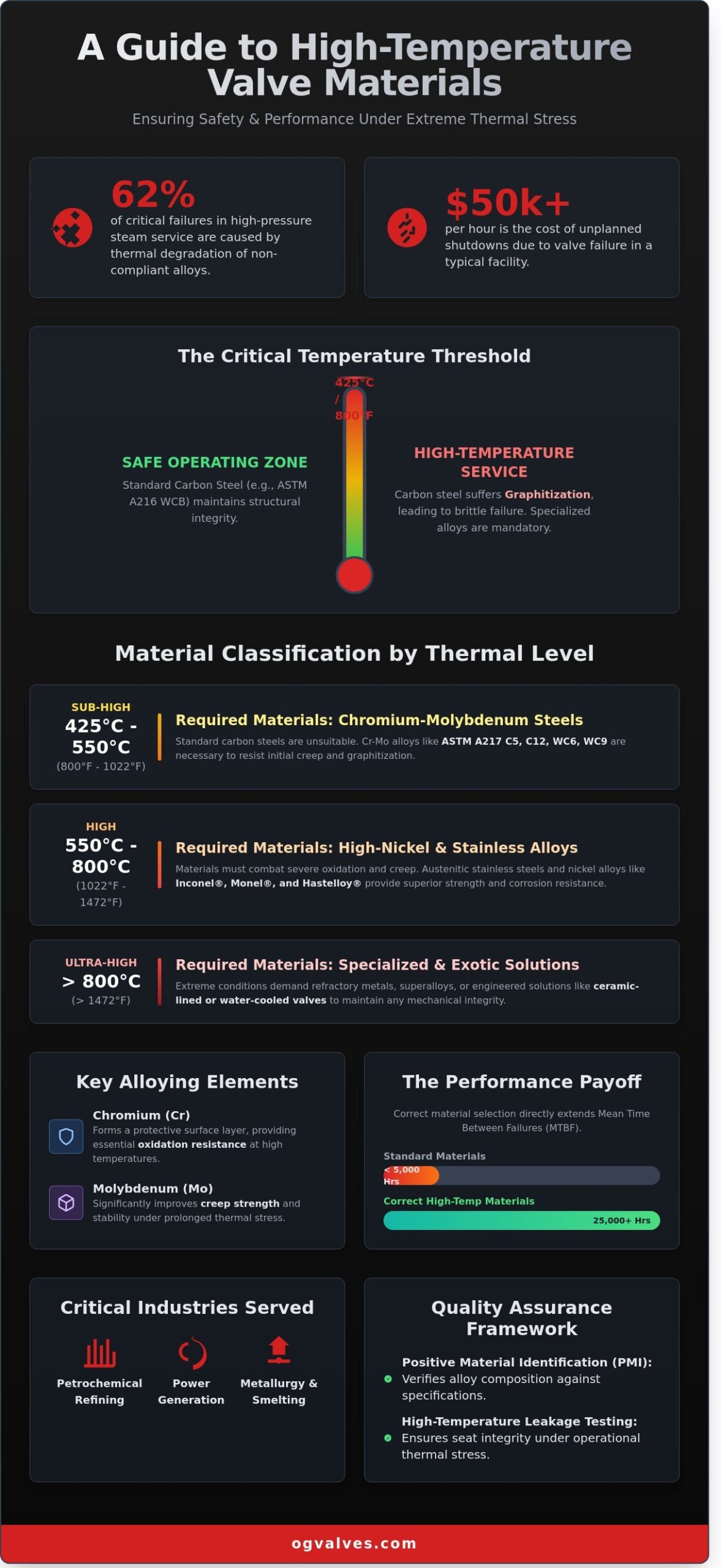
Industry data from 2023 indicates that 62% of critical component failures in high-pressure steam service result from thermal degradation and creep-rupture in non-compliant alloys. Engineers understand that the selection of high temperature valve materials isn’t a routine procurement task; it’s a fundamental safety requirement dictated by the rigid parameters of ASME B16.34 and API 600 standards. Failure to account for precise thermal expansion coefficients leads to catastrophic mechanical integrity loss and unplanned operational shutdowns that often cost facilities upwards of $50,000 per hour in lost production.
This technical guide delivers an authoritative engineering analysis of ASTM material grades, focusing on the performance of forged and cast alloys under extreme thermal stress. You’ll gain the specific data required to identify the correct material grade for service environments reaching 815°C while ensuring full compliance with international safety codes. The following sections detail thermal degradation factors, specific tensile strength requirements, and selection criteria designed to minimize the 14-week lead times typical of exotic alloy sourcing.
Key Takeaways
Define the critical thresholds for high-temperature service and apply ASME B16.34 standards to establish accurate pressure-temperature ratings for valve bodies.
Categorize high temperature valve materials across five thermal levels to ensure appropriate alloy selection for environments exceeding 700°C.
Mitigate mechanical failure risks by analyzing the effects of creep, oxidation, and thermal fatigue on industrial fluid control components.
Identify the necessary material specifications and specialized coatings, such as Stellite, required to maintain seat integrity in gate and ball valve architectures.
Establish rigorous quality assurance frameworks using Positive Material Identification (PMI) and high-temperature leakage testing to verify material compliance.
Defining High-Temperature Service in Industrial Valve Engineering
The threshold for high-temperature service in industrial valve engineering is fixed at 425°C (800°F). This temperature represents a metallurgical boundary where the mechanical properties of standard alloys begin to degrade rapidly. ASME B16.34 serves as the primary regulatory framework for establishing pressure-temperature ratings for valve bodies. It dictates how much pressure a valve can safely contain as the operating temperature rises. Engineers must strictly adhere to these ratings to prevent catastrophic shell failure or seat leakage in volatile environments.
Selecting the appropriate high temperature valve materials requires an understanding of how thermal stress affects molecular structures. Standard carbon steel, such as ASTM A216 WCB, is unsuitable for service above the 425°C limit. At these sustained temperatures, carbon steel undergoes graphitization. This is a process where the carbide phases in the steel decompose into graphite flakes. This transformation makes the metal brittle and significantly reduces its impact resistance. For operations exceeding this limit, chromium-molybdenum steels or high-nickel alloys are mandatory to maintain structural integrity.
Three critical industries rely on these high-temperature specifications for daily operations:
Petrochemical Refining: Thermal cracking and hydrotreating processes often operate between 500°C and 700°C.
Power Generation: Supercritical and ultra-supercritical steam plants require valves that can withstand 600°C at pressures exceeding 250 bar.
Metallurgy: Smelting and heat-treatment facilities utilize valves to control high-velocity hot gases and molten media.
Temperature Classifications and Standards
The industry categorizes heat levels into three distinct tiers to streamline material selection. Sub-high temperature service covers the range of 425°C to 550°C. High-temperature service spans 550°C to 800°C. Anything exceeding 800°C is classified as ultra-high temperature, requiring specialized ceramic-lined or water-cooled valve designs. API 600 and ISO 10434 standards provide the rigorous testing protocols needed for these heat-resistant constructions. Designers must also account for thermal equilibrium. If the valve body and internal trim don’t reach thermal stability at the same rate, the resulting uneven expansion can cause the valve to seize or the seals to fail.
The Economic Stakes of Material Integrity
The cost of material failure extends far beyond the price of a replacement unit. In a 500MW power plant, an unplanned shutdown due to valve failure can result in losses exceeding $180,000 per day in lost revenue. Correct material selection directly extends the Mean Time Between Failures (MTBF) from a few thousand hours to over 25,000 hours of continuous service. OG Valves approaches procurement by prioritizing long-term performance over initial capital expenditure. By utilizing high temperature valve materials that exceed minimum compliance standards, we ensure that critical infrastructure remains operational under the most rigorous thermal loads. This technical precision reduces the frequency of maintenance cycles and mitigates the risk of high-stakes safety hazards in the field.
Classification of High-Temperature Valve Materials by Thermal Level
Industrial valve selection relies on a rigorous classification system that aligns material properties with specific thermal thresholds. Engineers categorize high temperature valve materials into five distinct levels to ensure mechanical integrity and operational safety. This hierarchy begins at the Sub-high level, starting at 325°C, and extends to Level V, which covers extreme service environments exceeding 700°C. As temperatures rise, the internal microstructure of the metal must resist creep, oxidation, and graphitization. The transition from standard carbon steel to sophisticated nickel-based superalloys isn’t arbitrary; it’s a calculated response to the thermal degradation of mechanical properties. Media type significantly dictates the specific grade within these levels. For instance, high-pressure steam requires different oxidation resistance than sulfur-rich oil or corrosive process gases. Chromium and molybdenum are the primary alloying elements used to enhance high-temperature strength. Chromium provides essential oxidation resistance by forming a protective surface layer, while molybdenum improves creep strength and stability under prolonged thermal stress.
Sub-High to Level I: Carbon and Low-Alloy Steels
At temperatures between 325°C and 425°C, carbon steels like ASTM A216 WCB and WCC remain the standard choice for non-corrosive media such as saturated steam or boiler feedwater. These materials provide a cost-effective solution for moderate thermal loads. However, carbon steel faces a hard limit at 425°C because prolonged exposure leads to graphitization, where the carbide phase breaks down into graphite, severely embrittling the valve body. To bridge the gap between 425°C and 593°C, industry specifications shift to low-alloy steels. ASTM A217 WC6 and WC9 are the primary specifications for these environments. WC6 contains 1.25% chromium and 0.5% molybdenum, while WC9 increases these levels to 2.25% chromium and 1% molybdenum to provide superior creep resistance. Forged steel ASTM A105 is frequently used for smaller high-pressure valves, but it’s restricted to 425°C. Beyond this point, its tensile strength drops rapidly, making it unsuitable for Level I service. Precise pressure-temperature ratings for these alloys are defined within the ASME B16.34 standard, which serves as the mandatory framework for industrial valve compliance.
Level II to Level V: Stainless Steels and Exotic Alloys
When service temperatures exceed 593°C, carbon and low-alloy steels lose their structural utility. Level II and Level III applications typically utilize austenitic stainless steels like ASTM A351 CF8 and CF8M. These grades are the workhorses of the petrochemical industry, offering excellent resistance to both high-temperature oxidation and chemical corrosion. For extreme Level IV and Level V conditions, where temperatures surpass 700°C, the industry relies on nickel-based superalloys and exotic metals. Inconel 625 and Hastelloy C276 are specified for their ability to maintain high yield strength and resist pitting in aggressive environments. Monel 400 is often the preferred choice for specialized hydrofluoric acid service at elevated temperatures. A critical engineering concern in these zones is the 730°C threshold, where many high temperature valve materials begin to experience significant plastic deformation. At this stage, the material’s ability to recover from stress is compromised, necessitating the use of materials with high nickel and cobalt content to ensure long-term performance. If your facility requires a technical evaluation of material grades for extreme thermal service, our engineering team provides comprehensive specification support.
Overcoming Mechanical Failure: Creep, Oxidation, and Thermal Fatigue
Industrial valve performance in extreme heat isn’t merely a matter of melting points. It’s a complex struggle against structural degradation over thousands of operational hours. Engineers must select high temperature valve materials that resist the synergistic effects of Creep, Oxidation, and Thermal Fatigue. When temperatures exceed 427°C (800°F), standard carbon steels lose structural integrity, requiring a shift to alloy steels or nickel-based superalloys to prevent catastrophic rupture.
Oxidation presents a constant threat to external and internal valve surfaces. High temperatures accelerate the chemical reaction between the metal and the process media or atmosphere, leading to the formation of oxide scales. If these scales flake off, they cause abrasive wear on seating surfaces and thin the pressure-retaining walls. Chromium content is the primary defense here. A minimum of 12% chromium is typically required to form a stable, protective oxide layer that halts further penetration. Without this metallurgical barrier, the valve’s service life is cut short by rapid metal loss.
Metal-to-metal seating is a non-negotiable requirement for these environments. Soft seals, such as PTFE or reinforced elastomers, generally fail or decompose once temperatures surpass 250°C. In high-stakes oil and gas applications, relying on a polymer seal invites leakage and fire hazards. Instead, precision-ground metal seats, often hard-faced with Stellite 6 or similar cobalt-based alloys, provide the necessary durability. These materials maintain a hardness of approximately 35-45 HRC even at 538°C, ensuring the valve remains bubble-tight throughout its lifecycle.
The Science of Creep Strength
Creep is the slow, permanent deformation of a solid material under mechanical stress at high temperatures. In valve engineering, this phenomenon can lead to the gradual elongation of stems or the distension of the valve body, eventually causing operational failure. To combat this, we specify materials with high allowable stress values as defined by ASME Section II, Part D. Coarse-grained structures often provide superior creep resistance compared to fine-grained alternatives. Alloying elements like molybdenum and vanadium are critical, as they create stable carbides that pin grain boundaries and restrict atomic sliding under load.
Managing Thermal Expansion and Sealing
Differential thermal expansion is a frequent cause of valve seizing. When a valve body and its internal trim are made of materials with mismatched expansion coefficients, the internal components can expand faster than the housing. This leads to mechanical binding. We mitigate this risk through several design protocols:
Flexible Wedges: Utilizing API 600 gate valve designs with flexible wedges allows for slight deformation, preventing the gate from becoming trapped in the seats during cool-down.
High-Clearance Stems: Increasing the tolerances between the stem and the guide bushings prevents galling when the metal expands.
Advanced Gasketing: We utilize graphite-faced 316 stainless steel spiral wound gaskets or kammprofile gaskets. These components maintain seal integrity despite the constant cycling of the valve body.
Selecting the correct high temperature valve materials requires a clinical analysis of the specific thermal profile of the project. It’s not just about surviving the heat; it’s about maintaining precise tolerances and mechanical function under conditions that would cause lesser materials to flow like plastic. Every specification must adhere to ISO 15848-1 standards to ensure that even under thermal stress, fugitive emissions remain within strict compliance limits.
Material Selection Framework for Specific Valve Architectures
Selecting high temperature valve materials requires a clinical analysis of how thermal expansion and mechanical stress interact within specific valve geometries. Each architecture presents unique failure modes that engineers must mitigate through precise metallurgical choices.
Gate valves operating in high-pressure steam or hydrocarbon processing face significant risks of galling. This adhesive wear occurs when the wedge and seat rings move against each other under high load. To prevent this, engineers specify 13% Chromium steel for the wedge, often paired with hard-faced seat rings. For temperatures exceeding 427°C, API 600 Trim 5 is the industry standard, utilizing full Stellite facing on both the wedge and seat to maintain a seal. Proper stem material selection is equally critical; 410 stainless steel provides the necessary tensile strength and oxidation resistance for these demanding environments. For deeper technical insights into these configurations, consult our Technical Guide to Industrial Gate Valves.
Ball valves historically relied on soft polymer seats like PTFE or PEEK, but these materials degrade rapidly above 200°C. High-temperature service necessitates a transition to metal-seated designs. These valves utilize specialized coatings such as Tungsten Carbide or Chromium Carbide, applied via High-Velocity Oxygen Fuel (HVOF) spraying. This process creates a bond strength exceeding 10,000 psi, ensuring the coating remains intact during thermal cycling.
Triple offset butterfly valves represent the primary solution for high-temperature isolation where space is limited. The geometry eliminates friction between the seal and seat during the entire 90-degree stroke. These valves typically employ laminated metallic seals, often a combination of Grade 316 stainless steel and flexible graphite. This layered construction maintains a bubble-tight shutoff even as components expand at different rates.
Globe valves face the most rigorous conditions due to their role in throttling service. The high-velocity fluid flow through the restricted orifice leads to erosion and “wire-drawing” of the plug and seat. Materials like Inconel 625 or Monel are frequently specified for the trim to resist these erosive forces. Engineers seeking a broader understanding of industrial valves selection criteria and API 600 compliance standards will find the full material and architecture decision framework essential for specifying the correct valve type across diverse service conditions.
Trim Materials and Hard-Facing
API 600 Trim Numbers provide a standardized framework for selecting high temperature valve materials based on service conditions. Stellite 6, a cobalt-based alloy, is the most prevalent hard-facing material. It maintains a hardness of approximately 37-45 HRC at elevated temperatures, providing a critical barrier against erosion. We apply these alloys using Plasma Transferred Arc (PTA) welding to ensure minimal dilution with the base metal, preserving the alloy’s integrity.
Specialised Components: Stems and Bolting
Thermal cycling induces significant stress on external fasteners and internal stems. We utilize ASTM A193 B7 bolting for temperatures up to 427°C, but transition to ASTM A193 B16 for service reaching 593°C. This grade contains Chromium-Molybdenum-Vanadium, which offers superior creep resistance. Stems are often manufactured from 17-4 PH or Inconel 718 to prevent bending or thread deformation when the valve is operated under high thermal loads.
Strategic Procurement and Quality Assurance for High-Spec Valves
Procuring high temperature valve materials requires a technical verification framework that eliminates the risk of material substitution or structural failure. In high-pressure steam or thermal processing environments, a single metallurgical discrepancy can lead to catastrophic system loss. We implement Positive Material Identification (PMI) as a mandatory protocol for every critical component. This process utilizes X-ray fluorescence (XRF) or Optical Emission Spectroscopy (OES) to confirm that the elemental composition of the alloy, such as the chromium or molybdenum content in F91 or C12A steels, matches the Mill Test Report (MTR) exactly. It’s a clinical approach to ensuring that what’s specified is what’s installed.
Quality assurance extends beyond chemistry to functional performance. Our testing protocols adhere strictly to API 598 and ISO 5208 standards, encompassing four distinct phases. Hydrostatic shell testing is performed at 150 percent of the maximum working pressure to ensure casting integrity. Pneumatic testing identifies micro-leakage in gas service applications. For high-temperature specifications, seat leakage tests are conducted according to FCI 70-2 Class V or VI standards. These tests verify shut-off capabilities under extreme thermal expansion, where material tolerances are most vulnerable.
Final compliance is verified through rigorous documentation. We provide EN 10204 3.1 certification as standard, which ensures full traceability to the original heat number from the foundry. For high-stakes offshore or nuclear applications, we facilitate EN 10204 3.2 certification. This involves an independent third-party inspector, such as Lloyd’s Register or DNV, to witness the manufacturing and testing stages. This level of oversight provides the high-stakes trust required by procurement specialists in the oil and gas sectors. Procurement engineers who need to structure compliant RFQs for these specifications will find the industrial valve quote technical specification and RFQ guide an essential resource for eliminating data gaps and ensuring material grades are accurately captured on the first submission.
Verifying Material Integrity
PMI testing is non-negotiable for nickel-based alloys and high-grade stainless steels where corrosion resistance depends on precise alloying. We use non-destructive testing (NDT) methods, including Radiographic Testing (RT) for 100 percent of weld seams and Ultrasonic Testing (UT) to detect internal forging defects. These 12-point inspection plans ensure full traceability from the foundry to the final installation site. It prevents the integration of substandard materials into critical infrastructure where failure isn’t an option.
The OG Valves Advantage in Global Supply
We maintain a global inventory of 15,000+ high-spec valves, enabling 72-hour fast-track delivery to the Middle East, North America, and Asia Pacific. Our engineers provide technical support to ensure the selected high temperature valve materials achieve the optimal price-to-performance ratio for your specific pressure-temperature curve. We don’t just supply hardware; we provide engineered solutions that meet ASME B16.34 requirements. Contact OG VALVES LTD. for technical consultation on high-temperature specifications.
Securing Industrial Performance Through Metallurgical Precision
Selecting the correct high temperature valve materials requires a rigorous assessment of thermal thresholds and mechanical stress factors. Engineers must account for creep rates and oxidation cycles to prevent catastrophic failure in systems operating above 425°C. Adhering to ASME B16.34 and API 600 standards ensures that the chosen alloys maintain structural integrity under extreme pressure-temperature ratings. OG Valves maintains a comprehensive inventory of API and ASME compliant valves, engineered to meet the strictest ISO 9001 and NACE MR0175 material specifications. Our strategic distribution hub in Northern Ireland facilitates global fast-track delivery, ensuring that critical infrastructure projects meet their commissioning deadlines. By prioritizing documented metallurgy and verified testing protocols, procurement specialists can mitigate operational risks and extend the service life of high-spec valve architectures. We’re ready to provide the technical expertise your project demands.
What is the maximum temperature for a standard WCB carbon steel valve?
The maximum operating temperature for a standard WCB carbon steel valve is 427°C (800°F) according to ASME B16.34 specifications. Prolonged exposure above this threshold leads to graphitization, where the carbon phase converts to graphite and reduces the structural integrity of the casting. Engineers must transition to alloy steels like WC6 for applications exceeding this limit to ensure safety and performance.
Can stainless steel valves be used in high-temperature steam applications?
Stainless steel valves are suitable for high-temperature steam applications when the correct grade is selected for the specific thermal profile. Grade 316 stainless steel maintains its mechanical properties up to 600°C, but stabilized grades like 347 are preferred for steam service reaching 815°C. These alloys prevent intergranular corrosion, ensuring the long-term durability of the high temperature valve materials in pressurized steam environments.
What is the difference between ASTM A217 WC6 and WC9 materials?
The primary difference between ASTM A217 WC6 and WC9 is the chromium and molybdenum content in the alloy composition. WC6 contains 1.25% chromium and 0.5% molybdenum, while WC9 features 2.25% chromium and 1% molybdenum. This increased alloy concentration gives WC9 superior creep resistance and allows for a higher maximum temperature rating of 593°C compared to the 538°C limit for WC6.
Why is Stellite hard-facing used in high-temperature valves?
Stellite hard-facing is applied to valve seating surfaces to provide essential resistance against galling, erosion, and thermal fatigue at elevated temperatures. This cobalt-based alloy maintains a hardness of approximately 40 HRC even at 500°C. By utilizing Stellite 6 or Stellite 12 overlays, manufacturers ensure that the internal components don’t seize or degrade during high-velocity flow conditions in critical industrial processes.
How does high temperature affect the pressure rating of an industrial valve?
High temperatures reduce the allowable working pressure of an industrial valve through a process known as thermal derating. According to ASME B16.34 Table 2-1.1, a Class 600 WCB valve has a maximum working pressure of 102.1 bar at 38°C. This rating drops to 28.3 bar when the temperature reaches 425°C. Precise calculations are mandatory to prevent catastrophic failure under these reduced pressure-temperature envelopes.
What are the best valve materials for temperatures exceeding 800°C?
For temperatures exceeding 800°C, engineers specify nickel-based superalloys such as Inconel 625 or Hastelloy C276 to maintain mechanical strength. These high temperature valve materials offer 100% resistance to oxidation and creep deformation in extreme environments. In specialized petrochemical applications reaching 1000°C, ceramic-lined valves or advanced refractory materials are often the only viable solution for maintaining flow control and system integrity.
Is PMI testing required for all high-temperature valve procurements?
Positive Material Identification (PMI) testing is mandatory for 100% of high-temperature valve procurements where material traceability is critical for safety. Standard ASTM E1476 protocols ensure that the chemical composition matches the Mill Test Report exactly. Using X-ray fluorescence or optical emission spectroscopy prevents the accidental installation of incorrect alloys, which could lead to a 95% reduction in service life or immediate failure.
Can I use soft-seated ball valves in high-temperature service?
You can’t use soft-seated ball valves in high-temperature service because the polymer seals will degrade or melt. Standard PTFE seats fail at 200°C, while reinforced RPTFE is limited to approximately 260°C. For temperatures above these limits, metal-to-metal seating is required to maintain a leak-tight seal. Metal seats are typically ground to a Class VI shut-off standard to ensure performance in rigorous thermal cycles.
 Responsive Menu