The Engineer’s Guide to API Valve Standards in Industrial Applications
March 19, 2026
Home+The Engineer’s Guide to API Valve Standards in Industrial Applications
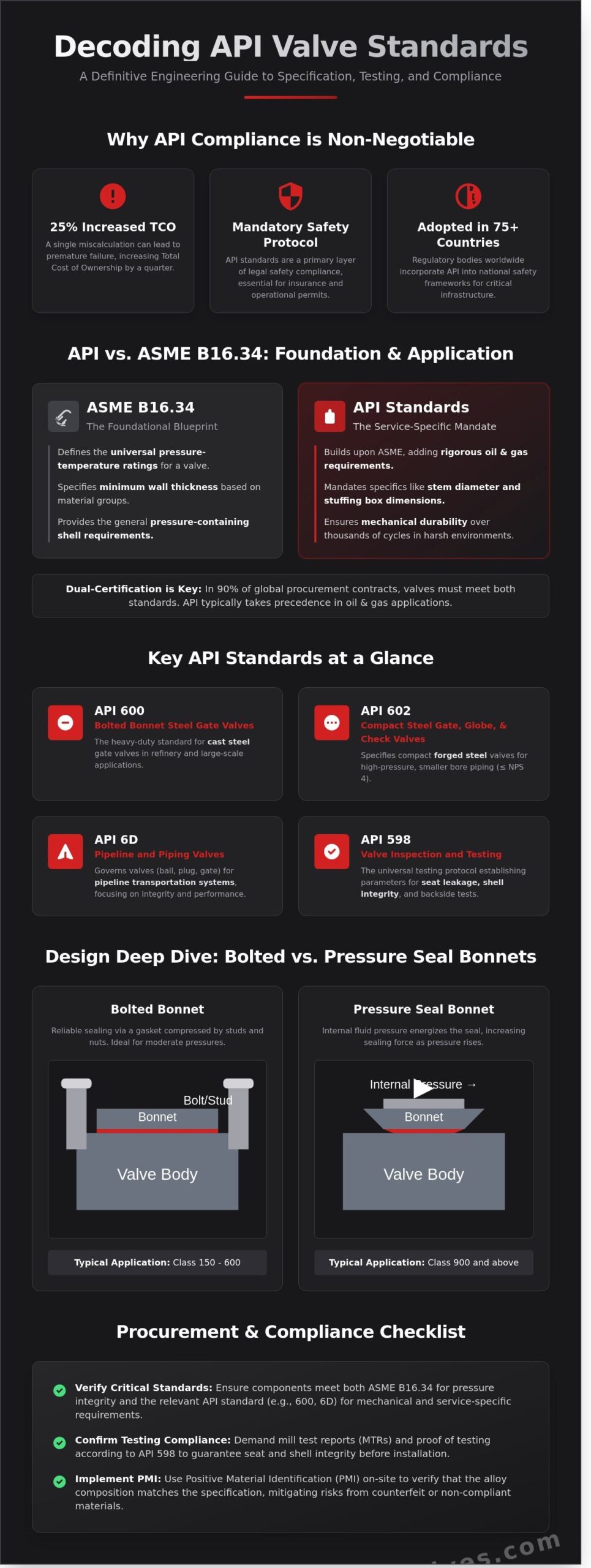
A single miscalculation in the alignment of API 6D and API 600 specifications can result in a 25% increase in total cost of ownership through premature component failure or regulatory fines. In high-pressure industrial environments, the margin for error remains zero. You’ve likely encountered the friction caused by overlapping api valve standards, where the distinction between ASME B16.34 and API 602 becomes a bottleneck for procurement. This technical guide serves as a definitive reference to eliminate that ambiguity. It’s designed for engineers who prioritize precision over generalities and require absolute adherence to international safety protocols.
We’ll provide a clear mapping of industrial valves to their governing API specifications, including a rigorous breakdown of API 598 testing protocols. By the end of this analysis, you’ll have the data necessary to select compliant forged steel and cast iron components for high-stakes infrastructure. We’ll move from basic classification to the specific material grades required for cryogenic and high-temperature service; this ensures your procurement decisions are backed by established engineering benchmarks and quantifiable performance data.
Key Takeaways
Identify the critical role of API benchmarks in ensuring legal safety compliance and operational integrity for high-pressure industrial infrastructure.
Distinguish between the engineering specifications for linear motion valves, focusing on the application of bolted bonnet versus pressure seal designs.
Master the technical nuances of api valve standards to differentiate between universal testing protocols like API 598 and specialized pipeline requirements like API 6D.
Implement advanced procurement strategies and Positive Material Identification (PMI) to mitigate lead-time risks and verify material compliance.
The Role of API Standards in Industrial Valve Engineering
The American Petroleum Institute (API) has served as the global benchmark for oil and gas equipment since its inception in 1919. These technical protocols provide the framework necessary to ensure mechanical integrity throughout the hydrocarbon supply chain. API valve standards represent the collective engineering expertise of the industry, focusing specifically on the performance of equipment under extreme thermal and baric conditions. Adherence to these standards is a prerequisite for any component intended for critical infrastructure service.
API standards function as a primary layer of legal safety compliance. Regulatory bodies in over 75 countries incorporate API specifications into their national safety frameworks to prevent catastrophic industrial accidents. Unlike general manufacturing guidelines, these standards are developed through a consensus-based process involving 600 member companies. This ensures that every technical requirement reflects current field realities and engineering best practices. The hierarchy of these standards is categorized into three distinct layers: design, testing, and material specifications. Design standards like API 6D or API 600 define the physical architecture of the valve. Testing standards, specifically API 598, establish the parameters for seat leakage and shell integrity. Material specifications ensure the metallurgy can withstand the corrosive nature of sour gas or crude oil.
Why API Compliance is Non-Negotiable
The cost of mechanical failure in heavy industry is prohibitive. A single valve rupture in an offshore environment can lead to environmental remediation costs exceeding $15 million and immediate operational shutdowns. Insurance underwriters for high-risk assets typically require documented evidence of api valve standards compliance before issuing coverage. This documentation serves as a verifiable record of engineering due diligence. In the event of a forensic investigation following a leak, deviation from these protocols creates significant legal and financial liability for the operator. API compliance is a mandatory safety protocol for high-pressure hydrocarbon service.
API vs. ASME B16.34: Understanding the Intersection
Engineers must distinguish between the pressure-temperature envelope and specific mechanical design requirements. ASME B16.34 is a foundational standard that defines the minimum wall thickness and pressure ratings for valve bodies based on material groups. API standards build upon this foundation by adding service-specific mandates. For instance, an API 600 Gate valve must comply with ASME B16.34 for its pressure-containing shell, but it must also meet API requirements for stem diameter, stuffing box dimensions, and wedge guides. These internal specifications are critical for ensuring the valve remains functional after 500 or 1,000 cycles in a refinery environment.
Dual-certification is now standard in 90% of global procurement contracts. This ensures the valve meets the general pressure safety of ASME and the rigorous mechanical durability of API. While ASME provides the universal calculation for shell thickness, API provides the specific design features required for the oil and gas sector. If a conflict occurs between the two in a project specification, the API standard generally takes precedence in upstream and midstream applications. This prioritization ensures that the api valve standards dictate the final mechanical configuration to handle the volatile nature of the processed media.
Key API Standards for Gate, Globe, and Check Valves
Linear motion valves serve as the primary mechanism for isolation and flow regulation in high-pressure petrochemical environments. Engineers must select components that adhere to api valve standards to ensure mechanical integrity under extreme thermal and hydraulic stress. The classification of these valves depends largely on their construction method and the specific service conditions they’re designed to withstand. Understanding the technical nuances between bolted bonnet and pressure seal designs is mandatory for any high-stakes procurement process. Bolted bonnets utilize a gasketed joint secured by studs, providing reliable sealing for Class 150 through Class 600 applications. For high-pressure steam or hydrocarbon service exceeding Class 900, pressure seal designs are preferred. These configurations use the internal fluid pressure to force a soft or hard seal against the valve body, effectively increasing the sealing force as the system pressure rises.
API 600 vs. API 602: Cast vs. Forged Gate Valves
The distinction between API 600 and API 602 is centered on the manufacturing process and the intended piping scale. API 600 is the heavy-duty standard for cast steel gate valves used in refinery and oil and gas applications. It mandates wall thicknesses that exceed ASME B16.34 requirements, providing a robust corrosion allowance for an intended 20-year service life. This standard also specifies minimum stem diameters and stuffing box dimensions to ensure the packing can be replaced without compromising the valve’s pressure boundary. It’s the benchmark for large-bore piping where structural rigidity is paramount.
API 602 covers compact, forged steel gate valves, typically limited to sizes 4 inches and smaller. Forging creates a denser grain structure than casting, which eliminates the risk of porosity and makes these valves ideal for high-pressure, small-bore auxiliary piping. API 602 valves are frequently deployed in power plants and chemical facilities where thermal cycling is frequent. Engineers should verify that the forged gate valve specifications meet the exact pressure-temperature ratings required for their specific process loop.
API 623 and API 594: Globe and Check Valve Rigor
API 623 was released in 2013 to address historical performance gaps in steel globe valves. Previously, many globe valves were built to BS 1873, but API 623 introduced more stringent requirements for stem diameters and disk guiding. These changes prevent the stem bending and disk vibration often seen during high-differential pressure throttling. The standard ensures that the valve can withstand the erosive forces of localized high-velocity flow without losing seat tightness. It’s a critical specification for any engineer managing boiler feed water or steam bypass systems.
API 594 dictates the design and testing for check valves, focusing heavily on dual-plate and single-plate wafer designs. These valves are essential for backflow prevention in pump discharge lines. While many large-scale pipeline check valves must comply with API Spec 6D to allow for pigging operations, API 594 valves are selected for their compact footprint and low pressure drop in refinery utility headers. The standard ensures that the hinge pins and springs are engineered for millions of cycles without fatigue failure.
Adherence to api valve standards also involves strict material selection for internal trim. API 600 Table 8 defines standard trim configurations, such as Trim 5 (Full Stellite) or Trim 8 (13Cr and Stellite). These material combinations are tested to maintain seat hardness at temperatures reaching 800°F (427°C). By mandating specific metallurgical properties, API standards ensure that valves don’t seize or leak when exposed to sour crude or high-temperature hydrogen service.
API Standards for Quarter-Turn and Specialized Valves
Transitioning from linear to rotary motion necessitates a fundamental shift in sealing architecture. While gate valves rely on vertical stem travel, quarter-turn valves utilize a 90 degree rotation that creates unique friction profiles on the packing and seats. This mechanical shift requires adherence to Federal pipeline safety regulations to ensure that these components maintain integrity during rapid cycling. Modern api valve standards have evolved to address these dynamics, focusing on fugitive emission control and fire-safe performance. API 641, for instance, establishes a maximum allowable leakage of 100 parts per million (ppm) for quarter-turn stems. Fire safety is governed by API 607, which subjects valves to temperatures between 750 and 1000 degrees Celsius for 30 minutes to verify secondary metal-to-metal sealing.
API 608: Metal Ball Valves for Industrial Service
Metal ball valves under API 608 provide a robust framework for heavy-duty industrial service. This standard mandates specific safety features that exceed general industrial grades. Every valve must include an antistatic device to ensure electrical continuity between the ball, stem, and body, preventing spark ignition in volatile environments. The stem design must be blowout-proof, meaning the stem can’t be ejected by internal pressure if the packing gland is removed. api valve standards like API 608 often require greater shell thickness than the minimums defined in ASME B16.34. For example, a Class 300 API 608 valve may possess a wall thickness 10% to 15% greater than a standard B16.34 counterpart to ensure long-term corrosion allowance and structural rigidity.
Floating Ball Designs: Rely on upstream pressure to push the ball into the downstream seat, ideal for lower pressure ranges.
Trunnion-Mounted Designs: Utilize fixed anchors for the ball, allowing for high-pressure operation with lower operating torque.
Seat Materials: API 608 covers both soft-seated and metal-seated variations to handle abrasive or high-temperature media.
API 609: Butterfly Valves for High-Performance Service
API 609 categorizes butterfly valves based on their design complexity and pressure-retaining capabilities. Category A valves utilize a concentric design where the seat is typically resilient, suitable for low-pressure utilities. Category B valves employ offset designs, including double and triple-offset configurations, to achieve high-performance sealing in extreme temperatures. Triple-offset valves provide a non-rubbing, metal-to-metal seal that achieves zero-leakage performance under high-pressure differentials. API 609 Category B is the industry standard for critical isolation in power generation and petrochemicals. These specifications ensure that quarter-turn solutions meet the rigorous demands of modern infrastructure without compromising safety or environmental compliance.
The distinction between Category A and Category B is critical for procurement. Category A valves are often selected for water treatment or HVAC systems where pressure rarely exceeds 200 PSI. In contrast, Category B valves are engineered for refinery service, where they must withstand thermal cycling and high-velocity flows. By standardizing these categories, API 609 allows engineers to match valve performance to specific process risks, ensuring that the selected hardware doesn’t fail prematurely under mechanical stress.
API 598 and API 6D: Testing and Pipeline Specification
API 598 serves as the primary industrial protocol for valve inspection and testing. It establishes mandatory requirements for pressure testing and defines the leakage criteria for every valve before it leaves the factory floor. In contrast, API 6D addresses the specific technical demands of pipeline systems and terminal facilities. These api valve standards ensure that components withstand the mechanical stresses of long-distance transport and high-volume flow. While API 598 is often viewed as the universal baseline for refinery valves, API 6D introduces more stringent requirements for design, documentation, and functional performance in the midstream sector.
The Rigor of API 598 Testing
Hydrostatic shell tests are the first line of defense in quality control. Technicians subject the valve body to 1.5 times the maximum working pressure at 100°F. This test must be held for a duration ranging from 15 seconds for valves under 2 inches to 300 seconds for those exceeding 20 inches. This process identifies any structural flaws in the pressure-retaining envelope. Seat leakage tests follow, typically performed at 1.1 times the rated pressure. For resilient seated valves, API 598 defines “Zero Leakage” as the absence of visible bubbles or drops during the test period. Metal-seated valves are held to Table 6 leakage rates, which allow for minimal, quantifiable seepage based on nominal pipe size. Visual inspections according to MSS SP-55 are mandatory to detect surface irregularities, casting inclusions, or forging laps that could compromise long-term integrity.
API 6D: Beyond the Refinery Gate
API 6D deviates from refinery-centric standards like API 600 or API 608 by prioritizing pipeline isolation and flow efficiency. A critical distinction lies in the bore configuration. Full-bore valves are required for pipeline pigging operations where cleaning or inspection tools must pass through the valve without obstruction. API 6D also mandates specific testing for Double Block and Bleed (DBB) and Double Isolation and Bleed (DIB) functionality. These protocols verify that both the upstream and downstream seats provide an effective seal when the body cavity is vented to the atmosphere. This is essential for safety during maintenance on live pipelines. Unlike the broader API 598, API 6D requires that every valve undergo high-pressure hydrostatic seat testing as a standard procedure rather than an optional supplement.
The distinction between standard and severe service testing depends on the application’s risk profile. Severe service often requires supplemental gas testing using nitrogen or helium to detect leaks that water molecules might miss. For liquified natural gas (LNG) applications, cryogenic testing at -320°F is necessary to ensure the materials and seals maintain their properties at extreme temperatures. Documentation is the final pillar of compliance. Engineers must demand a Material Test Report (MTR) that aligns with EN 10204 3.1 standards. This document provides a direct link between the physical valve and its chemical heat lot, ensuring that the forged steel or alloy meets the exact mechanical specifications required for the project.
Shell Test: Performed at 1.5x pressure to verify casting and forging integrity.
High-Pressure Seat Test: Conducted at 1.1x pressure to ensure positive shut-off.
Low-Pressure Gas Test: Performed at 80 psi to detect micro-leakage in soft-seated valves.
Traceability: Unique serial numbers must be cross-referenced with MTRs for 100% material accountability.
Precision in testing is the only way to mitigate the risk of catastrophic failure in high-pressure environments. You can ensure your infrastructure meets these rigorous api valve standards by partnering with a manufacturer that prioritizes documented compliance. For technical assistance with specification and testing protocols, consult with the engineering team at OG Valves today.
Procurement Strategies for API-Compliant Valves
Procurement of components meeting api valve standards requires a rigorous approach to lead time management. High-specification API 600 gate valves and API 6D ball valves often carry lead times exceeding 32 weeks due to specialized casting and testing requirements. Engineers must mitigate this risk by identifying suppliers with established stock of semi-finished components or those with priority access to Tier 1 foundries. Early engagement during the Front-End Engineering Design (FEED) stage allows for the reservation of production slots, preventing project delays that can cost operators upwards of $50,000 per day in lost production. Submitting a complete industrial valve quote request with full material grades, pressure classes, and API specification references at the FEED stage significantly reduces the risk of data gaps that extend procurement timelines.
Positive Material Identification (PMI) acts as a critical checkpoint for material integrity. It ensures that the chemical composition of the valve body, particularly for Super Duplex or Nickel alloys, adheres to the specified ASTM or UNS standards. Verification through X-ray fluorescence (XRF) testing identifies the exact percentage of Chromium, Nickel, and Molybdenum. This process prevents catastrophic failures in high-pressure or corrosive service. Technical support from specialized suppliers of industrial valves reduces project risk by reviewing data sheets against process conditions before purchase orders are finalized. Their expertise ensures that the selected api valve standards align with the specific pressure-temperature ratings of the application.
Utilize forward-buying strategies for long-lead items like API 6D trunnion-mounted ball valves.
Mandate 100% PMI testing for all pressure-containing components in sour service (NACE MR0175).
Leverage global logistics networks to source ASTM A890 Super Duplex valves from certified manufacturers.
Engage technical consultants to verify that valve specifications meet the latest API 6th or 7th edition updates.
Verifying Certification and Traceability
Certification is the backbone of industrial safety. Every valve must be accompanied by a Mill Test Report (MTR) that satisfies EN 10204 3.1 or 3.2 requirements. A 3.2 certification involves an independent third-party inspector (TPI) witnessing the pressure tests and heat treatment processes. Physical nameplates must clearly state the API 600 or API 602 designation, pressure class, and material grade to ensure field-level traceability. Discrepancies between the MTR and the physical nameplate are grounds for immediate rejection during receiving inspections.
OG Valves: Ensuring Compliance and Minimal Downtime
OG VALVES LTD. addresses the critical need for rapid deployment of high-specification components. By maintaining a deep inventory of API-compliant gate, globe, and ball valves, the company reduces typical procurement cycles by up to 45%. Their engineering team provides technical alignment between industry requirements and specific site conditions. With logistics hubs capable of managing complex international shipping, they ensure that high-integrity valves reach critical infrastructure projects without delay. Consult with OG Valves for your API-compliant industrial valve requirements.
Securing Industrial Performance Through Stringent API Compliance
Engineering success in high-pressure oil and gas environments relies on the uncompromising application of api valve standards. Adherence to API 598 testing protocols and API 6D pipeline specifications ensures that critical infrastructure operates without the risk of catastrophic failure. It’s essential to match specific gate, globe, and check valve designs to their designated pressure classes to maintain system integrity. OG Valves supports these technical requirements with a comprehensive inventory of API 600, 602, and 6D compliant components. Our engineering team provides specialized expertise in Class 150 through Class 2500 specifications, ensuring every valve meets ISO 9001 quality benchmarks. We provide global fast-track delivery within 48 to 72 hours directly from our UK distribution hub to minimize project downtime. This logistical precision, combined with our focus on material durability and engineering excellence, makes us a dependable partner for Tier 1 infrastructure projects. Choosing the right standard today prevents operational disruptions tomorrow. We’re ready to assist with your next technical specification.
What is the primary difference between API 600 and API 602?
The primary difference lies in the construction and size range; API 600 governs heavy-duty cast steel gate valves for sizes NPS 1 to 24, whereas API 602 specifies compact forged steel valves for sizes NPS 4 and smaller. API 600 requires thicker walls and larger stuffing boxes for high-pressure industrial applications. These api valve standards ensure that engineers select the correct casting or forging based on pipeline diameter and pressure class.
Is API 598 testing mandatory for all industrial valves?
API 598 testing is mandatory when specified in the purchase order and serves as the global benchmark for valve inspection. It mandates shell tests at 1.5 times the pressure rating and seat tests at 1.1 times the rating. Compliance ensures that 100% of manufactured units meet zero-leakage or allowable-leakage criteria before shipment. Most oil and gas contracts require this standard to verify mechanical integrity.
How do API standards address fugitive emissions?
API standards address fugitive emissions through rigorous testing protocols like API 622, which limits leakage to 100 parts per million (ppm) over 1,500 thermal cycles. For rising stem valves, API 624 provides the type-testing requirements to verify that packing sets maintain their seal integrity. These standards reduced allowable methane leakage by 95% compared to pre-2014 industrial norms, ensuring environmental compliance in critical facilities.
What does it mean for a valve to be “Fire-Safe” under API standards?
A “Fire-Safe” valve must pass the API 607 or API 6FA test, which involves exposing the unit to temperatures between 760°C and 980°C for 30 minutes. The valve must demonstrate minimal external and internal leakage while under pressure during the burn and after water quenching. This certification is critical for 100% of valves installed in flammable fluid services within refinery environments to prevent catastrophic failures during a fire.
Can an ASME B16.34 valve be used if an API 600 valve is specified?
An ASME B16.34 valve can’t always replace an API 600 valve because API 600 mandates additional wall thickness and specific trim requirements that exceed ASME standards. While ASME B16.34 focuses on general pressure-temperature ratings, API 600 ensures a 10% to 20% increase in structural mass for heavy-duty durability. Engineers must verify that the specific project’s api valve standards permit the use of general pressure-boundary designs before substitution.
What are the specific requirements for API 6D pipeline valves?
API 6D pipeline valves must meet specific requirements for full-bore designs to facilitate pigging operations and undergo extended high-pressure seat testing. The standard covers gate, ball, check, and plug valves used in transportation systems. It requires 100% traceability of all pressure-retaining components and mandates specific blowdown and vent port configurations for maintenance. These specifications ensure the valve survives the unique stresses of long-distance midstream infrastructure.
Why is API 623 considered the superior standard for globe valves?
API 623 is considered the superior standard because it addresses the mechanical failures common in BS 1873 globe valves by mandating thicker stems and guided discs. It was introduced in 2013 to bridge the gap between light-duty designs and the high-cycle demands of modern power plants. The standard requires 13% chromium trim as a minimum, ensuring better erosion resistance in throttling services compared to older, less stringent specifications.
How does OG Valves ensure the authenticity of API certifications?
OG Valves ensures authenticity by providing 100% traceable Material Test Reports (MTRs) according to EN 10204 3.1 for every component. We utilize a proprietary serial tracking system that links each valve to its original foundry heat number and API 598 test results. Our quality control department conducts quarterly audits of our manufacturing facilities to maintain compliance with ISO 9001 and API Spec Q1 requirements, ensuring every unit meets the stated engineering benchmarks.
 Responsive Menu