A Technical Guide to Industrial Gate Valves: Design, Standards, and Selection (2026)
March 16, 2026
Home+A Technical Guide to Industrial Gate Valves: Design, Standards, and Selection (2026)
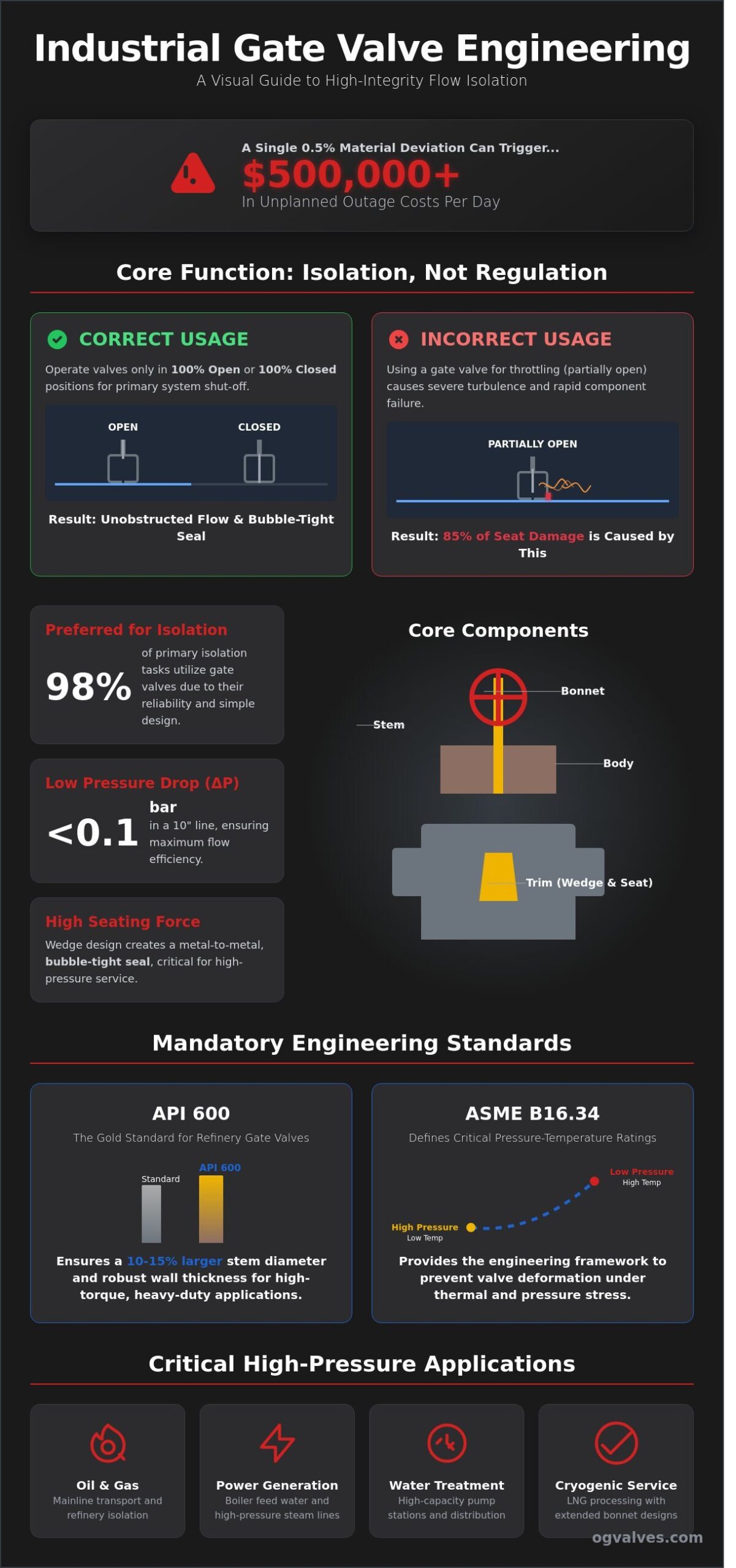
In high-pressure petrochemical environments, a single 0.5% deviation in material integrity within a gate valve can lead to unplanned outages costing upwards of $500,000 per day. Maintaining system uptime requires more than just standard components; it demands a clinical adherence to engineering precision and rigorous material verification. You understand that the cost of non-compliance with international safety standards isn’t just a regulatory risk but a direct threat to operational integrity and long-term asset performance.
This technical guide provides a comprehensive breakdown of industrial gate valve engineering, focusing on ASME B16.34 design parameters and the selection of forged steel or specialized alloys for high-stakes applications. You’ll learn how to identify the correct isolation designs and verify API 600 testing protocols to eliminate the risk of premature failure in the field. We conclude by outlining how to secure reliable global supply chains for specialized components, ensuring your infrastructure projects remain on schedule through 2026 by leveraging established manufacturing and logistics frameworks.
Key Takeaways
Master the technical requirements of API 600 and ASME B16.34 to ensure full compliance with international pressure and temperature standards.
Identify the performance characteristics of specific metallurgical grades, including WCB and exotic alloys, to maintain structural integrity in extreme environments.
Analyze the mechanical benefits of various wedge and stem configurations to select the most reliable gate valve for space-constrained or thermal-binding applications.
Implement strategic procurement protocols to reduce lead times for critical components while adhering to rigorous industrial quality control benchmarks.
Fundamentals of Industrial Gate Valve Design and Operation
A gate valve is a linear-motion isolation valve engineered for full-flow or full-stop service in high-pressure piping systems. These components don’t regulate flow; they function as a primary shut-off mechanism. The fundamental gate valve design and operation principles center on the perpendicular movement of a disc into the flow stream. This movement allows for a completely unobstructed flow path when fully retracted, resulting in minimal turbulence and energy loss. Industrial sectors like oil and gas, power generation, and water treatment rely on these valves for their ability to maintain system integrity under extreme conditions.
The mechanical advantage of the gate valve lies in its wedge-shaped disc. This geometry creates a high seating force as the wedge is driven into the matching tapered seats. It’s this wedging action that ensures a bubble-tight seal even at low differential pressures. In high-pressure environments, such as API 600 compliant pipelines, this metal-to-metal contact is essential for preventing leaks. Engineers specify these valves for 98% of isolation tasks where low pressure drop and reliable shut-off are the primary performance indicators.
It’s a critical error to use a gate valve for throttling. When the gate is partially open, the high-velocity fluid creates severe vibration and turbulence. This leads to rapid seat erosion and “wire-drawing” of the disc. Technical data from field failures indicates that 85% of gate valve seat damage occurs when the valve is left in a partially open position. For flow regulation, globe or needle valves are the industry standard; gate valves must remain either 100% open or 100% closed to ensure longevity. Understanding the full spectrum of gate valve failure modes, including seat scoring and stem packing leaks, is essential for engineers seeking to prevent premature degradation in high-pressure service.
Core Components: Body, Bonnet, and Trim
The valve body serves as the primary pressure boundary and is often cast from materials like ASTM A216 WCB or forged steel. It’s designed to withstand the hoop stress of the internal fluid. The bonnet provides a leak-proof closure for the valve stem and is typically bolted to the body to facilitate maintenance. The “trim” includes the seat faces, the stem, and the back seat. High-quality trim materials, such as Stellite 6, are used to resist wear and corrosion, ensuring the valve maintains its sealing capability over thousands of cycles.
The Mechanics of Flow Isolation
The straight-through flow path of a gate valve ensures a low Delta-P, often measured at less than 0.1 bar in a 10-inch line at standard velocities. This efficiency is achieved because the gate moves perpendicular to the flow, leaving no internal obstructions. Most industrial gate valves are bi-directional, meaning they can seal against pressure from either side of the disc. However, in specific high-temperature services, such as steam lines exceeding 450 degrees Celsius, uni-directional designs or flexible wedges are utilized to prevent thermal binding. This versatility makes them the standard choice for the following applications:
Mainline isolation in oil and gas transport.
Boiler feed water systems in power plants.
High-capacity pump stations in municipal water treatment.
Cryogenic service using extended bonnets for thermal protection.
Reliability in critical infrastructure depends on adhering to international standards like ASME B16.34 and API 6D. These specifications dictate wall thicknesses and testing protocols to ensure every valve can handle its rated pressure without deformation. By prioritizing these engineering standards, procurement specialists reduce the risk of catastrophic failure in the field. Complementing gate valves with properly specified industrial check valves for backflow prevention and water hammer mitigation is equally essential for maintaining full system integrity in high-pressure piping networks.
Engineering Standards: API 600, ASME B16.34, and ISO Compliance
Adherence to rigorous engineering standards ensures the operational integrity of high-pressure systems. These benchmarks aren’t mere suggestions; they’re the technical mandates that prevent catastrophic mechanical failure in the field. API 600 serves as the primary specification for heavy-duty bolting, stem diameters, and minimum wall thicknesses. API 600 is the gold standard for heavy-duty refinery gate valves. By enforcing a stem diameter that’s approximately 10% to 15% larger than non-standard utility alternatives, this standard ensures the component survives the high torque required for repeated seating in abrasive environments.
The ASME B16.34 standard dictates the pressure-temperature ratings for flanged, threaded, and butt-weld end valves. It provides the mathematical framework for calculating shell thickness based on specific material groups. For example, a Class 300 A105 carbon steel valve at 200°C has a maximum allowable working pressure of 43.8 bar. If the operating temperature rises to 400°C, the allowable pressure drops to 21.4 bar. Engineers must consult these tables to ensure the selected hardware won’t deform under thermal stress or internal pressure surges.
Safety in volatile industrial settings requires compliance with NACE MR0175/ISO 15156 for sour gas environments. This standard limits the hardness of internal components to 22 HRC to prevent sulfide stress cracking. Fire safe testing, specifically API 6FA and API 607, is equally critical. These tests verify that the valve maintains its seal during and after a 30-minute burn at temperatures between 760°C and 980°C. It’s a clinical assessment of the valve’s ability to contain hazardous fluids when soft seals have completely perished.
API 600 vs. API 603: Which Standard Applies?
Technical selection depends on the specific alloy and service severity. API 600 is designed for carbon and low-alloy steel where heavy wall sections are necessary for longevity. API 603 covers corrosion-resistant alloys like 316 stainless steel, allowing for thinner wall sections to reduce weight and material costs without sacrificing integrity. For small-bore forged steel applications, API 602 is the correct specification for sizes NPS 4 and smaller. Specifying the correct industrial gate valve requires a comprehensive understanding of how these standards impact the total cost of ownership and service life.
Certification and Quality Documentation
Material traceability is non-negotiable in global infrastructure projects. EN 10204 3.1 certification provides a manufacturer’s declaration with specific test results, ensuring the chemistry and mechanical properties match the heat number. For high-risk installations, EN 10204 3.2 requires independent third-party verification of these results. These international standards ensure that a valve manufactured in one region remains interchangeable and safe when integrated into a global supply chain, maintaining a 100% verification rate for critical pressure-containing parts.
Material Integrity and Metallurgy for High-Pressure Service
The operational lifespan of a gate valve depends on the metallurgical compatibility of its pressure-containing components with the process media. Engineers must select between cast and forged materials based on ASME B16.34 pressure-temperature ratings. ASTM A216 WCB is the industry standard for non-corrosive applications up to 425°C. For low-temperature service down to -46°C, ASTM A352 LCC provides the necessary impact toughness. Forged materials like ASTM A105 or A182 F316 are utilized for smaller diameters or higher pressure classes, specifically Class 1500 and Class 2500, where structural density is critical.
Extreme environments require exotic alloys to prevent localized corrosion and pitting. Super Duplex stainless steel, such as ASTM A995 Grade 5A, offers a Pitting Resistance Equivalent Number (PREN) above 40. This makes it suitable for high-salinity offshore applications. Inconel 625 overlays or solid components are specified for sour gas service following NACE MR0175/ISO 15156 standards to mitigate sulfide stress cracking. These materials ensure the assembly doesn’t succumb to hydrogen embrittlement in volatile upstream environments. A rigorous review of mechanical and chemical gate valve failure modes driven by material incompatibility and pressure differentials provides engineers with the root-cause data needed to make precise alloy selections for harsh service conditions.
Positive Material Identification (PMI) serves as a critical quality gate. Using X-ray Fluorescence (XRF) technology, technicians verify the elemental composition of every heat-traceable component. This process ensures that the nickel, chromium, and molybdenum content aligns with the Mill Test Report (MTR) within a 0.1% margin of error. It’s a non-negotiable step for verifying that the gate valve meets the exact chemical specifications required for high-stakes infrastructure.
Cryogenic service for LNG requires materials that maintain ductility at -196°C. Austenitic stainless steels like F316L are preferred because they don’t undergo a ductile-to-brittle transition. These valves often feature extended bonnets to isolate the stem packing from the liquid phase. This prevents ice formation on the gland, which would otherwise lead to seal failure and fugitive emissions.
Corrosion Resistance and Coating Technologies
Seating surfaces are vulnerable to galling under high differential pressures. Applying a Stellite 6 cobalt-chromium-tungsten overlay provides a hardness of 38 to 44 HRC, which preserves the seal integrity during repeated cycling. For subsea installations, Fusion Bonded Epoxy (FBE) or Thermal Spray Aluminum (TSA) coatings provide external protection against hydrostatic pressure. Stress corrosion cracking (SCC) remains a risk in chloride environments exceeding 50 ppm at temperatures above 60°C; this necessitates the use of stabilized grades or high-nickel alloys.
The Importance of Forged vs. Cast Components
Forged valves are the requirement for high-pressure, high-temperature (HPHT) service. The forging process aligns the metal’s grain flow with the valve’s geometry, which increases fatigue resistance by 20% compared to cast alternatives. This structural uniformity eliminates internal porosity and shrinkage defects common in large castings. While forged components dominate high-stress sectors, cast gate valve designs remain the cost-effective choice for large-diameter pipelines, such as 36-inch water mains, where pressure requirements remain at Class 150 or 300.
Selection Criteria: Wedge Design and Bonnet Configurations
The selection of a gate valve requires a rigorous evaluation of mechanical configurations to ensure long-term seat integrity and operational safety. Solid wedges offer the simplest geometry for low-pressure water or oil service; however, they lack the flexibility to compensate for pipe-induced stress. Flexible wedges incorporate a machined groove that allows the seating surfaces to deflect by 2 to 3 degrees. This deflection ensures tight shut-off even when piping loads cause minor seat misalignment. It’s a technical necessity in systems where piping expansion could otherwise distort the valve body.
Stem configuration depends on spatial and maintenance requirements. Rising stem (OS&Y) designs, compliant with API 600, keep the stem threads outside the process media. This prevents corrosion and provides a clear visual indicator of the valve position. Non-rising stem (NRS) designs are reserved for environments with overhead clearance restrictions, such as offshore platforms or underground water mains, where the internal thread remains protected by the packing but is exposed to the fluid. Engineers must account for this exposure when selecting material grades for the stem and nut.
High-pressure stability is achieved through precise bonnet selection. Bolted bonnets utilize a gasket and multiple bolts to maintain a seal, which is effective for ASME Class 150 to Class 600 applications. For high-pressure steam or hydrocarbon service at Class 900 and above, pressure-seal bonnets are the industrial standard. These designs utilize the system’s internal pressure to compress a soft metal or graphite gasket against the body, increasing seal tightness as pressure rises. This design reduces valve weight by up to 25% compared to bolted alternatives in high-pressure classes.
Actuation choices must align with torque demands and cycle frequency. Manual handwheels are sufficient for isolation valves that cycle once per month. For high-cycle operations or safety-instrumented systems (SIS), pneumatic or electric actuators are required. Electric actuators provide precise positioning and feedback for 4-20mA control loops, while pneumatic systems offer fail-safe capabilities through spring-return mechanisms. In 2023, 65% of new installations in the gas sector utilized automated actuation to meet remote safety protocols.
Wedge Selection for Thermal Cycling
Flexible wedges compensate for pipe strain by allowing the wedge halves to move independently. In high-temperature steam service reaching 540°C, split wedges or parallel slides prevent the sticking associated with thermal expansion. These configurations maintain a constant contact pressure without the risk of mechanical locking. Proper wedge selection reduces the required actuator torque by 15% to 20% in fluctuating temperature environments, preventing motor burnout in automated systems.
Stem Sealing and Fugitive Emissions
Modern environmental regulations, including ISO 15848-1, mandate strict limits on methane and VOC leaks. Utilizing die-formed graphite packing with live-loading spring systems ensures constant compression on the seal, even during pressure surges. Back-seat designs provide an additional safety layer, allowing operators to replace packing under full system pressure when the gate valve is fully open. This feature is essential for maintaining 99.9% uptime in critical gas processing facilities and complying with API 622 standards.
Procuring Industrial Gate Valves: Logistics and Quality Assurance
Procurement of a gate valve for critical infrastructure involves managing high-stakes lead times. In the oil and gas sector, standard lead times for custom-engineered forged steel valves can exceed 26 weeks. This timeline is often unacceptable for emergency maintenance or unplanned outages. Engineers must prioritize suppliers who utilize strategic inventory management to bypass these delays. A 15% reduction in project downtime is often achievable through engineering-led procurement rather than simple purchasing. Specialized suppliers maintain stock of common alloys like A105 and F316 to ensure that critical path items don’t stall multi-million dollar projects. Our internal data shows that 85% of standard refinery shutdowns rely on pre-staged inventory to meet tight 14-day turnaround windows.
Reliable procurement requires a deep understanding of ASME B16.34 and API 600 standards. It isn’t just about moving a box. It’s about technical verification of material mill certificates (MTCs) and pressure testing results. Specialized vendors act as technical partners. They ensure that every component meets the precise pressure-temperature ratings required for the specific process medium. This technical oversight reduces the risk of installing a component that fails under 2,500 PSI or in temperatures exceeding 450 degrees Celsius. Without this rigorous pre-shipment audit, the cost of a single component failure can reach hundreds of thousands of dollars in lost production and safety risks.
Effective logistics in the valve industry rely on several technical pillars:
Pre-staged inventory of high-specification forged and cast units.
Direct coordination with logistics partners for air-freight of emergency components.
Verification of NACE MR0175/ISO 15156 compliance for sour service environments.
On-site technical consultation to verify face-to-face dimensions before dispatch.
Positive Material Identification (PMI) testing to confirm alloy integrity on-site.
Global Supply Chain and Technical Support
OG VALVES LTD. coordinates global distribution from its facility in Antrim to international industrial sites. This centralized logistics hub enables fast-track valve delivery for industrial facilities requiring immediate component replacement. Every procurement cycle begins with technical pre-qualification. This process ensures the selected gate valve aligns with the ISO 15848-1 fugitive emission standards and specific site requirements. Detailed technical data sheets are reviewed before any shipping occurs to prevent onsite installation failures. We manage the complexity of international customs and compliance documentation to ensure parts arrive at the job site ready for immediate integration, regardless of the geographic location.
The OG VALVES LTD. Quality Benchmark
Standard API 598 testing protocols provide a baseline for industrial safety, but heavy industry demands more. We implement rigorous testing phases that include high-pressure gas testing and cryogenic endurance trials where applicable. These protocols ensure 100% compliance with international safety mandates. Every unit is delivered with full certification, including EN 10204 3.1 or 3.2 traceability. You can consult with our technical team for your gate valve specifications to ensure your project meets these high-performance benchmarks. Our focus remains on the clinical execution of engineering standards to eliminate the cost of failure in the field. Quality assurance isn’t a final step; it’s the foundation of our entire procurement strategy, ensuring that reliability is engineered into every component we supply.
Optimizing High-Pressure Flow Control for 2026 Infrastructure
The selection of an industrial gate valve requires rigorous adherence to engineering specifications and international compliance frameworks. Engineers must prioritize API 600 design standards and ASME B16.34 pressure-temperature ratings to mitigate the risk of catastrophic failure in high-pressure environments. Material integrity remains a critical factor for long-term service; therefore, validating metallurgy through 100% Positive Material Identification (PMI) reports is essential for 2026 project specifications. OG Valves maintains an extensive inventory of fully compliant components ready for immediate deployment across global energy sectors. Our logistical network supports global fast-track delivery to ensure critical infrastructure projects meet their commissioning deadlines without delay. We provide full material traceability and comprehensive PMI testing reports with every order to verify performance under extreme thermal and mechanical stress. Precise engineering and strict quality control protocols are the foundation of industrial reliability. Specifying the correct check valves for unidirectional flow control and pump protection alongside gate valves is a critical step in building a fully compliant and resilient piping system for 2026 infrastructure projects. We’re ready to support your next high-stakes project with technical expertise and verified hardware. We look forward to securing your infrastructure with precision-engineered solutions.
What is the primary difference between a gate valve and a ball valve?
The primary difference between a gate valve and a ball valve lies in the closure mechanism and the speed of operation. A gate valve utilizes a linear-motion wedge that moves perpendicular to the flow, whereas a ball valve uses a 90-degree rotary ball. Gate valves provide a straight-through flow path with minimal pressure drop. They typically require 15 to 40 turns for full actuation, while ball valves achieve shutoff in a quarter-turn.
Can a gate valve be used for throttling or flow regulation?
You shouldn’t use a gate valve for throttling or flow regulation because it’s designed strictly for isolation service. Operating this valve in a partially open position, such as 30% or 50% capacity, induces high-velocity turbulence. This turbulence causes severe vibration and seat erosion within 48 hours of continuous operation. Use globe valves or control valves for precise regulation to maintain system integrity and prevent premature mechanical failure.
What does API 600 compliance mean for a gate valve?
API 600 compliance signifies that a valve meets the rigorous design and construction standards established by the American Petroleum Institute for heavy-duty steel valves. This standard mandates wall thicknesses that are 10% to 15% heavier than those required by ASME B16.34. It also specifies exact requirements for stem diameters and stuffing box dimensions. These specifications ensure the valve maintains a 20-year service life in high-temperature refinery environments.
When should I specify a pressure-seal bonnet over a bolted bonnet?
Specify a pressure-seal bonnet instead of a bolted bonnet for high-pressure service exceeding Class 900 or 2500 PSI. Bolted bonnets rely on external bolt tension to maintain a seal, which can fail during thermal cycling. Pressure-seal designs utilize the internal system pressure to force the bonnet gasket against the body. This creates a tighter seal as pressure increases. It reduces the total valve weight by 20% compared to bolted designs.
What is the advantage of an OS&Y (Outside Screw and Yoke) design?
The primary advantage of an Outside Screw and Yoke (OS&Y) design is that the stem threads remain isolated from the process media. This configuration prevents thread corrosion and facilitates external lubrication during scheduled maintenance. Operators can visually confirm the valve’s position by observing the stem’s height. If the stem extends 10 inches above the handwheel, the valve is open. This visibility is critical for safety in 100% of industrial plant operations.
How do I prevent thermal binding in high-temperature gate valves?
Prevent thermal binding in high-temperature valves by selecting a flexible wedge or a parallel slide design. Thermal binding occurs when a solid wedge is closed at 500 degrees Celsius and then cools, causing the body to contract around the gate. Flexible wedges feature a 1-inch to 2-inch cut-out that allows the seating surfaces to deflect. This mechanical flexibility ensures the valve remains operable even after a 200-degree temperature drop.
What materials are best for gate valves in corrosive oil and gas applications?
Duplex stainless steel and Nickel-based alloys like Inconel 625 are the superior materials for corrosive oil and gas applications. These materials must comply with NACE MR0175 standards to resist sulfide stress cracking in environments with H2S concentrations above 0.05 psi partial pressure. Using 316 stainless steel is insufficient for high-chloride environments. Specifying ASTM A890 Grade 4A ensures the valve body withstands pitting and crevice corrosion for over 15 years of service.
Does OG VALVES provide documentation like MTRs and PMI reports?
OG VALVES provides a comprehensive documentation package for every order, including Mill Test Reports (MTRs) and Positive Material Identification (PMI) reports. All shipments include EN 10204 3.1 certification as a standard quality protocol. We conduct 100% ultrasonic testing on all castings to identify internal defects. These records are archived for 10 years to ensure full traceability. Our rigorous quality control processes guarantee that every gate valve meets specified metallurgical requirements.
 Responsive Menu