Industrial Valve Safety Standards in the UK: A Technical Compliance Guide (2026)
April 23, 2026
Home+Industrial Valve Safety Standards in the UK: A Technical Compliance Guide (2026)
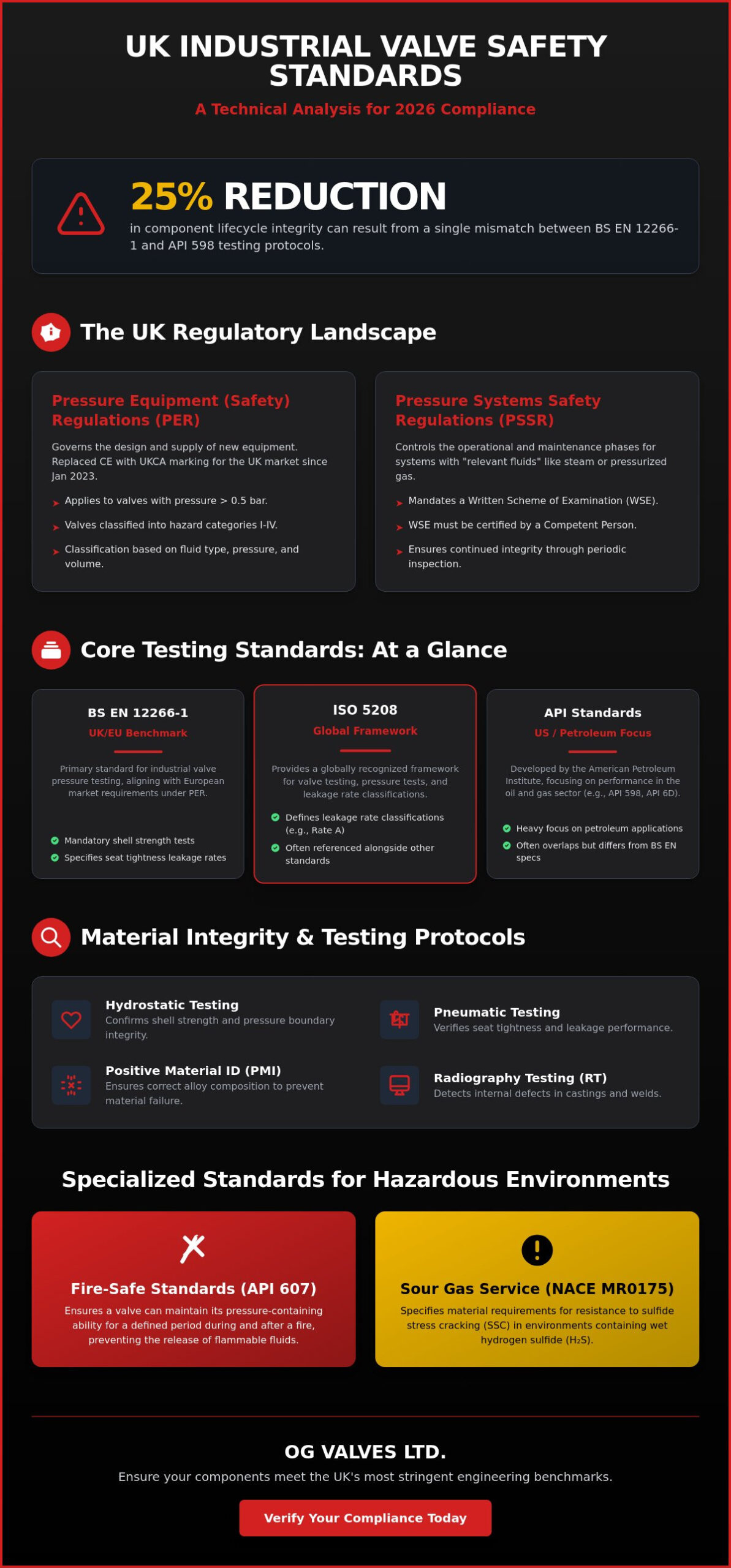
A single mismatch between BS EN 12266-1 testing protocols and API 598 specifications can lead to a 25% reduction in component lifecycle integrity. For engineers managing critical infrastructure, the ambiguity between overlapping international standards remains a primary driver of catastrophic failure and unplanned downtime. Adhering to the latest industrial valve safety standards in the uk isn’t just a regulatory formality; it’s a fundamental requirement for maintaining pressure boundary integrity in high-stakes environments. Precision is mandatory.
Analyzing the technical nuances of ISO 5208 alongside domestic British Standards requires absolute accuracy to avoid the high cost of non-compliant material selection. This guide delivers a comprehensive technical analysis of the BS EN, ISO, and API standards governing valve performance for 2026. We’ll examine specific hydrostatic testing pressures, Positive Material Identification (PMI) procedures, and the rigorous framework necessary for ensuring compliant procurement across UK industrial sites.
Key Takeaways
Define the mandatory compliance framework established by the Pressure Equipment (Safety) Regulations (PER) and the role of BSI in harmonising technical specifications.
Compare pressure testing methodologies and leakage rate classifications under BS EN 12266-1 and ISO 5208 to maintain rigorous industrial valve safety standards in the uk.
Identify the high-precision material integrity protocols, including Positive Material Identification (PMI) and Radiography, required to mitigate the risk of structural failure.
Distinguish the specialized fire-safe and sour gas standards, such as API 607 and NACE MR0175, essential for ensuring operational durability in hazardous environments.
Execute a systematic verification of supplier technical data sheets to ensure all procured components meet the stringent engineering benchmarks required for industrial service.
The UK Regulatory Landscape for Industrial Valve Safety
Compliance with industrial valve safety standards in the uk requires a precise understanding of the statutory framework governing pressure systems. The British Standards Institution (BSI) maintains the primary technical architecture by adopting and harmonising BS EN standards. These standards provide the engineering specifications necessary for material selection and pressure testing across the oil, gas, and water sectors. Safety in this technical context isn’t merely the absence of incidents. It’s defined by the dual metrics of pressure containment and operational reliability. Containment ensures the valve body and seals withstand internal forces without catastrophic failure. Reliability ensures the valve performs its intended function, such as isolation or regulation, across its entire service life under specified process conditions.
Pressure Equipment (Safety) Regulations (PER)
The Pressure Equipment (Safety) Regulations 2016 (PER) apply to any valve assembly where the maximum allowable pressure exceeds 0.5 bar. This legal framework originates from the Pressure Equipment Directive (PED), which established the foundational technical requirements for equipment used across Europe. Since January 2023, the UKCA marking has replaced the CE mark for the UK market, signifying that a valve meets these rigorous safety benchmarks. Manufacturers must classify valves into categories I through IV based on the hazard level. This classification is determined by the fluid type (Group 1 for hazardous or Group 2 for non-hazardous), the maximum allowable pressure, and the internal volume of the component.
PSSR and the Written Scheme of Examination
Material test reports (MTRs) confirming chemical and physical properties of forged or cast components.
Hydrostatic and pneumatic test certificates according to BS EN 12266-1.
Maintenance logs documenting seal replacements, seat leakage tests, or actuator recalibrations.
Design calculations for wall thickness and flange ratings.
Adhering to these industrial valve safety standards in the uk prevents mechanical fatigue and ensures long-term infrastructure stability. Engineering teams must prioritize these regulations to mitigate the risk of pressure excursions in high-stakes environments. Failure to maintain a valid WSE can lead to legal liability and compromised site safety.
Core BS EN and ISO Standards for Industrial Valves
Adherence to industrial valve safety standards in the uk ensures mechanical integrity across high-pressure systems. BS EN 12266-1 serves as the primary benchmark for industrial valve pressure testing, specifying mandatory tests for shell strength and seat tightness. While ISO 5208 provides a global framework for leakage rate classifications, BS EN 12266-1 aligns these requirements with European market expectations. Under The Pressure Equipment (Safety) Regulations 2016, manufacturers must demonstrate that every assembly meets these rigorous testing protocols before deployment.
Engineers often manage systems where BS EN standards intersect with American API 6D or ASME B16.34 specifications. While API standards focus heavily on petroleum sector performance, BS EN standards prioritize harmonized safety across various European industrial applications. For instance, BS EN 558 standardizes face-to-face and end-to-end dimensions, ensuring that a valve from one manufacturer is dimensionally compatible with existing pipework. This dimensional consistency prevents mechanical stress during installation and simplifies maintenance cycles.
Standards for Isolation Valves (Gate, Ball, Globe)
BS EN 1984 governs steel gate valves used in heavy industry, mandating specific wall thicknesses and seating requirements. For petroleum and petrochemical plants, BS EN ISO 17292 defines the design parameters for metal ball valves. BS EN 13709 establishes the technical requirements for steel globe and check valves, focusing on flow regulation and shut-off reliability. These standards ensure that isolation components maintain seat integrity under thermal cycling. Professionals often source high-specification isolation valves that exceed these minimum safety thresholds to ensure long-term durability.
Check Valve and Butterfly Valve Specifications
BS EN 12334 provides the specification for industrial cast iron check valves, while BS EN 16767 covers steel and cast iron variants. The latter includes technical nuances regarding disc closure speed and water hammer prevention. For flow control, BS EN 593 dictates the requirements for industrial metallic butterfly valves, emphasizing torque consistency and seat durability. Adhering to these industrial valve safety standards in the uk is critical for preventing backflow and ensuring system performance. Every component must undergo verification against these benchmarks to mitigate the risk of failure in the field. It’s a fundamental requirement for maintaining the safety of critical infrastructure.
Material Integrity and Rigorous Testing Protocols
Adhering to industrial valve safety standards in the uk requires a clinical approach to material validation. Material failure in high-pressure systems often stems from microscopic structural defects or incorrect alloy composition. Engineers utilize Positive Material Identification (PMI) to verify that the chemical signature of the valve body matches the specific design requirements. This process is mandatory for high-performance alloys like Super Duplex (ASTM A890) used in corrosive offshore environments. Without PMI, the risk of material mix-ups increases, potentially leading to rapid stress corrosion cracking in petrochemical service.
Non-Destructive Testing (NDT) provides a forensic analysis of the valve without compromising its structural state. Radiography (RT) identifies internal volumetric flaws such as gas inclusions or shrinkage in cast components. For surface-level integrity, Magnetic Particle (MT) and Dye Penetrant (PT) testing detect hairline cracks that could propagate under cyclic loading. These protocols ensure that every component meets the rigid specifications required for critical infrastructure. When managing these assets, technical teams should consult the HSE guide to pressure system safety to align their maintenance schedules with the Pressure Systems Safety Regulations 2000 (PSSR).
PMI Testing and Material Traceability
Material traceability is anchored in the BS EN 10204 standard. A 3.1 inspection certificate provides manufacturer-verified results, while a 3.2 certificate requires an independent third-party witness to validate the melt shop’s data. In high-pressure gas applications, 3.2 certification is the benchmark for safety. It ensures that the forged steel or cast iron used in production hasn’t been substituted with inferior grades during the supply chain process. This level of documentation is a fundamental requirement of industrial valve safety standards in the uk for 2026.
Pressure Testing and Leakage Rates
Testing protocols follow the BS EN 12266-1 framework to define performance under stress. The shell test, conducted at 1.5 times the maximum allowable pressure, verifies the structural housing’s strength. The seat test, performed at 1.1 times the design pressure, evaluates the internal sealing capability.
Rate A: Defines zero visible leakage, typically required for hazardous or toxic media.
Rate B to G: Allows for incremental leakage volumes, suitable for non-critical water or air service.
High-Pressure Gas Testing: Uses nitrogen or helium to detect leaks that hydrostatic tests might miss due to the smaller molecular size of gas.
For specialized applications, cryogenic testing at -196°C ensures that valve seats maintain a bubble-tight seal even under extreme thermal contraction. These tests aren’t optional; they’re the technical baseline for industrial reliability.
Application-Specific Safety Standards in Heavy Industry
Engineering precision in high-risk environments demands adherence to application-specific industrial valve safety standards in the uk. General certifications provide a baseline, but specialized sectors like oil and gas or power generation require rigorous validation against extreme thermal and chemical stressors. Failure to match the valve specification to the specific media and pressure class risks catastrophic infrastructure failure and environmental non-compliance.
Oil, Gas, and Petrochemical Safety
Refinery operations prioritize fire-safe integrity to prevent the escalation of localized incidents. API 607 and ISO 10497 specify that valves must maintain a tight seal during and after exposure to a fire for 30 minutes at temperatures between 750°C and 1000°C. API 6D serves as the governing specification for pipeline valves in the UK, ensuring that isolation remains absolute during emergency shutdowns. It’s a critical secondary standard that complements the Pressure Equipment Directive (PED).
In flammable services, anti-static requirements under BS EN 12266-2 are mandatory for ball and plug valves. These designs prevent static discharge between the ball, stem, and body, eliminating potential ignition sources. For sour gas applications, NACE MR0175/ISO 15156 defines material requirements to prevent sulfide stress cracking. This standard limits the hardness of carbon and low-alloy steels to 22 HRC. This ensures the valve’s structural integrity isn’t compromised by hydrogen-induced cracking in H2S-rich environments.
Power Generation and Water Treatment
Environmental compliance across all heavy industries hinges on ISO 15848-1. This standard classifies fugitive emissions based on tightness levels. Class A represents the highest level of sealing integrity, reducing the leakage of volatile organic compounds to negligible levels. Adopting these industrial valve safety standards in the uk is essential for meeting the 2026 environmental targets regarding methane reduction and industrial emission controls.
Engineers can ensure full compliance by reviewing our range of certified industrial valves designed for high-pressure and high-temperature service.
Procurement teams serve as the final gatekeeper for operational integrity. Validating that equipment meets industrial valve safety standards in the uk requires a rigorous audit of technical documentation before any hardware reaches the site. This process begins with the verification of Material Test Reports (MTRs) and technical data sheets. These documents must confirm that chemical compositions and mechanical properties align with the design pressure and temperature ratings specified for the application. Engineers must demand EN 10204 3.1 or 3.2 certification to ensure full traceability from the foundry to the final assembly.
Technical support is indispensable when performing standard-to-standard mapping. In global supply chains, engineers often encounter the need to reconcile ASME B16.34 specifications with British Standards or European EN requirements. A competent supplier provides the precise data necessary to bridge these gaps without compromising safety. Fast-track delivery also functions as a safety protocol. Prolonged downtime in high-pressure systems increases the risk of stagnant fluid corrosion or seal degradation. Rapid replacement of safety-critical components prevents the use of non-compliant, temporary fixes that often lead to catastrophic failure.
Evaluating Supplier Technical Competence
A supplier’s quality management system is the primary benchmark for reliability. ISO 9001:2015 accreditation indicates that a vendor follows documented, repeatable processes for quality control. Procurement specialists should prioritize suppliers who maintain extensive local inventory of forged steel and cast iron components. Immediate access to certified stock allows for the rapid replacement of safety-critical valves during unplanned outages. For a detailed breakdown of these requirements, see Industrial Valves: The Engineer’s Comprehensive Guide to Selection and Standards (2026).
OG Valves: Technical Specification and Global Supply
OG Valves delivers high-specification components engineered for the rigorous demands of the oil, gas, and water treatment sectors. Our technical expertise encompasses the full range of gate, ball, and check valve standards, ensuring every unit maintains industrial valve safety standards in the uk. We manage a global supply chain focused on material integrity and manufacturing precision. Our clinical focus on durability ensures that every valve performs under extreme industrial loads. For specific data on flow control and material grades, refer to A Technical Guide to Industrial Gate Valves: Design, Standards, and Selection (2026).
Securing Operational Integrity Through Technical Compliance
Adherence to BS EN 12266-1 pressure testing protocols and ISO 5208 leakage requirements remains the baseline for industrial asset integrity in 2026. Engineers must prioritize EN 10204 Type 3.1 material traceability to ensure forged steel and cast iron components meet the rigorous demands of heavy industry. Strict alignment with industrial valve safety standards in the uk isn’t just a legal necessity; it’s a critical protocol for preventing catastrophic failure in high-pressure systems. OG Valves maintains an extensive inventory of gate, ball, and globe valves engineered for API 6D and BS EN compliance. Our technical team provides specialized expertise in ISO 10497 fire-safe testing and cryogenic specifications to minimize operational downtime through global fast-track delivery schedules. It’s vital to source components that exceed minimum performance benchmarks to ensure long-term durability in volatile environments. We’re ready to support your procurement requirements with precision-engineered solutions that meet the highest international certifications. Request a Technical Quote for Industrial Valves to verify your project’s compliance today.
Frequently Asked Questions
What is the primary British standard for industrial valve pressure testing?
BS EN 12266-1 is the primary British standard for the pressure testing of industrial valves. It defines mandatory requirements for shell strength, seat tightness, and functional integrity. The 2012 version of this standard establishes Rate A as the zero-leakage benchmark for resilient-seated valves. This protocol ensures mechanical performance before a component enters service in high-pressure oil or gas environments. It’s the technical baseline for verifying valve integrity across the UK.
Does the UK still follow EN standards after Brexit for industrial valves?
The UK continues to adopt and maintain BS EN standards for industrial valve safety standards in the uk following the transition period ending December 31, 2020. The British Standards Institution retains its membership in CEN and CENELEC. This means 95% of technical specifications for valve manufacturing remain aligned with European norms. Engineers must ensure documentation references the BS EN prefix to demonstrate compliance with current domestic regulatory frameworks and safety protocols.
What is the difference between BS EN 12266-1 and ISO 5208?
BS EN 12266-1 and ISO 5208 are technically identical in their testing procedures and leakage rate definitions. ISO 5208 serves as the international baseline, while BS EN 12266-1 is the specific implementation adopted for use within the UK. Both standards utilize the same 7 leakage rate categories, ranging from Rate A to Rate G. Selecting either standard ensures a consistent testing methodology for metal-seated or soft-seated industrial valves in global supply chains.
What material certifications are required for safety-critical valves in the UK?
Safety-critical valves in the UK require material certification according to BS EN 10204, typically at the 3.1 or 3.2 level. A 3.1 certificate provides verification by the manufacturer’s authorized inspection representative. For high-risk applications, the 3.2 certificate adds an independent third-party inspection requirement. These documents verify the chemical composition and mechanical properties of alloys like ASTM A105 or A350 LF2 steel to ensure they meet the specific project requirements.
Are API 6D valves compliant with UK safety standards?
API 6D valves are compliant with industrial valve safety standards in the uk when they meet the Pressure Equipment (Safety) Regulations 2016. While API 6D is an American Petroleum Institute specification, its testing requirements often exceed basic British standards. Operators in the North Sea sector frequently specify API 6D for pipeline service. Manufacturers must provide the UKCA mark alongside API monograms to ensure legal installation in UK territories for pressure-containing equipment.
What are the fire-safe requirements for industrial valves in the UK?
Fire-safe compliance for UK industrial valves is governed by BS EN ISO 10497. This standard subjects the valve to a 30-minute burn period at temperatures between 750 and 1000 degrees Celsius to verify seat and stem seal integrity. API 607 is also widely accepted as a comparable fire-test specification for quarter-turn valves. Documentation must confirm the valve maintained its pressure-containing capability during and after the specified thermal exposure to ensure site safety.
How do fugitive emission standards affect valve selection?
Fugitive emission standards like ISO 15848-1 dictate the selection of stem packing and seal materials to minimize volatile organic compound leaks. The standard classifies valves into Tightness Classes A, B, or C based on measured helium or methane leakage. Selecting a Class A valve reduces environmental impact and supports the UK’s 2050 Net Zero targets. Engineers must specify these ratings for valves handling hazardous fluids to prevent atmospheric contamination and meet environmental compliance.
What is the role of the UKCA mark for industrial valves?
The UKCA mark is the mandatory certification for industrial valves placed on the market in Great Britain since January 1, 2021. It indicates that the product meets the technical requirements of the Pressure Equipment (Safety) Regulations 2016. While the CE mark remains valid in Northern Ireland, GB installations require the UKCA logo on the valve nameplate. This marking confirms that the manufacturer has completed all necessary conformity assessment procedures for the UK market.
 Responsive Menu