Metal Seated vs Soft Seated Ball Valves for Steam: A Technical Specification Guide (2026)
April 28, 2026
Home+Metal Seated vs Soft Seated Ball Valves for Steam: A Technical Specification Guide (2026)
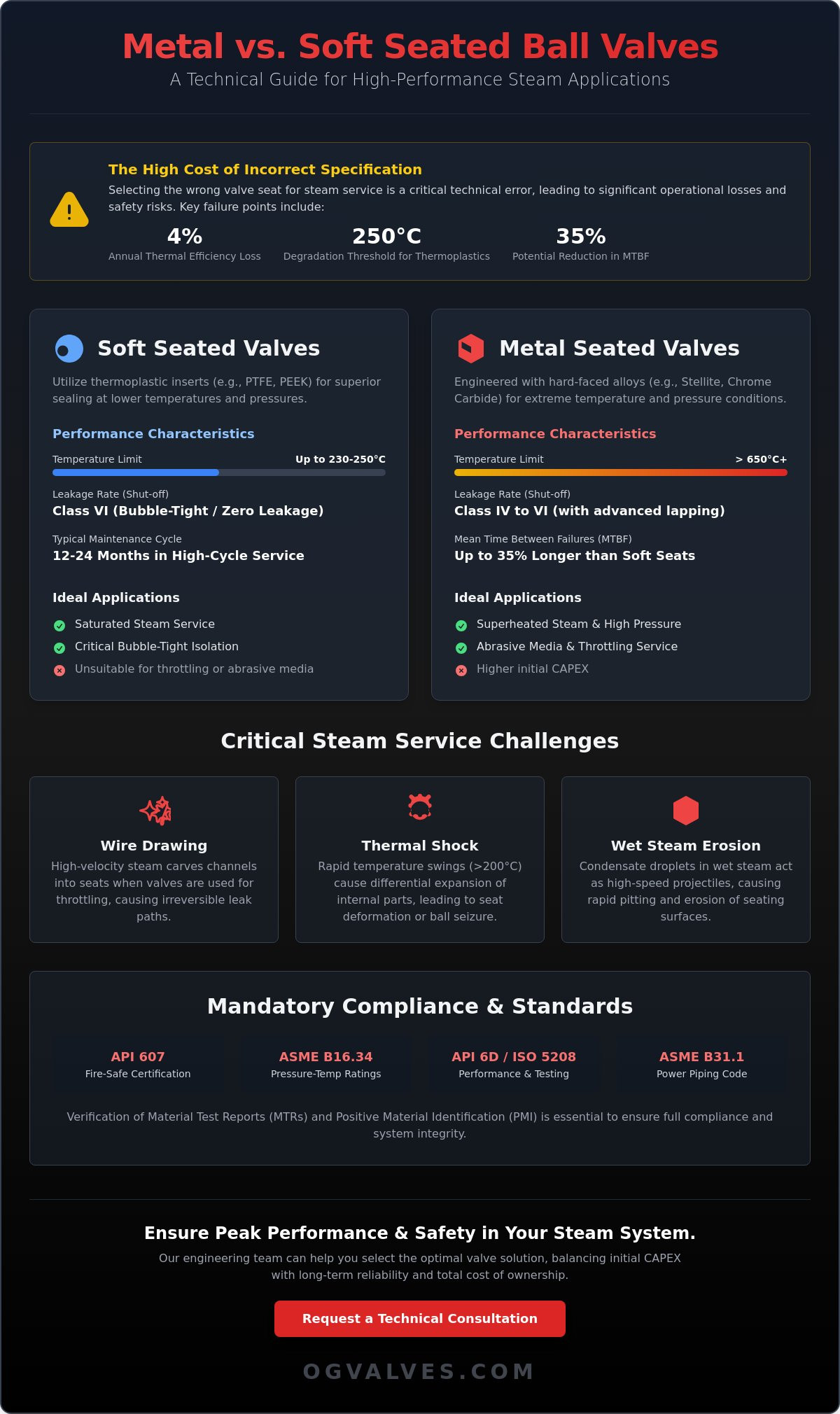
The assumption that a higher ANSI leakage class always correlates with superior system reliability is a technical fallacy that costs industrial facilities an average of 4% in annual thermal efficiency due to steam cutting. Engineers frequently encounter premature seat failure when operating at the 250°C threshold, where the physical properties of thermoplastic inserts begin to degrade under high-velocity saturated steam. Selecting between metal seated vs soft seated ball valves for steam requires a clinical understanding of material metallurgy and the specific pressure-temperature ratings defined by ASME B16.34.
You recognize that unplanned maintenance cycles in high-pressure steam lines aren’t just an operational nuisance; they’re a risk to infrastructure integrity. This technical specification guide provides a rigorous analysis to help procurement specialists determine the optimal seating material for saturated and superheated applications. We’ll examine the definitive performance thresholds for reinforced PTFE, PEEK, and hard-faced metal alloys to ensure your selection meets API 6D and ISO 5208 standards while extending mean time between failures by up to 35%.
Key Takeaways
Analyze the critical interface between the ball and seat to maintain system thermal efficiency and prevent component degradation in high-velocity steam environments.
Assess the chemical and thermal thresholds of PTFE and reinforced PEEK when evaluating metal seated vs soft seated ball valves for steam to ensure operational safety in saturated steam service.
Identify the engineering necessity of specific alloy grades, such as Stellite and Chrome Carbide, for maintaining seat integrity in superheated steam and high-pressure bypass applications.
Utilize a rigorous selection matrix based on pressure, temperature, and velocity to optimize the balance between initial CAPEX and long-term total cost of ownership (TCO).
Standardize procurement protocols by verifying Material Test Reports (MTRs) and Positive Material Identification (PMI) to ensure full compliance with ASME and API standards.
Fundamental Mechanics of Ball Valve Seating in Steam Systems
The interface between the ball and seat represents the most critical pressure boundary in industrial steam distribution. In high-velocity steam applications, where flow rates often exceed 30 meters per second, this contact zone experiences intense mechanical stress and thermal cycling. Maintaining seat integrity isn’t just about leak prevention; it’s a core requirement for system thermal efficiency. A minor leak in a 10-bar steam line can waste over 50 kilograms of steam per hour, significantly increasing operational costs over a standard 8,760-hour production year. Understanding the underlying ball valve mechanics is essential for selecting the correct configuration between metal seated vs soft seated ball valves for steam.
Steam systems distinguish strictly between isolation service and flow control. Ball valves typically function as quarter-turn isolation devices. Using them for continuous throttling leads to “wire drawing,” where localized high-velocity steam carves paths into the seating material. Standard construction follows two primary architectures. Floating ball designs use upstream pressure to force the ball against the downstream seat, creating a seal. Trunnion-mounted designs fix the ball on a vertical axis, utilizing spring-loaded seats to maintain contact. Trunnion designs are mandatory for Class 600 and higher pressure ratings to manage the massive torque requirements and ensure consistent sealing under variable loads. Selecting between metal seated vs soft seated ball valves for steam requires an analysis of the specific pressure drop across the valve and the potential for thermal shock.
The Physics of Steam at the Seating Surface
Dry steam induces mechanical wear through high-velocity impingement. However, wet steam poses a greater risk. Condensate droplets act as high-speed projectiles that cause rapid seat erosion and pitting. Thermal expansion also dictates valve performance. During a cold start-up, valve internals expand at different rates based on their material coefficients. If the design doesn’t account for these 200°C+ temperature swings, the ball can seize within the seats, leading to catastrophic actuator failure or seat deformation. Engineers don’t overlook these expansion rates when specifying tolerances for high-pressure headers.
Seating Classifications and Standards
Engineering specifications rely on ASME B16.34 and API 608 to define the structural requirements of ball valves. For steam isolation, Class VI shut-off, often termed bubble-tight, is the benchmark for performance. While soft seats traditionally met this standard, advanced metal-to-metal lapping techniques now achieve Class VI compliance in high-temperature environments. Additionally, API 607 fire-safe certification remains a non-negotiable requirement for steam lines in petrochemical facilities. This ensures the valve maintains a secondary seal even if the primary soft seat is destroyed by external heat sources during a facility incident.
Performance Limitations of Soft Seated Ball Valves in Steam Service
Soft seated ball valves serve as the primary solution for saturated steam applications where bubble-tight shut-off is a critical requirement. These valves utilize thermoplastic inserts to achieve a Zero Leakage rate, yet their operational ceiling is strictly defined by the thermal and mechanical properties of the seat material. When evaluating metal seated vs soft seated ball valves for steam, engineers must recognize that soft seats are susceptible to rapid degradation once temperatures exceed 230°C or when high differential pressures are present during opening and closing cycles.
Maintenance cycles for soft seated valves in steam service are typically shorter than their metal counterparts. In high-cycle environments, elastomer and thermoplastic degradation often necessitates seat replacement every 12 to 24 months to prevent bypass leakage. Adherence to industry compliance standards such as ASME B31.1 is mandatory for determining the safe operating envelope of these materials within power piping systems.
Common Soft Seat Materials: PTFE, RPTFE, and PEEK
Virgin PTFE remains the standard for low-pressure steam, offering excellent chemical inertness but limited thermal resistance, typically capping at 175°C. To extend this range, Reinforced PTFE (RPTFE) incorporates 15% glass or carbon fillers, which enhances structural stability and raises the functional limit to approximately 230°C at 250 PSI. These materials maintain high compatibility with common boiler treatment chemicals, including neutralizing amines and oxygen scavengers, which can sometimes swell or degrade lesser elastomers.
PEEK (Polyether ether ketone) seats bridge the performance gap between traditional soft seats and metal-to-metal designs. PEEK provides a robust solution for steam temperatures reaching 315°C, offering superior resistance to abrasive wear. For systems requiring validated seat integrity in these intermediate ranges, reviewing the technical specifications of industrial ball valves ensures proper material selection for specific steam enthalpies.
Failure Modes: Wire Drawing and Deformity
The most prevalent failure mode in steam service is “wire drawing,” also known as steam cutting. This occurs when a valve is partially cracked open or fails to seal completely, allowing high-velocity steam to escape through microscopic gaps. The resulting localized erosion creates deep grooves in the soft seat material, leading to a total loss of sealing integrity that cannot be reversed without component replacement.
Thermal cycling further compounds these risks by inducing “cold flow” in thermoplastic components. Cold flow is a permanent deformation under constant pressure. This phenomenon, combined with the expansion and contraction of the valve body during heat-up and cool-down phases, often results in seat misalignment or the loss of pre-load. This technical limitation is a decisive factor in the metal seated vs soft seated ball valves for steam debate for high-pressure headers and superheated lines.
Engineering Advantages of Metal Seated Ball Valves for High-Temperature Steam
High-pressure steam environments, particularly superheated steam and turbine bypass systems, require the mechanical resilience of metal seats. While soft seats fail as temperatures approach 260°C (500°F), metal seated configurations maintain structural integrity at 538°C (1000°F) and beyond. The primary distinction in the metal seated vs soft seated ball valves for steam debate lies in the material’s ability to resist thermal degradation and high-velocity erosion. Engineers specify 316 stainless steel for valve bodies, but the critical performance occurs at the seat interface where Stellite 6 or Chrome Carbide overlays are applied.
The necessity for metal seats becomes absolute in high-pressure bypass applications where steam velocities can reach sonic levels. In these conditions, any polymer-based seal would suffer immediate wire-drawing or total deformation. Metal seats provide a rigid mechanical barrier that resists the abrasive nature of scale and particulates often found in aging steam headers. This durability ensures that the valve’s primary sealing surface remains intact over thousands of thermal cycles.
Hardening and Surface Treatment Technologies
HVOF (High-Velocity Oxy-Fuel) coating processes represent the industry standard for hardening. This technique propels carbide particles at supersonic speeds, creating a dense, non-porous layer with bond strengths exceeding 10,000 PSI. For steam service, Chrome Carbide is preferred over Tungsten Carbide when temperatures surpass 400°C, as Tungsten Carbide is susceptible to oxidation in high-temperature steam environments. Stellite 6 overlays are also utilized for their exceptional cobalt-based hardness, which prevents galling during high-frequency operation. Matched ball-and-seat lapping is the final critical step, where the components are ground together to create a unique, hand-finished fit that ensures maximum contact area.
Leakage Class Realities: Class IV and V
Achieving a seal in high-cycle steam duty involves a technical trade-off between durability and leakage class. Metal seats typically adhere to ASME B16.104 Class IV or Class V standards. While Class VI (bubble-tight) is the benchmark for soft seats, metal seats rarely achieve this without excessive actuator torque that risks mechanical galling. These industrial ball valves undergo rigorous hydro and pneumatic testing to ensure they meet the specific allowable leakage rates defined for high-pressure isolation. It’s a functional reality that a Class V seal provides sufficient isolation for most steam bypass and power generation applications where absolute zero-leakage isn’t as critical as the valve’s ability to open and close reliably under extreme thermal stress.
Class IV: 0.01% of rated valve capacity, suitable for general steam service.
Class V: 0.0005 ml per minute per inch of orifice diameter, required for high-pressure critical bypass.
Lapping: Ensures the mechanical integrity of the seal by matching the ball and seat geometries to micron-level precision.
The selection of metal seated vs soft seated ball valves for steam must prioritize the long-term cost of maintenance over initial leakage specifications. Metal seats don’t require the frequent replacements associated with PTFE or PEEK seals in steam service, making them the standard for critical infrastructure.
Comparative Analysis: Selecting Seat Materials Based on Steam Quality
Engineering the optimal steam system requires a rigorous evaluation of the selection matrix: pressure, temperature, and fluid velocity. These three variables dictate the mechanical survival of the valve internals. High-velocity steam often carries entrained particulates or scale that can erode soft polymer seats in fewer than 500 operational cycles. While initial CAPEX for soft-seated options is lower, the total cost of ownership (TCO) frequently favors metal alternatives in high-cycle environments. Metal seated vs soft seated ball valves for steam analysis indicates that metal-to-metal designs reduce unplanned maintenance downtime by approximately 35% in systems prone to wire-drawing.
Boiler Feed: High-pressure requirements necessitate the structural integrity of metal seats to prevent seat deformation.
Turbine Isolation: Zero-leakage is critical; metal seats with specialized coatings provide the necessary resilience against thermal cycling.
Condensate Lines: Flashing conditions create high-velocity slugs that can tear soft seat inserts, making metal the safer technical choice.
Saturated Steam Selection Framework
Reinforced Polytetrafluoroethylene (RPTFE) serves as the industry standard for saturated steam applications where temperatures remain below 175°C. It’s a cost-effective solution for low-pressure utility steam. However, a technical “gray area” exists between 180°C and 210°C. In this range, polymers begin to lose structural rigidity, leading to “cold flow” and subsequent seal failure. If your process parameters frequently cross this 200°C threshold, transitioning to a metal seat is mandatory to ensure long-term compliance. For alternative isolation strategies in these conditions, refer to our gate valve vs ball valve comparison for detailed design standards.
Superheated Steam and Severe Service
Superheated steam environments are strictly the domain of metal-seated valves. These systems don’t allow for the use of elastomers or polymers due to instantaneous thermal degradation. Metal-to-metal contact, often enhanced with Stellite 6 or Chromium Carbide coatings, handles the extreme thermal shock associated with rapid system depressurization. The friction coefficient in these assemblies is substantially higher than in lubricated soft seats. Consequently, sizing actuators for metal-seated valves requires a safety factor of 25% to 50% above the standard breakaway torque to ensure reliable operation under full differential pressure.
For precise technical specifications and material grade recommendations for your steam infrastructure, contact the OG Valves engineering team for a comprehensive consultation.
Strategic Procurement and Compliance Standards for Steam Service
Procurement of high-pressure steam components requires a rigorous verification process to mitigate catastrophic failure risks. When evaluating metal seated vs soft seated ball valves for steam, engineers must prioritize material traceability. Every critical component, specifically the ball and seat interface, requires a comprehensive Material Test Report (MTR). These documents verify the chemical composition and mechanical properties of alloys like XM-19 or Stellite 6 overlays. Positive Material Identification (PMI) testing provides an additional layer of security by confirming alloy integrity at the point of delivery. This prevents the accidental installation of lower-grade materials that would fail under 500°F steam conditions. For global operations, compliance with the Pressure Equipment Directive (PED) 2014/68/EU is mandatory. It ensures that pressure-retaining parts meet the safety requirements necessary for high-pressure environments across the European Economic Area and beyond.
Quality Assurance and Testing Protocols
Standard hydrostatic testing often fails to replicate the molecular behavior of high-temperature steam. We utilize high-pressure gas testing to identify leaks that water-based methods miss. Seat integrity is further validated through fugitive emission standards like ISO 15848-1, which limits leakage to less than 10^-6 mg/m/s. These protocols are essential for maintaining environmental compliance and operational efficiency. Engineers benefit from partnering with a specialist valve supplier to ensure every technical specification aligns with API 608 and ASME B16.34 standards. Rigorous testing isn’t optional. It’s the only way to guarantee performance in supercritical steam applications.
Inventory Management for Critical Steam Infrastructure
Emergency steam outages can cost industrial facilities upwards of $25,000 per hour in lost production. Maintaining a strategic inventory of high-specification metal seated valves is a prerequisite for minimal downtime. Our global logistics network facilitates fast-track delivery, often reducing lead times from 20 weeks to under 72 hours for standard sizes. This rapid response is critical when a soft-seated valve fails prematurely due to thermal degradation. Proper inventory management ensures that the correct metal seated vs soft seated ball valves for steam are available for immediate deployment. We focus on these logistics to protect your operational continuity.
Technical Procurement Checklist:
Verify MTRs for ASTM A182 F316/F316L forge grades.
Execute PMI on all pressure-retaining shells and stems.
Confirm PED 2014/68/EU Category III or IV compliance.
Request API 607 fire-safe certification for all steam line isolation valves.
Optimizing Steam System Integrity Through Advanced Material Selection
Selecting between metal seated vs soft seated ball valves for steam requires a rigorous evaluation of thermal loads and pressure differentials. Soft seated designs typically reach their operational limit at 232°C before polymer degradation occurs. For high-pressure saturated steam, metal seated valves utilizing Grade 6 Stellite or tungsten carbide coatings are essential to maintain ASME B16.34 compliance. These components ensure Class V or VI shut-off integrity and prevent the erosion common in severe service environments. Engineering teams must prioritize materials that withstand thermal expansion while meeting API 607 fire-safe requirements for 2026 safety protocols.
OG Valves maintains an extensive inventory of API and ASME compliant valves to support critical infrastructure. We provide global fast-track delivery for industrial outages, ensuring that your facility’s downtime is minimized through efficient logistics. Our technical expertise in severe service material selection ensures your system meets the highest safety benchmarks. Request a Technical Quote for Industrial Steam Valves to secure reliable components for your next project. It’s time to elevate your facility’s operational precision with hardware built for endurance.
Frequently Asked Questions
Can soft seated ball valves be used in superheated steam?
Soft seated ball valves shouldn’t be used in superheated steam applications because temperatures frequently exceed 250°C (482°F). Most elastomeric and thermoplastic seat inserts degrade rapidly under these conditions, leading to seat deformation and catastrophic seal failure. For superheated service, the technical specification requires metal seated ball valves to maintain structural integrity. This ensures the valve complies with ASME B16.34 pressure-temperature ratings for high-pressure steam systems.
What is the maximum temperature limit for a PTFE seated ball valve in steam service?
The maximum temperature limit for virgin PTFE seated ball valves in steam service is 204°C (400°F) at low pressures. However, operating at the upper limit of this range significantly reduces the material’s mechanical strength and increases the risk of cold flow. Most engineers specify reinforced PTFE (RPTFE) for saturated steam up to 150 PSI to prevent premature seal degradation and ensure long-term performance in industrial boiler systems.
Why do metal seated ball valves require higher torque than soft seated ones?
Metal seated ball valves require higher torque because the metal-to-metal contact generates a higher coefficient of friction compared to self-lubricating polymers. To achieve a reliable seal, the design must apply higher seating loads to overcome surface irregularities on the ball and seat rings. When comparing metal seated vs soft seated ball valves for steam, engineers must size actuators with a 25% safety factor to account for this increased breakout torque.
What is steam cutting and how does it affect ball valve seats?
Steam cutting is a form of high-velocity erosion that occurs when high-pressure steam leaks through a small orifice, such as a damaged seat. This localized wire-drawing effect creates deep grooves in the seating surface, making it impossible to maintain a tight shut-off. In systems with 10% or higher moisture content, the droplets act as abrasive projectiles. This process rapidly destroys soft seats and necessitates the use of hardened metal alloys.
Is it possible to achieve a bubble-tight seal with a metal seated ball valve?
It’s possible to achieve a bubble-tight seal, classified as ANSI/FCI 70-2 Class VI, through precision lapping of the ball and seat sets. This process ensures the components are matched within 0.0001 inches of tolerance. While standard metal seated valves often meet Class IV or V leakage rates, high-performance designs utilizing tungsten carbide coatings and spring-loaded seats provide the zero-leakage performance required for critical isolation in steam distribution headers.
Which seat material is best for abrasive particulates in steam condensate?
Tungsten carbide or chrome carbide coatings are the superior choices for handling abrasive particulates in steam condensate. These materials provide a hardness rating exceeding 70 HRC, which protects the sealing surfaces from suspended solids and pipe scale. Unlike soft materials that trap debris and cause scoring, hardened metal seats wipe the ball surface during operation. This mechanical action maintains seal integrity in systems following the ISO 4406 cleanliness standards.
How does thermal expansion affect ball valve operation in steam lines?
Thermal expansion causes the ball and stem to expand at different rates than the valve body, which can lead to mechanical binding of the valve. In steam lines reaching 350°C, a 4-inch valve can experience dimensional changes that increase operating torque by 40% or more. Engineers mitigate this risk by utilizing spring-loaded seat designs and selecting materials with matched coefficients of thermal expansion to ensure consistent performance across temperature cycles.
What are the most common hardening coatings for metal seats in steam service?
The most common hardening coatings for metal seats in steam service include High-Velocity Oxygen Fuel (HVOF) applied Tungsten Carbide and Stellite 6 cobalt-based alloys. These coatings increase surface hardness to between 50 and 72 HRC. When evaluating metal seated vs soft seated ball valves for steam, these treatments are essential for preventing galling at temperatures above 315°C. These specifications align with API 6D standards for durability in severe service environments.
 Responsive Menu