Alternatives to Gate Valves for Pipeline Isolation: A Technical Engineering Guide
April 29, 2026
Home+Alternatives to Gate Valves for Pipeline Isolation: A Technical Engineering Guide
A single millimeter of particulate matter on a gate valve seat can compromise the isolation integrity of a Class 600 pipeline. While the gate valve is a legacy standard, its susceptibility to seat erosion and slow multi-turn actuation often necessitates the integration of high-performance alternatives to gate valves for pipeline isolation. You’re aware that manual gate operation during an emergency shutdown is a liability when seconds dictate the containment of high-pressure media.
This technical guide provides a rigorous analysis of valve configurations engineered for critical industrial isolation. We’ll detail how adopting quarter-turn technologies like triple-offset butterfly valves or metal-seated ball valves can reduce maintenance intervals and ensure full compliance with API 6D and ASME B16.34 standards. You’ll examine specific sealing mechanisms that provide zero-leakage performance in compact piping skids where traditional gate valve dimensions are impractical.
Key Takeaways
Analyze the mechanical limitations of traditional gate valves and the technical advantages of quarter-turn ball valves for achieving verifiable, bubble-tight isolation.
Evaluate high-performance alternatives to gate valves for pipeline isolation, including Triple Offset Butterfly Valves (TOV) and plug valves designed for abrasive slurry and high-cycle service.
Utilize ASME B16.34 and API 6D pressure-temperature ratings to accurately select valve configurations based on media corrosivity, erosivity, and phase requirements.
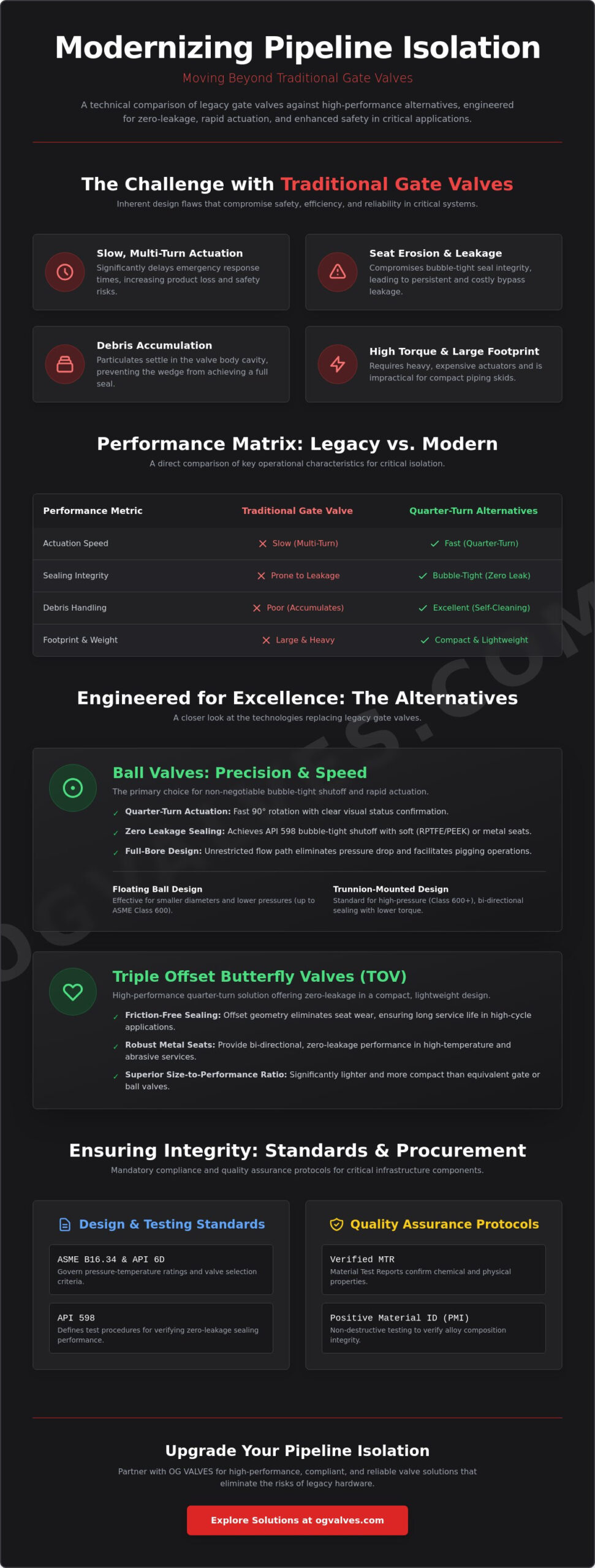
Establish rigorous quality assurance protocols by integrating Verified Material Test Reports (MTR) and Positive Material Identification (PMI) into the procurement of critical infrastructure components.
The Limitations of Traditional Gate Valves in Critical Pipeline Isolation
Pipeline isolation is the mechanical process of establishing a verifiable pressure barrier within a piping system to ensure the safety of downstream personnel and equipment during maintenance or emergency shutdowns. While the standard wedge gate design is a historical staple in industrial infrastructure, engineers increasingly evaluate alternatives to gate valves for pipeline isolation due to inherent mechanical limitations. A primary Isolation valve must provide a bubble-tight seal, yet gate valves frequently succumb to seat erosion and wedge sticking in high-cycle or high-pressure environments.
Failure modes often manifest as stem leakage or the inability to fully seat the wedge. In high-flow systems, the slow multi-turn operation required to actuate a gate valve significantly delays emergency response times. This lag can result in increased product loss or escalated safety risks. Additionally, debris-laden media presents a severe challenge. Particulates often settle in the bottom cavity of the valve body, preventing the wedge from reaching its full travel. This compromises the metal-to-metal seating, leading to persistent bypass leakage that necessitates costly repairs.
Verifying Isolation Integrity: The Double Block and Bleed Requirement
In high-risk maintenance environments, the Double Block and Bleed (DBB) configuration is a mandatory safety protocol. This setup requires two independent sealing surfaces with a bleed point in between to verify zero leakage. Standard gate valves require two separate units and a spool piece to achieve this, which increases the installation footprint and weight by up to 50% compared to integrated DBB units. Isolation integrity, according to API 598 standards, is defined as the valve’s ability to maintain a verifiable seal against specified test pressures without visible leakage across the seating surfaces.
Operational Friction and Maintenance Overhead
Long-term reliability is often hindered by packing gland wear, which is the leading cause of fugitive emissions in aging infrastructure. Large-diameter gate valves, such as those exceeding NPS 24, demand massive torque levels when operated under high differential pressure. This necessitates heavy, expensive actuation systems or manual gearboxes that require significant physical effort. For a deeper analysis of these mechanical constraints and design standards, consult A Technical Guide to Industrial Gate Valves. These maintenance burdens drive the industry toward more efficient, quarter-turn alternatives to gate valves for pipeline isolation that offer lower torque and reduced footprint.
Ball Valves: The Precision Alternative for Bubble-Tight Shutoff
Ball valves represent a primary category of alternatives to gate valves for pipeline isolation, specifically where bubble-tight shutoff is a non-negotiable requirement. Unlike the multi-turn operation of a gate valve, the quarter-turn kinematics of a ball valve allow for rapid actuation. This 90-degree rotation provides clear visual confirmation of the valve’s status. It reduces the risk of human error during critical maintenance procedures. Engineering teams favor this design for its reliability in high-cycle applications where gate seats might suffer from premature wear or particulate accumulation.
Sealing integrity depends on the material selection. Soft-seated designs utilizing RPTFE or PEEK provide Zero Leakage (API 598) at temperatures up to 200°C. For high-temperature or abrasive media, metal-seated configurations with Stellite or Tungsten Carbide coatings ensure long-term performance. Full-bore ball valves maintain a flow path identical to the pipe’s internal diameter. This eliminates the turbulence and pressure drop often associated with globe valves or reduced-port designs. It also facilitates efficient pigging operations, which is a significant advantage over traditional wedge-style gates in midstream applications.
Floating vs. Trunnion Ball Valves for Isolation
In floating ball designs, the ball is suspended between two seats. Upstream pressure forces the ball against the downstream seat to create a seal. This mechanism is effective for smaller diameters but becomes problematic at higher pressures. For pipelines operating at ASME Class 600 or above, trunnion-mounted valves are the standard. These utilize fixed stems and spring-loaded seats that maintain constant contact with the ball. This design reduces operating torque and ensures bi-directional sealing. It’s essential to evaluate these mechanics when selecting alternatives to gate valves for pipeline isolation in large-diameter gas transmission lines. Engineers should consult the Industrial Ball Valves: A Technical Engineering & Specification Guide for detailed torque calculations and material compatibility matrices.
Actuation and Control in Isolation Circuits
Automation is vital for modern pipeline integrity. Integrating pneumatic or electric actuators allows for remote isolation in response to emergency shutdown (ESD) signals. Specification of the Fail-Safe position is a critical safety step. In most isolation circuits, a Fail-Close configuration is mandated to prevent the continued flow of hazardous media during a power or signal loss. For a deeper analysis of automation standards, refer to the Industrial Valve Actuators: A Technical Guide. These systems ensure that isolation occurs within milliseconds, protecting downstream equipment from pressure surges. If your project requires high-integrity shutoff, you can review our technical specifications to match the correct actuator to your specific service conditions.
Specialized Isolation: Butterfly and Plug Valve Solutions
Engineers increasingly specify alternatives to gate valves for pipeline isolation to address weight constraints and high-cycle fatigue. Triple Offset Butterfly Valves (TOV) represent a significant shift from traditional resilient-seated designs. The TOV geometry incorporates three distinct offsets. The third offset, an inclined conical axis, eliminates seat friction during the entire 90-degree stroke. This design ensures torque-seated sealing and reduces component wear. It’s a reliable solution for critical infrastructure where seat degradation isn’t acceptable.
Triple Offset Butterfly Valves as Gate Valve Replacements
The geometry of the third offset creates a camming action that ensures metal-to-metal contact only at the final point of closure. This eliminates the rubbing common in gate or ball valves. TOVs provide a compact footprint compared to heavy gate valve castings. On offshore platforms or modular skids, a TOV can reduce total assembly weight by up to 45%. These valves meet API 607 and ISO 10497 fire-safe standards for hydrocarbon service, ensuring integrity during extreme thermal events. For a deeper technical analysis of these components, consult The Engineer’s Guide to Industrial Butterfly Valves.
Plug Valves for Severe Service Isolation
Plug valves offer superior performance in abrasive slurries where gate valve seats often fail due to sediment accumulation in the body cavity. Non-lubricated plug valves utilize PTFE or PFA sleeves to provide chemical resistance and bubble-tight isolation without the risk of process contamination. In contrast, lubricated variants require periodic sealant injection but excel in high-pressure gas applications where secondary sealing is vital. Eccentric plug designs are particularly effective for solids-laden media. The plug lifts off the seat immediately upon rotation, preventing abrasive wear from suspended particles. While a standard gate valve offers a full circular bore, a rectangular port plug valve typically provides 60% to 70% of the pipe area while maintaining superior sealing integrity in high-cycle operations.
When evaluating alternatives to gate valves for pipeline isolation, the selection depends on the specific media characteristics. Plug valves remain the standard for high-solids content, while TOVs dominate in space-constrained, high-temperature environments. Both options provide the long-term reliability required in ASME B16.34 compliant systems. They don’t suffer from the wedge-sticking issues common in gate designs during thermal cycling.
Engineering Selection Criteria for Pipeline Isolation
Engineers must evaluate specific operational parameters when vetting alternatives to gate valves for pipeline isolation. Media analysis serves as the primary technical filter. Corrosive or erosive fluids dictate metallurgy; the phase of the media (gas vs. liquid) influences sealing selection. High-velocity gas streams often require metal-seated configurations to prevent seat erosion. If the media contains particulates, a knife gate or a ball valve with scrapers is necessary to maintain seat integrity.
Adherence to ASME B16.34 and API 6D pressure-temperature tables is mandatory. These standards define the pressure-retaining capabilities of the valve body across thermal gradients. Leakage integrity must align with MSS SP-61 or API 598 testing requirements. While gate valves provide metal-to-metal contact, high-performance butterfly valves or soft-seated ball valves often achieve Class VI “bubble-tight” shutoff. This is essential for volatile organic compound (VOC) containment in 2024 compliance frameworks.
Installation environment factors include total weight and spatial orientation. A 24-inch gate valve can weigh 2,500 kg, which is often 30% more than a comparable triple-offset butterfly valve. This weight reduction simplifies pipe support design and improves maintenance accessibility. Orientation matters too; some alternatives don’t perform well when installed horizontally due to sediment buildup in the tracks.
Material Compatibility and Metallurgy
Offshore isolation demands high-strength, corrosion-resistant alloys. Specifying Duplex (UNS S31803) or Super Duplex (UNS S32750) ensures longevity in chloride-rich environments. For high-temperature steam service reaching 540°C, metal-seated valves utilize hard-facing techniques. Stellite 6 overlays provide the necessary hardness to resist thermal cycling. If the application involves sour gas, compliance with NACE MR0175/ISO 15156 is non-negotiable to prevent sulfide stress cracking in the valve stem and body.
Verifying Flow Coefficients (Cv) and Pressure Drop
Valve selection directly impacts long-term operational costs. A valve’s Flow Coefficient (Cv) determines the pressure drop across the device. Full-bore ball valves provide an unobstructed flow path, optimizing throughput and reducing pump energy consumption. Restricted-bore alternatives to gate valves for pipeline isolation can introduce turbulence, leading to a 15% increase in energy loss per station. Detailed technical specifications regarding flow dynamics are available in our Industrial Valves: The Engineer’s Comprehensive Guide.
Procurement and Compliance: Sourcing High-Performance Isolation Valves
Procurement of high-integrity valves requires rigorous verification of material provenance. OG Valves mandates comprehensive Material Test Reports (MTR) and utilizes Positive Material Identification (PMI) to confirm alloy compositions before any component enters the assembly phase. These protocols mitigate the risk of stress corrosion cracking or premature mechanical failure in volatile environments. When engineers evaluate alternatives to gate valves for pipeline isolation, compliance with API 6D, ASME B16.34, and ISO 14313 standards provides the baseline for operational safety. Strategic inventory management allows for the immediate availability of high-specification ball and butterfly valves, reducing the standard 24-week lead times that often stall large-scale infrastructure projects.
Verification of heat numbers and material traceability for all pressure-containing parts.
Strict adherence to NACE MR0175/ISO 15156 for sour service applications.
Standardized documentation packages including hydro-test certificates and functional test reports.
Quality Assurance and Factory Acceptance Testing (FAT)
Every valve undergoes standardized pressure testing to verify zero-leakage performance according to API 598 or ISO 5208 before leaving the facility. These tests include high-pressure hydrostatic shell tests and low-pressure air seat tests. For high-stakes industrial projects, we facilitate Third-Party Inspection (TPI) services through agencies such as ABS or DNV to provide an additional layer of verification. Technical teams at OG Valves analyze project data sheets to ensure valve specifications, including torque requirements and bore dimensions, align perfectly with the existing pipeline architecture. This technical alignment is critical when implementing alternatives to gate valves for pipeline isolation to ensure the new hardware integrates with existing actuators and control systems.
Global Logistics and Fast-Track Supply
Supply chain volatility often delays the acquisition of specialized alloys like Super Duplex or Monel. OG Valves bypasses these bottlenecks through a robust network of vetted foundries and a centralized distribution model. In a 2023 emergency replacement project, we delivered 12-inch Class 600 isolation valves within 14 days to a midstream facility, preventing an estimated $1.5 million in daily production losses. This fast-track capability ensures that critical infrastructure maintains its integrity without the typical 30-week wait for custom-engineered components. It’s a logistical advantage that prioritizes functional reality over administrative delays. Consult with OG Valves for high-specification isolation solutions to secure your project timelines and technical requirements.
Securing Operational Integrity with Advanced Isolation Specifications
Identifying the correct alternatives to gate valves for pipeline isolation is a mandatory step for maintaining zero-leakage performance in modern high-pressure systems. Precision-engineered ball valves provide the bubble-tight shutoff necessary for critical isolation, while butterfly and plug designs offer technical solutions for space-constrained or high-cycle environments. Engineering teams must prioritize strict compliance with API 6D and ASME B16.34 standards to mitigate the risks of catastrophic failure and unscheduled downtime in heavy industrial sectors. It’s essential to evaluate torque requirements and seat material compatibility during the specification phase to ensure long-term durability.
OG Valves maintains an extensive inventory of API 6D and ASME B16.34 compliant valves to meet these rigorous demands. Our technical expertise in high-pressure heavy industry applications allows us to provide the clinical precision required for oil, gas, and water treatment sectors. We utilize global fast-track delivery capabilities to ensure your critical infrastructure components arrive on site when they’re needed most. Contact OG Valves for technical consultation on your pipeline isolation requirements. We look forward to supporting your next high-stakes engineering project with uncompromising quality.
Frequently Asked Questions
Can a ball valve fully replace a gate valve in high-pressure steam systems?
High-pressure steam systems require ball valves with metal seats or specialized PEEK inserts to withstand temperatures exceeding 250°C. While gate valves provide a linear flow path, ball valves offer faster isolation and superior sealing at pressures up to ASME Class 2500. Engineers must specify metal-to-metal seating to prevent seat erosion from high-velocity steam. These alternatives to gate valves for pipeline isolation ensure tighter shutoff in critical thermal cycles.
What is the difference between bubble-tight shutoff and standard gate valve leakage classes?
Bubble-tight shutoff indicates a Zero Leakage rate as defined by API 598 or ISO 5208 Rate A standards. Standard gate valves typically adhere to ASME B16.104 Class IV or V, allowing for measurable leakage rates of 0.01% of valve capacity. Soft-seated ball or butterfly valves achieve a 100% seal, whereas metal-seated gate valves rely on mechanical wedging that often permits minor bypass under low-pressure conditions.
When should I use a triple offset butterfly valve instead of a gate valve?
Select a triple offset butterfly valve when installation space is restricted by 30% or weight limits are critical in offshore platforms. TOVs provide bi-directional, zero-leakage performance across temperature ranges from -196°C to 815°C. They eliminate the friction-induced wear seen in gate valves because the seal only contacts the seat at the final point of closure. This design extends service life in high-cycle applications.
Are plug valves better than gate valves for slurries and abrasive media?
Plug valves outperform gate valves in slurry services because the rotating plug wipes the seating surfaces clean during operation. In media with 15% or higher solids content, gate valve seats often accumulate debris in the bottom cavity, preventing full closure. Lubricated plug valves or sleeve-lined versions protect the sealing faces from abrasive wear, maintaining integrity in mining or wastewater applications where gate valves frequently fail.
What API standards govern the testing of isolation valves?
API 598 covers the testing and inspection requirements for most industrial valves, including shell and seat leakage tests. For pipeline applications, API 6D specifies more rigorous protocols for pressure testing and design verification. These standards ensure that alternatives to gate valves for pipeline isolation meet the 110% maximum allowable working pressure requirement during hydrostatic seat tests. Compliance with these specifications is mandatory for high-integrity infrastructure.
Does a quarter-turn valve increase the risk of water hammer in a pipeline?
Rapid closure of quarter-turn valves can generate pressure surges exceeding 200% of the normal operating pressure, leading to water hammer. Gate valves require multiple turns, which naturally slows the closing speed. To mitigate this risk in ball or butterfly valves, engineers install gear operators or slow-acting pneumatic actuators. These components ensure the closing time exceeds the critical time of the pipeline, protecting the system from hydraulic shock.
What are the weight savings when switching from gate valves to butterfly valves?
Switching from a 12-inch ASME Class 300 gate valve to a high-performance butterfly valve yields a weight reduction of approximately 70%. A standard gate valve in this specification weighs roughly 450 kilograms, while a comparable butterfly valve weighs only 130 kilograms. This reduction lowers structural support costs and simplifies installation logistics in complex piping networks. It’s a critical factor for offshore or modular skid construction.
How do I ensure an isolation valve is fire-safe for oil and gas applications?
Ensure fire safety by specifying valves tested to API 607 or API 6FA standards. These certifications require the valve to maintain pressure integrity during and after exposure to temperatures between 760°C and 980°C for 30 minutes. The design must incorporate a secondary metal-to-metal seal that engages if the primary soft seals decompose. Rigorous documentation and heat-traceable material certificates confirm the valve’s capability in volatile hydrocarbon environments.
 Responsive Menu