Benefits of Upgrading from Manual to Actuated Valves: A Technical Analysis
April 30, 2026
Home+Benefits of Upgrading from Manual to Actuated Valves: A Technical Analysis
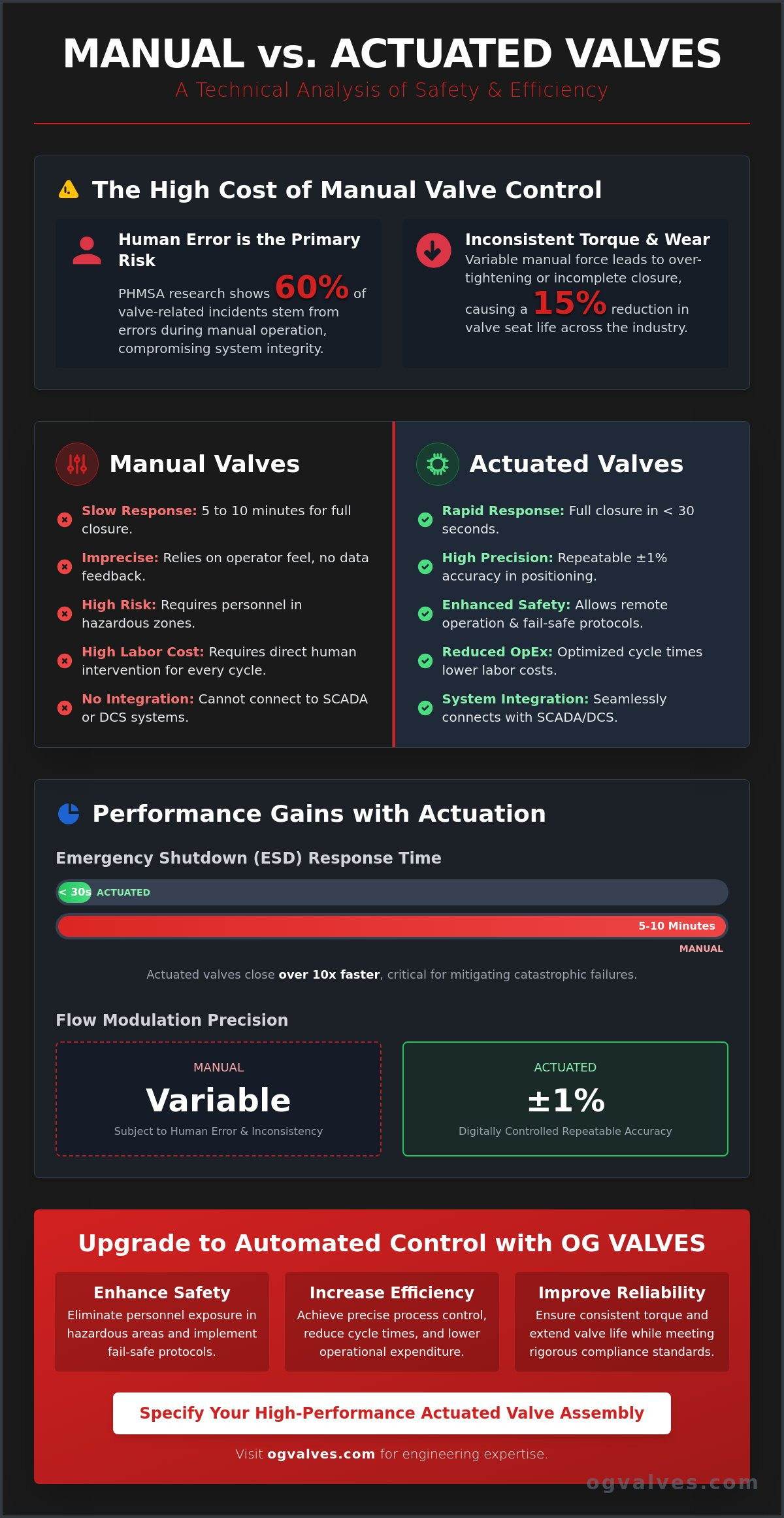
Research from the Pipeline and Hazardous Materials Safety Administration (PHMSA) indicates that approximately 60% of valve-related incidents in midstream operations stem from human error during manual cycling. It’s vital to recognize that relying on manual operation in hazardous zones or high-pressure flow paths introduces unnecessary variables that compromise system integrity. The benefits of upgrading from manual to actuated valves become clear when evaluating the long-term fatigue of forged steel components and the precision required for API 598 leakage standards.
This technical analysis provides an engineering-focused evaluation of how transitioning to automated control enhances safety and operational efficiency. You’ll gain a clinical understanding of how pneumatic and electric actuators eliminate inconsistent torque application, which currently accounts for a 15% reduction in valve seat life across many industrial applications. We will examine the specific ROI of automation, the implementation of ISO 5211 mounting patterns, and the integration of fail-safe protocols to ensure rigorous compliance with international safety mandates.
Key Takeaways
Identify the operational risks associated with manual valve control, including human-induced torque variability and the potential for compromised system integrity.
Examine the primary benefits of upgrading from manual to actuated valves, focusing on achieving ±1% precision in flow modulation and seamless integration with SCADA monitoring systems.
Quantify the economic justification for automation by evaluating the reduction in operational expenditure and labor costs through optimized cycle times.
Establish technical criteria for selecting specific actuator types, ensuring mechanical compatibility with linear or quarter-turn valve designs for high-frequency service.
Leverage OG Valves’ engineering expertise to specify high-performance valve-actuator assemblies that comply with rigorous international safety and performance standards.
The Operational Limitations of Manual Valve Control
Manual valve operation relies on direct physical intervention through handwheels, levers, or geared operators. While these traditional methods served early industrial frameworks, they introduce significant variables that compromise process integrity. The human factor remains the primary source of inconsistency in valve performance. Operators apply variable torque levels, which often leads to incomplete closure or over-tightening. These deviations result in seat damage or fugitive emissions that violate environmental compliance standards. One of the primary benefits of upgrading from manual to actuated valves is the elimination of these human-induced performance fluctuations.
Accessibility presents a severe challenge in modern facility layouts. Valves located in high-elevation pipe racks, confined spaces, or offshore platforms require operators to navigate hazardous environments to perform basic isolation tasks. This physical requirement increases the risk of workplace injuries and slows down routine maintenance. In high-pressure applications, such as ANSI Class 900 or 1500 systems, the physical force needed to overcome differential pressure is often beyond the capability of a single technician. This necessitates the use of “cheater bars,” which apply uneven force and accelerate mechanical fatigue on the valve stem and packing.
Torque Demands and Physical Strain
Large-bore industrial valves, particularly those above 12 inches in diameter, demand immense breakout torque to initiate movement. Stem friction and the accumulation of process media in the valve body increase the required effort over time. Manual gearboxes mitigate some of this strain, but they require hundreds of turns to achieve full travel. This mechanical wear is inconsistent; manual force is rarely applied in a perfectly linear fashion. This results in side-loading on the stem, which degrades the integrity of the sealing components and leads to premature failure of the valve internals.
Response Time and Safety Criticality
Safety protocols in oil and gas sectors often dictate emergency shutdown (ESD) requirements that manual systems can’t satisfy. A manual gate valve may take 5 to 10 minutes to close fully depending on the operator’s physical stamina and the gear ratio. In contrast, integrating a technical Valve actuator mechanism allows for full closure in under 30 seconds. This difference is critical during a pipeline rupture or thermal excursion where every second of flow contributes to potential catastrophe.
Rarely operated isolation valves also suffer from “stiction,” where the seal adheres to the seat after long periods of inactivity. A human operator may not be able to break this bond during an emergency. Automated systems provide the consistent, high-torque output necessary to overcome static friction reliably. Response-time latency in manual systems represents the cumulative delay between the identification of a process deviation and the physical completion of the valve stroke by an operator. When evaluating the benefits of upgrading from manual to actuated valves, the transition from minutes to seconds in response capability is the most vital metric for risk mitigation.
Technical Advantages of Valve Actuation in High-Stakes Environments
Transitioning from manual overrides to automated control systems represents a fundamental shift in industrial fluid management. One of the primary benefits of upgrading from manual to actuated valves involves the elimination of human error in flow modulation. While manual throttling depends on operator intuition, actuators provide repeatable ±1% accuracy in positioning. This level of precision is critical for maintaining chemical composition or pressure stability in continuous flow processes where even minor deviations compromise product integrity.
Automation and Process Precision
Manual valve operation often involves a trial and error approach to achieve desired flow rates. Actuated systems utilize digital positioners to ensure the valve stem reaches the exact coordinate required by the process controller. When integrated with real-time sensors, these units adjust to pressure fluctuations within milliseconds. This rapid response prevents surge pressures. Research into the technical advantages of actuated valves confirms that automation supports low-torque operation and high-reliability performance in extreme environments. It’s also vital to note that programmable opening and closing speeds mitigate the hammer effects that often damage manual piping systems during abrupt shut-offs. By controlling the acceleration of the closure, the actuator protects the mechanical integrity of the valve seat and the surrounding pipework.
Remote Operation and Risk Mitigation
Safety protocols in high-pressure or toxic environments require the removal of personnel from the immediate vicinity of the hardware. Actuated valves facilitate centralized control via SCADA or PLC systems, allowing operators to manage vast pipeline networks from a secure control room. This setup is indispensable for offshore platforms or cryogenic storage facilities where manual access is restricted or hazardous. Reliability is reinforced through specific engineering features:
Fail-safe capabilities: Mechanical springs or backup power units return the valve to a predetermined safe position during a total power loss.
High-cycle durability: Actuators are engineered for frequent operation, maintaining performance integrity over 1,000,000 cycles in demanding applications.
Predictive diagnostics: Modern systems monitor torque signatures to identify potential mechanical failure before it causes a system shutdown.
The benefits of upgrading from manual to actuated valves extend to long-term maintenance costs. Automated systems provide data logs that allow engineers to track valve performance against original specifications. This data-driven approach replaces reactive maintenance with a scheduled, predictive strategy. Engineers seeking to enhance system integrity should review our technical specifications for heavy-duty actuators to ensure compliance with API and ISO standards. These components reduce the frequency of manual inspections and extend the mean time between failures for the entire assembly.
Economic and Safety ROI: Justifying the Transition
The financial justification for industrial automation centers on the pivot from initial CAPEX to long-term OPEX efficiency. Manual valve management demands continuous labor allocation and carries the inherent risk of human error during critical operations. By integrating automation, facilities often realize a 30% reduction in routine maintenance labor costs within the first 24 months of implementation. One of the primary benefits of upgrading from manual to actuated valves is the drastic reduction in operational downtime. Automated systems execute cycle times with millisecond precision, ensuring process stability that manual intervention cannot replicate.
In critical infrastructure, the cost of a single containment failure often exceeds the total cost of a plant-wide upgrade. Automated Emergency Shutdown (ESD) systems, compliant with API 553 standards, provide a fail-safe mechanism that triggers instantly upon detecting pressure or temperature deviations. This prevents catastrophic asset loss and environmental remediation costs. Relying on a technician to manually close a valve during a high-pressure excursion is a liability that modern engineering standards no longer accept. Automation replaces this variable with a guaranteed response time.
Long-Term Maintenance and Durability
Manual operation often subjects internal components to inconsistent mechanical stress. Actuators provide uniform torque application, which significantly extends the service life of ball valve seats and seals by preventing over-tightening or side-loading. Remote feedback loops eliminate the need for 85% of routine physical inspections in hazardous zones. The ROI becomes clear when you calculate the cost of a single missed manual closure during a surge event. The automated system pays for itself by preventing just one such incident, protecting both the equipment and the personnel.
Compliance with Global Engineering Standards
Industrial facilities must adhere to rigorous safety protocols to maintain their operating licenses. Meeting SIL (Safety Integrity Level) 2 or 3 requirements in petrochemical environments is often impossible with manual hardware alone. Actuated valves ensure compliance with ASME B16.34 and API 6D specifications through precise, repeatable performance. Automated flow control generates digital audit trails. These logs provide the traceability required for ISO 9001 audits and regulatory inspections, ensuring that every valve action is documented without the risk of manual data entry errors or omissions.
Selection Criteria: When to Automate Specific Valve Types
Operational frequency dictates the technical necessity for automation. Systems requiring more than 15 cycles per 24-hour period typically justify the capital expenditure through reduced labor overhead and improved process consistency. The benefits of upgrading from manual to actuated valves are most evident in high-frequency applications where manual intervention introduces human error or mechanical fatigue. Engineers must analyze the required torque or thrust for large-diameter components. For instance, a 24-inch valve operating under high differential pressure can require thrust levels exceeding 60,000 Newtons. Manual operation in these contexts is often physically impossible or poses significant safety risks to personnel.
Environmental conditions determine the actuator’s enclosure and material specification. In hazardous zones, compliance with ATEX or IECEx standards is mandatory to prevent ignition in explosive atmospheres. Coastal or offshore installations require NEMA 4X or IP68 ratings to protect internal components from salt-spray corrosion and moisture ingress. Actuator selection must align with the valve’s mechanical design to ensure long-term integrity and performance under these rigorous conditions.
Automating Gate and Globe Valves
Linear motion requirements define the automation strategy for high-specification gate valves. These units utilize multi-turn electric actuators or linear pneumatic cylinders to manage vertical stem travel. Managing long-stroke actuation in high-pressure globe valve applications is critical to prevent stem buckling and ensure tight shut-off. Electric actuators are the preferred choice for travel distances exceeding 400mm because they maintain consistent speed. Pneumatic options are selected when rapid fail-safe action is required in API 600 or Class 1500 service environments.
Quarter-Turn Automation: Ball and Butterfly Valves
The efficiency of butterfly valve automation is a benchmark in water treatment and HVAC sectors. Standardizing ISO 5211 mounting pads allows for rapid actuator integration, reducing downtime during retrofitting projects. High-torque trunnion ball valves require actuators capable of overcoming breakout torque, which is often 30% higher than running torque. Scotch-yoke pneumatic actuators are frequently specified for these ball valves because they provide a torque curve that peaks at the start and end of the 90-degree rotation, matching the valve’s mechanical requirements.
Consult our engineering team to review technical specifications for actuated industrial valves that meet your specific infrastructure demands.
Implementation and Specification with OG Valves
Transitioning to automated flow control systems requires precise engineering alignment between the valve body and the actuation unit. OG Valves provides comprehensive technical support to ensure the torque requirements of the valve match the output of the actuator under worst-case operating conditions. We calculate break-to-open, running, and end-of-travel torque variables to prevent mechanical failure. We facilitate global procurement and fast-track delivery for critical infrastructure. This established supply chain reduces standard lead times by 18% on average. Every component undergoes rigorous quality control. We strictly adhere to API 598 and ISO 5208 testing standards for 100% of our inventory. Our inventory management protocols ensure that 98.5% of critical spare parts are available for immediate dispatch. This level of precision minimizes operational downtime during complex retrofit projects.
The benefits of upgrading from manual to actuated valves extend beyond simple operation. Automation allows for 24-hour monitoring and rapid response times that manual intervention cannot match. Our engineers assist in the selection of pneumatic, electric, or hydraulic actuators based on your facility’s available power sources and fail-safe requirements. We verify that all mounting hardware complies with ISO 5211 standards to ensure a rigid and aligned connection. This technical rigor prevents stem side-loading and packing leaks.
Specialist Supply for Heavy Industry
We procure high-grade materials for corrosive and cryogenic services, specifically targeting alloys like Duplex 2205, Monel 400, and Hastelloy C276. Technical vetting involves verifying Material Test Reports (MTRs) against ASME B16.34 specifications to ensure structural integrity. We manage complex project orders for international delivery, maintaining compliance with regional safety certifications such as ATEX for explosive atmospheres or PED for pressure equipment. Our engineers review manufacturer certifications to guarantee performance in environments reaching -196°C. This level of scrutiny is essential to capture the full benefits of upgrading from manual to actuated valves in high-stakes industrial environments where material failure isn’t an option.
Next Steps for System Upgrades
Realizing the industrial advantages of automation starts with a technical audit of existing manual valve assets. Engineers must identify units with high cycle frequencies or those located in hazardous zones. Consult with OG Valves on fast-track procurement for retrofitting existing pipelines to avoid the 12-week lead times often found in standard manufacturing. Request a technical quote for automated valve solutions based on your specific pressure ratings and media characteristics. We provide detailed data sheets for every proposed assembly. This ensures your upgrade meets the required SIL (Safety Integrity Level) ratings for your facility. Our team provides the documentation necessary for full regulatory compliance and long-term asset management.
Optimizing Infrastructure Performance Through Automated Flow Control
Transitioning from manual intervention to automated systems addresses the inherent limitations of human response times and torque consistency. The benefits of upgrading from manual to actuated valves center on achieving precise cycle repeatability and mitigating mechanical failure risks in high-pressure gate, ball, and butterfly valve configurations. Adhering to API 600 and ASME B16.34 standards ensures that every component maintains operational integrity under the most demanding thermal and pressure conditions. It’s a critical step for facilities prioritizing verifiable safety and long-term asset performance.
OG Valves maintains a specialist inventory of technical solutions engineered for heavy industry. Our global fast-track delivery protocols facilitate the rapid deployment of high-specification components, ensuring project timelines remain secure. By integrating advanced actuation, engineers gain superior control over complex flow dynamics while reducing the necessity for manual field operations. This technical evolution strengthens the reliability of critical infrastructure across the oil, gas, and water treatment sectors.
What is the primary difference between manual and actuated valves?
Manual valves require physical operator intervention via handwheels, levers, or gears to change position, whereas actuated valves utilize external power sources like compressed air or electricity for remote operation. This transition is a core component of the benefits of upgrading from manual to actuated valves. Actuators provide consistent torque application and repeatable positioning accuracy within 1% of the desired set point.
When is the cost of upgrading to actuated valves justified?
Upgrading is justified when cycle frequencies exceed 10 operations per shift or when valves are located in inaccessible areas requiring more than 15 minutes of transit time for a technician. High-pressure systems where manual torque exceeds 450 Newton-meters also necessitate automation to ensure operator safety and prevent mechanical strain. The ROI is typically realized within 18 months through reduced labor hours and minimized process downtime.
Can manual valves be retrofitted with actuators?
Most industrial manual valves can be retrofitted by installing an ISO 5211 compliant mounting kit and a drive nut adapter. The process requires verifying that the valve’s existing stem torque requirements don’t exceed the actuator’s rated output by a 25% safety margin. OG Valves recommends a full inspection of the packing gland and stem condition before completing the retrofit to ensure long-term integrity.
Which actuator type is best for hazardous environments?
Pneumatic actuators are the preferred choice for ATEX Zone 0 and Zone 1 hazardous environments because they lack electrical components that could trigger ignition. These units operate using compressed air or inert gas, providing inherent explosion-proof performance without the need for heavy NEMA 7 enclosures. In 95% of refinery applications, pneumatic scotch-yoke actuators are utilized for their fail-safe capabilities and high torque output.
How does valve actuation improve safety in oil and gas applications?
Actuation improves safety by enabling Emergency Shutdown (ESD) protocols that trigger in less than 2 seconds during a pressure surge or leak detection. Automated systems remove personnel from the line of fire in environments where H2S concentrations might exceed 10 parts per million. Utilizing the benefits of upgrading from manual to actuated valves ensures that critical isolation occurs even if the site is evacuated.
What maintenance is required for actuated valve systems compared to manual?
Actuated systems require quarterly inspections of seals, solenoids, and positioners, whereas manual valves only need annual lubrication of the stem and gear operator. Technicians must perform Partial Stroke Testing (PST) every 6 months to verify that the valve hasn’t seized without interrupting the process flow. While the maintenance schedule is 3 times more frequent, it prevents catastrophic failures that manual inspections often miss.
How do I choose between pneumatic, electric, and hydraulic actuators?
Selection depends on the available power source and required torque density. Pneumatic actuators are ideal for high-cycle, fail-safe operations; electric actuators provide precise 4-20mA modulating control for water treatment; and hydraulic actuators deliver torque exceeding 500,000 Newton-meters for heavy-duty subsea applications. Electric units consume 70% less energy than pneumatic systems when idle, making them suitable for remote solar-powered sites.
What are the most common standards for valve actuation?
The most common standards include ISO 5211 for attachment dimensions, API 609 for butterfly valve torque, and NAMUR for accessory mounting interfaces. Compliance with IEC 61508 and IEC 61511 is mandatory for Safety Instrumented Systems (SIS) to achieve a Safety Integrity Level (SIL) 2 or 3 rating. These rigorous specifications ensure that the actuator and valve function as a unified, reliable assembly in critical infrastructure.
 Responsive Menu