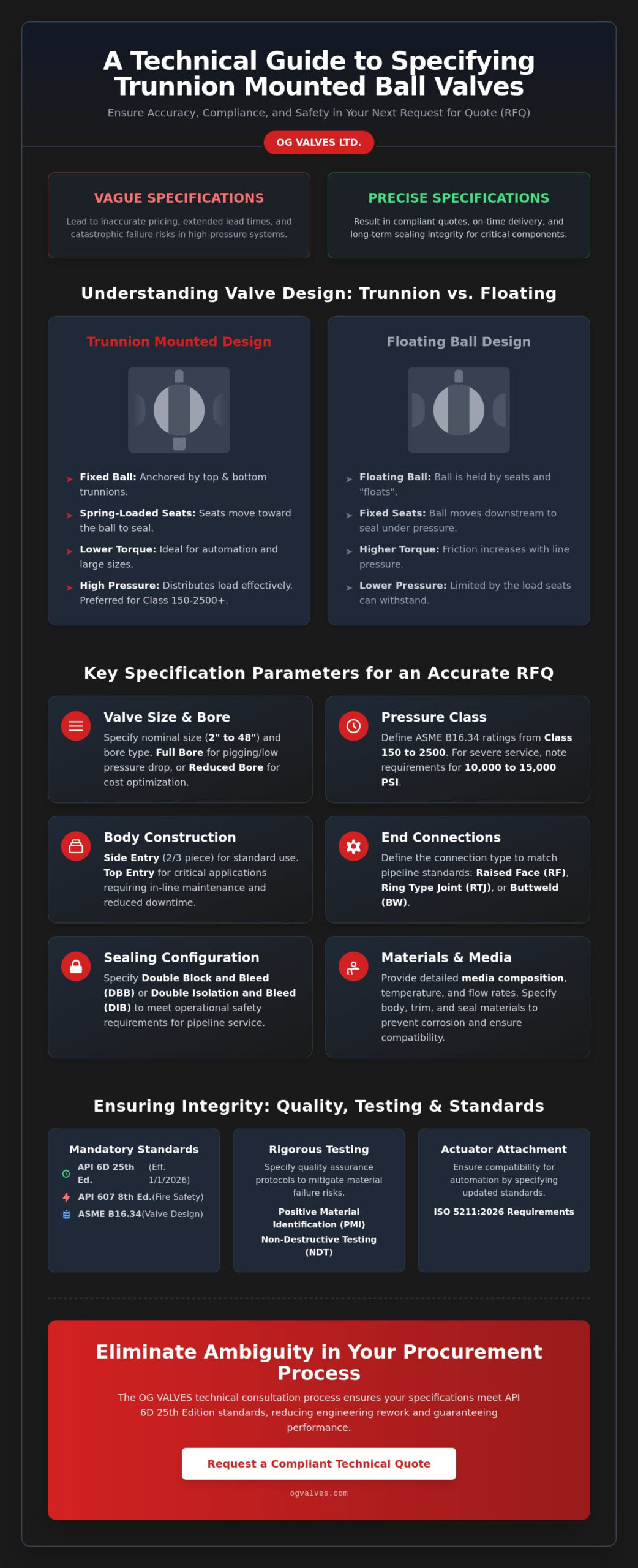
Stainless steel accounted for 48% of the global ball valve market in 2025, but material dominance doesn’t guarantee operational integrity. For engineers in the oil and gas sectors, the difference between a high-performance installation and a catastrophic failure lies in the precision of the initial technical specification. When you prepare to get a quote for trunnion mounted ball valves, vague parameters lead to inaccurate pricing and extended lead times for critical high-pressure components.
You recognize that technical ambiguity remains a primary risk factor in industrial procurement. This guide establishes the rigorous specification framework required to master the procurement process and ensure long-term sealing integrity. We examine the mandatory transition to API Specification 6D 25th Edition standards effective January 1, 2026, and the updated ISO 5211:2026 requirements for actuator attachments. You’ll gain the technical clarity needed to secure a quote that meets exact ASME and API 607 8th Edition compliance standards.
Key Takeaways
Understand the mechanical advantages of trunnion designs for managing axial stress in high-pressure systems ranging from Class 150 to 2500.
Identify the precise dimensional data and ASME B16.34 parameters required to get a quote for trunnion mounted ball valves that eliminates technical ambiguity.
Differentiate between Double Block and Bleed (DBB) and Double Isolation and Bleed (DIB) sealing configurations to ensure operational safety in pipeline service.
Specify rigorous quality assurance protocols, including Positive Material Identification (PMI) and Non-Destructive Testing (NDT), to mitigate material failure risks.
Learn how the OG Valves technical consultation process ensures compliance with API 6D 25th Edition standards while reducing engineering rework.
Understanding Trunnion Mounted Ball Valve Design for Critical Service
A trunnion mounted ball valve is a high-precision isolation component where the ball is mechanically anchored by a trunnion at the top and bottom. This fixed-ball geometry differs fundamentally from floating ball designs where the ball moves downstream to seal against the seat under pressure. In a trunnion configuration, the seats are spring-loaded and move toward the ball. This arrangement prevents excessive axial stress on the seat materials, ensuring long-term sealing integrity in high-pressure environments. Engineers specify this Trunnion Mounted Ball Valve Design for large-scale infrastructure projects requiring diameters from 2″ to 48″ and pressure ratings spanning ASME Class 150 to 2500.
The mechanical advantage of the trunnion design is most evident in severe service applications. While floating valves are limited by the physical load the seats can withstand, trunnion valves distribute the hydraulic load of the process media through the trunnion bearings and into the valve body. This capability makes them the preferred choice for high-pressure gas transport, midstream pipeline operations, and aggressive petrochemical processing. When procurement specialists look to get a quote for trunnion mounted ball valves, they prioritize these designs to minimize seat wear and prevent the material failure often seen in corrosive or high-temperature environments.
The Trunnion Mechanism and Torque Efficiency
The fixed-ball geometry significantly reduces operating torque by transferring the hydraulic load directly to the valve body. Because the ball doesn’t press into the downstream seat with the full force of the line pressure, the friction remains constant regardless of the operating pressure. It’s a critical factor for automation efficiency. Lower torque requirements allow for smaller, more cost-effective actuators. This reduction in component size lowers the total system cost and improves the response time of emergency shutdown systems. The lower trunnion acts as a pivot point, ensuring the ball remains centered even under maximum differential pressure.
Side Entry vs. Top Entry Configurations
Body construction choice depends on maintenance protocols and site accessibility. Side entry configurations, available in two-piece or three-piece bolted designs, are the industry standard for most midstream applications. They offer a balance of cost-efficiency and structural integrity. However, top entry designs are essential for critical infrastructure where in-line repairability is mandatory. A top entry valve allows maintenance personnel to access internal components without removing the valve from the pipeline. This reduces downtime in high-stakes environments. When you prepare to get a quote for trunnion mounted ball valves, specifying the body configuration is a primary step in aligning the hardware with your facility’s service frequency and maintenance capabilities.
Key Specification Parameters for an Accurate Quote
Precision in a Request for Quote (RFQ) is the primary safeguard against procurement delays and engineering rework. Ambiguity in technical parameters often results in misaligned commercial bids that fail to meet site-specific safety requirements. To get a quote for trunnion mounted ball valves that ensures operational compliance, engineers must provide a comprehensive data set. This documentation must include dimensional requirements, pressure ratings under ASME B16.34, and specific end connection types such as Raised Face (RF), Ring Type Joint (RTJ), or Buttweld (BW) preparations.
Standardizing the RFQ process reduces the risk of material failure in high-temperature or high-pressure environments. When procurement specialists provide quantifiable data rather than vague descriptions, they enable manufacturers to align production schedules with project timelines. It’s essential to define the full scope of service, including media composition and flow rates, to ensure the internal components withstand the anticipated mechanical loads.
Defining the Pressure Class and Bore
Matching the valve to existing infrastructure requires strict adherence to ASME B16.5 or B16.47 flange standards. Bore selection is equally critical for system performance. You should specify a Full Bore design for systems requiring pigging operations or minimal pressure drop across the valve. Reduced Bore configurations may be selected for cost optimization in non-pigging services where flow restriction is permissible. For extreme deep-water or high-pressure land applications, specify components rated for 10,000 to 15,000 PSI service. This ensures the valve maintains its API 6D certification for pipeline integrity and safety.
Material Specifications and Chemical Compatibility
Material selection must account for the chemical composition and corrosive nature of the process media. Standard body materials include A105 forged steel or WCB cast carbon steel for general industrial service. For corrosive or low-temperature environments, specify 316/CF8M stainless steel or LF2/LCC low-temperature alloys. Trim materials such as 13Cr, Duplex, or Super Duplex provide the necessary resistance for severe service conditions. In sour gas applications, compliance with NACE MR0175/ISO 15156 is mandatory to prevent sulfide stress cracking. Providing these specific material grades is the only way to get a quote for trunnion mounted ball valves that reflects the actual performance requirements of your critical infrastructure.
Operational data rounds out the specification package. Manufacturers require the minimum and maximum temperature ranges to verify seat material compatibility, whether specifying soft-seated materials like Devlon and PEEK or tungsten carbide-coated metal seats. A technically complete RFQ prevents the necessity of engineering rework after the commercial submission is finalized.
Evaluating Performance Standards: API 6D, Fire Safety, and Sealing
Performance standards serve as the definitive validation of valve integrity in critical infrastructure. Adherence to the 25th edition of API Specification 6D, which became effective on January 1, 2026, is the primary requirement for pipeline service. This standard dictates rigorous manufacturing and testing protocols that ensure the valve can withstand the mechanical loads of high-pressure environments. When procurement specialists prepare to get a quote for trunnion mounted ball valves, they must verify that the manufacturer provides documented evidence of compliance with these updated regulatory frameworks.
Safety features like anti-static devices and anti-blowout stem designs are non-negotiable requirements for industrial valves. The anti-static device ensures electrical continuity between the ball, stem, and body, preventing the accumulation of static charges that could ignite volatile media. Similarly, the anti-blowout stem design utilizes an internal shoulder that prevents the stem from being ejected under line pressure, even if the gland bolting is compromised. These features are standard in every high-performance trunnion valve specification.
DBB vs. DIB Sealing Configurations
Specifying the correct sealing configuration is essential for operational safety during downstream maintenance. Double Block and Bleed (DBB) valves utilize two Single Piston Effect (SPE) seats that rely on upstream pressure to create a seal. In contrast, Double Isolation and Bleed (DIB) configurations provide an additional layer of redundancy. DIB-1 designs employ two Double Piston Effect (DPE) seats, providing bi-directional sealing on both the upstream and downstream sides. DIB-2 configurations utilize one SPE seat and one DPE seat. It’s a critical distinction for applications where the cavity pressure must be managed without compromising the primary seal.
Fire Testing and Fugitive Emission Standards
Fire safety certifications must align with the specific seat material of the valve. The 8th edition of API 607, published in October 2022, remains the current standard for fire testing of soft-seated, quarter-turn valves in 2026. Metal-seated valves typically require API 6FA certification. Both standards ensure that the valve maintains its sealing integrity during and after a high-temperature event, often through the use of secondary graphite seals that activate when primary soft seals fail. Additionally, ISO 15848-1 compliance is necessary for controlling fugitive emissions in environmentally sensitive areas, ensuring the valve stem packing prevents the release of volatile organic compounds. Securing a technically compliant quote for trunnion mounted ball valves requires a clinical focus on these performance benchmarks to ensure long-term operational safety.
Managing Procurement Risks: Materials, Testing, and Logistics
Procuring critical infrastructure components requires a clinical approach to risk mitigation. Material integrity is the primary concern for engineers managing high-pressure or corrosive environments. While stainless steel accounted for 48% of the global ball valve market share in 2025, the prevalence of material grade substitution necessitates rigorous verification. Positive Material Identification (PMI) is a mandatory protocol to confirm the chemical composition of alloy components before assembly. When you get a quote for trunnion mounted ball valves, ensuring that PMI is included in the quality plan prevents the use of non-compliant materials that lead to premature failure.
Non-Destructive Testing (NDT) provides the quantifiable data required to validate the structural integrity of the valve body and internal components. Radiographic Testing (RT) is essential for identifying internal defects in cast components, while Ultrasonic Testing (UT) is specified for high-pressure forgings. Magnetic Particle Testing (MT) or Dye Penetrant Testing (PT) should be utilized to detect surface irregularities. These testing protocols must be clearly defined in the technical specification to avoid commercial disputes during the inspection phase. For broader selection criteria and performance data, consult our guide on industrial valves.
Quality Assurance and Inspection (FAT/SAT)
Factory Acceptance Testing (FAT) protocols must align with API 6D and project-specific requirements. Standard procedures include hydrostatic shell testing at 1.5 times the rated working pressure and high-pressure gas seat testing to ensure zero-leakage performance. Coordinating with a Third-Party Inspection (TPI) agency is a standard requirement for global infrastructure projects. This independent oversight ensures that every quality control milestone, from raw material heat numbers to final torque testing, is documented and verified. Site Acceptance Testing (SAT) then confirms that no damage occurred during transit and that the valve is ready for service.
Logistics and Fast-Track Global Supply
Managing lead times for valves made from exotic alloys or specialized material grades requires a strategic supply chain approach. Procurement specialists must demand comprehensive documentation, including Material Test Reports (MTRs) and a Certificate of Conformance, to ensure traceability back to the foundry. To mitigate the risk of project delays, specify fast-track delivery options for critical maintenance shutdowns. Strategic inventory management and global logistics partnerships allow for the rapid deployment of standard Class 600 or Class 900 components. You should always request a detailed production schedule alongside your technical bid to ensure the manufacturer can meet your specific project milestones without compromising on testing rigor.
Requesting a Technical Quote for Trunnion Mounted Ball Valves
Submitting a generic Request for Quote (RFQ) is a primary cause of engineering rework and project delays. When procurement teams fail to provide exhaustive technical parameters, manufacturers must rely on default assumptions that might not align with site-specific safety protocols. To get a quote for trunnion mounted ball valves that ensures long-term operational integrity, you must provide a comprehensive technical package. This package should include detailed data sheets and relevant Piping and Instrumentation Diagrams (P&IDs) to define the valve’s role within the broader infrastructure. Precise data prevents the ambiguity that leads to incorrect commercial bids.
The OG VALVES LTD. approach prioritizes technical consultation before any commercial submission is finalized. We recognize that high-pressure components in the oil, gas, and water treatment sectors carry a zero-tolerance policy for failure. By conducting a rigorous review of your specifications, we identify potential conflicts in material selection or performance standards early in the process. For a deeper analysis of design standards, explore our ball valve pillar for detailed design insights. This methodical review ensures that the final hardware matches the functional reality of your critical service environment.
The OG VALVES LTD. Advantage in Technical Procurement
Our expertise centers on high-specification O&G and petrochemical valve supply. We act as a dependable partner rather than a mere vendor. We provide direct access to engineering support for complex valve sizing and torque calculations. This technical depth ensures that every component maintains compliance with the latest international certifications, including the January 1, 2026, API 6D updates. Our global reach allows us to manage large-scale industrial demands while maintaining a stoic focus on engineering excellence. We understand the cost of failure and the necessity of quality in heavy industry.
Next Steps: Submitting Your RFQ
Preparing your technical data sheet is the final step in the procurement workflow. Ensure that all pressure ratings, material grades, and testing requirements discussed in previous sections are clearly tabulated. Accurate documentation is the benchmark for industrial safety. Turnaround times for complex trunnion valve quotes typically range from 48 to 72 hours. This duration depends on the complexity of exotic alloy requirements or non-standard bore sizes. This deliberate pace ensures that every technical detail is accounted for without the use of conversational filler. When you are ready to get a quote for trunnion mounted ball valves, you can Request a Quote for Your Industrial Valve Needs through our secure engineering portal.
Optimizing Technical Compliance for Critical Infrastructure Projects
Securing operational safety in high-pressure environments requires a clinical focus on technical data and international standards. This guide has established that adherence to the 25th edition of API Specification 6D, effective January 1, 2026, is the primary benchmark for pipeline integrity. By standardizing your RFQ process with precise dimensional data and rigorous NDT requirements, you eliminate the ambiguity that leads to engineering rework. Long-term sealing performance in critical service depends on the correct selection of materials, including Super Duplex and high-pressure alloys, verified through Positive Material Identification.
OG VALVES LTD. provides API 6D and ISO 9001 compliant supply chains to meet large-scale industrial demands. Our specialists leverage global logistics and fast-track delivery capabilities to ensure your project milestones are met without compromising testing rigor. When you are ready to get a quote for trunnion mounted ball valves, our engineering team is prepared to provide a technically compliant commercial submission. We act as a dependable partner in your infrastructure’s reliability.
Request a Technical Quote for Trunnion Mounted Ball Valves to ensure your facility maintains the highest standards of industrial safety.
Frequently Asked Questions
What is the primary difference between a trunnion and a floating ball valve?
The primary difference lies in the mechanical anchoring of the ball. In a floating design, line pressure pushes the ball against the downstream seat to create a seal. Conversely, the trunnion design utilizes fixed bearings to absorb hydraulic loads, while spring-loaded seats move toward the ball. This configuration is essential for diameters exceeding 6″ and pressure ratings above Class 600 where torque management is critical.
Does a trunnion mounted ball valve require regular lubrication?
Regular lubrication is mandatory for maintaining the integrity of the seat and stem seals in industrial service. Most trunnion valves feature sealant injection fittings for both the stem and seats. Injecting specialized lubricants every 6 to 12 months, depending on cycle frequency, prevents debris accumulation and provides emergency sealing if primary seals are damaged. It also ensures consistent torque efficiency in high-pressure gas service.
What are the most common API standards for trunnion valves?
The most critical standard is API Specification 6D, with the 25th Edition becoming effective on January 1, 2026. For fire safety, API 607 8th Edition, published in October 2022, governs soft-seated valves, while API 6FA applies to metal-seated designs. These certifications ensure the valve maintains sealing integrity during high-temperature events. Every technical specification must cite these standards to ensure global regulatory compliance and safety.
Can trunnion ball valves be used for bidirectional flow?
Trunnion ball valves are inherently bidirectional due to their spring-loaded seat design. Both the upstream and downstream seats operate independently to maintain a seal against the ball regardless of flow direction. This capability is vital for pipeline applications where flow direction might reverse during midstream operations. When you prepare to get a quote for trunnion mounted ball valves, verify if Double Isolation and Bleed (DIB) configurations are required for enhanced safety.
How does a trunnion design handle high-pressure differentials?
The trunnion design handles high-pressure differentials by transferring the hydraulic force of the process media through the trunnion bearings and into the valve body. This prevents the ball from pressing excessively into the downstream seat, which would otherwise cause high operating torque or seat deformation. By maintaining a fixed axis, the valve ensures consistent sealing performance even at 15,000 PSI service levels without compromising the internal components.
What information is essential for an accurate ball valve quote?
To get a quote for trunnion mounted ball valves, you must provide the nominal size, ASME pressure class, and bore type. Additional requirements include the media composition, minimum and maximum operating temperatures, and specific material grades for the body and trim. Including P&IDs and technical data sheets ensures the manufacturer accounts for all NDT and fire-safety certifications required for your specific infrastructure and avoids engineering rework.
What is the benefit of a three-piece body design for trunnion valves?
A three-piece body design offers superior maintenance flexibility compared to one-piece or two-piece configurations. The central body section can be removed for seat or seal replacement without disturbing the existing flange connections in the pipeline. This modularity reduces downtime during critical maintenance shutdowns. It also allows for the use of forged materials for all three components, ensuring maximum structural integrity in high-pressure service environments.
Are metal-seated trunnion valves better for high temperatures than soft-seated?
Metal-seated trunnion valves are technically superior for temperatures exceeding 200°C. While soft seats like PTFE or PEEK provide zero-leakage sealing at lower temperatures, they degrade in extreme heat or abrasive service. Metal seats, often coated with Tungsten Carbide or Chromium Carbide, maintain structural integrity and sealing performance in aggressive media. They’re the standard for high-temperature petrochemical processing where soft materials can’t survive the operational environment.
 Responsive Menu