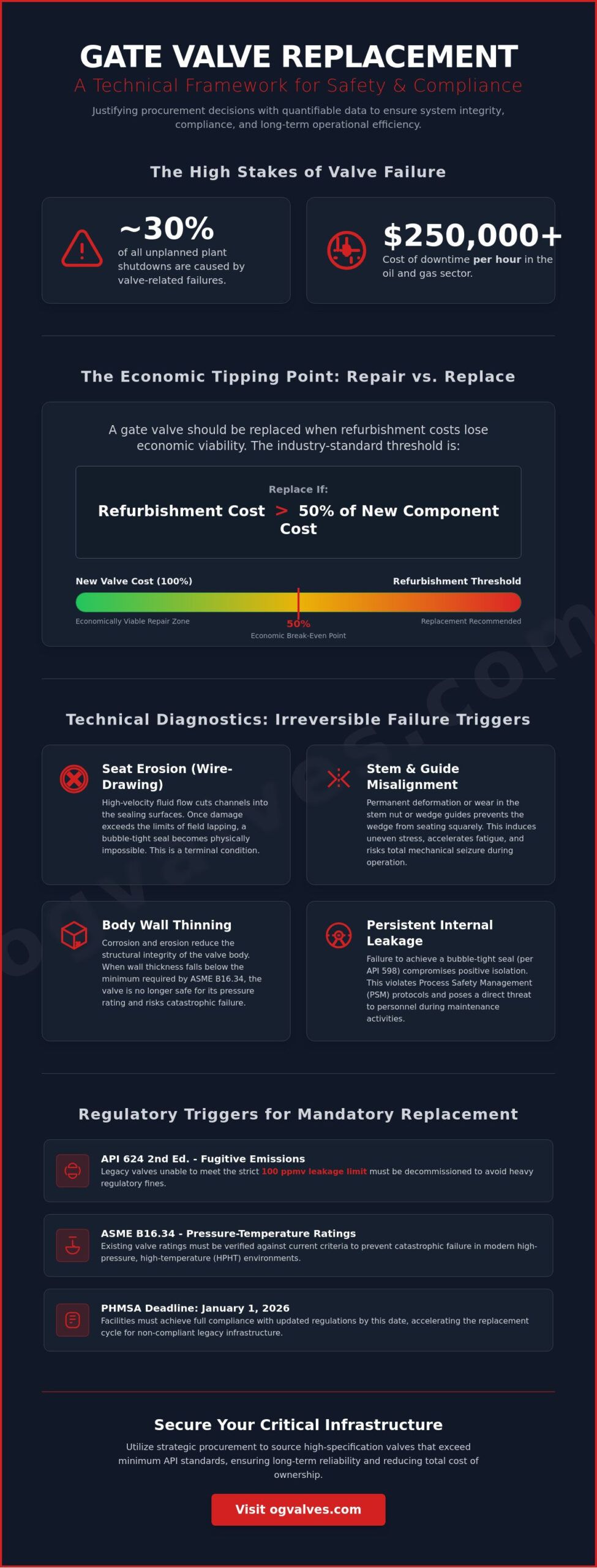
Nearly 30% of all unplanned plant shutdowns stem from valve-related failures, with downtime costs in the oil and gas sector often exceeding $250,000 per hour. Engineers understand that gate valves are the critical isolation points of any high-pressure system, yet corrosive media and high-cycle wear eventually compromise even the most robust API 600 or API 6D specifications. You’re likely balancing the need for maximized asset life against the non-negotiable risks of a catastrophic breach or regulatory non-compliance. This guide establishes a rigorous framework to determine exactly when to replace a gate valve in industrial service by evaluating metallurgical integrity and mechanical tolerances against current international standards.
We’ll provide a clinical diagnostic checklist to justify procurement decisions using quantifiable data. This includes analyzing the 100 ppmv fugitive emission threshold mandated by the API 624 2nd Edition and identifying the 60% to 80% cost threshold where refurbishment loses its economic viability against new ASME B16.34 (2025) compliant components. The following technical analysis ensures your facility maintains compliance with the January 1, 2026, PHMSA regulations while securing long-term operational efficiency and safety across your critical infrastructure.
Key Takeaways
- Identify irreversible mechanical failures such as wire-drawing seat erosion and stem misalignment that compromise the non-negotiable requirement for bubble-tight isolation.
- Apply a rigorous economic framework to determine when to replace a gate valve in industrial service, specifically when refurbishment costs exceed 50% of the value of new components.
- Assess legacy infrastructure against updated API 622 and 624 standards to ensure compliance with modern fugitive emission mandates and low-leakage packing requirements.
- Verify that existing valve pressure-temperature ratings remain aligned with current ASME B16.34 criteria to prevent catastrophic failure in high-pressure environments.
- Utilize strategic procurement to source high-specification valves that exceed minimum API standards, ensuring long-term reliability and reduced total cost of ownership.
Establishing the Stakes: Why Gate Valve Integrity is Non-Negotiable
A Gate valve is engineered for a singular purpose: absolute isolation. These components aren’t designed for throttling or flow regulation; doing so induces turbulent flow and high-velocity impingement on the sealing surfaces. When a gate valve fails to achieve a bubble-tight seal, the component has reached a critical failure point. In high-pressure, high-temperature (HPHT) environments, the cost of failure is significantly higher than in standard water service. A passing valve in a 600# steam line or a volatile hydrocarbon manifold represents an immediate threat to life and asset integrity. Identifying when to replace a gate valve in industrial service depends on distinguishing between a “nuisance leak,” such as a worn packing gland, and systemic integrity loss involving seat erosion or body thinning.
Industrial gate valve replacement is the process of decommissioning an asset that no longer meets its original design specification or safety factor. This decision is often driven by the realization that the cost of unscheduled downtime, which averages $250,000 per hour in the oil and gas sector, far outweighs the procurement cost of a high-specification replacement. Reliability is the only acceptable metric in critical infrastructure.
The Role of Isolation in Critical Infrastructure
Positive isolation is the cornerstone of downstream maintenance safety. If a gate valve allows internal leakage, it compromises the effectiveness of Emergency Shutdown (ESD) systems and violates Process Safety Management (PSM) protocols. Valve seat integrity is directly linked to the safety of personnel performing line breaks or vessel entries. In 2026, many facilities are transitioning from reactive maintenance to predictive models where any deviation from API 598 testing standards triggers an immediate replacement review to maintain system-wide reliability.
Primary Drivers for Replacement in 2026
Technological and regulatory shifts are accelerating the replacement cycle. Many operators are phasing out manual valves in favor of automated high-performance wedges to integrate with Industry 4.0 control systems. There’s also a significant shift in metallurgy; facilities are replacing legacy cast iron valves with forged steel or specialized alloys to enhance fatigue resistance. Environmental mandates are perhaps the strongest driver. With the API 624 2nd Edition setting a strict 100 ppmv leakage limit, legacy valves that cannot meet these fugitive emission standards are being systematically decommissioned to avoid heavy regulatory fines. Ensuring compliance requires a rigorous evaluation of when to replace a gate valve in industrial service before a violation occurs.
Technical Indicators: Identifying Critical Mechanical and Material Failure
Determining when to replace a gate valve in industrial service requires a clinical assessment of both mechanical tolerances and material stability. While visual inspections identify external leaks, internal degradation often remains hidden until a critical failure occurs. Engineering-grade diagnostics must go beyond surface-level observations to include metallurgical states and wall thickness integrity. Professionals frequently monitor five critical signs of gate valve failure, such as persistent internal passing or increased operational torque, to establish a baseline for decommissioning.
Internal seat erosion, often characterized by “wire-drawing” or cavitation, represents a terminal condition when the damage depth exceeds the technical limits of field lapping. Once the sealing surface is compromised beyond a few thousandths of an inch, achieving a bubble-tight seal becomes physically impossible. Similarly, permanent deformation in the stem nut or wedge guides leads to misalignment. This prevents the wedge from seating squarely, inducing uneven stress that accelerates component fatigue and risks a total mechanical seizure during critical isolation events.
Mechanical Tolerance and Sealing Failure
A valve is classified as “passing” when internal leakage exceeds the maximum allowable rates defined by API 598. While minor stem packing leaks might be addressed through gland adjustments, a damaged stuffing box or a scored stem usually necessitates a full assembly review. High operational torque is another clinical indicator. If torque requirements increase by more than 20% over the recorded baseline without a clear process change, internal mechanical binding or deposit buildup is likely occurring. Engineers should evaluate these metrics before deciding to repair or source a high-performance industrial gate valve from OG VALVES LTD. to ensure continued system safety.
Material Integrity and Environmental Stress
Material degradation often dictates the replacement window in harsh service environments. Ultrasonic testing (UT) is the standard method for detecting body wall thinning. If the measured wall thickness falls below the minimums specified in ASME B16.34, the valve’s pressure-containing capability is compromised. In legacy systems, specialists must look for Stress Corrosion Cracking (SCC) or graphitisation. Graphitisation, particularly in carbon steel components exposed to temperatures above 427°C (800°F), converts carbides into graphite nodules, severely reducing the material’s impact strength. In abrasive slurry service, erosion rates can exceed 0.5 mm per year, making annualized metal loss calculations essential for forecasting the optimal replacement window. Thermal cycling also plays a role, as repeated expansion and contraction can warp the wedge-to-seat fit, rendering the valve unreliable for high-pressure isolation.

The Engineering Decision: Repair vs. Replacement Economic Framework
Deciding when to replace a gate valve in industrial service isn’t a subjective choice but a data-driven economic calculation. Engineers typically apply the “50% Rule” as a primary technical recommendation. If the estimated cost of refurbishment, including specialized labor, OEM parts, and mandatory testing certifications, exceeds 50% of the price of a new component, replacement is the default action. This threshold accounts for the reality that a repaired valve retains its legacy fatigue life, whereas a new unit resets the Mean Time Between Failure (MTBF) clock to zero.
Lead times are a critical variable in this framework. While a complex repair might take 72 hours, the delivery of a stock valve could occur within 24 hours. Given that downtime costs in high-stakes sectors reach $250,000 per hour, the delta in speed often justifies the procurement of new hardware. New valves also carry manufacturer performance guarantees and warranties that field repairs simply can’t match. Lifecycle Cost Analysis (LCCA) must account for the probability of recurring failure in repaired units.
Calculating the Total Cost of Ownership (TCO)
A comprehensive TCO analysis extends beyond the initial purchase price. Direct costs involve parts and rigorous testing such as Positive Material Identification (PMI) and Non-Destructive Testing (NDT). Indirect costs are often more severe, including lost production revenue and energy loss from internal leakage. Risk-adjusted costs must also be factored in, particularly potential fines for environmental non-compliance if a repaired seal fails to meet API 624 standards. For a broader view on managing these assets, consult the Industrial Valves: The Engineer’s Comprehensive Guide from OG VALVES LTD..
Assessing Repairability Limits
Some valves are classified as Beyond Economic Repair (BER) due to structural damage that compromises the pressure boundary. Deep seat pocket erosion or wire-drawing on the wedge often requires extensive weld-overlay. In high-pressure service, the heat-affected zones (HAZ) created by such repairs can introduce new stress concentrations, increasing the risk of brittle failure. If the valve lacks original material trace documentation, the cost of refurbishment often climbs to 60 to 80% of a new unit’s price, making replacement the only logical engineering decision to ensure long-term system integrity.
Compliance and Standards: Regulatory Triggers for Mandatory Replacement
Regulatory non-compliance represents a significant legal and operational liability that often overrides mechanical condition. Determining when to replace a gate valve in industrial service frequently depends on the evolving landscape of international standards. For instance, the PHMSA regulations incorporating the API 6D 25th Edition became effective on January 1, 2026. This mandate requires pipeline operators to ensure all isolation components meet updated safety and design criteria. If a legacy valve cannot be verified against these current specifications through original documentation, decommissioning is the only viable path to maintaining regulatory standing.
The transition to low-emission (Low-E) packing is another non-negotiable trigger. The API 624 2nd Edition (2023) mandates a strict 100 ppmv leakage limit for rising stem valves. Legacy valves designed before these rigorous testing protocols often lack the stuffing box finish and dimensional tolerances required for modern graphite packing sets. Attempting to retrofit these units usually results in recurring failures, making full replacement with API 622-compliant hardware the standard engineering practice. Documentation is equally critical; modern industrial projects require full Material Test Report (MTR) traceability. Assets lacking verifiable material data are often replaced during scheduled turnarounds to satisfy insurance requirements and safety audits.
Fugitive Emissions and Environmental Accountability
Leak Detection and Repair (LDAR) programs act as the primary mechanism for flagging non-compliant assets. When a valve consistently fails emission monitoring despite packing adjustments, it indicates a fundamental design inadequacy. Tightening EPA standards in 2026 have made “nuisance leaks” a source of heavy financial penalties. Upgrading to heavy-duty API 600 gate valves provides the structural robustness and sealing integrity required for high-pressure refining. You can secure your facility’s environmental compliance by sourcing API-certified gate valves from OG VALVES LTD. that exceed the 100 ppmv threshold.
Safety Integrity Levels (SIL) and Replacement Cycles
Safety Integrity Levels (SIL) depend on the predictable performance of every component within a Safety Instrumented System (SIS). If proof testing reveals a Probability of Failure on Demand (PFD) that exceeds the original SIS design parameters, the valve has reached the end of its reliable service life. In sour service environments, NACE MR0175/ISO 15156 compliance is mandatory. Valves that don’t meet these metallurgical requirements for H2S resistance must be replaced to prevent sulfide stress cracking. For a comprehensive look at these design requirements, review the A Technical Guide to Industrial Gate Valves from OG VALVES LTD.. This technical alignment ensures that your replacement cycle is driven by quantifiable safety data rather than reactive maintenance.
Strategic Procurement: Ensuring System Reliability with High-Specification Valves
The technical evaluation of when to replace a gate valve in industrial service must conclude with a procurement strategy that prioritizes asset longevity over initial capital expenditure. Selecting a replacement that merely meets the minimum requirements of API 600 or API 6D often results in a repeat of the original failure mode. High-specification valves with enhanced material properties and tighter manufacturing tolerances provide the necessary safety margins for critical infrastructure. At OG VALVES LTD., every replacement component undergoes rigorous quality assurance protocols, including Positive Material Identification (PMI) and high-pressure gas testing in accordance with the API 598 11th Edition (2023). This clinical approach to testing ensures that the new asset possesses the metallurgical integrity required to withstand the specific pressures and temperatures of your process manifold.
Engineering expertise is essential during the selection phase to prevent premature degradation. Leveraging detailed material trace documentation and NDT results from the failed unit allows for the optimization of the replacement’s specification. By identifying whether the failure was driven by erosion, Stress Corrosion Cracking, or thermal fatigue, specialists can prescribe superior material grades or specialized trim configurations that reset the operational clock and extend the Mean Time Between Failure (MTBF).
Selecting the Right Material Grade for Replacement
In corrosive or high-chloride environments, transitioning from standard carbon steel to Duplex or Super Duplex stainless steel is a technical necessity. Forged gate valves offer a superior grain structure and improved fatigue resistance compared to cast alternatives, making them the preferred choice for high-pressure isolation where structural homogeneity is paramount. We provide bespoke material specifications and non-standard trims, such as Stellite 6 hardfacing, to ensure the new valve performs reliably in the most demanding HPHT or cryogenic services.
Minimising Downtime through Fast-Track Supply
Because valve-related issues contribute to 30% of unplanned plant shutdowns, the speed of procurement is a primary factor in maintaining facility uptime. OG VALVES LTD. operates as a stockist-expert, maintaining an extensive inventory of specialized components to facilitate emergency replacements. Our global logistics network is engineered to deliver critical valves to international industrial sites within the narrow maintenance windows required for successful turnarounds. This logistical precision, combined with our adherence to the latest ASME B16.34 (2025) standards, ensures your system returns to service without compromising safety. Contact OG VALVES for technical consultation on your next gate valve replacement project.
Optimizing System Integrity Through Data-Driven Replacement
Identifying the optimal window for decommissioning requires a clinical synthesis of mechanical diagnostics and regulatory awareness. The transition from field repair to full replacement occurs when internal seat erosion exceeds verifiable lapping limits or when legacy hardware fails the 100 ppmv fugitive emission standards mandated by the API 624 2nd Edition. Maintaining a rigorous diagnostic schedule ensures that deciding when to replace a gate valve in industrial service remains a proactive technical strategy rather than a reactive response to a $250,000 per hour unplanned shutdown. Safety and reliability depend on assets that meet the updated January 1, 2026, PHMSA requirements.
OG VALVES LTD. maintains an extensive inventory of API 600 and ASME B16.34 compliant valves to support these critical infrastructure needs. We specialize in fast-track global delivery for emergency maintenance and offer deep technical expertise in material selection for corrosive and HPHT service environments. Our commitment to engineering excellence ensures that every replacement unit provides long-term durability and compliance across your most demanding process manifolds. Request a Technical Quote for High-Specification Gate Valves. Your facility’s reliability is a direct result of these precise engineering choices.
Frequently Asked Questions
What is the typical service life of an industrial gate valve?
Service life is dictated by metallurgy and process media rather than a fixed timeframe. Carbon steel valves in non-corrosive service typically last 15 to 20 years, while cast iron units often reach their limit within 8 to 12 years. These windows shrink by 40% in high-cycle or abrasive environments where erosion rates are accelerated. Determining when to replace a gate valve in industrial service requires evaluating these variables against current performance data.
Can a leaking gate valve always be repaired in-line?
No. While minor packing leaks can be addressed through gland adjustments, internal seat damage like wire-drawing or body wall thinning requires removal from the line. If the repair cost exceeds 50% of the value of a new ASME B16.34 compliant valve, in-line attempts are economically inefficient. Most high-pressure isolation failures involve seat erosion that cannot be corrected without specialized shop equipment and resurfacing.
How do I know if my gate valve is ‘passing’ internally?
Engineers utilize acoustic emission testing or temperature differential analysis to detect internal leakage. A temperature drop across the valve in steam service or a localized sound peak indicates that the wedge isn’t achieving a bubble-tight seal. Any leakage rate that exceeds the maximum allowable limits defined in the API 598 11th Edition (2023) signifies a failure of the primary isolation function.
What are the most common causes of gate valve failure in oil and gas service?
Corrosion remains the leading cause of failure, with 37% of external leakage incidents in power plants attributed to casting defects. In oil and gas service, Stress Corrosion Cracking and erosion from particulate matter are primary drivers. Sour service environments specifically accelerate metallurgical degradation through hydrogen-induced cracking, necessitating strict adherence to NACE MR0175 standards for all replacement components to ensure long-term system integrity.
When should I choose a ball valve instead of replacing a gate valve?
Transition to a ball valve when your process requires rapid quarter-turn actuation or superior sealing in high-cycle service. Ball valves offer better performance for frequent operation, whereas gate valves are designed for infrequent isolation. However, gate valves remain the standard for high-pressure isolation where a straight-through flow with minimal pressure drop is required. Always verify that the replacement valve meets the original system’s pressure-temperature ratings.
Does a stiff or hard-to-turn handle always mean the valve needs replacement?
A stiff handle often indicates dried packing or a lack of lubrication in the stem nut. It’s not an immediate signal for replacement but requires diagnostic attention. If the operational torque increases by more than 20% after proper lubrication, it likely indicates internal wedge misalignment, galling, or stem damage. These mechanical issues are terminal indicators that the valve has reached its end-of-life and requires a new replacement unit.
What industry standards govern the replacement criteria for industrial valves?
The primary standards include API 600 for steel gate valves, API 6D for pipeline service, and ASME B16.34 for pressure-temperature ratings. The API 598 11th Edition provides the rigorous testing criteria used to determine if an asset still meets its performance specification. Compliance with the ASME B16.34 2025 Edition is now the benchmark for ensuring that new valves align with modern safety and design criteria.
How does fugitive emission legislation affect valve replacement cycles?
Environmental legislation forces shorter replacement cycles for legacy assets that cannot meet modern Low-E requirements. The API 624 2nd Edition (2023) mandates a strict 100 ppmv leakage limit for rising stem valves. Because many older valves were not designed for the high-performance graphite packing required to meet these standards, they must be systematically replaced to avoid heavy regulatory fines and ensure environmental compliance across the facility.
 Responsive Menu