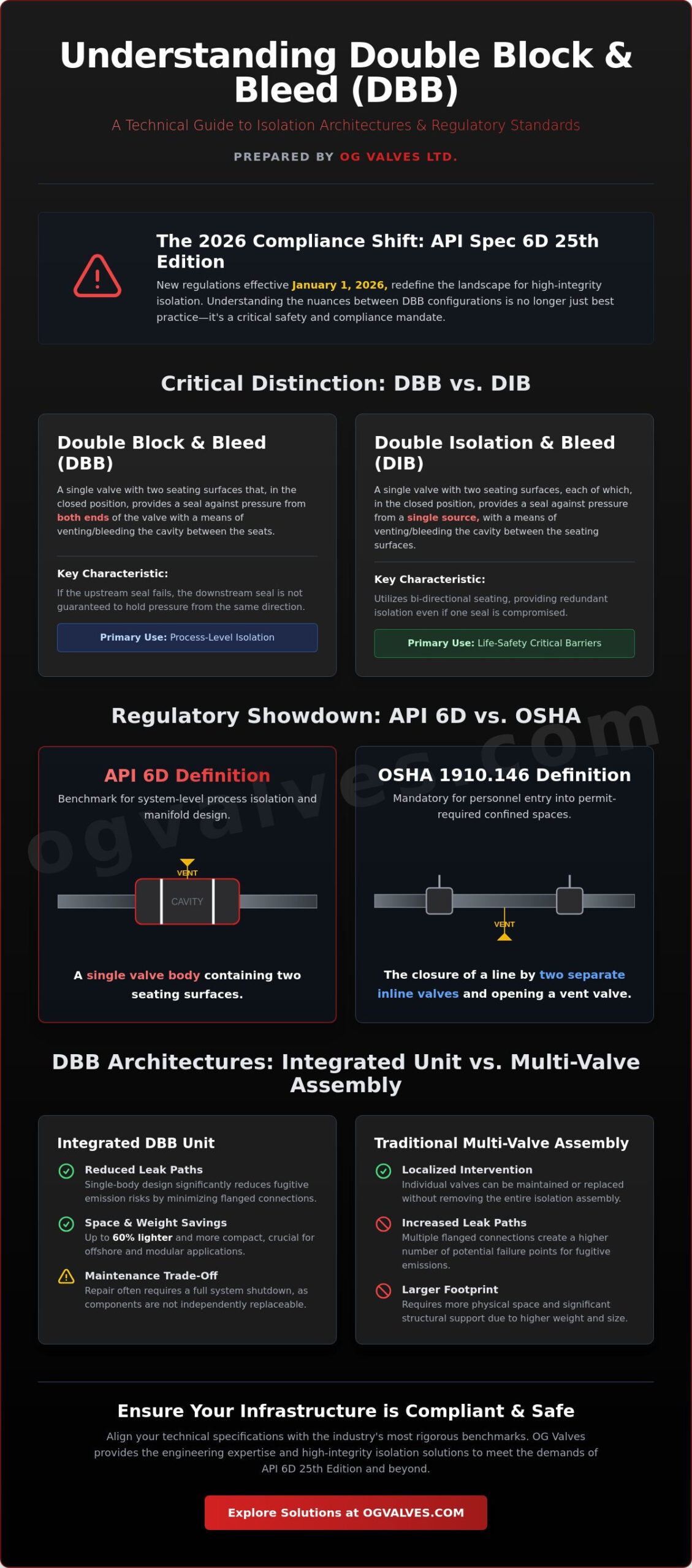
The implementation of API Spec 6D 25th Edition on January 1, 2026, has fundamentally redefined the compliance landscape for high-integrity isolation. Engineers and procurement specialists often struggle with the technical ambiguity between API and OSHA definitions, where a misunderstanding of a double block and bleed valve configuration can lead to catastrophic safety failures or regulatory non-compliance. This lack of clarity is compounded by the 2026 requirements for stricter testing and enhanced documentation regarding fugitive emission performance.
You recognize that selecting the correct isolation strategy is not merely a procurement task but a critical safety mandate. This guide provides a definitive technical analysis of DBB configurations, international standards, and material selection criteria to ensure your infrastructure meets the most rigorous industrial benchmarks. We will examine the engineering distinctions between integrated units and discrete multi-valve assemblies, evaluate the performance of ball valves and plug valves in high-pressure scenarios, and outline the quality assurance protocols necessary for modern industrial safety.
Key Takeaways
- Differentiate between API 6D and OSHA definitions to ensure regulatory compliance and operational safety in high-integrity isolation.
- Analyze the engineering trade-offs between integrated units and traditional multi-valve double block and bleed valve configuration designs regarding leak-path mitigation and weight.
- Select optimal block components, such as ball valves or plug valves, based on media characteristics and specific system pressure classifications.
- Validate assembly performance by applying rigorous API 6D testing protocols and API 598 inspection standards for verified sealing integrity.
- Optimize project timelines by aligning technical specifications with global supply chain capabilities for specialized alloy industrial valves.
Defining Double Block and Bleed (DBB) Configurations
Positive isolation is the primary engineering objective in high-pressure industrial systems. A double block and bleed valve configuration functions as a critical safety barrier, allowing for the secure maintenance or sampling of downstream equipment without depressurising the entire line. By isolating the fluid source and venting the trapped pressure between two sealing surfaces, operators ensure that zero energy reaches the work zone. This configuration is essential for handling hazardous media in the oil, gas, and power sectors where the cost of a leak is measured in both environmental impact and personnel safety.
Technical experts frequently conflate DBB with Double Isolation and Bleed (DIB). While they share a similar nomenclature, their mechanical functions differ significantly under API 6D 25th Edition standards. A DBB valve provides a seal against pressure from each end of the valve with a means of venting the cavity between the seats. However, if the upstream seal fails, the downstream seal doesn’t necessarily hold pressure from the same direction. In contrast, DIB units utilize bi-directional seating to provide redundant isolation even if one seal is compromised. It’s a distinction that defines the boundary between process-level isolation and life-safety critical barriers.
API 6D vs. OSHA: Navigating Regulatory Standards
The 2026 regulatory landscape requires precise adherence to either API or OSHA definitions depending on the operational context. API 6D defines a double block and bleed valve configuration as a single valve body containing two seating surfaces. This is often achieved through trunnion-mounted ball valves or specialized plug valves. Conversely, OSHA standards for permit-required confined spaces (1910.146) mandate a more literal interpretation. They define DBB as the closure of a line by locking two separate inline valves and opening a vent valve between them. Engineers must prioritize the OSHA definition for personnel entry into vessels, while the API definition remains the benchmark for system-level process isolation and manifold design.
The Mechanism of Cavity Depressurisation
The bleed valve is the diagnostic heart of the block and bleed manifold. Its primary role is to validate the integrity of the primary block seals. If the bleed port continues to discharge fluid after the initial cavity volume is evacuated, it indicates a seat failure in one of the block valves. Standard sizing for these bleed components typically ranges from 1/2 inch to 2 inch NPS, depending on the main line diameter and the viscosity of the media. For toxic or high-pressure applications, this vent must be routed to a closed disposal system or flare rather than being discharged directly to the atmosphere. This ensures that fugitive emissions are controlled in accordance with the enhanced 2026 environmental protocols.
Primary DBB Configuration Architectures: Single Unit vs. Multi-Valve
Selecting the appropriate double block and bleed valve configuration involves a critical evaluation of system geometry and leak-path mitigation. Engineers typically choose between a traditional multi-valve assembly and an integrated single-body unit. The traditional approach utilizes two independent valves separated by a spool piece containing a bleed port. While this provides a high degree of physical separation, it introduces multiple potential leak paths through additional flanged connections. Each flange represents a risk for fugitive emissions; it’s a primary concern under 2026 environmental regulations.
Integrated units consolidate these components into a single body, significantly reducing the number of joints. For offshore platforms and modular skid designs, the space and weight savings are decisive. An integrated DBB valve can reduce the weight of an isolation assembly by up to 60 percent compared to a traditional three-valve setup. This reduction simplifies structural support requirements and lowers overall project costs. However, maintenance trade-offs exist; repairing a single integrated unit often requires a full system shutdown, whereas discrete valves might allow for more localized intervention. It’s a critical consideration when designing a double block and bleed valve configuration for high-vibration environments where joint integrity is constantly tested.
The Modular Multi-Valve Assembly
Traditional configurations often employ industrial gate valves as the primary block components. These assemblies provide a physical separation that’s highly valued in safety-critical work, as the spool piece can be completely removed to insert a blind flange. This setup offers flexibility, allowing engineers to specify different valve types for the upstream and downstream blocks based on specific media characteristics. For example, a system might use a gate valve for the upstream block to handle high-pressure slurries and a globe valve for the downstream block to provide throttling capabilities during sampling. Adhering to both OSHA and API DBB standards ensures these modular setups meet necessary personnel protection requirements.
Integrated Single-Body DBB Valves
Modern integrated designs frequently utilize industrial ball valves featuring self-relieving seats. These units are available in twin-ball or single-ball designs. Twin-ball configurations offer true redundancy by placing two independent balls in a single housing, providing two separate sealing barriers. Single-ball DBB valves rely on the upstream and downstream seats of a single ball to provide isolation. While single-ball units are more compact, twin-ball designs are preferred for high-pressure gas transmission and chemical injection manifolds where seal redundancy is non-negotiable. If your project requires high-integrity isolation with minimal footprint, reviewing technical specifications for specialized industrial valve assemblies is a necessary step in the procurement process.
Strategic Valve Selection for DBB Assemblies
Engineering a robust double block and bleed valve configuration requires a precise alignment between valve architecture and the chemical properties of the process media. The selection of the primary block components is dictated by pressure class, temperature extremes, and the presence of particulate matter. While ball valves remain the industry standard for general high-pressure service, specific applications involving slurries or high-solids content necessitate the use of plug valves to prevent seat erosion and cavity clogging. A technical overview of a Double Block and Bleed Valve System underscores that the block valves must provide a bubble-tight shut-off to ensure the bleed valve can effectively verify seal integrity.
Material selection is a critical factor in mitigating risk within corrosive environments containing H2S or CO2. For standard hydrocarbon service, carbon steel with internal trim upgrades is often sufficient. However, offshore applications or highly sour service require stainless steel or Super Duplex alloys to resist pitting and stress corrosion cracking. Procurement specifications must mandate compliance with NACE MR0175/ISO 15156 standards when high concentrations of hydrogen sulfide are present. For the bleed function, engineers must choose between needle valves and ball valves. Needle valves offer superior precision for controlled venting and sampling, whereas ball valves are utilized when rapid cavity depressurization is the operational priority.
Ball Valves in DBB Service
Trunnion-mounted ball valves are the preferred choice for high-pressure isolation because they minimize operating torque and ensure stable seat loading. Floating designs are typically restricted to smaller bore sizes or lower pressure classes where the fluid pressure helps seat the ball against the downstream seal. Engineers must specify metal-seated options for abrasive media or temperatures exceeding 200 degrees Celsius, as soft seats may degrade. Additionally, the integration of a fail-safe actuator is vital for automated double block and bleed valve configuration systems, ensuring the assembly defaults to a secure state during a loss of power or signal.
High-Performance Butterfly and Plug Options
In low-pressure systems where weight and space are restricted, high-performance butterfly valves can be configured in a DBB arrangement. These provide a cost-effective solution for large-diameter lines, though they may not offer the same level of seal redundancy as ball units. Lubricated plug valves represent the benchmark for harsh service involving heavy slurries. Their ability to wipe the seating surfaces during operation prevents solids from compromising the seal. Furthermore, full-bore plug and ball valves are essential in pipeline DBB configurations to maintain compatibility with pigging operations, ensuring that the internal diameter remains unobstructed for maintenance tools.
The transition to the API Spec 6D 25th Edition, effective January 1, 2026, has introduced more stringent testing requirements for every double block and bleed valve configuration. Compliance is no longer just about functional isolation; it’s about quantifiable performance under extreme pressure differentials. Engineers must verify that the assembly meets specific leakage rates, typically categorized under ISO 5208 or API 598. API 598 provides the baseline for valve inspection and testing, ensuring that the primary block seals and the bleed mechanism function as a cohesive system before deployment. This level of scrutiny is necessary to maintain the integrity of critical infrastructure in high-stakes environments.
API 6D Testing Protocols
Testing a double block and bleed valve configuration involves pressurizing the valve cavity to verify that the seating surfaces provide a reliable seal from both ends simultaneously. For soft-seated valves, the industry standard is “zero leakage,” often referred to as Rate A. Metal-seated valves allow for a minimal, measurable leakage rate, though high-integrity projects often demand tighter tolerances. The 2026 standards emphasize the following procedures:
- Hydrostatic testing: This uses water to verify structural integrity at 1.5 times the rated working pressure, ensuring the body and seats can withstand operational surges.
- Pneumatic testing: This utilizes inert gas, such as nitrogen, to detect minute leaks that liquid might miss. It’s a critical requirement for gas transmission applications where fugitive emissions must be minimized.
- DIB-1 and DIB-2 variants: These require additional tests to ensure that the seats are bi-directional. This provides a secondary layer of redundancy if the primary upstream seal fails.
Material Integrity and Certification
Reliability in an isolation assembly is fundamentally linked to material science. Positive Material Identification (PMI) is a non-negotiable requirement for alloy valves. It prevents the installation of incorrect grades that could lead to premature failure in corrosive environments. In sour gas applications, NACE MR0175/ISO 15156 compliance is mandatory to prevent sulfide stress cracking. Traceability is managed through EN 10204 certification. A 3.1 certificate provides manufacturer-verified data, while a 3.2 certificate requires independent third-party inspection, offering the highest level of assurance. Performance is further validated by API 607 fire-safe certification and ISO 15848-1 fugitive emission standards, which are essential for environmental compliance in modern industrial sectors.
To ensure your project meets these evolving safety standards, you should consult with a specialist in high-integrity industrial valves to review your specific isolation and testing requirements.
Optimising Procurement for Critical Isolation Projects
Procuring a double block and bleed valve configuration requires a technical assessment that extends beyond simple part-number comparisons. It demands a rigorous evaluation of how the hardware aligns with the specific process conditions of the project. Technical expertise in industrial valves is essential during the initial specification phase to prevent the selection of incompatible materials or architectures. OG VALVES LTD. supports project managers by reviewing these specifications against global benchmarks, ensuring that the chosen isolation strategy is both safe and commercially viable. This proactive approach mitigates the risk of operational failure and regulatory non-compliance.
Leveraging established global supply chains is the most effective method for reducing lead times on specialized DBB units. When dealing with high-integrity isolation, the availability of specific alloys or specialized trunnion-mounted designs can dictate the entire project timeline. Fast-track delivery is often a necessity for emergency maintenance and planned shutdowns where downtime costs are substantial. By maintaining a clinical focus on logistical precision and engineering excellence, we ensure that critical components reach the site exactly when they’re required, accompanied by all necessary technical documentation.
Technical Support and Specification Review
Precise alignment between the double block and bleed valve configuration and the Piping and Instrumentation Diagram (P&ID) is a non-negotiable requirement. Every assembly must be evaluated against the required Safety Integrity Level (SIL) to ensure the isolation strategy meets the system’s risk reduction targets. This technical review includes consulting on material compatibility for extreme environmental conditions, such as high-salinity offshore environments or high-temperature steam service. We act as a dependable partner to bridge the gap between engineering design and procurement reality, ensuring the specified valves are physically and chemically suited for their intended service life.
Global Logistics and Quality Assurance
The cost of failure in heavy industry is high; therefore, quality assurance remains the cornerstone of the procurement process. Every component undergoes rigorous pre-delivery inspection protocols to ensure it’s site-ready upon arrival. This includes the verification of all testing results, such as the API 6D and NACE certifications discussed in previous sections. By utilizing strategic inventory management and comprehensive project management, we help managers navigate the complexities of global logistics without compromising on structural soundness. Contact OG VALVES LTD. for technical specifications and quotes on DBB configurations.
Advancing Industrial Isolation Standards for 2026
Engineering a high-integrity industrial system requires a precise alignment between regulatory standards and mechanical execution. The adoption of API Spec 6D 25th Edition necessitates a sophisticated understanding of how a double block and bleed valve configuration functions as a primary safety barrier. You must prioritize the mitigation of leak paths through integrated designs and ensure material compatibility with corrosive media such as H2S or CO2. Selecting the correct block components, whether ball or plug valves, ensures long-term operational reliability and compliance with stringent environmental protocols.
OG VALVES LTD. provides the technical foundation for your most critical isolation projects. We maintain a specialist industrial valve inventory and offer global fast-track delivery capabilities to minimize downtime during emergency maintenance or scheduled shutdowns. Our team delivers expert technical support to ensure full API compliance and structural soundness in every assembly we provide. This commitment to engineering excellence allows us to act as a dependable partner in your global supply chain.
Request a Technical Quote for Industrial DBB Valve Solutions to secure your infrastructure with engineered precision. We look forward to supporting your next high-stakes project.
Frequently Asked Questions
What is the difference between DBB and DIB valves?
A DBB valve provides a seal against pressure from both ends of the valve with a central vent, while a Double Isolation and Bleed (DIB) valve utilizes bi-directional seating to provide redundant isolation if one seal fails. API 6D 25th Edition specifies that a DBB does not necessarily provide positive isolation if only one side is under pressure and the upstream seal is compromised. DIB-1 and DIB-2 configurations offer higher safety levels for critical process barriers.
Why is a bleed valve necessary in a double block configuration?
The bleed valve is essential for depressurizing the central cavity and providing a measurable verification of seat integrity. If the bleed port continues to discharge media after the cavity is drained, it indicates that one of the primary block seals has failed. This mechanism is the only way to ensure that a double block and bleed valve configuration is truly isolating the downstream equipment from the process pressure.
Can I use two separate ball valves to create a DBB system?
Yes, using two separate ball valves with a spool piece and a bleed valve is the traditional method for achieving positive isolation. This setup is often preferred by OSHA for personnel protection during vessel entry because it provides a physical break in the line. While it requires more space and creates additional leak paths at the flanges, it allows for the complete removal of a section for maintenance or blanking.
What are the common materials used for DBB valves in offshore environments?
Offshore environments require materials that resist chloride-induced stress corrosion cracking and pitting. Common selections include Super Duplex stainless steel, 316 stainless steel, and carbon steel with Corrosion Resistant Alloy (CRA) cladding or overlays. These materials ensure the structural integrity of the valve body and internal trim in high-salinity conditions. Compliance with NACE MR0175 is mandatory if the media contains hydrogen sulfide.
How do I test a DBB valve for seat integrity according to API 6D?
API 6D seat integrity testing involves pressurizing the valve cavity and monitoring for leakage across the seats. For a double block and bleed valve configuration, the valve is partially opened to fill the cavity, then closed; pressure is then applied through the bleed port. Soft-seated valves must demonstrate zero leakage, while metal-seated valves are tested to specific allowable leakage rates defined in API 598 or ISO 5208.
Is a single-unit DBB valve always better than a multi-valve assembly?
A single-unit DBB valve isn’t always superior; the choice depends on space, weight, and maintenance requirements. Integrated units offer significant weight savings and fewer potential leak paths, which is critical for offshore skids. However, modular multi-valve assemblies allow for the replacement of individual components without discarding the entire unit. Maintenance teams often prefer discrete valves for systems where seat erosion is frequent and requires regular intervention.
What industry standards govern the design of double block and bleed systems?
The primary standards governing these systems are API Spec 6D for valve design and OSHA 1910.146 for confined space isolation requirements. API 598 defines the inspection and testing protocols for the assembly. Additionally, ISO 15848-1 governs fugitive emission performance, which is increasingly critical under 2026 environmental regulations. Engineers must also consider ASME B16.34 for pressure-temperature ratings of the valve bodies.
Are DBB valves suitable for high-temperature steam applications?
DBB configurations are suitable for high-temperature steam provided they utilize metal-seated designs and appropriate alloys. Soft-seated ball valves will degrade in steam service, so metal-seated globe valves or gate valves are typically specified. The selection must account for thermal expansion to prevent the ball or wedge from seizing in the closed position. Proper cavity venting is also necessary to prevent pressure build-up from trapped condensate.
 Responsive Menu