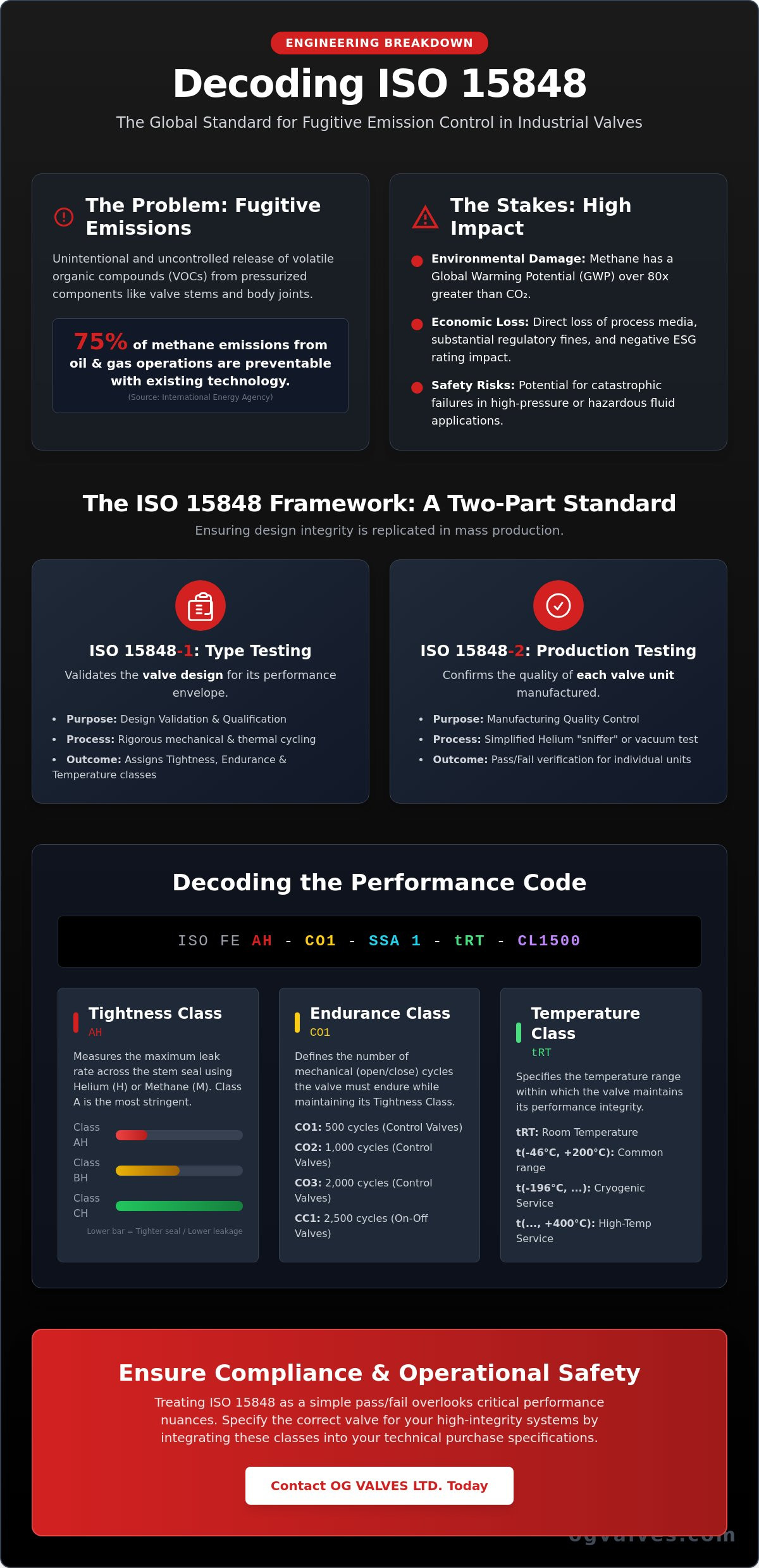
The International Energy Agency estimates that 75% of methane emissions from oil and gas operations are preventable with existing technology, yet fugitive emissions testing for valves iso 15848 remains a source of technical ambiguity for many procurement teams. You’re likely aware that a standard seal isn’t sufficient to meet evolving environmental mandates or to avoid substantial regulatory fines. Compliance requires more than a checklist. Treating ISO 15848 as a simple pass or fail certification ignores the critical performance-based nuances that define a valve’s actual operational safety margin.
This analysis provides an authoritative engineering breakdown of ISO 15848-1:2015 and ISO 15848-2:2015 to ensure your infrastructure adheres to the highest industrial precision. You’ll gain a clear understanding of Tightness, Endurance, and Temperature classes. This knowledge allows you to specify the correct gate, ball, or butterfly valves for volatile organic compound service. We examine the specific testing methodologies for helium and methane leak detection, the differences between type testing and production acceptance, and the rigorous protocols required to mitigate fugitive emission risks in high-stakes environments.
Key Takeaways
- Identify the specific performance margins of industrial valves by decoding the ISO 15848 three-tier classification system for Tightness, Endurance, and Temperature.
- Evaluate the technical differences between ISO and API standards to select the most rigorous testing framework for volatile organic compound containment.
- Understand the procedural requirements for fugitive emissions testing for valves iso 15848, including the application of Helium vacuum and sniffing methodologies.
- Establish robust procurement protocols by integrating ISO 15848 compliance into Technical Purchase Specifications for high-integrity gate, ball, and butterfly valves.
The Critical Role of ISO 15848 in Fugitive Emission Control
Fugitive emissions are defined as the unintentional and uncontrolled release of volatile organic compounds (VOCs) or hazardous fluids from pressurized industrial components. In valve assemblies, these releases primarily originate from the stem (or shaft) seals and the primary body joints. ISO 15848 establishes a comprehensive technical framework for the measurement, classification, and qualification of these leaks in both isolating and control valves. As heavy industry sectors align with net-zero mandates, fugitive emissions testing for valves iso 15848 has become a critical benchmark for engineering excellence. This standard ensures that critical infrastructure components, such as gate and ball valves, meet the stringent leakage requirements necessary for modern environmental compliance.
The shift toward stringent regulatory adherence is driven by the global necessity for industrial safety and atmospheric protection. ISO 15848 has emerged as the unified global benchmark, replacing fragmented local standards with a rigorous performance-based classification system. It provides procurement specialists with a clinical method for evaluating a valve’s sealing durability under extreme thermal and mechanical stress. Adhering to this standard isn’t merely a matter of regulatory box-ticking. It’s a fundamental requirement for maintaining the structural soundness of high-integrity systems in the petrochemical, power, and gas sectors.
Differentiating ISO 15848-1 and ISO 15848-2
The ISO 15848 standard is bifurcated to address both design validation and manufacturing quality control. ISO 15848-1:2015/Amd.1:2017 serves as the type-testing standard. It subjects valve assemblies to rigorous mechanical and thermal cycling to determine their performance class over a simulated lifecycle. This part of the standard is used to qualify a valve design for specific tightness and endurance classes. In contrast, ISO 15848-2:2015 is utilized for production acceptance testing. It provides a simplified helium sniffer test protocol for individual units before they leave the factory. This dual-layered approach ensures that the engineering integrity validated during type testing is successfully replicated during large-scale manufacturing.
Environmental and Economic Impacts of Valve Leaks
The failure to control valve leaks results in quantifiable economic loss and severe environmental degradation. Stem seal failure leads to the steady depletion of process media, directly impacting the operational output of petrochemical and gas facilities. The environmental stakes are high. Methane emissions possess a Global Warming Potential (GWP) over 80 times greater than CO2 when measured over a 20-year timeframe. The International Energy Agency estimates that 75% of these emissions from oil and gas operations are preventable with existing seal technologies. By mandating fugitive emissions testing for valves iso 15848, organizations can safeguard their corporate ESG ratings and reduce the risk of catastrophic failures in high-pressure hazardous fluid applications.
Decoding the ISO 15848 Classification System
ISO 15848-1 utilizes a rigorous alphanumeric coding system that defines the specific performance envelope of a valve assembly. This system eliminates the ambiguity of simple pass or fail designations by categorizing valves based on three critical variables: Tightness Class, Endurance Class, and Temperature Class. For engineering teams, understanding this nomenclature is essential for matching valve capabilities to site-specific environmental requirements. Fugitive emissions testing for valves iso 15848 provides a standardized metric that allows for the objective comparison of different valve designs across global manufacturers, ensuring that the selected equipment can withstand the intended service life without seal degradation.
The classification code typically appears as a technical string, such as “ISO FE AH – CO1 – SSA 1 – tRT – CL150”. Each segment identifies a specific testing outcome. The Tightness Class (A, B, or C) measures the leak rate across the stem seal using either Helium or Methane. The Endurance Class defines the number of mechanical cycles the valve completed without exceeding the specified tightness limit. Finally, the Temperature Class designates the thermal range, from cryogenic levels at -196°C to high-temperature steam applications at +400°C, within which the valve maintains its structural integrity.
Tightness Class Analysis: AH vs. BH vs. CH
Class AH represents the highest level of sealing performance, typically requiring bellows seals or highly advanced live-loaded packing systems. For Helium, Class AH specifies a leak rate of ≤ 10⁻⁶ mg·s⁻¹·m⁻¹ per meter of stem circumference. Class BH is the industry standard for high-integrity applications, allowing a leak rate of ≤ 10⁻⁴ mg·s⁻¹·m⁻¹ with Helium. Class CH is reserved for less hazardous media, where a leak rate of ≤ 10⁻² mg·s⁻¹·m⁻¹ is acceptable. Achieving fugitive emissions efficiency across these classes requires precise material selection and exacting machining tolerances for stem and stuffing box surfaces.
Mechanical Endurance and Thermal Cycling
Endurance testing simulates the operational life of the valve through thousands of mechanical cycles. For isolating valves, such as certified ball valves and gate valves, classes range from CO1 (2,500 cycles) to CO3 (10,000 cycles). Control valves face more rigorous demands, with classes CC1 (20,000 cycles) through CC3 (100,000 cycles). These cycles are performed in conjunction with thermal transitions from room temperature to the design temperature limits, which creates significant stress on the packing and seal joints. CC3 is the gold standard for control valve longevity because it validates seal integrity through 100,000 mechanical cycles alongside multiple thermal fluctuations.
ISO 15848 vs. API Standards: Selection Framework
Selecting the appropriate standard for emission control requires an understanding of the technical divergence between ISO 15848 and the American Petroleum Institute (API) specifications. While ISO 15848 provides a comprehensive “whole valve” type-testing framework, API standards are often more component or valve-type specific. API 622 focuses strictly on the performance of the packing material itself. In contrast, API 624 and API 641 serve as the design validation standards for rising stem gate valves and quarter-turn ball valves, respectively. For engineers managing global infrastructure, fugitive emissions testing for valves iso 15848 is often the preferred benchmark due to its broad scope and performance-based classification system which accommodates various valve architectures and service conditions.
Geographic preferences dictate standard selection in many industrial sectors. The North American oil and gas market remains heavily anchored in API standards, largely due to their alignment with EPA Method 21 requirements. Conversely, European and international projects typically prioritize ISO 15848 as the unified global standard. This geographic split often necessitates dual certification for manufacturers. Procuring valves that meet both ISO and API criteria ensures project compatibility across different regulatory jurisdictions and simplifies the global supply chain for critical infrastructure components.
Key Differences in Testing Methodology
The technical distinction between these standards lies in their test media and measurement units. ISO 15848 primarily utilizes Helium within a vacuum chamber or via sniffing to measure a mass flow rate in mg/s/m, which accounts for the stem circumference. API standards utilize Methane and rely on the sniffing method to measure concentration in parts per million (ppm). This makes ISO 15848 a more precise engineering metric for quantifying the actual volume of lost product. It’s also standard practice to require ‘Fire Safe’ testing, such as API 607, in conjunction with fugitive emissions testing for valves iso 15848 to ensure the valve maintains its structural soundness during and after a thermal event.
Standard Selection by Valve Type
The mechanical dynamics of a valve dictate which standard is most applicable for design validation. Engineers specifying butterfly valves for power generation or desalination typically rely on ISO 15848 because it effectively evaluates the performance of the shaft seals through varied thermal cycles. High-pressure gate valves in upstream oil and gas service often follow API 624 to ensure the rising stem doesn’t drag contaminants into the packing. Industrial ball valves require distinct evaluation via API 641 or ISO 15848 because their quarter-turn stem dynamics create different wear patterns on the primary seals compared to linear motion valves. Matching the standard to the valve’s mechanical motion is essential for long-term operational reliability.
Testing Methodologies and Leak Detection Techniques
The execution of fugitive emissions testing for valves iso 15848 requires a clinical adherence to mass spectrometer leak detection (MSLD) protocols. Helium is the primary tracer gas utilized due to its small molecular size and inert properties, allowing it to penetrate even microscopic leak paths. The vacuum method is the most rigorous technique for type testing. It involves placing the entire valve assembly, or the specific sealing area, within a vacuum chamber to quantify the total leakage rate. Conversely, the sniffing method is often employed for localized leak detection or production acceptance testing. This technique uses a calibrated probe to measure the concentration of helium escaping from the stem seal or body joints.
Precise preparation of the test specimen is mandatory to ensure data integrity. All components must undergo a thorough cleaning and degreasing process to remove residual lubricants or contaminants that could temporarily mask leak paths. Assembly must follow the manufacturer’s exact specifications for bolt torque and packing compression. ISO 15848-1 qualification demands continuous data logging throughout the test cycle. This includes recording the internal pressure, temperature fluctuations, and the number of mechanical actuations to provide a verifiable performance history of the valve under stress.
The testing sequence initiates with a baseline measurement at room temperature before progressing to the specified design temperature limits. Thermal cycling is a critical phase of the protocol. It exposes the seal materials to expansion and contraction, which often reveals vulnerabilities not present during static room-temperature tests. For projects requiring verified containment, engineers should specify ISO 15848-certified gate and globe valves that have undergone these rigorous MSLD procedures.
Stem Seal Design and Material Science
The choice between graphite-based and PTFE-based packing systems depends on the thermal and chemical requirements of the application. Graphite offers superior fire safety and high-temperature resistance, while PTFE provides exceptional chemical inertness for hazardous fluid service. To counteract thermally induced seal degradation, many high-integrity designs utilize live-loading systems. These systems employ Belleville spring washers to maintain a constant compressive force on the packing gland, compensating for material wear or relaxation over time. Bellows seals provide a hermetic metallic barrier, making them the only design capable of achieving the zero-leakage threshold required for Class AH tightness.
Body Joint Integrity and Gasket Selection
While the stem seal is the primary focus, ISO 15848 also evaluates the static seal between the valve body and bonnet. Spiral wound gaskets with high-density fillers are frequently specified for emission-controlled service due to their resilience under pressure fluctuations. In extreme high-pressure applications, Ring Type Joints (RTJ) provide a robust metal-to-metal seal that minimizes the risk of fugitive releases. Maintaining bolt torque consistency is non-negotiable. Uneven loading at the flange can create localized gaps in the gasket compression, leading to failure during the thermal cycling phases of the fugitive emissions testing for valves iso 15848.
Specifying Certified Valves: Procurement Strategies
Successful containment of hazardous fluids depends on the precise integration of ISO 15848 requirements into the Technical Purchase Specification (TPS). Vague requests for “low-emission valves” are insufficient for high-stakes industrial projects. Procurement teams must define the exact classification string, including Tightness, Endurance, and Temperature classes, as established during the fugitive emissions testing for valves iso 15848. This level of specificity ensures that manufacturers provide equipment capable of meeting the site’s specific environmental safety margins. It’s the only way to guarantee that the hardware’s performance envelope aligns with the operational reality of the facility.
Evaluating Manufacturer Test Reports (MTRs) requires a clinical focus on the test parameters rather than just the final result. For critical service, third-party witness requirements should be mandated during the type-testing phase to validate the performance data. OG VALVES LTD. facilitates this process by verifying that all high-specification components adhere to the agreed-upon engineering benchmarks. This reduces the risk of non-compliance during site audits and ensures that the procurement process remains rooted in quantifiable data rather than manufacturer claims.
Verification and Quality Assurance
Documentation must clearly distinguish between ISO 15848-1 (Type Testing) and ISO 15848-2 (Production Acceptance Testing). Type testing validates the design architecture, while production testing confirms the manufacturing consistency of the specific unit being purchased. Serial number traceability is non-negotiable for certified valve supply. It provides a permanent link between the physical component and its performance certification. OG VALVES LTD. provides technical support for international infrastructure projects by ensuring that every industrial valve in the supply chain meets these rigorous traceability standards. This methodical approach ensures that technical experts can trust the integrity of the seals installed in their systems.
Future-Proofing Your Infrastructure
Industrial operators must anticipate stricter EPA and EU emission limits as global net-zero targets approach. Investing in Class AH or BH valves today provides a higher long-term ROI by extending the intervals between seal replacements and reducing the likelihood of future retrofitting costs. Managing lead times for certified equipment is often a challenge in fast-track projects. Partnering with global suppliers who maintain an inventory of fugitive emissions testing for valves iso 15848 compliant units is the only reliable method for maintaining project schedules without compromising on engineering excellence. This forward-looking strategy mitigates the risk of environmental fines and ensures the long-term durability of the infrastructure.
OG VALVES LTD. acts as a dependable partner in sourcing and verifying these critical components. By anchoring procurement strategies in rigorous testing and quality control processes, the brand ensures that each gate, ball, or butterfly valve performs to its stated technical capability. This structured approach to supply chain management is essential for maintaining the structural soundness and operational safety of global heavy industry infrastructure. It’s a commitment to functional reality and long-term performance that technical experts and procurement specialists require for high-stakes projects.
Advancing Industrial Compliance through Rigorous Standard Adherence
Understanding the technical nuances of ISO 15848 classification allows engineering teams to mitigate environmental risks and ensure long-term seal integrity. Selecting the correct tightness class and endurance level is the only clinical method for meeting modern net-zero mandates while maintaining operational efficiency. Rigorous fugitive emissions testing for valves iso 15848 serves as the definitive benchmark for ensuring containment in high-pressure petrochemical and gas applications.
OG VALVES LTD. provides the technical foundation for these critical infrastructure needs through specialist technical support and a global logistics network. Our extensive inventory of API and ISO certified gate, ball, and butterfly valves ensures your project adheres to the highest engineering standards without unnecessary delay. Request a Technical Quote for ISO 15848 Certified Valves to secure high-integrity components for your next project. Achieving superior environmental performance is a matter of precision engineering and dependable partnership.
Frequently Asked Questions
Is ISO 15848-1 testing mandatory for all industrial valves?
ISO 15848-1 is not a universal legal mandate for every valve produced, but it’s frequently required by project technical specifications in the petrochemical and gas sectors. It serves as a type-testing standard to validate the design integrity of a valve family. Regulatory frameworks often necessitate the use of certified valves to meet site-specific emission limits and safety protocols.
What is the difference between Tightness Class A and Tightness Class B?
Tightness Class A specifies a significantly lower leak rate than Class B, typically requiring a hermetic bellows seal to achieve the ≤ 10⁻⁶ mg·s⁻¹·m⁻¹ Helium threshold. Class B is the benchmark for high-integrity industrial packing systems, permitting a leak rate of ≤ 10⁻⁴ mg·s⁻¹·m⁻¹. Selecting between these classes depends on the toxicity and Global Warming Potential of the process media.
Can a valve be certified to both ISO 15848 and API 624?
A valve can be certified to both ISO 15848 and API 624; this dual qualification is often preferred for global project compatibility. While ISO 15848 provides a performance-based classification across various temperatures, API 624 focuses on rising stem gate valves using Methane. Procuring valves with both certifications ensures compliance across different international regulatory jurisdictions.
Does ISO 15848-2 cover 100% of the valves in a production batch?
ISO 15848-2 is designed for production acceptance testing and typically applies to 100% of the valves in a batch unless otherwise specified in the purchase agreement. Unlike the type-testing in Part 1, this part of the fugitive emissions testing for valves iso 15848 involves a simpler helium sniffer test at room temperature. This ensures the manufacturing quality of each individual unit matches the qualified design.
What are the common test gases used for fugitive emission testing?
Helium and Methane are the primary test gases utilized for detecting fine leak paths in valve assemblies. Helium is preferred for its small molecular size and inert nature, making it the standard for high-precision mass spectrometer leak detection. Methane is frequently used in North American applications to align with sniffing protocols and to simulate actual process conditions in gas service.
How does stem packing material affect ISO 15848 performance?
Stem packing material is the primary factor influencing a valve’s ability to maintain its tightness class over thousands of cycles. PTFE-based designs offer low friction and chemical resistance but are limited by thermal transitions, whereas graphite-based systems provide fire-safe performance at higher temperatures. The mechanical properties of these materials directly impact the endurance class achieved during fugitive emissions testing for valves iso 15848.
What is the significance of the Endurance Class CO1 vs CO3?
The significance of Endurance Class CO1 versus CO3 lies in the number of mechanical actuations the valve can withstand while maintaining its seal. CO1 qualifies the valve for 2,500 cycles, which is standard for many isolating valves, while CO3 requires 10,000 cycles. Specifying CO3 provides a higher safety margin for valves in frequent operation, reducing the risk of premature seal failure.
Does the standard include end connection joints like flanges or welds?
The ISO 15848 standard doesn’t include the evaluation of end connection joints such as flanges or welds. Its technical scope is restricted to the stem seals and the primary body joints of the valve assembly. External piping connections must be managed through other piping standards and site-specific installation protocols to ensure total system containment.
 Responsive Menu