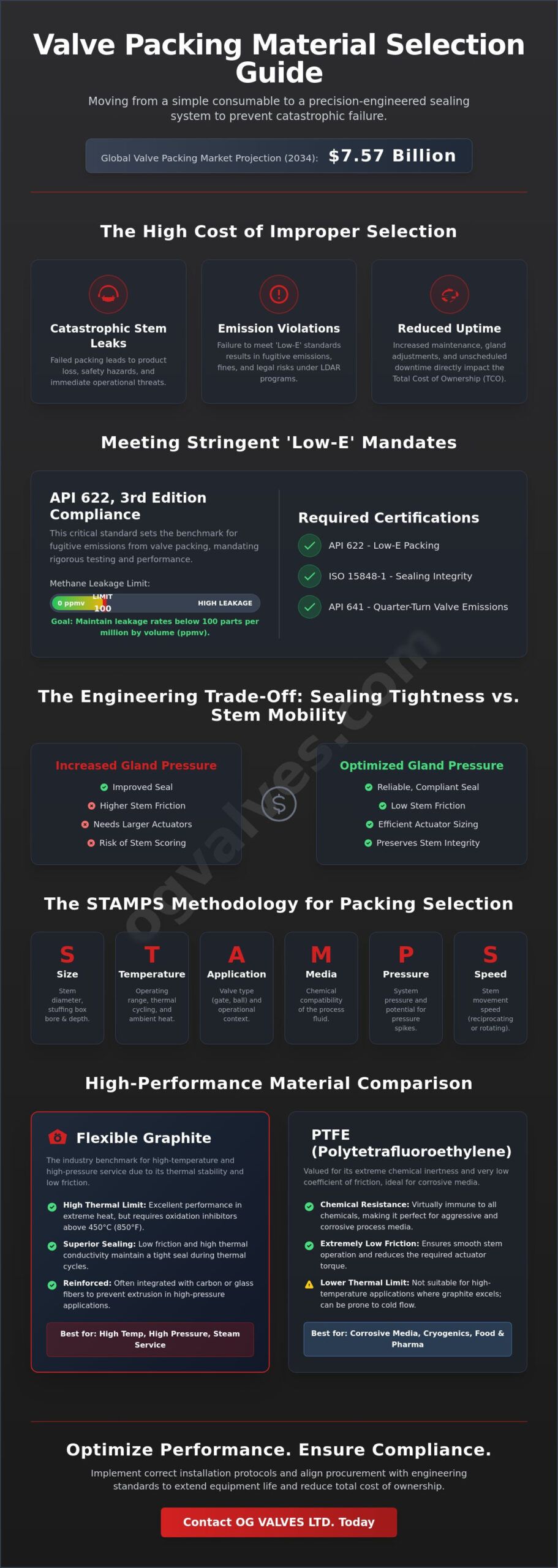
Treating valve packing as a simple consumable rather than a precision-engineered sealing system is a calculation that frequently results in catastrophic stem leaks and total operational failure. With the global valve packing market projected to reach $7.57 billion by 2034, the technical requirements for these components have shifted from basic containment to rigorous environmental compliance. This valve packing material selection guide addresses the critical engineering challenges of material degradation during extreme thermal cycling and the necessity of maintaining methane leakage rates below 100 ppmv as mandated by API 622, 3rd Edition.
You understand that unscheduled downtime due to fugitive emission violations or excessive stem friction is unacceptable in high-stakes industrial environments. This article provides a comprehensive technical framework for selecting materials based on pressure, temperature, and chemical compatibility. We examine the specific performance data required to achieve compliance with ISO 15848-1 and API 641, ensuring your gate and ball valves maintain structural integrity. By following this methodical evaluation of technical specifications and engineering standards, you can extend your Mean Time Between Planned Maintenance and protect critical infrastructure from premature mechanical wear.
Key Takeaways
- Identify the critical role of the valve stuffing box as a dynamic seal and its impact on achieving stringent fugitive emission compliance.
- Utilize this valve packing material selection guide to differentiate between flexible graphite and PTFE based on thermal limits and chemical compatibility.
- Apply the STAMPS methodology to ensure every operational parameter, from process media to ambient heat, is accounted for during material specification.
- Align procurement strategies with international engineering standards, including API 622 and ISO 15848-1, to verify sealing integrity through rigorous type testing.
- Optimize long-term performance by implementing correct installation torque and compression protocols that reduce stem friction and extend the Mean Time Between Planned Maintenance.
The Critical Function of Valve Stem Packing in Industrial Sealing
The mechanical integrity of industrial valves depends on the effectiveness of the stuffing box assembly. This component serves as a dynamic seal, housing compression packing that must prevent process media from escaping along the reciprocating or rotating stem. Understanding The Critical Function of Valve Stem Packing is essential for engineers who prioritize operational safety and regulatory adherence. This valve packing material selection guide highlights that packing isn’t a static barrier but a functional interface that must withstand mechanical loads while facilitating stem movement.
The choice of packing material dictates the long-term reliability of the entire valve assembly. When packing fails, the resulting stem leaks don’t just cause product loss; they trigger unscheduled downtime and environmental violations. Engineers must view packing selection as a system-level decision that directly affects the Total Cost of Ownership (TCO). High-quality materials reduce the frequency of gland adjustments and prevent the degradation of expensive valve stems, ensuring that the initial procurement cost is offset by extended service intervals.
Fugitive Emissions and the ‘Low-E’ Mandate
Fugitive emissions are defined as unintentional leaks of volatile organic compounds (VOCs) or hazardous air pollutants from equipment components. Under Leak Detection and Repair (LDAR) programs, these emissions are monitored with extreme scrutiny. Modern environmental regulations now mandate ‘Low-E’ certified packing as a baseline requirement for most heavy industrial applications. For instance, API 622, 3rd Edition, sets a stringent limit of 100 ppmv for methane leakage. Selecting packing materials that fail to meet these benchmarks exposes a facility to significant legal risks and environmental penalties. High-performance packing minimizes VOC leakage by maintaining a tight molecular seal against the stem, even under fluctuating pressures.
Mechanical Stress and Stem Friction
A critical engineering trade-off exists between sealing tightness and stem mobility. Increasing gland pressure improves the seal but simultaneously elevates stem friction. This friction directly influences actuator sizing. Higher torque or thrust requirements necessitate larger, more expensive actuators to overcome the resistance. If the packing material creates excessive drag, it can slow valve response times or lead to erratic control performance in automated systems.
Excessive gland pressure often results in stem scoring. This occurs when the packing material or trapped particulates abrade the metal surface, creating permanent leak paths that no amount of tightening can fix. Maintaining packing integrity requires materials with high elasticity and thermal stability. During thermal cycling, valve components expand and contract at different rates. If a packing material lacks the resilience to recover its shape, a leak path forms. Reliable sealing is a product of precise material science and calculated mechanical load, ensuring the valve remains operational without compromising safety standards.
Selecting the appropriate sealing medium is a calculation based on chemical compatibility, thermal stability, and mechanical durability. This section of the valve packing material selection guide evaluates the technical properties of the primary materials used in high-stakes industrial environments. Engineering teams must distinguish between materials that provide a static barrier and those that offer dynamic resilience under fluctuating process conditions.
Flexible graphite remains the benchmark for high-temperature and high-pressure service due to its low friction and excellent thermal conductivity. Technical specifications for these materials are often governed by ASTM F2168, which defines the requirements for expanded graphite in industrial sealing. To prevent extrusion in high-pressure applications, carbon or glass fibers are frequently integrated as reinforcement. These fibers provide the structural framework necessary to maintain packing volume when the stuffing box is subjected to extreme mechanical loads.
Graphite: Thermal Limits and Oxidation
Pure expanded graphite is highly effective but possesses a critical vulnerability to oxidation in aerobic environments. While it remains stable in reducing atmospheres at temperatures exceeding 2700°C, it begins to oxidize at approximately 454°C (850°F) in the presence of oxygen. This oxidation process converts the solid carbon into carbon dioxide gas, leading to volume loss and subsequent seal failure. Engineers must specify graphite with high-quality corrosion inhibitors to mitigate this risk. In high-pressure gate valve applications, wire-reinforced graphite provides the structural integrity required to resist blowout and maintain sealing force.
PTFE and Synthetic Alternatives
Polytetrafluoroethylene (PTFE) offers near-universal chemical resistance and exceptionally low stem friction, making it ideal for corrosive media. However, its application is limited by a maximum operating temperature of 260°C (500°F). A primary technical challenge with PTFE is “cold flow,” a phenomenon where the material deforms under constant pressure. To counter this, reinforced PTFE utilizing carbon or glass fillers is specified to improve creep resistance. For applications requiring better compressibility at lower gland loads, expanded PTFE (ePTFE) is preferred. This material possesses a porous structure that allows for superior sealability on irregular stuffing box surfaces while maintaining chemical inertness.
Advanced thermoplastics like PEEK are reserved for specialized environments where mechanical strength must be maintained at temperatures higher than standard PTFE can support. For complex configurations involving multiple media types, consulting a technical specialist ensures that your ball valves are equipped with the optimal material blend for long-term performance.
The STAMPS Methodology for Packing Selection
Engineering precision in sealing systems requires a structured approach to material specification. The STAMPS methodology serves as the industry standard for this process, ensuring that every operational variable is evaluated before procurement. This valve packing material selection guide utilizes the STAMPS framework—Size, Temperature, Application, Media, Pressure, and Speed—to eliminate the guesswork that leads to premature seal failure. By following this methodical progression, technical experts can align material capabilities with the specific demands of the industrial environment.
Size determination involves calculating the exact cross-section and required ring count for the stuffing box. The cross-section is typically defined as half the difference between the stuffing box bore and the stem diameter. Pressure requirements must account for both steady-state operation and potential system spikes. If the system pressure exceeds the structural limits of the packing, the material will extrude into the clearances, resulting in a total loss of sealing integrity. High-pressure environments necessitate materials with high modulus of elasticity and reinforced edges to resist this deformation.
Linear vs. Rotary Motion Dynamics
The type of valve motion dictates the mechanical stress applied to the packing rings. While check valves rarely require packing due to their internal self-actuating design, control valves demand materials with high-cycle resilience. Linear motion in gate and globe valves subjects the packing to axial friction as the stem moves through the rings. Conversely, the rotary motion of butterfly valve shafts or ball valve stems creates localized shear stress. High stem travel speeds generate significant frictional heat within the stuffing box, which can degrade synthetic fibers if the thermal dissipation properties of the material are insufficient.
Chemical Compatibility and PH Limits
Media compatibility is evaluated using the pH scale, ranging from 0 to 14. Synthetic fibers like aramid are generally effective within the pH 2–12 range but will degrade rapidly when exposed to strong mineral acids or highly concentrated bases. Specialized applications involving cryogenic fluids or strong oxidizers require high-purity PTFE or specifically treated graphite. For graphite-based packing sets, the integration of sacrificial anodes, such as zinc dust, is a vital engineering specification. These anodes prevent galvanic corrosion of the valve stem in the presence of moisture, protecting the metal surface from pitting that would otherwise create permanent leak paths.
Regulatory Compliance: API and ISO Testing Standards
Regulatory adherence serves as the final technical verification for any valve packing material selection guide. Modern industrial standards have shifted from prescriptive material lists to performance-based type testing. This evolution ensures that sealing systems can meet the 100 ppmv (parts per million by volume) methane leakage threshold mandated by global environmental agencies. Procurement specialists must distinguish between material-level certifications and full-valve assembly tests to ensure total system compliance.
API 622, 3rd Edition, Addendum 1 (March 2022) is the primary benchmark for testing the packing material itself. This standard subjects the packing to 1510 mechanical cycles and five thermal cycles, reaching temperatures of 260°C (500°F). While API 622 qualifies the material, API 624 (2nd Edition, 2023) and API 641 (2nd Edition, 2023) qualify the valve assembly. These standards require that the packing used within the valve has already passed API 622 testing. This two-tier validation process is critical for specifying a compliant ball valve or gate valve in hazardous media service.
Decoding API 622 and 624 Requirements
The distinction between API 622 and API 624 is fundamental to engineering integrity. API 622 evaluates the “ingredients”—the packing rings—under controlled laboratory conditions to verify their fugitive emission capabilities. API 624, however, tests the “entire assembly,” verifying how the packing interacts with a specific rising stem valve design. It’s not enough to specify “Low-E” packing; the valve manufacturer must prove the assembly maintains the 100 ppmv limit through rigorous thermal and mechanical cycling. Failure to align these two certifications often leads to regulatory non-compliance during LDAR inspections.
ISO 15848-1 Classification Levels
ISO 15848-1:2015 provides a comprehensive international classification system for fugitive emissions. This standard categorizes valves based on Tightness Classes and Endurance Classes. Tightness Class A represents the most stringent level, typically reserved for bellows-sealed valves or high-performance packing systems, while Class B is the industry standard for high-quality technical procurement. Endurance classes, such as CO1 (500 cycles) or CO2 (1500 cycles), define the mechanical life of the seal under specific temperature and pressure ratings. When reviewing a compliance certificate, engineers must verify that the tested temperature and pressure ranges match their specific process conditions. Selecting a valve with an ISO 15848-1 Class B, CO2 rating provides a verifiable benchmark for long-term sealing reliability in critical infrastructure. For projects requiring documented adherence to these global benchmarks, you can view our certified valve specifications to ensure your facility meets current environmental mandates.
Facility-wide standardisation of packing materials is an effective strategy for reducing inventory complexity and mitigating the risk of incorrect material application. By utilising this valve packing material selection guide to identify high-performance, versatile materials—such as reinforced flexible graphite—procurement teams can consolidate their stock. This approach ensures that even general-service valves are equipped with materials that meet high-pressure and high-temperature requirements, preventing the accidental installation of inferior seals in critical lines. A unified procurement strategy simplifies maintenance training and ensures consistency in sealing integrity across the entire infrastructure.
Technical procurement must also account for the total life cycle of the valve. While the initial cost of high-spec packing is higher, the reduction in unscheduled downtime and the prevention of stem damage provide a significant return on investment. Engineers should prioritise suppliers who provide documented evidence of material testing and compliance with the engineering standards discussed in previous sections. This clinical focus on quality assurance is the only reliable method for achieving long-term operational stability in heavy industrial sectors.
Installation and Maintenance Best Practices
Correct installation is as critical as the material specification itself. While some technicians follow the ‘50% compression’ rule as a general guideline, engineers must mandate adherence to specific torque values provided by the manufacturer. Over-tightening gland bolts is a leading cause of stem scoring and increased actuator wear, which eventually necessitates expensive component replacement. In multi-ring packing sets, staggering the joints at 90° or 120° intervals is essential. This configuration prevents the formation of a direct leak path through the packing stack. For applications subject to frequent thermal cycling, live-loading systems—utilising Belleville spring washers—maintain constant gland pressure, effectively compensating for material relaxation or thermal expansion.
Global Supply and Technical Support
OG VALVES LTD. functions as a dependable partner in critical infrastructure, offering more than simple component supply. Our inventory is managed to ensure the rapid delivery of valves that adhere to the most current fugitive emission standards. We verify that every gate, ball, and globe valve in our supply chain meets the specific material requirements identified in your valve packing material selection guide. This commitment to engineering excellence ensures that your procurement process aligns with global safety benchmarks and operational output goals. Our global supply chain capabilities allow us to handle large-scale industrial demands while maintaining the precision required for specialised applications.
Technical specialists are available to assist with complex material cross-referencing and project-specific documentation. Ensuring that your facility remains compliant with API 622 and ISO 15848-1 requires precise coordination between engineering and procurement teams. It’s vital to anchor every procurement decision in rigorous testing data and quality control protocols. Contact our technical team for bespoke valve specification and procurement to secure components engineered for long-term performance and regulatory adherence.
Securing Operational Integrity Through Standardized Engineering Protocols
Maintaining the integrity of industrial sealing systems requires a disciplined approach to material science and mechanical standards. This valve packing material selection guide has established that the transition to performance-based testing, specifically API 622 and ISO 15848-1, is now the baseline for regulatory adherence. Applying the STAMPS methodology allows engineers to balance chemical compatibility against mechanical friction. This ensures that every stuffing box component contributes to the longevity of the valve assembly while meeting strict environmental mandates.
OG VALVES LTD. acts as a dependable partner in this technical procurement process. We maintain an extensive inventory of API-certified valves and possess the technical expertise required to select materials for the most corrosive industrial environments. Our global fast-track delivery capabilities ensure that high-specification components reach your site when they’re needed most. Consult OG VALVES LTD. for High-Specification Industrial Valve Solutions to align your infrastructure with the highest benchmarks of engineering excellence. Implementing these rigorous standards today secures the operational output of your facility for the years ahead.
Frequently Asked Questions
What is the most common cause of valve packing failure?
Improper installation torque remains the primary cause of packing failure in industrial environments. When gland bolts aren’t tightened to precise technical specifications, the material fails to achieve the required contact pressure against the stem and stuffing box wall. Conversely, over-tightening is equally detrimental. It leads to stem scoring and excessive frictional heat that degrades the material structure, resulting in premature seal degradation and leakage.
Can I use graphite packing in high-temperature oxygen service?
Graphite isn’t recommended for high-temperature oxygen service because it oxidizes rapidly at temperatures exceeding 454°C (850°F) in aerobic environments. This oxidation process converts solid carbon into gas, leading to volume loss and total seal failure. Specialized synthetic materials or treated graphite with high-purity inhibitors are required for these specific oxidizing atmospheres to maintain structural integrity and safety.
What is the difference between API 622 and API 624?
API 622 is a performance test for the packing material itself, whereas API 624 is a type test for the entire rising stem valve assembly. This distinction is critical in any valve packing material selection guide. API 624 requires that the graphite packing used within the valve must have already passed the API 622 fugitive emissions testing protocols to ensure compliance.
How many rings of packing are typically required for an industrial valve?
Industrial valves typically utilize five rings of packing, though the exact count depends on the stuffing box depth and pressure rating. The bottom rings provide the primary seal, while the upper rings distribute the gland load. Using too many rings can increase stem friction without improving sealing effectiveness. This makes precise calculation essential for maintaining optimal operational output and reducing actuator wear.
What is ‘live loading’ in valve stem packing?
Live loading involves the use of Belleville spring washers on gland bolts to maintain a constant compressive load on the packing set. This mechanism automatically compensates for material relaxation, wear, and thermal expansion during operational cycling. It’s an essential engineering standard for valves in high-cycle or extreme temperature services where manual gland adjustments are infrequent or impractical.
Is PTFE packing suitable for high-pressure steam applications?
PTFE is generally unsuitable for high-pressure steam applications because its thermal limit is 260°C (500°F). Steam at high pressures frequently exceeds this threshold, causing the PTFE to soften and undergo “cold flow” deformation. This valve packing material selection guide recommends flexible graphite for steam service due to its superior thermal stability and resistance to high-pressure extrusion.
How do I calculate the required gland torque for new packing?
Calculating gland torque requires a technical formula that accounts for stem diameter, stuffing box bore, and the target gland pressure. This pressure must exceed the system pressure by a specific factor defined by the material’s modulus of elasticity. Engineers must consult the specific torque charts provided by the manufacturer to ensure values don’t exceed the mechanical limits of the gland bolts.
What are the advantages of die-formed graphite rings over braided packing?
Die-formed graphite rings offer superior density and dimensional stability compared to standard braided packing. Because they’re pre-compressed to a specific density, they require less gland adjustment and provide a more immediate seal upon installation. Braided packing is often utilized as end rings in a set to provide structural support and prevent the extrusion of the softer die-formed rings.
 Responsive Menu