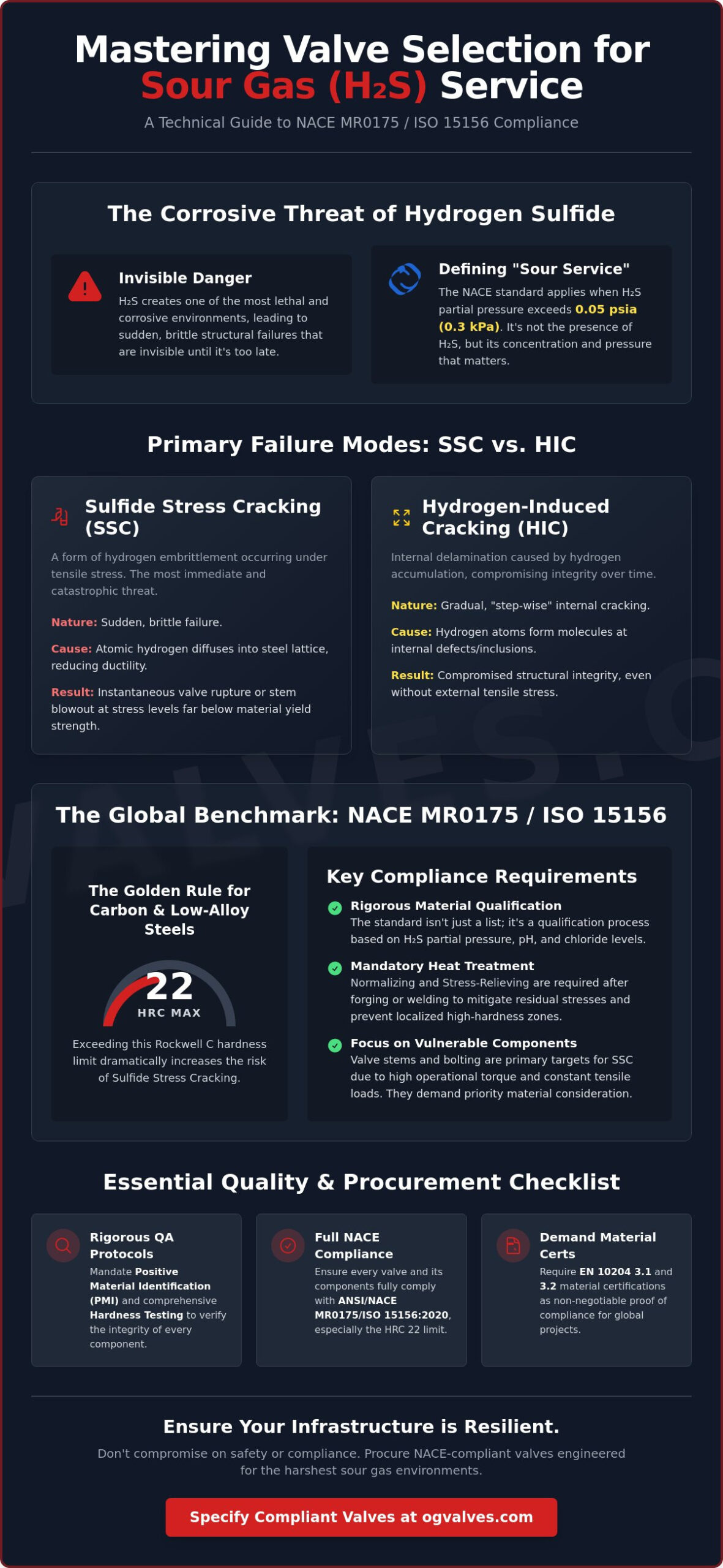
In high-pressure sour gas environments, the difference between operational integrity and catastrophic structural failure often hinges on a few microns of material hardness or a single metallurgical certification. Technical experts recognize that hydrogen sulfide creates one of the most lethal and corrosive environments in the energy sector. The complexity of selecting valves for sour gas service (h2s) is compounded by the necessity of preventing invisible brittle failures while maintaining compliance with rigorous international safety benchmarks.
This technical guide provides a precise framework for identifying H2S-compliant components that adhere to the current ANSI/NACE MR0175/ISO 15156:2020 standards. It’s essential to master material science protocols used to mitigate Sulfide Stress Cracking (SSC) and Stress Corrosion Cracking (SCC). We analyze the specific requirements for gate, ball, and globe valves, while addressing the upcoming restructuring of NACE standards into three distinct parts. This overview ensures your infrastructure remains resilient against chemical degradation and regulatory scrutiny.
Key Takeaways
- Identify the metallurgical triggers of Sulfide Stress Cracking (SSC) and how H2S partial pressure thresholds dictate material selection for high-strength steels.
- Ensure full compliance with ANSI/NACE MR0175/ISO 15156:2020 when selecting valves for sour gas service (h2s), specifically regarding the HRC 22 hardness limit for carbon steels.
- Evaluate the performance of gate, ball, and butterfly valves in high-pressure environments while addressing the technical risks of H2S accumulation in valve dead spaces.
- Establish rigorous quality assurance protocols, including Positive Material Identification (PMI) and hardness testing, to verify the integrity of valve bodies and internal components.
- Master the procurement requirements for global infrastructure projects, including the necessity of EN 10204 3.1 and 3.2 material certifications.
The Mechanics of Sulfide Stress Cracking (SSC) in Sour Gas Service
Selecting valves for sour gas service (h2s) requires a rigorous evaluation of the partial pressure of hydrogen sulfide within the process stream. Sour service isn’t defined by the mere presence of H2S, but by the specific chemical environment that triggers material degradation. When H2S contacts high-strength steel in the presence of water, a corrosion reaction occurs that generates atomic hydrogen. These hydrogen atoms don’t form molecules immediately; instead, they diffuse into the metal lattice, causing internal pressure and reducing the material’s ductility.
Defining Sour Service Parameters
Determining NACE MR0175/ISO 15156 applicability starts with calculating the H2S partial pressure. You multiply the total system pressure by the mole fraction of H2S in the gas phase. The standard typically applies when the partial pressure exceeds 0.05 psia (0.3 kPa). Environmental factors like temperature and pH significantly influence the rate of cracking. While higher temperatures can sometimes reduce the risk of SSC, low pH levels and ambient temperatures often accelerate hydrogen absorption. Distinguishing between standard sour and highly sour environments is critical for material grading, as higher H2S concentrations demand more advanced corrosion-resistant alloys (CRAs).
Primary Failure Modes: SSC vs. HIC
Sulfide Stress Cracking (SSC) is a form of hydrogen embrittlement occurring in the presence of water and H2S. This failure mode is particularly dangerous because it’s sudden and brittle, occurring at stress levels far below the material’s yield strength. In pressurized systems, Sulfide Stress Cracking (SSC) can lead to instantaneous valve body rupture or stem blowout. Conversely, Hydrogen-Induced Cracking (HIC) involves the accumulation of hydrogen at internal defects or inclusions within the steel. This results in internal delamination and “step-wise” cracking that compromises the structural integrity of the valve body over time, even in the absence of external tensile stress.
Valve stems and bolting represent the most vulnerable components in any sour gas installation. Stems are subjected to high operational torque and constant tensile loads, making them primary targets for SSC. Bolting is often overlooked, yet it’s frequently made from high-strength materials that are inherently susceptible to embrittlement. Engineering teams responsible for selecting valves for sour gas service (h2s) must prioritize materials that maintain ductility under these high-load conditions. Failure to account for the synergistic effects of H2S concentration, tensile stress, and material hardness in these specific parts often leads to the most frequent and severe operational failures.
Regulatory Framework: NACE MR0175 and ISO 15156 Compliance
The global benchmark for metallic materials in H2S environments is defined by the ISO 15156-1 Standard, which is technically identical to NACE MR0175. This framework serves as a rigorous set of requirements for preventing brittle failure in upstream production and gas processing plants. When selecting valves for sour gas service (h2s), engineers must distinguish between the standard’s three parts: general principles, cracking-resistant steels, and corrosion-resistant alloys. It isn’t a simple material list. It’s a qualification process that demands specific environmental data, including H2S partial pressure, pH, and chloride concentration, to ensure the chosen components won’t fail under operational stress.
Material Hardness Limits and Heat Treatment
The most critical metric for carbon and low-alloy steels is the hardness threshold of HRC 22. Exceeding this limit dramatically increases the risk of Sulfide Stress Cracking. Hardness is essentially a proxy for the material’s strength and microstructural state; higher hardness often indicates a martensitic structure that’s highly susceptible to hydrogen embrittlement. To achieve compliance, manufacturers must employ precise heat treatment processes. Normalizing and stress-relieving are mandatory for valve bodies and internal components after forging or welding. Residual stresses from cold working must be mitigated through thermal processing, as localized high-hardness zones in welds are frequent points of failure in non-compliant equipment.
Selection of Corrosion-Resistant Alloys (CRAs)
In environments where partial pressures or chemical aggression exceed the limits of carbon steel, engineers must transition to CRAs. This often involves specifying Duplex or Super Duplex stainless steels, which offer superior resistance to both SSC and chloride-induced pitting. For the most severe service conditions, Nickel-based alloys like Inconel or Monel are required to ensure long-term mechanical integrity. Detailed guidance on these materials can be found in our resource on Industrial Valve Material Selection for Chemical Processing. These alloys provide the necessary metallurgical stability to withstand the corrosive synergy of H2S and brine.
Rigorous documentation is the final pillar of regulatory compliance. Every component requires material traceability, typically through EN 10204 3.1 or 3.2 certifications. These documents verify that the chemical composition and mechanical properties, including hardness test results, meet the specified NACE requirements. If you’re managing a high-stakes project, consulting with a technical expert ensures that your specifications align with the latest 2021/2025 regulatory updates. This meticulous approach to selecting valves for sour gas service (h2s) mitigates the risk of “invisible” brittle failures that can compromise safety and lead to environmental disasters.
Comparative Analysis: Selecting Valve Types for H2S Environments
Mechanical design is as critical as metallurgy when selecting valves for sour gas service (h2s). While the previous sections established the necessity of NACE-compliant materials, the physical configuration of a valve determines how it handles the operational realities of toxic media. High-pressure H2S environments demand designs that minimize leak paths and prevent the accumulation of corrosive gases within the valve body. Failure to match the valve type to the specific process conditions often results in premature seal degradation or mechanical seizure.
Gate and Globe Valves in Sour Service
In upstream isolation, industrial gate valves are frequently specified due to their linear motion and robust sealing capabilities. However, rising stem designs introduce a potential point of atmospheric leakage at the packing gland. For sour service, this requires high-integrity packing materials and often a lantern ring for leak detection. NACE compliance further dictates that seat-to-body welds must be stress-relieved to prevent localized hardness zones. Globe valves follow similar metallurgical constraints but are primarily utilized for throttling where precise flow control is required despite the aggressive nature of the media.
Ball and Butterfly Valves: Sealing Challenges
Quarter-turn valves offer rapid operation but present distinct risks in H2S environments. Ball valves, particularly floating designs, can trap sour gas in the body cavity “dead space.” This trapped H2S can concentrate over time, increasing the risk of Sulfide Stress Cracking in the body or ball. Trunnion-mounted ball valves are preferred for high-pressure service as they reduce the load on the seats and lower the torque required for operation. When using industrial butterfly valves, a triple-offset configuration is essential to achieve a gas-tight, metal-to-metal seal that resists the corrosive effects of sour gas without the friction that leads to seat wear.
Plug valves serve as a viable alternative for abrasive sour media. Their lubricated or sleeved designs protect the sealing surfaces from direct contact with the flow, which is beneficial when the gas stream contains solids. Regardless of the valve type, H2S exposure inevitably impacts seal integrity and torque. Elastomeric seals must be carefully selected to avoid explosive decompression, while actuators must be sized with a significant safety factor to account for increased friction caused by sulfide film buildup on moving parts. This methodical approach to valve geometry ensures that selecting valves for sour gas service (h2s) results in a system that remains operational throughout its intended life cycle.
Technical Specification and Quality Assurance Protocols
Verification is the final safeguard when selecting valves for sour gas service (h2s). Engineering specifications are only effective if the physical hardware matches the documented metallurgy. In sour gas applications, the procurement process must include non-destructive testing (NDT) to confirm that every component meets NACE MR0175 requirements. This rigorous quality assurance prevents the installation of non-compliant materials that might otherwise pass visual inspection but fail under hydrogen exposure.
Positive Material Identification (PMI) and Hardness Testing
Positive Material Identification (PMI) using X-ray fluorescence (XRF) technology is mandatory for all pressure-containing parts. This portable analysis verifies the alloy composition, ensuring that high-nickel or duplex materials haven’t been substituted with lower-grade alternatives. A standard protocol requires 100% PMI for valve bodies, stems, and bonnets. Hardness testing must follow, focusing specifically on the heat-affected zone (HAZ) in welded components. Even if the base metal is compliant, improper welding can create localized hardness spikes exceeding the HRC 22 limit discussed in previous sections, creating a prime site for Sulfide Stress Cracking.
Elastomers and Explosive Decompression (ED)
Selecting valves for sour gas service (h2s) also demands a focus on non-metallic components. High-pressure gas systems are prone to Rapid Gas Decompression (RGD), also known as explosive decompression. When system pressure drops quickly, gas trapped inside the elastomer structure expands, causing internal ruptures or “blistering.” To mitigate this, engineers must specify AED (Anti-Explosive Decompression) seals. H2S-compatible elastomers like Viton (FKM) or Kalrez (FFKM) are preferred, provided they carry the necessary RGD certifications for high-pressure service.
Surface treatments provide an additional layer of protection for internal moving parts. Electroless Nickel Plating (ENP) is frequently used to enhance corrosion resistance on ball valves and stems. However, in abrasive sour media, Tungsten Carbide coatings offer superior hardness and wear resistance. These coatings must be applied with high-velocity oxy-fuel (HVOF) processes to ensure a dense, low-porosity bond that prevents H2S from reaching the substrate. For projects requiring these exact specifications, request a technical quote from our engineering team to ensure full compliance with international safety standards.
Procuring NACE-Compliant Valves for Global Projects
Successful procurement bridges the gap between engineering theory and operational reality. When selecting valves for sour gas service (h2s), the final challenge isn’t just defining the specification, but ensuring the global supply chain delivers components that strictly adhere to those requirements. High-stakes projects in the energy sector can’t afford the delays or risks associated with non-compliant hardware. Procurement strategies must therefore prioritize material traceability and verified manufacturer performance to safeguard long-term infrastructure integrity.
Technical Support and Material Certification
Material certification is the primary evidence of regulatory compliance. For sour gas applications, the distinction between EN 10204 3.1 and 3.2 certification is critical. A 3.1 certificate is a statement issued by the manufacturer’s own authorized inspection representative, whereas 3.2 certification requires the presence of an independent third-party inspection (TPI) body, such as Lloyd’s Register or Bureau Veritas. In high-pressure H2S environments, 3.2 certification provides a superior level of assurance, as the TPI verifies the chemical analysis and mechanical testing at the source. This rigorous documentation ensures that the metallurgical properties discussed in our Industrial Valves: The Engineer’s Comprehensive Guide are met without exception.
Global Supply Chain for Critical Infrastructure
OG VALVES LTD. manages technical compliance by maintaining a robust network capable of fast-track sourcing for specialized alloys like Super Duplex and Inconel. Lead times for these materials are notoriously long, yet critical infrastructure often requires rapid deployment to avoid costly downtime. Our technical expertise prevents material mismatches by reviewing client specifications against current 2021/2025 NACE/ISO benchmarks before the order is placed. This proactive review identifies potential issues with hardness limits or heat treatment protocols early in the procurement cycle.
The decision-making process for selecting valves for sour gas service (h2s) ultimately weighs the cost of failure against the cost of compliance. A single failure in a lethal H2S environment results in catastrophic environmental damage, legal liabilities, and total system shutdown. Investing in NACE-compliant gate, ball, or check valves with full material traceability isn’t merely a regulatory hurdle. It’s a fundamental requirement for operational safety. By partnering with an experienced global entity, engineering teams secure a reliable supply of high-spec components that are qualified to perform in the world’s most aggressive industrial environments.
Securing Operational Integrity in Lethal H2S Environments
Maintaining structural soundness in sour service requires a clinical focus on metallurgical compliance and mechanical design. As established, the prevention of Sulfide Stress Cracking hinges on adhering to strict HRC 22 hardness limits and utilizing advanced corrosion-resistant alloys. Selecting valves for sour gas service (h2s) isn’t simply a procurement task; it’s a critical safety protocol that demands verified material traceability and rigorous non-destructive testing. By integrating these technical specifications, engineers ensure that their infrastructure remains resilient against the catastrophic risks of hydrogen embrittlement.
Our commitment to industrial safety is backed by a comprehensive inventory of API 6D and NACE MR0175 certified stock. We provide 100% PMI and hardness testing to verify that every component meets your exact project requirements, supported by global fast-track logistics for critical needs. Request a Technical Quote for NACE-Compliant Valves to secure a dependable partner for your next high-stakes installation. You can move forward with the confidence that your systems are engineered for unwavering reliability and long-term performance.
Frequently Asked Questions
What is the NACE MR0175 standard for valves?
NACE MR0175 is the primary global standard, technically identical to ISO 15156, governing material selection for metallic components in H2S environments. It provides a technical framework to prevent Sulfide Stress Cracking (SSC) in upstream oil and gas production. When selecting valves for sour gas service (h2s), this standard dictates specific metallurgical requirements, including chemical composition, heat treatment, and hardness limits, to ensure structural integrity in toxic process streams.
Can I use standard carbon steel valves for sour gas service?
Standard carbon steel valves are generally unsuitable for sour service because they lack the required hardness controls and heat treatment protocols. NACE-compliant carbon steel must undergo normalizing or stress-relieving to eliminate residual tensile stresses. These components are strictly limited to a maximum hardness of HRC 22. Utilizing non-compliant steel in the presence of H2S invites catastrophic brittle failure through hydrogen-induced mechanisms that compromise the pressure boundary.
How do I calculate if my application requires NACE-compliant valves?
NACE compliance is determined by calculating the partial pressure of H2S in the process environment. You multiply the total system pressure by the mole fraction of H2S in the gas phase. If the resulting partial pressure equals or exceeds 0.05 psia (0.3 kPa), the standard’s material requirements become mandatory. This calculation is the foundational step for engineering teams when selecting valves for sour gas service (h2s) to ensure regulatory adherence and safety.
What are the best seat materials for H2S service?
Soft-seated valves require elastomers like Viton (FKM) or Kalrez (FFKM) that are certified for Anti-Explosive Decompression (AED). These materials resist chemical degradation and internal rupturing during rapid pressure fluctuations. For metal-seated configurations, Stellite or Tungsten Carbide overlays are applied to NACE-compliant base metals. These hard-facing materials provide the necessary wear resistance and sealing integrity in aggressive, high-pressure H2S environments without compromising the valve’s mechanical ductility or operational lifespan.
What is the difference between NACE MR0175 and NACE MR0103?
The primary difference lies in the operational environment: MR0175 targets upstream production, while MR0103 applies to downstream petroleum refining. Upstream environments often contain high chloride concentrations and water, necessitating more stringent material qualifications. Downstream refinery processes involve different stress-cracking mechanisms where chloride is less prevalent. While both standards focus on H2S, they define different material limits and environmental conditions, making it essential to specify the correct standard based on the facility’s location.
How does H2S affect valve torque and automation?
Hydrogen sulfide exposure significantly increases operational torque due to the formation of iron sulfide scales on internal moving parts. This sulfide film creates higher friction between the stem, ball, or gate and the seating surfaces. Automation systems must account for this by incorporating a safety factor of at least 25% or higher when sizing actuators. Failure to compensate for this increased resistance can lead to actuator stalling or valve seizure during critical safety operations.
Why is PMI testing mandatory for sour service valves?
PMI testing is mandatory because it provides non-destructive verification of the alloy’s chemical composition. In a global supply chain, material substitution is a significant risk that can lead to the installation of non-compliant components. Portable X-ray fluorescence (XRF) analyzers confirm that high-nickel or duplex alloys meet the specified technical benchmarks. This verification process ensures that the valve’s corrosion resistance aligns with the engineering design and the necessary NACE certification requirements for hazardous service.
What is the maximum hardness allowed for valves in sour service?
For carbon and low-alloy steels, the maximum allowable hardness is HRC 22 according to NACE MR0175/ISO 15156. This specific threshold is established because materials exceeding this limit exhibit a martensitic structure that’s highly susceptible to hydrogen embrittlement. Manufacturers must perform Rockwell hardness testing on valve bodies, bonnets, and stems to confirm compliance. Maintaining this limit is the most effective method for preventing the initiation of Sulfide Stress Cracking in pressurized industrial systems.
 Responsive Menu