The global desalination market is expanding toward a projected valuation of US$ 38.80 billion by 2034, yet the technical viability of these critical assets remains tethered to the performance of high-pressure flow control components. Engineers and procurement specialists recognize that standard austenitic stainless steels frequently fail under the chloride-induced stresses inherent in seawater processing. These failures result in significant operational downtime and complex maintenance cycles that jeopardize plant output. This technical guide provides a comprehensive analysis of the metallurgical requirements and engineering standards necessary to implement robust desalination plant valve solutions that withstand aggressive high-salinity environments.
We’ll examine the specific material classifications required for different plant zones, ensuring full compliance with ASME and API benchmarks. The discussion covers the transition to high-PREN alloys, such as super duplex stainless steel, and addresses the impact of new regulatory frameworks like Chile’s 2026 National Desalination Strategy. By establishing clear procurement protocols and technical specifications, operators can mitigate the risks of pitting and crevice corrosion while securing a reliable supply chain for fast-track project delivery.
Key Takeaways
- Identify why a Pitting Resistance Equivalent Number (PREN) exceeding 40 is the technical benchmark for mitigating chloride-induced stress corrosion cracking.
- Compare the performance of super duplex stainless steel grades against standard alloys to ensure durability in high-pressure reverse osmosis environments.
- Align procurement strategies with ASME B16.34 and API 6D standards to ensure that desalination plant valve solutions meet rigorous safety and operational benchmarks.
- Execute Positive Material Identification (PMI) testing to verify metallurgical integrity and prevent the inclusion of substandard materials in critical infrastructure.
- Select high-performance butterfly and trunnion-mounted ball valves based on specific flow control requirements for intake, distribution, and isolation zones.
Technical Challenges in Desalination Flow Control
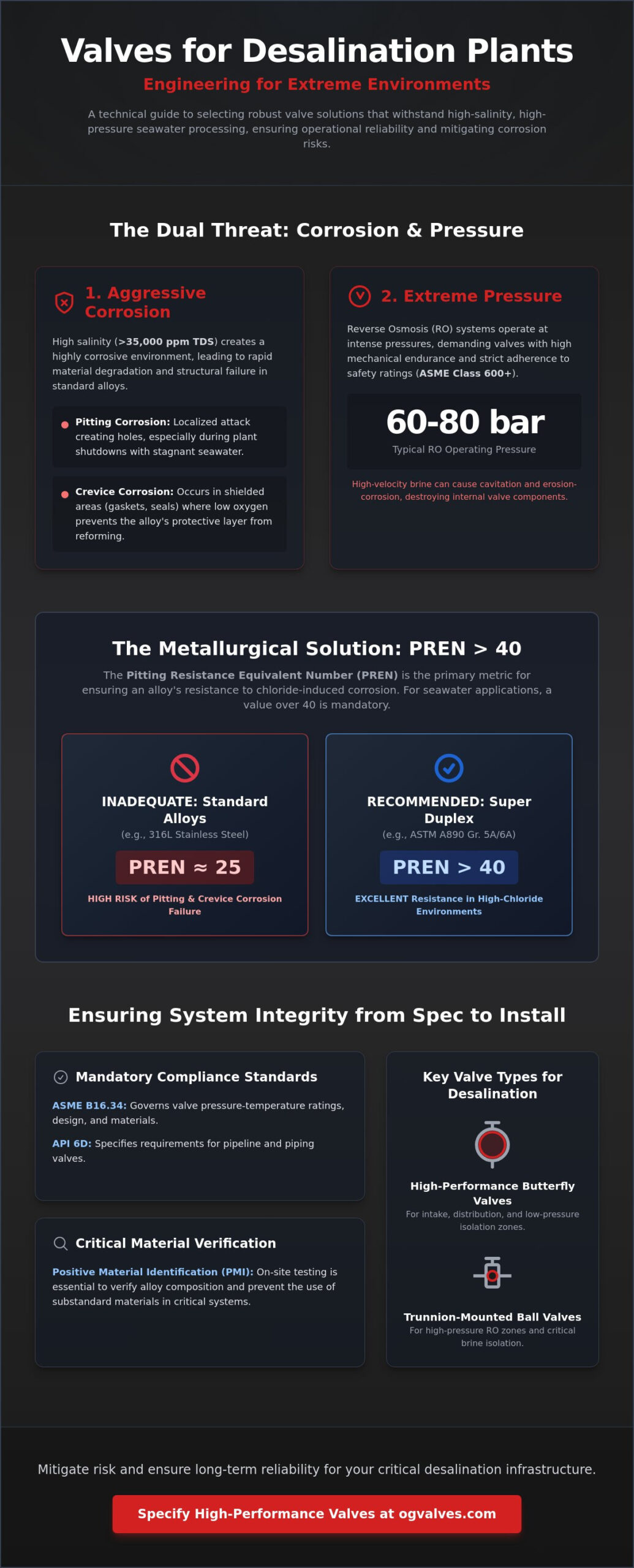
Desalination infrastructure operates under some of the most aggressive conditions in modern industry. High salinity levels, often exceeding 35,000 ppm of Total Dissolved Solids (TDS), create a highly corrosive electrolyte that challenges the structural integrity of all metallic components. Desalination processes vary from thermal distillation to membrane-based separation, but all share a common vulnerability: chloride-induced stress corrosion cracking (CSCC). This failure mode occurs when tensile stress and a corrosive environment combine to cause rapid, unpredictable structural failure. Identifying robust desalination plant valve solutions requires a deep understanding of these environmental stressors, including the impact of aggressive chemical cleaning cycles (CIP) that utilize acids and biocides to maintain membrane efficiency.
Seawater intake systems face biological fouling and abrasive particulate matter that can compromise valve seating surfaces. Conversely, brine discharge lines handle concentrated salt solutions that are significantly more corrosive than the initial feed water. High-pressure pumps used in Reverse Osmosis (RO) create intense mechanical stress on every downstream component. This environment demands valves that don’t just meet minimum standards but exceed them in terms of metallurgical stability and mechanical endurance. Failure to account for these variables leads to excessive downtime and increased total cost of ownership.
Corrosion Dynamics: Pitting and Crevice Failure
Pitting corrosion is a localized form of attack that creates small holes in the metal surface. It’s particularly dangerous during plant shutdowns when seawater remains stagnant within the valve body. In these conditions, chloride ions penetrate the passive film of the alloy, leading to rapid perforation. Crevice corrosion is equally critical; it occurs in shielded areas such as valve seats, gaskets, and stem seals. These narrow gaps restrict oxygen flow, preventing the metal from re-passivating its protective layer. In Multi-Stage Flash (MSF) systems, the combination of high temperature and high salinity accelerates these electrochemical reactions. Thermal stress further compounds the risk of mechanical failure in these distillation environments.
Pressure Requirements in Reverse Osmosis Systems
Modern RO plants rely on high-pressure pumps to overcome osmotic pressure, typically requiring operating pressures between 60 and 80 bar. Valves in these zones must adhere to rigorous ASME B16.34 class ratings, often moving into Class 600 or higher to ensure safety. Managing the brine reject line is a specific engineering challenge. High-velocity concentrated brine can cause cavitation, a phenomenon where vapor bubbles collapse and erode the valve internals. This erosion-corrosion cycle destroys valve trim and leads to total loss of flow control. Precise throttling is necessary to manage these pressure drops, requiring specialized valve designs that can handle high-pressure differentials without vibrating or leaking. High-performance desalination plant valve solutions are essential to maintain the pressure balance required for efficient membrane separation.
The selection of metallurgy dictates the service life and safety of desalination plant valve solutions. Standard austenitic stainless steels, such as Grade 316L, lack the chemical stability required to resist high-chloride environments at elevated pressures. Engineers must prioritize the Pitting Resistance Equivalent Number (PREN) as a primary validation metric. The Pitting Resistance Equivalent Number (PREN) is a mathematical formula used to quantify an alloy’s resistance to localized pitting corrosion based on its chemical composition of chromium, molybdenum, tungsten, and nitrogen. For seawater applications, a PREN value exceeding 40 is mandatory. This threshold differentiates standard duplex alloys from super duplex varieties, ensuring the valve body and internals remain passive against aggressive chemical attack.
Super duplex stainless steels, specifically ASTM A890 Grade 5A and 6A, are the industry standard for high-pressure reverse osmosis (RO) zones. These alloys contain approximately 25% chromium and significant levels of molybdenum and nitrogen. In contrast, standard 22Cr duplex alloys often fail in high-salinity brine lines where the chloride concentration is doubled. While 6% Molybdenum (6Mo) alloys offer even higher resistance, their cost often limits their use to specific critical components. For intake systems where biological fouling is a concern, Nickel-Aluminium Bronze (NAB) remains a viable option due to its inherent biocidal properties. However, it’s also necessary to consider Non-metallic valve solutions for low-pressure auxiliary lines where chemical compatibility is a higher priority than mechanical strength.
Alloy Selection: Super Duplex and Beyond
ASTM A890 specifications define the rigorous chemical and mechanical requirements for cast super duplex valves. While 22Cr duplex provides a lower initial capital expenditure, the lifecycle cost often favors 25Cr super duplex because of reduced maintenance intervals. In high-pressure RO stages, the risk of catastrophic failure makes super duplex the only technically sound choice. For procurement teams, verifying these specs through technical valve documentation is essential to ensure project compliance and long-term operational output. High-performance desalination plant valve solutions must be anchored in these quantifiable material standards to prevent premature asset depletion.
Surface Treatments and Coatings
Coatings serve as secondary protection rather than a primary defense in high-salinity flow. Fusion Bonded Epoxy (FBE) is frequently applied to carbon steel or low-alloy valves in non-critical water lines to prevent atmospheric and external corrosion. For high-wear areas, such as valve seats in abrasive intake lines, Stellite hard-facing is utilized to maintain seal integrity. Standard coatings often delaminate under high-pressure saline flow, making metallurgy the only reliable barrier against internal corrosion. Don’t rely on surface treatments to compensate for inadequate base metal selection in high-pressure RO environments.
Critical Valve Types for Desalination Processes
Effective flow control in desalination requires matching mechanical valve architecture to the specific hydraulic profile of each plant stage. While metallurgy provides the chemical resistance discussed previously, mechanical design dictates the valve’s ability to maintain a seal under varying pressure differentials. Selecting appropriate desalination plant valve solutions involves a distinction between high-volume intake requirements and high-pressure reverse osmosis (RO) isolation. Mechanical integrity must be prioritized to prevent bypass leakage that can compromise membrane efficiency.
High-performance butterfly valves are the primary choice for large-diameter intake and distribution lines. These valves offer a compact footprint and efficient flow characteristics for pre-treatment stages. For high-pressure RO isolation, trunnion-mounted ball valves provide the mechanical strength necessary to handle Class 600 or Class 900 ratings. These units manage high-torque requirements while ensuring bubble-tight shutoff during maintenance cycles.
In brine reject lines, check valves perform the essential function of preventing water hammer and backflow. Protecting expensive high-pressure pumps depends on the rapid, reliable closure of these components. Finally, globe valves are indispensable for chemical dosing and pressure management. Their linear motion design allows for the precise throttling required to maintain membrane feed stability and manage concentrated brine flow with minimal cavitation risk.
Butterfly Valve Configurations: Double vs. Triple Offset
Triple offset butterfly valves are utilized in high-pressure zones where zero-leakage isolation is a priority. The geometry of the triple offset design eliminates seat friction during operation, extending the service life of the valve internals. In contrast, concentric or double offset designs are suitable for low-pressure intake and pre-treatment stages. Seat material selection is equally vital; EPDM is standard for low-temperature intake, but metal-seated options are necessary for higher-temperature distillation processes. These mechanical configurations ensure that desalination plant valve solutions remain functional throughout the plant’s operational lifecycle.
High-Pressure Check Valve Design
Protecting high-pressure pumps requires non-slam axial check valves. These designs utilize a spring-assisted disc that closes before flow reversal occurs, mitigating the risk of hydraulic surges that can damage reverse osmosis membranes. For space-constrained desalination skids, dual plate check valves offer a compact footprint without sacrificing performance. Internal components, including springs and hinges, must be manufactured from super duplex or similar high-alloy materials to prevent mechanical failure in the saline flow. Standard stainless steel springs often suffer from chloride-induced fatigue, making material specification for internals as critical as the valve body itself.
Compliance, Standards, and Selection Criteria
Adherence to international engineering standards is the primary mechanism for ensuring the structural soundness of desalination plant valve solutions. These frameworks provide the quantifiable data necessary for technical experts to validate performance before installation. ASME B16.34 serves as the foundational standard, defining the pressure-temperature ratings, dimensions, and wall thickness requirements for valves with flanged, threaded, and welding ends. For heavy industrial gate valves, procurement specifications must align with API 600 or API 6D. These standards ensure that the mechanical design can withstand the rigorous operational output required in 2026 infrastructure projects.
In hybrid facilities where desalination is integrated with power generation, NACE MR0175/ISO 15156 compliance becomes necessary to manage sour environments. Quality assurance is further reinforced through standardized pressure testing. API 598 and ISO 5208 define the requirements for shell and seat leakage tests, providing the verification needed for high-stakes industrial applications. These protocols confirm that the valve internals can maintain integrity under the maximum allowable working pressure (MAWP) of the system. Rigorous testing prevents the catastrophic failure of components in high-pressure reverse osmosis zones.
Standard Certification and Documentation
Traceability is a non-negotiable requirement in critical infrastructure. Procurement specialists must demand EN 10204 3.1 or 3.2 material certificates to verify that the alloy composition matches the design specifications. These documents provide a direct link between the foundry’s heat number and the final assembled valve. For valves situated in hybrid power/desalination facilities, fire-safe certification under API 607 is essential to maintain plant safety during emergency scenarios. This level of documentation ensures that every component in the flow control system meets the necessary regulatory benchmarks.
Evaluating Flow Coefficient (Cv) for Desalination Skids
Optimizing energy consumption is a primary trend in modern desalination, with advanced systems achieving energy levels as low as 2.7 kWh per cubic meter as of 2026. Selecting valves with a high Flow Coefficient (Cv) reduces pressure drops across the system, directly impacting operational efficiency. Full bore valves are preferred in high-velocity lines to minimize turbulence and energy loss. When automating these systems, sizing actuators requires careful consideration of the increased break-to-open torque caused by saline crystallization on valve seats. Ensuring that the automation package is rated for high-torque conditions prevents operational delays. To ensure your project meets these rigorous benchmarks, consult our technical engineering team for detailed specification support.
Procurement and Logistics for Critical Infrastructure
The successful deployment of desalination plant valve solutions depends on a procurement strategy that balances technical precision with logistical agility. In a sector where downtime costs are calculated by the hour, fast-track procurement of high-specification alloys is a necessity rather than a luxury. Engineering teams must move beyond simple vendor selection to establish partnerships with entities capable of providing comprehensive technical support and specification reviews. This proactive approach prevents the procurement of incorrect materials that don’t meet the PREN requirements or pressure ratings established in the design phase.
Global supply chain management for desalination projects involves navigating the complexities of sourcing specialized components across international borders. Project managers must account for the lead times associated with casting super duplex or 6Mo alloys, which are often longer than those for standard carbon steel. Effective logistics management ensures that critical flow control components reach remote sites without compromising project timelines. This requires a robust network of international distributors and a deep understanding of global regulatory benchmarks to ensure seamless site delivery.
Quality Assurance and PMI Testing
Positive Material Identification (PMI) testing serves as the final barrier against metallurgical non-compliance. This non-destructive testing (NDT) method verifies the chemical composition of super duplex components before they leave the manufacturing facility. It’s common for foundries to handle multiple alloy grades; PMI ensures that no mix-ups occurred during the casting or assembly stages. For international projects, third-party inspection (TPI) protocols provide an additional layer of verification. These inspectors witness pressure tests and review material certifications to ensure every valve meets the project’s specific safety and performance criteria. These rigorous checks are essential for maintaining the structural soundness of the entire desalination skid.
Fast-Track Delivery and Inventory Management
Mitigating downtime during maintenance, repair, and operations (MRO) requires access to specialized inventory. Sourcing hard-to-find alloys like ASTM A890 Grade 5A from specialist providers can reduce lead times from months to weeks. Strategic inventory management involves maintaining a stock of common valve sizes and pressure classes used in high-pressure reverse osmosis skids. Delivering these components to remote global sites requires specialized logistics partners who understand the handling requirements for heavy industrial valves. By prioritizing fast-track delivery routes, operators can maintain operational output and ensure the long-term reliability of their desalination plant valve solutions.
Optimizing Operational Integrity in 2026 Desalination Infrastructure
Securing robust desalination plant valve solutions requires a procurement strategy anchored in technical precision and international compliance. We maintain an extensive inventory of specialized industrial valves and offer technical expertise in high-alloy metallurgy to support global infrastructure projects. Our global fast-track delivery capabilities ensure that high-specification components reach your site without compromising project timelines. Consult with our technical experts for high-specification desalination valve solutions to ensure the structural soundness of your next project.
Frequently Asked Questions
What is the best valve material for seawater desalination?
Super Duplex Stainless Steel, specifically ASTM A890 Grade 5A or 6A, is the optimal material for high-pressure seawater zones. These alloys provide the necessary resistance to chloride-induced stress corrosion cracking that causes standard materials to fail. For low-pressure intake systems, Nickel-Aluminium Bronze is often utilized due to its inherent anti-fouling properties and resistance to biological growth.
Why are triple offset butterfly valves used in desalination plants?
Triple offset butterfly valves are utilized because their geometry allows for friction-free operation and bubble-tight, metal-to-metal sealing. This design eliminates seat wear during opening and closing cycles, which is critical for maintaining zero-leakage isolation in high-pressure desalination plant valve solutions. The mechanical architecture ensures reliable performance in the aggressive conditions found in reverse osmosis skids.
How does PREN affect valve selection in high-salinity environments?
PREN serves as the primary mathematical benchmark for validating an alloy’s resistance to localized pitting and crevice corrosion. In high-salinity environments, a PREN value exceeding 40 is required to ensure the passive layer of the valve remains stable. Alloys with lower values are susceptible to rapid perforation, which compromises the structural integrity of the flow control system.
What is the difference between standard Duplex and Super Duplex valves?
The difference lies in the chemical composition, specifically the levels of chromium, molybdenum, and nitrogen. Standard 22Cr duplex typically has a PREN between 30 and 35, whereas 25Cr super duplex exceeds 40. Super duplex offers superior mechanical strength and localized corrosion resistance, making it the only technically sound choice for concentrated brine and high-pressure RO stages.
Can standard stainless steel valves be used in Reverse Osmosis systems?
Standard austenitic stainless steels like Grade 316L shouldn’t be used in the high-pressure stages of Reverse Osmosis systems. High chloride concentrations and tensile stresses in RO skids lead to rapid chloride-induced stress corrosion cracking. Utilizing these materials results in premature asset failure and significant operational risk, necessitating the use of higher-grade alloys with a PREN above 40.
What standards govern the testing of valves for desalination projects?
Valve testing is governed by API 598 and ISO 5208, which define the requirements for shell and seat leakage. Design standards include ASME B16.34 for pressure-temperature ratings and API 6D for pipeline-style valves. These frameworks ensure that desalination plant valve solutions meet international safety benchmarks and provide the traceability required for critical infrastructure projects.
How do you prevent cavitation in brine reject valve lines?
Cavitation in brine reject lines is managed through the implementation of multi-stage trim designs in globe valves or the use of orifice plates to dissipate energy. These solutions reduce the pressure in incremental steps, preventing the formation and collapse of vapor bubbles that erode valve internals. Controlling flow velocity through precise throttling is essential to maintain the integrity of the valve trim.
What is the role of PMI testing in valve procurement?
Positive Material Identification (PMI) testing provides empirical verification that the alloy chemistry matches the material test report (MTR). It’s a critical quality control step that prevents the installation of incorrect or substandard alloys in high-pressure zones. PMI testing ensures that the specific chromium and molybdenum levels required for corrosion resistance are present before the valves are dispatched to the site.
 Responsive Menu