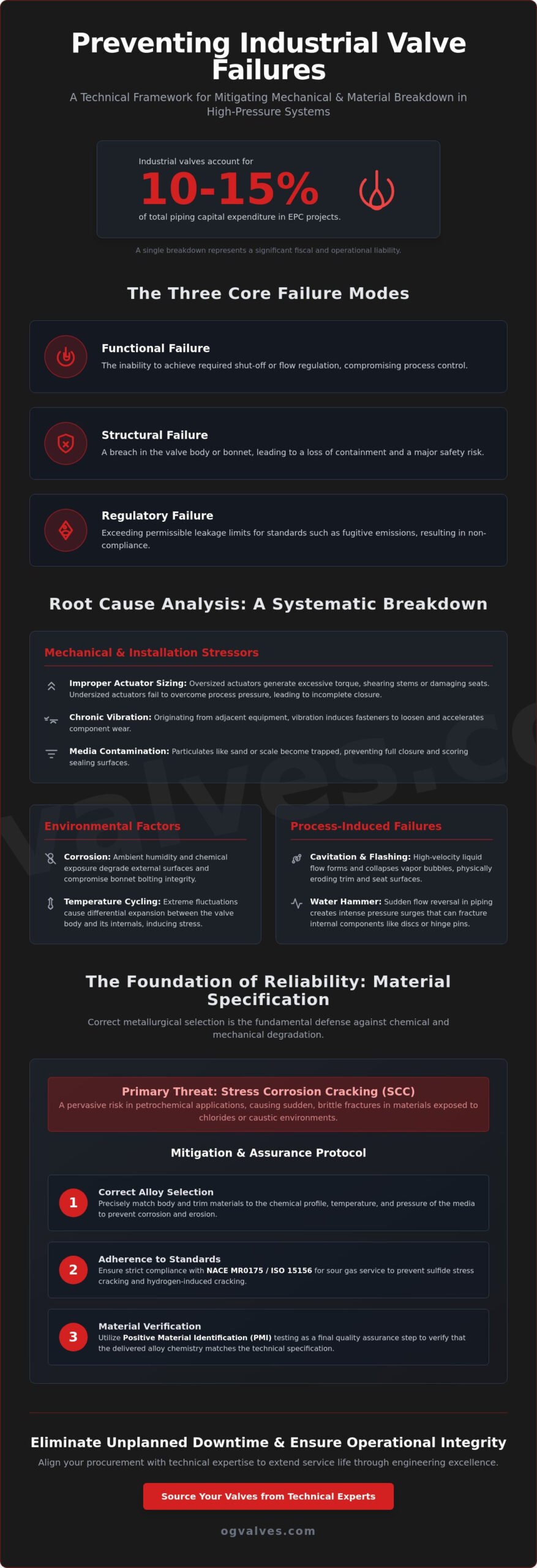
With industrial valves accounting for approximately 10% to 15% of total piping capital expenditure in 2026 EPC projects, a single mechanical breakdown represents a significant fiscal and operational liability. Reliability isn’t an accidental outcome of routine maintenance; it’s a rigorous procurement and specification discipline rooted in material science and strict regulatory adherence.
Technical experts recognize that unplanned facility downtime and the high cost of emergency replacements often stem from preventable material degradation or incorrect component specification. You’re likely facing increased pressure to eliminate fugitive emissions and mitigate pressure surges while maintaining compliance with the latest API and ASME benchmarks. This guide provides a comprehensive technical framework for preventing common industrial valve failures by identifying the root causes of mechanical and material breakdown in high-pressure systems.
We’ll examine the impact of updated standards like ISO 5210:2026 and API Std 609 (10th Edition), explore advanced mitigation strategies for cavitation and thermal fatigue, and outline protocols for achieving zero-leakage operations across your Gate, Ball, and Butterfly valve infrastructure. This methodical approach ensures your assets meet the rigorous demands of modern industrial environments while extending service life through engineering excellence.
Key Takeaways
- Identify the critical distinctions between functional, structural, and regulatory failure modes to establish a systematic diagnostic protocol for high-pressure systems.
- Analyze metallurgical selection criteria and Stress Corrosion Cracking (SCC) mitigation strategies essential for ensuring component survival in harsh petrochemical environments.
- Implement a technical framework for preventing common industrial valve failures by addressing design-specific vulnerabilities in gate, ball, and butterfly valve configurations.
- Integrate Risk-Based Inspection (RBI) frameworks and standardized cycling schedules to maintain the operational integrity of dormant isolation assets.
- Optimize long-term reliability by aligning procurement protocols with supplier technical expertise and utilizing fast-track delivery to mitigate the impact of unplanned downtime.
Root Causes of Industrial Valve Failure: A Systematic Analysis
Industrial valve failure is categorized by its impact on the process and the integrity of the pressure boundary. Functional failure involves the inability to achieve required shut-off or flow regulation, while structural failure refers to a breach in the body or bonnet. Regulatory failure occurs when a valve exceeds permissible leakage limits, such as fugitive emissions standards. Understanding these distinctions is the first step in preventing common industrial valve failures within high-pressure environments.
Environmental factors like ambient humidity and temperature cycling contribute to atmospheric corrosion and seal degradation. External corrosion often compromises the integrity of the bonnet bolting, while extreme temperature fluctuations cause differential expansion between the valve body and its internals. These factors, combined with operational stressors like cavitation and flashing, create a complex failure landscape that requires a clinical engineering approach to mitigate.
Mechanical and Structural Integrity Issues
Stem seizure occurs in high-cycle applications where lubrication is insufficient or particulates enter the guide area. Packing gland leaks remain a primary source of regulatory failure, necessitating precise adjustment of gland bolting to maintain a seal without impeding stem movement. Misalignment during installation puts uneven stress on the seat, leading to localized wear and eventual leakage. Mechanical fatigue is the progressive structural damage occurring when a valve body or internal component is subjected to cyclic loading or fluctuating pressure below its ultimate tensile strength.
Fluid Dynamics and Process-Induced Failures
High-velocity media creates conditions for cavitation and flashing, which physically erode the internal trim and seat. Cavitation occurs when liquid pressure drops below vapor pressure, forming bubbles that collapse violently against metal surfaces. Particulates like sand or scale act as abrasives, scoring the seats of Ball and Gate valves. In Check valves, “Water Hammer” results from sudden flow reversal, creating pressure surges that can fracture the disc or hinge pin. Reviewing Control Valve Failure Modes provides a technical baseline for how these dynamics manifest in automated systems.
Material Specification: Preventing Corrosion and Erosion
Metallurgical integrity serves as the fundamental defense against chemical and mechanical degradation in high-pressure systems. Selecting a valve body and trim material isn’t merely a procurement decision; it’s a critical engineering step in preventing common industrial valve failures. When the chosen alloy doesn’t align with the chemical profile of the media, the resulting corrosion can lead to wall thinning, pitting, and eventual pressure boundary breach.
Stress Corrosion Cracking (SCC) remains a pervasive threat in petrochemical applications, particularly where chlorides or caustic environments exist. SCC often manifests as sudden, brittle fracture in materials that otherwise appear ductile. To mitigate this risk, engineers must prioritize compliance with NACE MR0175/ISO 15156 for sour gas service. This standard dictates specific hardness limits and heat treatment requirements to prevent sulfide stress cracking and hydrogen-induced cracking in metallic components. Positive Material Identification (PMI) testing provides the final layer of quality assurance, verifying that the delivered alloy chemistry matches the project’s technical specifications before the valve enters service.
Corrosion Mitigation Strategies
Differentiating between Carbon Steel, Stainless Steel, and Super Duplex alloys depends on the chloride concentration and temperature of the process fluid. While Carbon Steel is sufficient for many non-corrosive hydrocarbons, Super Duplex offers superior resistance to pitting and crevice corrosion in seawater or aggressive chemical environments. For high-temperature erosion resistance, Stellite hard-facing on seating surfaces is essential to maintain a tight seal against abrasive particulates. For a deeper analysis of these classifications, consult our Industrial Valves: The Engineer’s Comprehensive Guide to Selection and Standards (2026).
Regulatory Standards for Material Integrity
ASME B16.34 defines the mandatory pressure-temperature ratings that govern valve body wall thickness and material strength. Adherence to ASTM material classifications ensures that each component, from the stem to the bolting, possesses the required tensile strength and impact resistance. Improper material grade substitution remains a leading cause of catastrophic failure. For example, using a standard grade of stainless steel in a high-pressure steam application that requires a specialized creep-resistant alloy will result in rapid deformation. Selecting the correct Gate and Ball valve materials through a rigorous technical procurement process is the only reliable method for preventing common industrial valve failures in critical infrastructure.
Failure Modes Across Primary Industrial Valve Types
Mechanical reliability in a piping system depends heavily on the specific architecture of the valve selected for the application. While material integrity was established in the previous section, the internal geometry of a valve introduces unique failure profiles. Achieving zero-leakage targets requires a granular understanding of design-specific vulnerabilities, which is a prerequisite for preventing common industrial valve failures in high-pressure headers. Linear motion valves, such as Gate and Globe types, face different operational risks than quarter-turn designs like Ball and Butterfly valves.
Gate valves frequently encounter wedge sticking, specifically thermal binding and pressure locking. Thermal binding occurs when a valve is closed while hot; the subsequent cooling causes the valve body to contract more than the wedge, pinning it in place. Seat scoring is another primary failure mode, often resulting from particulates trapped between the wedge and the seat during closure. In contrast, Ball valves are susceptible to trunnion bearing wear and seat deformation. In high-pressure service, the ball can exert excessive force on the downstream seat, leading to “cold flow” where the polymer seat material permanently deforms, compromising the seal.
Check valves present a distinct set of challenges focused on flow dynamics. Disc flutter occurs when the valve operates at low flow velocities, causing the disc to oscillate and prematurely wear the hinge pin and bushings. If the flow reverses suddenly, the resulting “slam” can lead to mechanical fracture of the internal components. Selecting a nozzle check valve over a traditional swing check can mitigate these effects by ensuring faster response times and reduced pressure surges.
Gate and Globe Valve Vulnerabilities
Wedge-to-seat misalignment in API 600 gate valves often stems from stem bending or improper guide machining. This prevents the wedge from seating uniformly, causing localized high-pressure points and leakage. Globe valves suffer from throttling damage when they aren’t specifically designed for flow regulation; the high-velocity fluid erodes the plug and seat when the valve is partially open. For detailed design specifications, reference A Technical Guide to Industrial Gate Valves.
Quarter-Turn Valve Failure Patterns
Butterfly valve seat degradation is common in high-velocity gas lines where the elastic seat is subjected to constant aerodynamic stress. In Ball valves, soft seat limitations become apparent in high-temperature service, where PTFE or reinforced polymers lose structural rigidity. These failures emphasize the necessity of preventing common industrial valve failures through rigorous design verification. Technical specifications for these assets are detailed in The Engineer’s Guide to Industrial Butterfly Valves.
Strategic Preventative Maintenance and Inspection Protocols
Operational reliability in heavy industry transitions from a theoretical design goal to a functional reality through the implementation of a Risk-Based Inspection (RBI) framework. By quantifying the Probability of Failure (POF) and Consequence of Failure (COF), technical teams prioritize high-risk assets where a pressure boundary breach would be catastrophic. This data-driven strategy is a cornerstone for preventing common industrial valve failures in complex piping networks.
Dormant isolation valves require standardized cycling schedules to prevent mechanical seizure caused by atmospheric corrosion or the accumulation of process particulates. Stems often bind when left in a static position for extended periods, necessitating high-pressure, temperature-stable lubrication for both stems and gear operators. Diagnostic testing, specifically seat leak tests and fugitive emission monitoring, provides the empirical data required to verify integrity before a critical failure occurs.
Inspection and Testing Standards
API 598 defines the industry benchmarks for valve inspection, mandating specific pressures and durations for shell and seat tests that your team must verify before commissioning. Non-Destructive Testing (NDT) methods, including ultrasonic testing (UT) for wall thickness and radiographic testing (RT) for internal defects, are critical for identifying subsurface cracks. API 624 is the mandatory type-testing standard for rising stem valves equipped with graphite packing to ensure fugitive emission compliance remains below 100 parts per million. Consistently applying these benchmarks is a prerequisite for preventing common industrial valve failures in high-pressure steam or hydrocarbon service.
Actuator and Control Maintenance
Improper actuator calibration frequently results in over-travel, which crushes seats in Ball valves or causes stem deformation in Gate valves. Pneumatic and electric actuators require precise limit switch settings to ensure the valve reaches the fully closed position without exceeding torque limits. In control applications, identifying “hunting” is vital, as this continuous oscillation accelerates trim wear and induces premature mechanical fatigue. For detailed technical specifications on automation integration, consult our Industrial Valve Actuators: A Technical Guide.
Establishing a rigorous maintenance protocol ensures your facility remains compliant with global safety standards. Contact the technical experts at OG VALVES LTD. to evaluate your current inspection framework and optimize your valve service life.
Ensuring Operational Integrity Through Technical Procurement
System reliability begins with a procurement strategy that prioritizes technical validation over initial capital expenditure. The role of a supplier extends beyond logistics; it serves as a critical engineering checkpoint for preventing common industrial valve failures. OG VALVES LTD. anchors its supply chain in clinical precision, ensuring that every asset, from high-pressure Gate valves to specialized Needle valves, meets the exact mechanical and metallurgical requirements of the intended service. A failure in the procurement phase often manifests as a failure in the field, making technical expertise a prerequisite for vendor selection.
Verifying Mill Test Reports (MTR) and comprehensive certification paperwork is mandatory for maintaining pressure boundary integrity. These documents provide the necessary traceability to confirm that the alloy composition and heat treatment processes align with ASTM and NACE standards. Without rigorous documentation, the risk of installing a sub-standard component increases, which can lead to catastrophic failure in sour gas or high-pressure steam environments. Clinical review of these certifications ensures that the material properties, such as yield strength and impact resistance, are sufficient for the projected operational stressors.
The Procurement Safety Net
Technical support during the selection phase acts as a safeguard against incorrect sizing, which remains a primary cause of premature trim wear and actuator failure. Procurement specialists must analyze the fluid dynamics of the application to recommend the appropriate trim and seat materials, preventing issues like cavitation or flashing before the valve is even manufactured. Efficient global logistics and fast-track delivery capabilities further mitigate the impact of unplanned downtime by providing rapid access to critical components. This responsiveness ensures that facility operators can replace aging or compromised assets before they lead to a total system breach. Maintaining strict traceability from the forge to the facility remains the benchmark for quality control in heavy industrial sectors.
Conclusion: Building a Failure-Resistant System
Achieving operational excellence requires a multi-layered approach that integrates material science, design verification, and rigorous maintenance protocols. This guide has detailed how preventing common industrial valve failures depends on a clinical focus on metallurgy, a granular understanding of design-specific vulnerabilities, and the implementation of Risk-Based Inspection frameworks. The long-term ROI of high-specification valves far exceeds that of commodity alternatives when accounting for the hidden costs of unplanned downtime, safety risks, and emergency repairs. By adhering to international standards and prioritizing engineering excellence, organizations can achieve zero-leakage targets and extended asset service life. For a detailed technical consultation on optimizing your valve infrastructure, contact the engineering team at OG Valves.
Advancing System Reliability Through Technical Excellence
Industrial valve reliability is a direct function of deliberate engineering and disciplined procurement. By integrating the systematic root cause analysis and precise metallurgical selection discussed in this guide, facilities significantly reduce the risk of structural and functional breaches. Adhering to these technical frameworks remains the most effective method for preventing common industrial valve failures in high-pressure headers.
Maintaining operational integrity requires a partner that understands the high-stakes nature of critical infrastructure. OG VALVES LTD. maintains an extensive inventory of API and ASME compliant components specifically engineered for demanding high-pressure and corrosive environments. Our global fast-track delivery capabilities and deep technical expertise ensure your facility remains compliant and productive while eliminating the liability of unplanned downtime.
Consult with our technical experts at OG VALVES LTD. for high-specification valve solutions to optimize your system’s longevity. We’re ready to assist you in achieving the highest standards of industrial safety and performance.
Frequently Asked Questions
What is the most common cause of industrial valve failure?
Media contamination and incorrect material selection are the primary drivers of valve degradation. Particulates cause seat scoring, while incompatible metallurgy leads to rapid corrosion. These factors account for a significant portion of unplanned downtime. Ensuring proper filtration and metallurgical validation is the first step in preventing common industrial valve failures in high-pressure headers.
How does cavitation damage an industrial valve?
Cavitation damages valves through the violent collapse of vapor bubbles against internal metallic surfaces. This phenomenon occurs when liquid pressure drops below vapor pressure and then recovers. The resulting localized shockwaves cause severe pitting and erosion, typically in the trim and downstream body area. If left unaddressed, cavitation can compromise the pressure boundary and lead to structural failure.
What is Positive Material Identification (PMI) and why is it necessary?
Positive Material Identification (PMI) is a non-destructive analysis used to verify the chemical composition of metallic alloys. This process is necessary to ensure the delivered valve metallurgy matches the engineering specification. It prevents catastrophic failures caused by the accidental substitution of sub-standard material grades in corrosive or high-temperature environments, providing a critical layer of quality assurance.
How often should industrial isolation valves be cycled?
Industrial isolation valves should be cycled at least once every six months to prevent mechanical seizure. Standardized schedules are essential for assets that remain dormant for extended periods. Regular operation prevents the accumulation of scale, debris, and atmospheric corrosion on the stem and seating surfaces. This practice ensures the valve remains functional for emergency isolation and routine maintenance activities.
What are the signs of valve packing failure?
Visible media leakage at the stem and a loss of gland bolt torque are the primary indicators of packing failure. Secondary signs include increased operating torque or stem pitting, which compromise the seal and lead to regulatory non-compliance. Identifying these indicators early allows for the adjustment of the packing gland or the replacement of seals before a total pressure breach occurs.
Can improper valve sizing lead to mechanical failure?
Yes, improper valve sizing is a direct contributor to mechanical failure through excessive torque or flow-induced vibration. Oversized actuators generate force that can shear stems or crush seats. Conversely, undersized valves in high-velocity lines suffer from rapid trim erosion, flashing, and cavitation. Correct sizing is a fundamental requirement for preventing common industrial valve failures and ensuring long-term system stability.
What is the difference between API 6D and API 600 failure standards?
API 6D governs pipeline valves with a focus on full-opening designs and piggability, while API 600 specifies heavy-duty refinery gate valves with thicker wall sections. Failure standards in API 6D prioritize through-conduit integrity and pressure testing for pipeline service. API 600 emphasizes structural robustness and seat-to-wedge alignment, ensuring reliability in high-temperature and high-pressure refinery applications.
How do fugitive emissions relate to valve integrity?
Fugitive emissions are a benchmark for valve integrity, representing unintended leaks that signal early-stage packing or seal degradation. These emissions often indicate that the valve’s pressure boundary is compromised, even if functional failure hasn’t occurred. Monitoring fugitive emissions is essential for maintaining compliance with environmental standards and identifying components that require immediate maintenance to prevent larger scale system failures.
 Responsive Menu