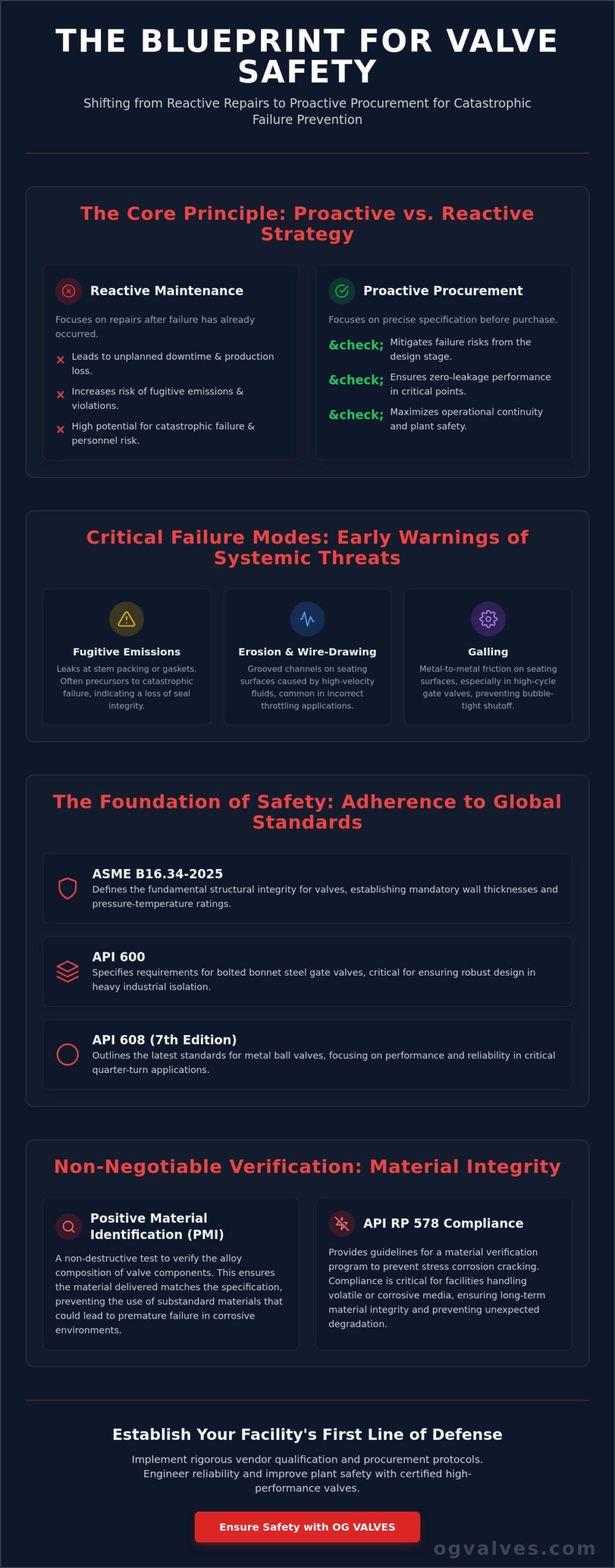
Industrial safety is a function of specification precision rather than maintenance frequency. While many operators focus on reactive repairs, the most effective strategy for improving plant safety with better valves begins at the procurement stage. In an era where emission control designs represent over 40% of new industrial valve purchases, the margin for error in material selection has vanished. You likely recognize that unplanned downtime from valve seat failure or fugitive emissions violations is an unacceptable operational risk that threatens both personnel and profitability.
We agree that maintaining zero-leakage performance in critical isolation points is the only acceptable benchmark for high-pressure environments. This guide provides an authoritative analysis of how rigorous valve specification, material integrity, and adherence to global standards like ASME B16.34-2025 mitigate catastrophic failure risks in heavy industrial facilities. We’ll examine the technical requirements for API 600 gate valves and the upcoming API 608 7th edition standards for ball valves. You’ll also learn how Positive Material Identification (PMI) protocols and API RP 578 compliance prevent premature degradation in corrosive services.
Key Takeaways
- Analyze critical failure modes and fugitive emissions as early indicators of structural degradation to prevent catastrophic facility events.
- Leverage international standards, including API 600, API 608, and ASME B16.34, to define the technical baseline for high-performance industrial valves.
- Utilize Positive Material Identification (PMI) and API RP 578 guidelines to verify chemical integrity and resist stress corrosion cracking in severe service.
- Optimize fluid dynamics and valve sizing (Cv) to eliminate mechanical fatigue and operational accidents caused by incorrect architectural selection.
- Establish a robust first line of defense for improving plant safety with better valves by implementing rigorous vendor qualification and procurement protocols.
Industrial Valve Failure Modes and Their Impact on Plant Safety
Valve integrity serves as the fundamental metric for industrial risk management. In high-pressure piping systems, the ‘weakest link’ principle dictates that a single component failure can compromise the entire pressure boundary. Engineering reliability isn’t a secondary concern; it’s the primary barrier against catastrophic events. Improving plant safety with better valves requires a shift from reactive maintenance to a technical understanding of how specific failure modes evolve into systemic threats. When a valve fails to operate as intended, the resulting loss of containment or flow control immediately degrades the facility’s safety integrity level (SIL).
Fugitive emissions are often dismissed as mere environmental compliance issues, yet they frequently serve as precursors to catastrophic structural failure. A leak at the stem packing or gasket interface indicates a loss of mechanical seal integrity that can lead to rapid erosion or localized corrosion. If left unaddressed, these minor leaks escalate into full-bore discharges. High-specification procurement effectively mitigates these risks. While the initial capital expenditure for premium alloys and advanced sealing technologies is higher, it’s negligible compared to the cost of unplanned downtime. Statistical data suggests that the financial impact of a single day of lost production in a heavy industrial facility often exceeds the total procurement cost of a high-performance valve fleet. A properly specified safety valve or isolation unit is an investment in operational continuity.
Common Failure Modes in Critical Flow Control
Erosion and wire-drawing occur when high-velocity fluids pass through a partially open valve, creating grooved channels in the seating surfaces. This is particularly prevalent in throttling applications where the valve isn’t designed for high-pressure drops. In high-cycle gate valves, galling of the seating surfaces results from metal-to-metal friction, eventually preventing a bubble-tight shutoff. Stem packing leaks remain a critical concern, as they present a direct risk of hazardous gas exposure to personnel. These failures are rarely sudden; they’re the result of selecting a valve architecture that doesn’t match the specific fluid dynamics of the process.
The Role of Isolation Valves in Emergency Response
The primary function of isolation valves is to provide a definitive barrier during emergency shutdowns or maintenance procedures. In automated assemblies, fail-safe configurations ensure that valves return to a predetermined safe position, either fully open or fully closed, upon loss of power or signal. For facilities handling volatile media, adherence to fire-safe testing standards like API 607 is mandatory. This certification verifies that the valve maintains its sealing capability even after exposure to extreme thermal stress. Improving plant safety with better valves involves ensuring every isolation point meets these rigorous thermal and mechanical benchmarks.
Adhering to Global Valve Standards: API 600, API 608, and ASME B16.34
Manufacturing standards represent the primary technical baseline for industrial risk mitigation. These documents aren’t merely suggestions; they define the minimum mechanical requirements for components operating in high-pressure, high-temperature environments. Improving plant safety with better valves requires strict adherence to the latest regulatory updates, such as ASME B16.34-2025. This standard dictates the relationship between material classification and pressure-temperature ratings. It also establishes mandatory wall thicknesses that differentiate industrial-grade valves from commercial alternatives. Without these structural safeguards, piping systems remain vulnerable to the mechanical failures documented in this OSHA Hazard Information Bulletin, where substandard component selection often leads to catastrophic loss of containment.
Verification of compliance is a non-negotiable step in procurement. Engineers must ensure that Material Test Reports (MTRs) match the physical components delivered to the site. This involves cross-referencing heat numbers and chemical compositions against the design specification. If the documentation doesn’t provide 100% traceability, the component shouldn’t be installed. Reliable procurement starts with a clinical focus on these data points. For facilities aiming for zero-leakage performance, sourcing from a vendor with a proven inventory of certified industrial valves is the most direct path to compliance.
API 600: The Gold Standard for Steel Gate Valves
API 600 (14th Edition, May 2021) defines the heavy-duty requirements for bolted bonnet steel gate valves used in refinery and oil and gas applications. This standard prioritizes durability over weight reduction. It mandates thicker walls and larger stem diameters than general-purpose standards. These design features ensure the wedge remains stable under extreme differential pressures, preventing the galling and mechanical fatigue that lead to isolation failure. In heavy industry, the API 600 specification remains the benchmark for long-term safety in critical isolation points.
API 608 and API 6D: Specification for Pipeline and Process Ball Valves
The upcoming 7th edition of API 608, scheduled for publication on April 1, 2025, introduces significant updates for metal ball valves. It will mandate compliance with the API 641 low-emission standard and require extended traceability marking. Unlike standard commercial ball valves, API 608 designs include anti-static devices and blow-out proof stems as baseline safety features. For pipeline applications, API 6D provides additional requirements for seat leakage testing and double block-and-bleed capabilities. Improving plant safety with better valves means selecting the specific API standard that matches your application’s pressure profile and emission targets.
Material Integrity and PMI Testing in Corrosive Environments
Material integrity determines the operational lifespan and safety envelope of any high-pressure piping system. In severe service applications, the chemical reality of material failure often manifests through Stress Corrosion Cracking (SCC) or Hydrogen-Induced Cracking (HIC) in sour (H2S) environments. Improving plant safety with better valves involves more than selecting the correct valve type; it requires absolute certainty regarding the chemical composition of the pressure-retaining parts. Brittle fracture can occur in seconds if metallurgy isn’t perfectly aligned with the process media’s temperature and pressure profiles. This focus on material verification is a core component of API’s updated valve standard, which emphasizes the necessity of rigorous testing to prevent catastrophic loss of containment.
The risk of ‘counterfeit’ materials in the global supply chain remains a critical threat to industrial infrastructure. Substandard alloys that don’t meet specified chemical markers can pass initial visual inspections but will fail prematurely under mechanical stress. Verification of material chemistry isn’t just a quality control step; it’s a fundamental safety protocol. Without field-verified data, operators rely on trust rather than technical reality, which is an unacceptable risk in high-stakes environments like petrochemical processing or offshore energy production.
Preventing Material Failure with PMI Testing
Positive Material Identification (PMI) is a non-negotiable safety protocol for modern industrial facilities. Using X-ray Fluorescence (XRF) technology, engineers can confirm the chemical composition of a valve body or stem without damaging the component. This process identifies “tramp elements” like copper, tin, or phosphorus in carbon steel, which significantly reduce structural integrity and weldability. It’s also vital for verifying the chromium and molybdenum content in low-alloy steels used for high-temperature steam applications. PMI serves as the final verification step to ensure materials comply with NACE MR0175/ISO 15156 requirements for sour service applications.
Specialised Alloys for Severe Service
Standard stainless steels often fail in offshore environments where chloride-induced pitting is prevalent. In these scenarios, specifying Super Duplex or Inconel provides the necessary corrosion resistance to maintain long-term structural soundness. For cryogenic applications, materials must maintain ductility at temperatures below -150°C, requiring specialized austenitic stainless steel grades. Improving plant safety with better valves also means addressing mechanical wear in abrasive media. Hard-facing requirements, such as the application of Stellite to seating surfaces, protect the valve’s internal architecture from erosion and wire-drawing. This ensures that the valve maintains its isolation capability even after thousands of cycles in challenging flow conditions.
Optimising Valve Selection for High-Pressure and Critical Flow
Precision in valve selection requires a clinical analysis of fluid dynamics, specifically the interaction between velocity, pressure, and temperature. Improving plant safety with better valves is impossible without accurate Flow Coefficient (Cv) calculations. Incorrectly sized valves lead to mechanical fatigue and operational instability. When a valve’s Cv is too high for the application, the result is often “hunting” or excessive vibration, which accelerates component failure. For throttling services, a globe valve is technically superior to a gate valve. While gate valves excel in isolation, using them for flow regulation leads to seat erosion and loss of containment. This cross-category comparison is vital for maintaining the structural integrity of the entire piping network.
Cavitation and flashing represent severe mechanical threats in control valve applications. Cavitation occurs when liquid pressure drops below vapor pressure, forming bubbles that collapse violently and pit the internal metal surfaces. Flashing occurs when the pressure remains below vapor pressure at the outlet. Both phenomena cause structural thinning and can lead to sudden pressure boundary failure. To mitigate these risks, engineers must specify hardened trims or multi-stage pressure reduction architectures. Reliability in emergency shutdown (ESD) scenarios also depends on the integration of high-performance actuators. These units must deliver sufficient torque to overcome differential pressures during critical events. For technical assistance in matching valve architecture to your facility’s specific pressure profiles, consult our engineering specialists for a detailed specification review.
Ball Valves vs. Butterfly Valves in Safety-Critical Systems
High-volume flow safety often dictates a choice between ball and butterfly designs. While standard concentric butterfly valves are common, safety-critical systems in high-temperature applications require triple offset designs to achieve zero-leakage performance. These designs eliminate seat friction and provide a torque-seated mechanical seal. For high-pressure isolation, trunnion-mounted ball valves are the engineering standard. They distribute the mechanical load across the trunnion bearings rather than the seats, ensuring consistent operation even at maximum differential pressure. This stability is a prerequisite for improving plant safety with better valves in high-pressure gas service.
Check Valves: Preventing Backflow and Water Hammer
Protecting rotating equipment like pumps and turbines requires the strategic deployment of check valves. These components prevent backflow, which can cause catastrophic reverse rotation in machinery. Non-slam designs are essential for mitigating the risk of pipeline rupture from water hammer, a phenomenon caused by the sudden closure of a check valve during flow reversal. Sizing these valves for the minimum flow rate is a technical necessity. If the flow is insufficient to hold the disc fully open, disc chatter occurs, leading to pin wear and eventual disc detachment. Engineering these points for reliability prevents the sudden pressure surges that threaten downstream personnel and infrastructure.
Engineering Reliability: The Role of Specialist Valve Procurement
Procurement serves as the primary technical gatekeeper in the industrial lifecycle. While maintenance teams manage existing infrastructure, the procurement phase represents the first line of defence against systemic failure. Improving plant safety with better valves requires a clinical approach to vendor qualification that moves beyond cost-per-unit metrics. It’s about mitigating supply chain risks by ensuring that every pressure-retaining component originates from a verified foundry with documented quality control systems. Substandard castings or non-compliant metallurgy often enter the facility through fragmented supply chains, making rigorous specialist oversight a prerequisite for operational security.
Final inspection protocols are the definitive verification of mechanical integrity. Before any component leaves a specialist supplier, it must undergo hydrostatic and pneumatic testing to confirm shell and seat soundness. These tests, typically conducted in accordance with API 598, provide quantifiable data that the valve can withstand its rated pressure without leakage. For critical isolation points, this verification is the difference between a controlled process and a catastrophic loss of containment. High-specification procurement ensures these safety benchmarks are met before the valve ever reaches the site, preventing the installation of units with latent manufacturing defects.
Validating Safety through Technical Expertise
Technical expertise is essential for validating safety during the selection process. It’s not enough to match a part number; engineers must verify that the valve’s design meets the specific requirements of international standards like API, ASME, DIN, or ISO. Managing comprehensive documentation packages is a core part of this reliability. Every valve should be accompanied by Material Test Reports (MTRs) and pressure test certificates that are ready for regulatory audits. This level of transparency ensures that the facility’s safety integrity level (SIL) remains intact throughout the asset’s lifecycle. Reliable procurement specialists act as a technical extension of the plant’s engineering team, ensuring that every specification matches the functional reality of the application.
Fast-Track Delivery and Global Logistics
The safety implications of global logistics are often overlooked in risk assessments. During unplanned outages, the ‘risk window’ expands every hour that a critical isolation point remains compromised or a temporary bypass is in use. Rapid supply and fast-track delivery of high-specification components are essential safety measures to close this window. Maintaining a massive inventory of certified valves allows for the immediate replacement of failed units, reducing the time personnel are exposed to hazardous conditions or volatile process environments. Improving plant safety with better valves is a logistical challenge as much as an engineering one. To secure your facility’s infrastructure and ensure immediate compliance with safety standards, Request a technical consultation or quote from OG VALVES LTD.
Securing Industrial Infrastructure through Technical Precision
To ensure your facility maintains zero-leakage performance under extreme conditions, Consult with OG VALVES LTD. for high-specification industrial valve supply. We provide specialist technical support for technical experts in heavy industrial sectors, maintaining an extensive inventory of API-standard gate, ball, and globe valves. Our global fast-track delivery capabilities ensure that critical replacements are available to minimize operational risk and downtime. Accurate specification remains the most reliable method for protecting critical infrastructure and personnel.
Frequently Asked Questions
What are the most common causes of industrial valve failure?
The primary causes of industrial valve failure include mechanical erosion, chemical corrosion, and incorrect architectural specification. Erosion occurs when high-velocity fluids create channels in seating surfaces, while galling results from metal-to-metal friction in high-cycle applications. These failures often stem from a misalignment between the valve’s design and the actual process conditions. Selecting the wrong valve type for throttling or isolation leads to rapid degradation and potential loss of containment.
How does API 600 improve the safety of gate valves?
API 600 improves gate valve safety by mandating higher minimum wall thicknesses and larger stem diameters than general-purpose standards. This standard focuses on heavy-duty service in refineries and oil and gas facilities where durability is paramount. By prioritizing structural soundness over weight reduction, API 600 ensures the valve body and wedge can withstand extreme differential pressures and thermal stresses without mechanical deformation or seal failure.
What is PMI testing and why is it critical for valve safety?
Positive Material Identification (PMI) is a non-destructive testing method used to verify the chemical composition of metal alloys. It’s critical for improving plant safety with better valves because it confirms that the physical component matches the Material Test Report (MTR). In high-pressure or corrosive environments, installing a valve with substandard metallurgy can lead to sudden brittle fracture or stress corrosion cracking, making PMI a vital safety protocol.
Can a valve be fire-safe if it doesn’t have an API 607 certification?
While a valve may be designed with fire-safe features, it isn’t technically fire-safe in high-stakes environments without an API 607 certification. This standard involves rigorous testing where the valve is exposed to fire for a specific duration to ensure it maintains its sealing capability. Without this verification, there’s no quantifiable evidence that the valve will prevent the spread of volatile media during a facility fire event.
What is the difference between a floating and a trunnion-mounted ball valve regarding safety?
Trunnion-mounted ball valves are technically superior for high-pressure applications because the ball is supported by bearings, which distribute mechanical loads and reduce seat wear. In contrast, a floating ball valve relies on the seats to support the ball, which can lead to seat deformation under high differential pressures. Trunnion designs ensure consistent torque and reliable sealing, making them the preferred choice for critical isolation points in heavy industry.
How does incorrect valve sizing lead to plant accidents?
Incorrect valve sizing, specifically an inaccurate Flow Coefficient (Cv), leads to cavitation, flashing, and excessive vibration. If a valve is oversized, it often operates near the seat, causing high-velocity erosion known as wire-drawing. These conditions result in localized structural thinning and mechanical fatigue. Over time, this degradation compromises the pressure boundary, leading to sudden failures and industrial accidents that threaten both personnel and infrastructure.
Why is material selection more critical than maintenance for valve longevity?
Material selection is more critical than maintenance because maintenance can’t compensate for inadequate metallurgy in corrosive or high-pressure environments. If a valve is made from the wrong alloy, it’ll succumb to stress corrosion cracking or hydrogen-induced cracking regardless of how often it’s serviced. Improving plant safety with better valves starts with specifying materials that are chemically compatible with the process media to ensure long-term structural integrity.
What standards should I look for in valves for the petrochemical industry?
For the petrochemical industry, engineers should prioritize valves that comply with API 600 for gate valves, API 608 for ball valves, and ASME B16.34 for pressure-temperature ratings. Additionally, NACE MR0175 compliance is mandatory for sour service applications involving H2S. These standards provide the technical baseline for wall thickness, stem design, and material testing required to maintain containment in complex chemical processing environments.
 Responsive Menu