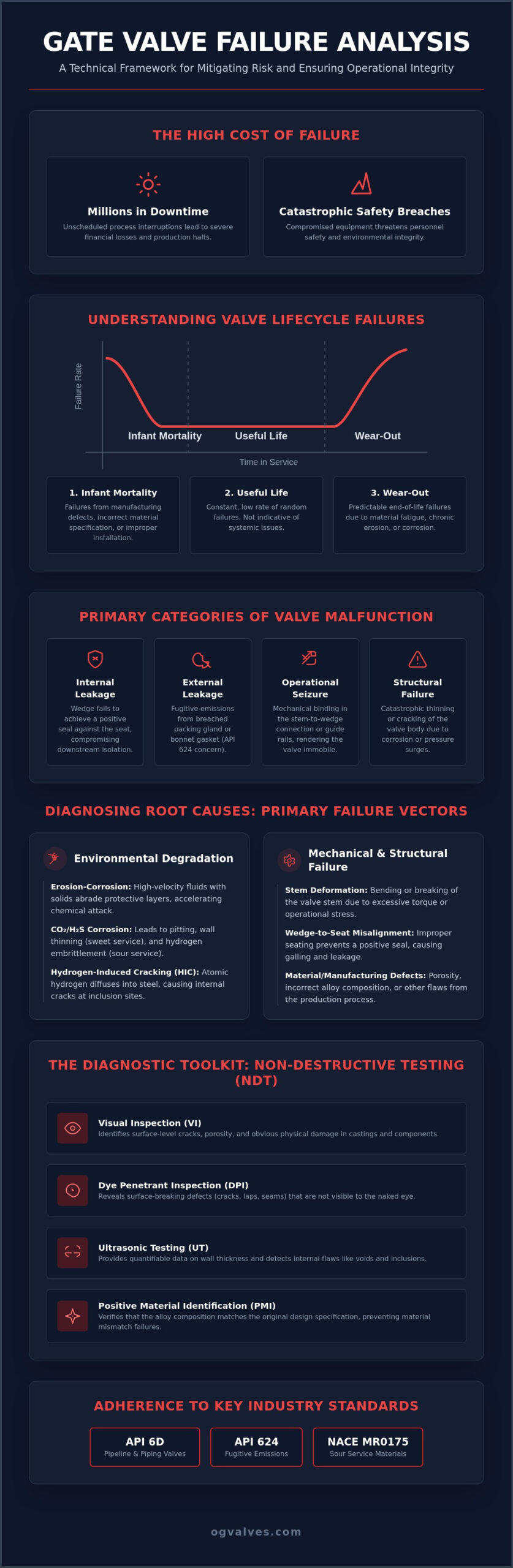
A single undetected fracture in a high-pressure wedge gate valve can result in millions of dollars in unscheduled downtime and catastrophic safety breaches. For technical experts managing heavy industrial sectors, the cost of equipment degradation is never merely financial; it represents a fundamental compromise in operational integrity. You recognize that identifying why a valve seized or leaked is critical to maintaining regulatory adherence and site safety. This technical guide establishes a rigorous framework for gate valve failure analysis, moving beyond surface-level repairs to address systemic engineering flaws.
We’ll provide a clinical examination of common failure mechanisms, from material fatigue in corrosive environments to non-compliance with the 25th edition of API 6D. By implementing a structured Root Cause Analysis (RCA) protocol, you can bridge the gap between forensic metallurgy and procurement specifications. This article details the precise methodologies required to evaluate structural soundness, minimize fugitive emissions according to API 624 standards, and ensure long-term performance in high-stakes infrastructure.
- Establish a systematic engineering framework for identifying failure mechanisms to mitigate the safety and financial risks associated with unscheduled industrial downtime.
- Differentiate between environmental degradation, such as erosion-corrosion coupling, and mechanical failure modes like stem deformation or wedge-to-seat misalignment.
- Execute a comprehensive gate valve failure analysis by integrating field data with rigorous laboratory findings and current API 6D regulatory benchmarks.
- Utilize Root Cause Analysis (RCA) protocols to refine technical specifications and material compatibility requirements for future high-pressure valve procurement.
Gate valve failure analysis constitutes a methodical engineering investigation designed to isolate the variables responsible for component degradation or operational cessation. In high-pressure industrial environments, a Gate valve serves as a primary isolation barrier. Its failure precipitates cascading risks. These include immediate safety hazards to personnel, environmental contamination through fugitive emissions, and severe financial losses stemming from unscheduled process interruptions. Reliability isn’t a luxury; it’s a requirement for maintaining regulatory adherence and structural soundness across critical infrastructure.
Reliability engineering frequently utilizes the Bathtub Curve to categorize failure probability over the lifecycle of a component. Initial failures, termed infant mortality, typically result from manufacturing defects, incorrect material specification, or improper installation. Conversely, wear-out failures occur at the end of the design life cycle, characterized by predictable material fatigue or chronic erosion. Distinguishing between these phases is vital for determining whether a failure is an isolated incident or indicative of a systemic procurement issue. Effective gate valve failure analysis identifies these patterns to prevent recurrences that compromise site safety.
Primary Categories of Valve Malfunction
Valve malfunctions generally manifest in three distinct technical categories. Internal leakage occurs when the wedge fails to achieve a positive seal against the seat, compromising downstream isolation. External leakage, or fugitive emissions, involves the breach of the packing gland or bonnet gasket. This is a critical concern under API 624 standards for rising stem valves. Operational seizure involves mechanical binding within the stem-to-wedge connection or guide rails, often rendering the valve immobile. Finally, structural integrity loss involves catastrophic thinning or cracking of the valve body, typically due to unchecked corrosion or pressure surges.
The Role of Non-Destructive Testing (NDT) in Preliminary Analysis
Accurate root cause identification requires the application of Non-Destructive Testing (NDT) to evaluate the component’s physical state without further damage. Visual Inspection (VI) and Dye Penetrant Inspection (DPI) identify surface-level cracks and porosity in the casting that could lead to structural failure. Ultrasonic Testing (UT) provides quantifiable data regarding wall thickness, detecting internal flaws that aren’t visible to the eye. Positive Material Identification (PMI) is essential to verify that the alloy composition matches the original design specification. This ensures that a lower-grade material wasn’t accidentally substituted during the manufacturing process, which often leads to premature failure in corrosive service.
Environmental degradation represents a primary failure vector in high-pressure industrial systems. In the context of gate valve failure analysis, the coupling of erosion and corrosion significantly accelerates material wastage rates. High-velocity process fluids, particularly those containing entrained solids like sand or scale, physically abrade the internal surfaces of the valve body and wedge. This mechanical action removes the protective oxide or passivated layers that normally shield the base alloy from chemical attack. It isn’t uncommon for these forces to work in tandem, leading to localized wall thinning that compromises the pressure-containing boundary.
Hydrogen-Induced Cracking (HIC) and Stress Corrosion
Petroleum refinery applications must adhere to NACE MR0175/ISO 15156 standards to mitigate Hydrogen-Induced Cracking (HIC). This phenomenon occurs when atomic hydrogen diffuses into the steel lattice, collecting at internal defects such as Manganese Sulfide (MnS) inclusions. These inclusions act as initiation sites for internal cracking and blistering. To prevent this, rigorous hardness testing is required, with limits typically maintained below 22 HRC to ensure material ductility. Failure to control these metallurgical variables results in brittle fractures that compromise the structural integrity of the valve assembly under load.
Pitting and Galvanic Corrosion in Industrial Systems
Localized pitting on sealing surfaces represents a critical failure mode that directly impacts shut-off capabilities. Galvanic corrosion occurs when dissimilar metals are utilized in the valve trim, creating an electrochemical cell that accelerates the degradation of the anodic component. This is often seen when stainless steel trim is paired with carbon steel bodies without adequate isolation. Mitigation strategies include the application of specialized hard-facing coatings or the selection of compatible high-performance alloys. While chemical attack is a major concern, engineers must also evaluate mechanical risks such as Pressure Locking and Thermal Binding which can be exacerbated by corrosion-related friction. For high-stakes environments, procurement of corrosion-resistant gate valves is the most effective method for ensuring long-term operational reliability.

Mechanical failure modes in high-pressure systems often stem from operational exceedances or thermal fluctuations that surpass the design limits of the component. While environmental degradation is a gradual process, mechanical failures can be abrupt and catastrophic. Precision in gate valve failure analysis requires a forensic look at the physical stresses exerted on the internal assembly. These stresses typically manifest as structural deformation or total component fracture, often rendering the valve inoperable and compromising the entire process loop.
Stem deformation represents a critical failure point, usually resulting from mechanical overload during the closing cycle. When an operator or automated actuator applies torque beyond the specified limit to achieve a seal, the stem undergoes plastic deformation or buckling. This distortion prevents the wedge from seating correctly, leading to misalignment. Misalignment between the wedge and seat faces creates uneven contact pressure, which allows high-velocity fluid to bypass the seal and erode the seating surfaces. Application of excessive actuator torque during valve closure induces high tensile stresses that frequently result in a brittle stem root fracture at the thread interface.
Thermal binding is another significant mechanical risk, particularly in high-temperature steam or hydrocarbon service. This “locked wedge” phenomenon occurs when a valve is closed while the system is at peak operating temperature. As the system cools, the valve body contracts at a different rate than the wedge, effectively jamming the wedge into the seats. Reopening a valve in this state requires force that often exceeds the yield strength of the stem or the internal drive nut, leading to secondary mechanical failures.
Abnormal Pressure Rise in the Middle Cavity
Trapped fluid within the valve cavity represents a severe safety risk that demands rigorous engineering attention. When a gate valve is fully closed, process liquid can remain trapped in the bonnet area. If the temperature of this trapped fluid increases, the resulting thermal expansion generates extreme internal pressures that can exceed the valve’s pressure-temperature rating. This abnormal pressure rise can lead to catastrophic bonnet gasket failure or permanent deformation of the valve body. Engineering solutions to mitigate this risk include:
- Pressure Relief Holes: Drilling a small equalization hole on the upstream side of the wedge.
- External Bypasses: Installing a dedicated bypass line to equalize pressure between the cavity and the pipeline.
- Flexible Wedges: Utilizing wedge designs that allow for slight deformation to relieve internal cavity pressure.
Gland Packing and Seal Failures
Gland packing failures are the primary source of fugitive emissions in industrial plants. Degradation of the packing material typically occurs due to high-cycle operation, extreme thermal cycling, and improper initial compression. Inaccurate installation often results in uneven loading on the packing rings, which creates localized leak paths. Modern industrial standards, such as API 624, require rising stem valves to undergo rigorous type testing to ensure sealing integrity. Maintaining compliance necessitates the use of high-specification graphite-based packing systems that can withstand the mechanical friction of the stem without compromising the seal.
A successful gate valve failure analysis requires the seamless integration of empirical field data with forensic laboratory findings. It isn’t enough to observe a fractured stem or a leaking seat; the engineer must determine why the component’s performance deviated from its design intent. This process begins with an exhaustive review of the operational history. Data logs detailing pressure cycles and temperature excursions provide the context necessary to identify fatigue or thermal binding. Without this historical data, metallurgical testing remains a snapshot of the result rather than a map of the cause.
Verifying design compliance against established benchmarks like API 600 for heavy-duty steel valves or API 603 for corrosion-resistant alloys is a mandatory step in the RCA process. If a valve fails prematurely in a petrochemical environment, the investigation must determine if the original specification accounted for the specific chemical and mechanical stressors present. These findings allow engineers to update maintenance intervals and refine procurement criteria, ensuring that future installations utilize high-performance gate valves designed for the actual service conditions rather than theoretical maximums.
The 5-Step Investigative Protocol for Failed Valves
A structured investigative protocol ensures that no critical evidence is lost during the forensic process. The following steps define a standard engineering approach to RCA:
- Evidence Preservation: Secure the valve in its “as-failed” state. Don’t clean or disassemble the component on-site, as this can destroy vital surface deposits or fracture patterns.
- Component Mapping: Perform a controlled disassembly. Document the orientation and condition of every part, from the wedge faces to the gland packing.
- Metallurgical Testing: Conduct hardness testing, spectrographic analysis, and microscopy to identify grain structure anomalies or chemical degradation.
- Numerical Simulation: Utilize Finite Element Analysis (FEA) or Computational Fluid Dynamics (CFD) to model the stresses that led to the failure.
- Corrective Action: Issue a final report that links the failure mode to a specific operational or design flaw, providing actionable steps for mitigation.
Adherence to International Design Standards
Understanding the nuances between API 600 and API 6D is essential for both analysis and procurement. API 600 focuses on the robust construction required for refinery service, while API 6D governs valves for pipeline and piping systems. The 25th edition of API 6D, published in 2021, is now incorporated into federal regulations as of January 1, 2026. This underscores the necessity of strict adherence to these standards. ASME B16.34 provides the necessary pressure-temperature ratings that define the safe operating envelope for these components. Rigorous material traceability, validated through EN 10204 3.1 or 3.2 certifications, ensures that the alloy used in the valve body matches the mill test report. This level of documentation is the primary form of brand validation in heavy industry, confirming that the product meets the global benchmarks required for safety and durability.
Strategic procurement represents the final stage of a proactive reliability cycle. Once a gate valve failure analysis identifies specific root causes, the focus shifts to preventing recurrence through rigorous technical specification. High-specification valves serve as the primary defense against the environmental and mechanical stressors detailed in previous sections. Selecting a valve based on its pressure-temperature rating alone is insufficient. Procurement specialists must account for the metallurgical nuances of the process media and the specific operational cadence of the facility to ensure long-term durability.
Specialist suppliers act as technical partners rather than mere vendors. They provide the necessary verification of material integrity through comprehensive documentation and adherence to global benchmarks. Reducing lead times for critical replacements is essential to minimize the financial impact of unscheduled downtime. However, speed shouldn’t compromise quality. A dependable supply chain ensures that replacement components meet the same rigorous testing standards as the original equipment, maintaining the structural soundness of the entire process loop.
Material Sourcing and Quality Assurance
Effective risk mitigation requires evaluating supplier inventory for high-performance alloys such as Super Duplex and Inconel. These materials offer superior resistance to the H2S and CO2 corrosion mechanisms that frequently cause premature failure in petrochemical environments. Technical support during the selection phase is critical to ensure that material compatibility aligns with the findings of any forensic investigation. For a deeper understanding of these criteria, consult Industrial Valves: The Engineer’s Comprehensive Guide to Selection and Standards (2026). This resource provides the technical data required to verify that chosen alloys meet the specific demands of high-pressure service.
Ensuring Operational Reliability with OG VALVES
OG VALVES LTD. positions itself as a technical partner in critical infrastructure by leveraging global logistics for the fast-track delivery of high-spec gate valves. Our expertise extends to interpreting complex API and NACE requirements, ensuring that every component delivered complies with the latest regulatory mandates, including the 25th edition of API 6D. This technical depth is vital when performing a gate valve failure analysis to determine if current inventory meets evolving safety standards. We anchor our claims in rigorous quality control processes, providing the reliability necessary for high-stakes industrial applications. For more information on optimizing your isolation barriers, refer to A Technical Guide to Industrial Gate Valves: Design, Standards, and Selection (2026).
Systematic gate valve failure analysis transforms reactive maintenance into a proactive asset management strategy. By isolating the metallurgical and mechanical variables responsible for component degradation, engineers can secure the structural integrity of high-pressure systems. Adherence to API 600 and the 25th edition of API 6D is essential for maintaining regulatory compliance and minimizing fugitive emissions. It’s clear that strategic procurement remains the final line of defense, ensuring that material specifications align with the actual environmental stressors of the process.
At OG VALVES LTD., we provide the technical depth required to interpret complex NACE and ASME standards for critical infrastructure. Our extensive inventory of API 600 and API 6D gate valves ensures that your facility maintains operational continuity without compromising on safety. We utilize an established global logistics network for fast-track delivery, specifically designed to reduce the high cost of industrial downtime when failures occur. Request a Technical Quote for High-Specification Industrial Valves to optimize your isolation barriers. We look forward to serving as your dependable partner in engineering excellence.
What are the most common causes of gate valve leakage?
Internal leakage is primarily caused by seat and wedge erosion, misalignment, or the entrapment of fluid particulates during closure. External leakage typically results from gland packing degradation or the failure of the bonnet gasket. These malfunctions often stem from thermal cycling or exceeding the pressure-temperature ratings defined by ASME B16.34 standards.
How does NACE MR0175 compliance prevent gate valve failure in sour service?
Compliance ensures that materials are resistant to Sulfide Stress Cracking (SSC) and Stress Corrosion Cracking (SCC) in H2S environments. The standard mandates strict hardness limits, typically 22 HRC for carbon steels, and specific heat treatment processes. This prevents the brittle fractures that are a frequent focus in gate valve failure analysis within the petrochemical sector.
Why do gate valve stems often break at the thread root?
Stem breakage at the thread root is usually a consequence of mechanical overload or fatigue at the point of highest stress concentration. Excessive actuator torque applied during the closing cycle induces tensile stresses that exceed the material’s yield strength. This brittle fracture is often aggravated by corrosion-assisted fatigue in high-cycle industrial applications.
What is the ‘abnormal pressure rise’ in a gate valve cavity?
This phenomenon occurs when process fluid trapped in the valve bonnet expands due to external heat, leading to extreme internal pressure. If not relieved, this pressure can cause bonnet gasket blowout or permanent deformation of the valve body. Design solutions like pressure relief holes or flexible wedges are required to mitigate this risk in high-temperature service.
How can I distinguish between erosion and corrosion in a failed valve?
Erosion is characterized by localized, directional material loss with a polished or “scooped” appearance, often occurring in high-velocity flow paths. Corrosion typically presents as uniform thinning, pitting, or surface oxidation across the component substrate. In many industrial cases, these forces operate together, necessitating a detailed gate valve failure analysis to identify the primary catalyst.
What role does API 600 play in ensuring gate valve reliability?
API 600 defines the heavy-duty design requirements for bolted bonnet steel gate valves used in refinery service. It specifies wall thicknesses and stem diameters that are more robust than standard pipeline valves. Adhering to this standard ensures structural soundness and long-term performance under the extreme thermal and pressure cycles typical of downstream processing.
Can a gate valve be used for throttling, and does this cause failure?
Gate valves are designed strictly for on-off isolation and shouldn’t be used for throttling. Using them in a partially open position causes high-velocity turbulence and vibration, leading to rapid erosion of the wedge and seat faces. This misapplication often results in “wire-drawing” and a total loss of sealing integrity, eventually requiring a complete valve replacement.
What is the difference between thermal binding and mechanical seizure?
Thermal binding occurs when a valve closed at high temperatures jams as the body contracts during cooling at a different rate than the wedge. Mechanical seizure results from physical binding due to a lack of lubrication, debris in the guide rails, or galling of the stem threads. While both prevent operation, thermal binding is specifically a function of differential thermal expansion.
 Responsive Menu