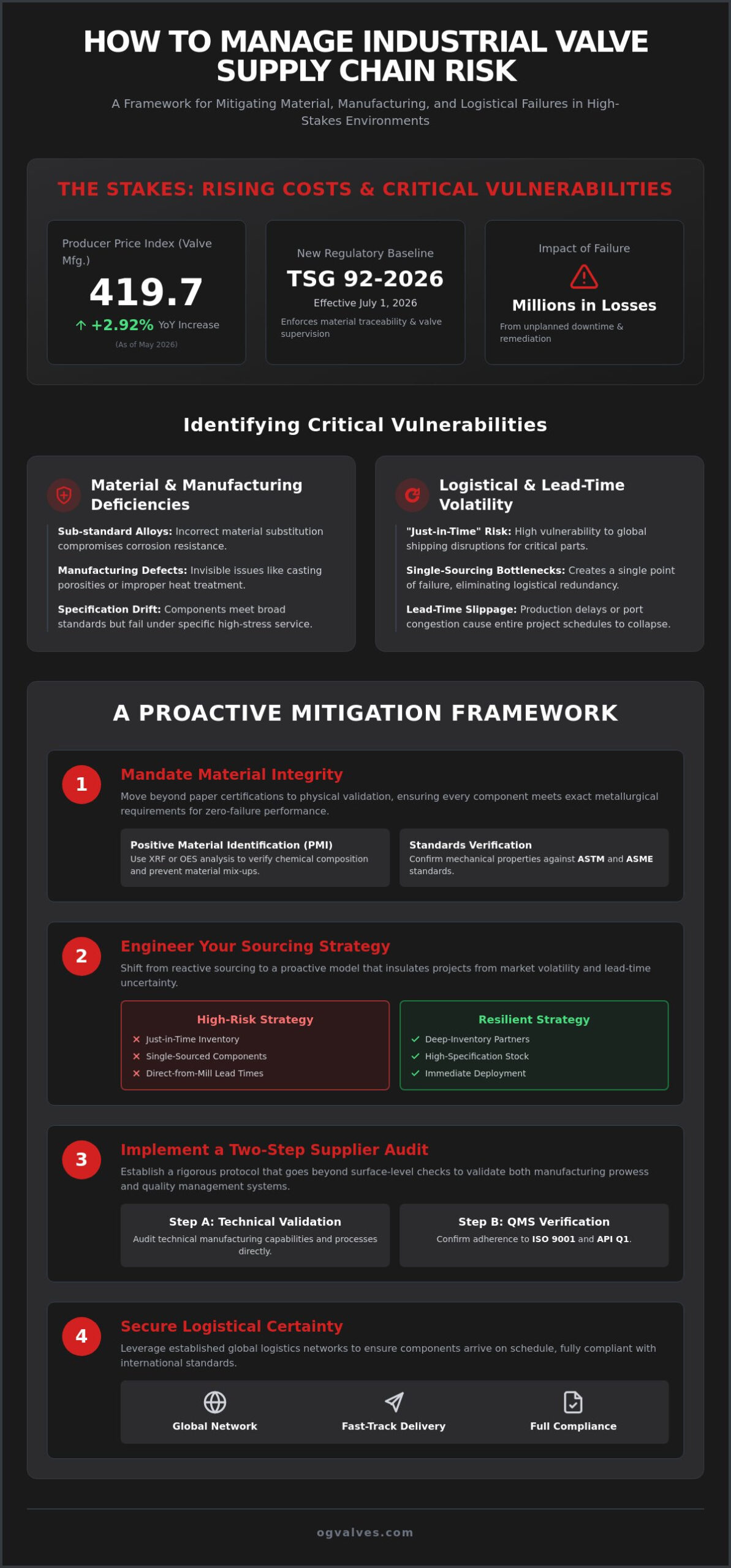
The enforcement of the TSG 92-2026 regulation on July 1, 2026, establishes a new baseline for material traceability and emergency shut-off valve supervision that industrial operators cannot ignore. Coupled with a Producer Price Index of 419.7 for valve manufacturing as of May 2026, the financial and operational stakes of procurement have reached a critical threshold. Most engineers and procurement specialists recognize that traditional vendor oversight is insufficient to prevent unforeseen downtime due to lead-time slippage or material failures in high-pressure environments. Mastering how to manage valve supply chain risk requires a clinical focus on technical specifications and regulatory alignment rather than simple cost-per-unit metrics.
This article provides a rigorous, standard-aligned framework for mitigating material, manufacturing, and logistical risks in industrial valve supply. You’ll gain the technical protocols necessary to achieve zero-failure material integrity and guaranteed fast-track delivery schedules while maintaining full compliance with the updated 2026 ISO and API standards. We’ll examine the transition from reactive sourcing to a proactive, engineering-led strategy that prioritizes structural soundness and global project management.
Key Takeaways
- Identify the intersection of material integrity, regulatory compliance, and logistical certainty to pinpoint critical vulnerabilities in heavy industrial infrastructure.
- Implement mandatory Positive Material Identification (PMI) and verify mechanical properties against ASTM and ASME standards to ensure zero-failure performance in corrosive environments.
- Establish a technical framework on how to manage valve supply chain risk by utilizing specialist inventory to mitigate market volatility and lead-time slippage.
- Adopt a rigorous two-step supplier audit protocol that validates technical manufacturing capabilities and adherence to ISO 9001 and API Q1 quality management systems.
- Leverage global logistics networks and technical expertise to secure fast-track delivery schedules while maintaining full regulatory compliance across international project sites.
Identifying Critical Vulnerabilities in the Valve Supply Chain
In heavy industrial sectors, valve supply chain risk represents the critical intersection of material integrity, regulatory compliance, and logistical certainty. It’s not merely a procurement challenge; it’s a technical safeguard against catastrophic operational failure. Effective supply chain risk management requires a granular understanding of how a single component’s failure can compromise a multi-billion dollar infrastructure project. Standard procurement protocols often fail because they prioritize unit cost over technical specification drift. This drift occurs when suppliers provide components that technically meet broad standards but lack the specific chemical or mechanical properties required for high-stress service.
The financial impact of failure in petrochemical and power generation facilities is severe. Unplanned downtime resulting from a ruptured gate valve or a leaking seal can result in millions of dollars in lost production and environmental remediation costs. As of May 2026, the Producer Price Index for industrial valve manufacturing reached 419.7, reflecting a 2.92% year-over-year increase. This rising cost environment, combined with volatile nickel and copper prices, often incentivizes suppliers to cut corners on material quality. Understanding how to manage valve supply chain risk involves identifying these hidden vulnerabilities before the hardware reaches the site.
Material and Manufacturing Deficiencies
Material failure is often rooted in the use of sub-standard alloys in high-pressure environments. When a supplier substitutes a lower-grade stainless steel or fails to meet precise chromium-nickel ratios, the component’s corrosion resistance is compromised. These shortcuts lead to premature failure in gate or globe valves, particularly in hydrogen or LNG applications. Adherence to established industrial valves standards is the only way to ensure baseline quality. Without rigorous testing, manufacturing defects like casting porosities or improper heat treatment remain invisible until the system is pressurized.
Logistical and Lead-Time Volatility
Project commissioning timelines are increasingly vulnerable to global shipping disruptions. Relying on “just-in-time” inventory for critical components like trunnion ball valves is a high-risk strategy for heavy industrial maintenance. If a single-sourced supplier faces production delays or regional port congestion, the entire project schedule collapses. Single-sourcing for specialized components creates a bottleneck that eliminates any technical or logistical redundancy. In 2026, managing these risks requires a shift toward deep-inventory partners who maintain high-specification stocks ready for immediate deployment, bypassing the volatility of direct-from-mill lead times.
Mitigating Risk Through Material Integrity and Technical Testing
Material integrity is the foundation of industrial safety. Establishing rigorous technical testing protocols is the most effective method for how to manage valve supply chain risk. Procurement teams must move beyond verifying paper certifications. They must implement physical validation processes that confirm every component meets the exact metallurgical requirements of the application. Verification of chemical composition and mechanical properties against ASTM and ASME standards is a non-negotiable requirement for critical infrastructure projects.
Positive Material Identification (PMI) Protocols
PMI serves as a critical gate in the procurement process. It prevents material mix-ups that often occur during the bulk manufacturing of specialized alloys. By utilizing X-ray fluorescence (XRF) or optical emission spectroscopy (OES), engineers verify the chemical composition of a valve body without damaging the component. This data should be integrated into digital material traceability records to ensure a transparent audit trail. In offshore gas applications, material verification prevents catastrophic failures caused by chloride-induced stress corrosion cracking in sub-standard stainless steels.
Non-destructive testing (NDT) provides visibility into the structural soundness of castings and forgings. Methods such as ultrasonic testing (UT) and radiographic testing (RT) identify internal defects like porosities or inclusions that lead to premature failure under high pressure. For corrosive or cryogenic environments, standardizing on high-specification materials like Duplex or Inconel is necessary. Verification of mechanical properties ensures the valve remains ductile at low temperatures and maintains tensile strength at high temperatures. Identifying these defects before the component reaches the site is a primary pillar of technical risk management.
Adherence to Global Regulatory Benchmarks
Compliance with API 6D and API 600 standards is mandatory for ball valve and gate valve procurement in oil and gas sectors. These benchmarks define the minimum requirements for design, manufacturing, and testing. Fugitive emission reduction has also become a priority, making ISO 15848-1 compliance a key indicator of a supplier’s engineering precision. Ensuring that suppliers maintain active certifications from global regulatory bodies reduces the risk of non-compliant hardware entering the system. For projects requiring documented compliance and technical support, partnering with established industrial suppliers during the specification phase is a proven risk-reduction strategy.
Strategic Sourcing vs. Market Volatility: A Comparative Analysis
Procurement specialists often prioritize the direct-to-factory model to minimize initial capital expenditure. However, this strategy frequently ignores the hidden costs of lead-time volatility and manufacturing backlogs. A comprehensive framework for how to manage valve supply chain risk must account for the logistical agility provided by specialist stocking distributors. In a market where the industrial valve PPI has risen to 419.7 as of May 2026, immediate access to high-specification inventory provides a critical hedge against price spikes and material shortages. This technical approach shifts the focus from simple vendor selection to strategic partnership with entities that maintain ready-to-ship assets.
Stocking Distributors vs. Direct Manufacturing
Direct-to-factory orders frequently face lead times exceeding 24 weeks. This delay introduces significant project risk, especially when specialized alloys are required. Immediate inventory availability ensures that critical maintenance schedules remain intact despite mill delays. Specialist suppliers often conduct independent third-party testing, providing an additional layer of verification beyond the manufacturer’s standard reports. For high-cycle butterfly valve applications, holding safety stock with a trusted partner eliminates the risk of production stops caused by unforeseen component failure. Technical oversight from a distributor who understands ASTM and ASME requirements ensures that the hardware delivered matches the engineering specification exactly.
Logistical Resilience and Global Reach
Establishing a Tactical Framework for Supplier Auditing
A tactical auditing framework serves as the final defensive layer in technical procurement. Relying on self-reported data from vendors introduces unacceptable levels of uncertainty into critical infrastructure projects. To understand how to manage valve supply chain risk, engineers must conduct deep-dive technical assessments that go beyond superficial compliance. This process ensures the manufacturing facility possesses the specific equipment and personnel necessary to execute high-specification orders without technical drift. A rigorous framework follows five distinct steps:
- Technical Capability Assessment: Verify CNC machining precision and hydrostatic pressure testing capacities on-site.
- Quality Management System (QMS) Audit: Confirm adherence to ISO 9001 and the more rigorous API Q1 requirements for oil and gas applications.
- Supply Chain Transparency: Map sub-tier suppliers for raw materials. The February 2026 release of API RP 591 (seventh edition) provides updated benchmarks for foundry qualification that must be enforced.
- Stability Assessment: Evaluate the vendor’s operational history to ensure they can withstand the material price volatility projected for 2026.
- Certification Verification: Review Mill Test Reports (MTRs) to confirm chemical and mechanical properties match the heat numbers on the valve bodies.
The Technical Audit Checklist
Precision auditing requires verifying that testing equipment is calibrated to international standards. Reviewing the qualifications of non-destructive testing (NDT) personnel and welding procedures is essential for high-pressure service. This checklist must also include actuator integration and automation standards. The updated 2026 ISO 5210 and ISO 5211 standards for actuator attachments provide the necessary benchmarks for ensuring mechanical compatibility and operational safety in automated systems.
Continuous Monitoring and Performance Review
Initial audits are insufficient without a system for continuous monitoring. Implementing Key Performance Indicators (KPIs) for lead-time accuracy and defect rates allows for real-time risk assessment. Annual technical audits maintain supply chain integrity by identifying shifts in manufacturing quality before they result in component failure. Leveraging digital documentation for real-time monitoring of supplier compliance ensures that all certifications remain current and valid. For organizations seeking to eliminate these administrative and technical burdens, partnering with a technically-vetted supplier ensures that all components have already passed these rigorous auditing gates.
Operationalizing Resilience with OG VALVES LTD.
OG VALVES LTD. integrates deep engineering expertise with an extensive inventory of gate, ball, globe, and butterfly valves to provide a turnkey solution for risk mitigation. We don’t just act as a supplier; we serve as a technical bridge between raw manufacturing and site-ready hardware. Mastering how to manage valve supply chain risk involves more than just selecting a vendor. It requires a partner capable of providing immediate, high-specification assets that have already passed rigorous quality gates. Our global logistics network is engineered for fast-track delivery, ensuring that heavy industrial projects bypass the lead-time volatility typical of direct-from-mill orders.
Our commitment to technical precision is anchored in strict adherence to API, ASTM, and ISO standards. Every component in our inventory undergoes a mandatory review of Mill Test Reports (MTRs) and internal quality checks to ensure material traceability. A global petrochemical facility recently utilized this framework to mitigate a critical downtime event. When a primary isolation valve failed, the original manufacturer quoted a lead time exceeding 20 weeks. OG VALVES LTD. leveraged its existing stock and technical support team to identify a compatible, high-specification replacement and delivered it to the site within days. This intervention reduced the facility’s projected financial loss by millions in lost operational output.
Unwavering Reliability in Critical Infrastructure
Reliability in high-stakes industrial procurement is built on documented performance and specialized technical support. We assist engineers during the selection process to ensure that the chosen metallurgy and design parameters match the specific corrosive or high-pressure environment of the application. This proactive involvement eliminates the risk of technical specification drift. Our approach to documentation integrity ensures that every valve is delivered with a complete data package, including PMI results and NDT certifications. It’s a clinical focus on engineering excellence that builds trust with procurement specialists who understand the cost of component failure.
Securing Your Supply Chain for 2026
The 2026 market environment demands a transition from reactive sourcing to a proactive technical framework. With material prices projected to remain volatile and new regulations like TSG 92-2026 coming into force, the window for error in procurement has closed. Partnering with a specialist supplier like OG VALVES LTD. allows your organization to navigate these complexities with certainty. We maintain the inventory depth and logistical agility necessary to insulate your projects from sudden market spikes or regional shipping bottlenecks. Transition your procurement strategy today to prioritize durability, regulatory adherence, and operational safety. Consult with our engineering team at OG VALVES LTD. to secure your high-specification valve requirements and establish a resilient supply chain for your critical infrastructure projects.
Executing the Technical Framework for Supply Chain Security
The 2026 industrial landscape requires a shift from reactive procurement to a clinical, engineering-led strategy. Success depends on the implementation of mandatory Positive Material Identification and the strict verification of ASTM and ASME mechanical properties. Transitioning to a procurement model that leverages immediate inventory depth allows facilities to bypass the 20-week lead times often associated with direct-to-factory orders. Mastering how to manage valve supply chain risk effectively transforms procurement from a logistical hurdle into a technical advantage. By integrating rigorous supplier auditing with global logistical agility, organizations ensure that every component meets the highest safety benchmarks.
OG VALVES LTD. supports these efforts as a specialist supplier to the Oil, Gas, and Power sectors. We maintain an extensive global inventory and provide fast-track global delivery capabilities to eliminate project delays and ensure regulatory compliance. Taking these proactive steps today will safeguard your critical infrastructure for the long term. Request a Technical Quote for Your Industrial Valve Needs and secure your operations with hardware built for durability and precision. We look forward to partnering with you on your next high-specification project.
Frequently Asked Questions
What are the primary types of risk in the industrial valve supply chain?
The primary types of risk include material integrity, regulatory non-compliance, and logistical uncertainty. Material risk involves the use of sub-standard alloys that fail prematurely in corrosive or high-pressure environments. Regulatory risk centers on the failure to meet updated 2026 standards, such as TSG 92-2026. Logistical risk encompasses lead-time slippage and shipping disruptions that delay project commissioning and increase operational costs.
How does Positive Material Identification (PMI) reduce procurement risk?
Positive Material Identification (PMI) reduces procurement risk by providing physical verification of a component’s chemical composition before it enters service. This process ensures the valve body matches the Mill Test Report heat numbers exactly, preventing material mix-ups during manufacturing. This validation is essential for how to manage valve supply chain risk in high-pressure or cryogenic applications where alloy precision is non-negotiable for safety.
Why is lead-time volatility a critical risk for heavy industries?
Lead-time volatility creates cascading delays in project schedules, often resulting in millions of dollars in lost production. In 2026, mill backlogs and global shipping disruptions make direct-to-factory lead times highly unpredictable. For heavy industries, this uncertainty compromises maintenance windows and emergency repairs. Immediate access to high-specification inventory is required to maintain project timelines and avoid the financial penalties of unplanned downtime.
What role do API and ISO standards play in risk mitigation?
API and ISO standards provide the technical baseline for design, manufacturing, and safety. Compliance with benchmarks such as API 6D for ball valves or ISO 15848-1 for fugitive emissions ensures that components are engineered for severe industrial service. These standards serve as a primary risk mitigation tool by standardizing quality and testing protocols across global supply chains, reducing the likelihood of mechanical failure.
How can a stocking distributor help manage supply chain disruptions?
A stocking distributor manages disruptions by maintaining an extensive inventory of high-specification valves that are ready for immediate deployment. This allows operators to bypass manufacturing delays and raw material shortages. Utilizing a specialist distributor is a proven method for how to manage valve supply chain risk when mill backlogs exceed acceptable project timelines. This strategy provides a logistical hedge against price volatility and shipping bottlenecks.
Is single-sourcing or multi-sourcing better for risk management in 2026?
Partnering with a deep-inventory specialist or using a multi-sourcing strategy is superior to single-sourcing in 2026. Relying on a single manufacturing site introduces a single point of failure during regional disruptions or mill shutdowns. A diversified supply strategy, supported by partners with global reach and technical expertise, provides the logistical redundancy necessary to maintain operational continuity and insulate projects from localized supply chain failures.
What technical certifications should I verify when auditing a valve supplier?
Auditors must verify ISO 9001 and API Q1 certifications for quality management systems. Technical certifications should include API 600 for gate valves, API 609 for butterfly valves, and updated 2026 ISO standards for actuator attachments. It’s critical to verify that non-destructive testing (NDT) personnel are qualified to international standards. All Mill Test Reports (MTRs) must be fully traceable to the specific heat numbers on the hardware.
How does fast-track delivery impact the financial risk of industrial operations?
Fast-track delivery minimizes the high cost of unplanned downtime by restoring system integrity within days rather than months. Reducing the duration of a shutdown directly preserves operational revenue and prevents the financial penalties associated with project delays. It’s a strategic tool for managing the financial risk inherent in critical infrastructure maintenance. Immediate hardware availability ensures that emergency repairs don’t escalate into long-term production losses.
 Responsive Menu