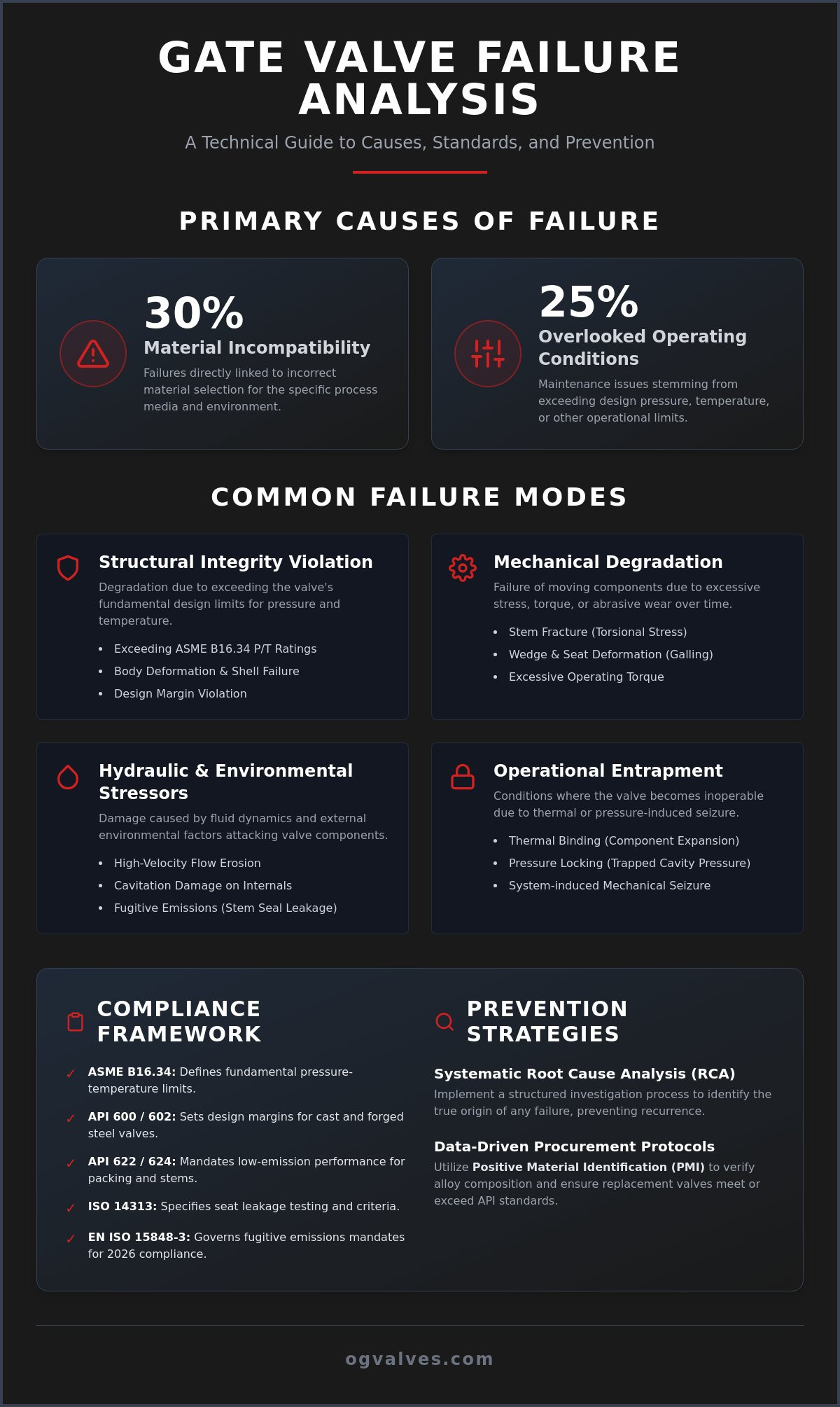
Nearly 30% of industrial valve failures are directly linked to material incompatibility; another 25% of critical maintenance issues stem from overlooked operating conditions. In high-pressure heavy industry, an unscheduled system shutdown represents a catastrophic risk to both operational safety and regulatory standing. You understand that the financial impact of a single failure far exceeds the procurement cost of a specification-compliant replacement. This technical guide provides a clinical gate valve failure analysis, focusing on the rigorous engineering standards required for 2026 compliance, including the updated API RP 591 and the latest EN ISO 15848-3 fugitive emissions mandates.
You’ll gain a precise understanding of the structural design margin violations and material-environment incompatibilities that lead to premature degradation. We’ll examine specific failure modes such as hydrogen embrittlement and seat leakage under the 2025 revision of ISO 14313. The following sections detail structured root cause analysis methodologies and technical prevention strategies designed for engineers and procurement specialists. This information ensures your infrastructure adheres to global benchmarks like the May 2026 API Std 609 and the revised MSS SP-78-2026 standards, moving your facility toward a model of unwavering reliability and engineering excellence.
Key Takeaways
- Evaluate structural integrity by applying ASME B16.34 pressure-temperature limits to prevent design margin violations.
- Identify mechanical failure modes such as stem thread stress concentration and wedge deformation resulting from excessive operating torque.
- Conduct a systematic gate valve failure analysis to resolve operational entrapment caused by thermal binding or pressure locking.
- Analyze hydraulic stressors to mitigate the effects of high-velocity erosion and cavitation on internal valve components.
- Implement data-driven procurement protocols using Positive Material Identification (PMI) to ensure all replacement valves meet API 600 or 602 standards.
Standardisation and Structural Integrity Frameworks
Gate valve failure analysis is the systematic investigation of mechanical or material degradation within a pressure-containing vessel. It’s a clinical process that identifies why a component failed to meet its intended design life or safety parameters. Technical experts begin this investigation by evaluating the asset against ASME B16.34. This standard is the foundational framework for defining pressure-temperature limits for industrial valves. When an application exceeds these established ratings, the valve’s structural integrity is compromised, often resulting in body deformation or catastrophic shell failure.
International standards like API 600 for cast steel and API 602 for forged steel dictate the structural design margins required for critical infrastructure. These benchmarks ensure that the valve can withstand both the internal fluid pressure and external piping loads. A comprehensive understanding of gate valve design and operation reveals that wall thickness requirements aren’t arbitrary. They serve as a calculated buffer against long-term corrosion and erosion. Thinner walls in sub-standard components lead to premature degradation, making frequent gate valve failure analysis a necessity for maintaining operational safety.
Design Margins and Safety Factors
Exceeding the pressure-temperature ratings specified in ASME B16.34 causes elastic and eventually plastic deformation of the valve body. This distortion prevents the wedge from seating correctly, leading to internal bypass. API 600 requires heavy-duty wall thicknesses to provide a robust margin for error in high-pressure environments. The safety factor is the ratio of material strength to operational stress. Maintaining a high safety factor ensures that the valve remains functional even during unexpected system surges or thermal transitions.
Regulatory Compliance: API 622 and 624
Environmental failure often occurs at the stem seal, where fugitive emissions can lead to regulatory non-compliance and safety risks. API 622 regulates the performance of the packing material itself, while API 624 provides the testing protocols for the valve’s rising stem. These standards ensure that the valve assembly can maintain a tight seal over thousands of cycles. Fugitive emission testing protocols significantly reduce the risk of stem seal leakage by verifying the packing’s integrity under realistic stress conditions. Integrating these international standards into the initial failure assessment process helps engineers determine if a leak resulted from material fatigue or a failure to meet 2026 low-emission mandates.
Mechanical Failure Modes: Stem, Wedge, and Seat Degradation
Mechanical failure in high-pressure service is typically the result of cumulative stress rather than a single event. A comprehensive gate valve failure analysis must isolate the specific point of mechanical breakdown, whether it’s located at the stem-to-wedge connection or the seating interface. Outside Screw and Yoke (OS&Y) designs mitigate some of these risks by keeping the stem threads outside the fluid stream. This prevents corrosive media from attacking the critical load-bearing threads, yet mechanical stressors like excessive operating torque remain a primary cause of component deformation. When these components fail, the safety of the entire pressure system is at risk.
Stem Fracture and Torsional Stress
Stem fractures often originate at the roots of the Acme threads, where stress concentration is highest. Engineers must calculate the Maximum Allowable Stem Torque (MAST) to prevent permanent deformation during manual or actuated operation. Identifying the difference between brittle fracture, which shows little to no material yielding, and ductile deformation is essential for determining if the failure resulted from a manufacturing defect or operational over-torque. A coarse thread pitch reduces the contact surface area but increases the mechanical advantage, which may elevate the risk of stem seizing if lubrication fails. Mechanical stress is often compounded by internal cavity pressure, a phenomenon explored in detail through pressure locking and thermal binding tests conducted by regulatory bodies.
Seating Surface Erosion
Wedge and seat degradation usually manifest as galling or erosion. In metal-to-metal seating, particulate matter in the process stream acts as an abrasive, “cutting” through even hard-faced Stellite surfaces over time. This erosion quickly compromises the valve’s ability to provide a bubble-tight shut-off. Once a leak path is established, high-velocity flow accelerates the damage, leading to catastrophic leakage that can’t be stopped by increasing torque. For more technical specifications on wedge geometries and material selection, refer to this technical guide to industrial gate valves. When mechanical integrity is compromised beyond repair, procurement of precision-engineered gate valves remains the only viable path to restoring system reliability and safety.
Hydraulic and Environmental Stressors: Erosion and Cavitation
Hydraulic stressors represent a significant portion of unforeseen operational failures in high-pressure systems. While gate valves are engineered for isolation, they often experience high-velocity flow during transitional opening and closing cycles. This velocity facilitates ‘flow cutting,’ a process where the process media physically removes material from the wedge and seat surfaces. A thorough gate valve failure analysis often reveals that these micro-channels are the root cause of internal bypass. Once the primary seal is compromised, high-velocity jets accelerate the degradation, making mechanical repair impossible and necessitating total component replacement.
Cavitation Physics in Isolation Valves
Cavitation occurs when the local fluid pressure drops below its vapour pressure, leading to the formation of vapour bubbles. As these bubbles transition into higher-pressure zones within the valve body, they implode. These implosions generate localized shock waves with enough energy to exceed the material’s yield strength. This process results in characteristic ‘honeycomb’ pitting on the wedge and body internals. You’ll recognize cavitation by its distinct noise and vibration signatures, which often mimic the sound of gravel moving through the piping. Mitigation requires specific material selection strategies, such as the application of cobalt-based hard-facing or the use of erosion-resistant alloys in high-velocity industrial services.
Corrosion and Material Incompatibility
Environmental degradation is frequently a function of fluid chemistry and stagnant line conditions. Stress Corrosion Cracking (SCC) remains a critical threat to stainless steel gate valves, particularly in chloride-rich environments. Crevice corrosion typically develops in the narrow tolerances between the seat rings and the valve body when the fluid is not in motion. In sour gas applications, engineers must ensure compliance with NACE MR0175/ISO 15156 to prevent sulfide stress cracking and hydrogen-induced damage. The NRC Generic Letter on Gate Valve Failures provides essential context on how environmental stressors and pressure differentials lead to catastrophic operational failure. For precise material ratings and environmental compatibility data, consult the comprehensive guide to selection and standards. Accurate identification of these stressors during a gate valve failure analysis is the only way to ensure the long-term integrity of heavy industrial infrastructure.
Root Cause Analysis (RCA): Identifying Thermal Binding and Pressure Locking
Root cause analysis (RCA) serves as the definitive stage of a clinical gate valve failure analysis. It moves beyond the simple identification of damaged components to determine why the operational environment exceeded the valve’s mechanical design limits. Thermal binding and pressure locking are among the most technically complex failure modes because they don’t involve material loss or visible fracture. Instead, they represent a total loss of functionality caused by internal physics and thermodynamic shifts. Understanding these phenomena is essential for preventing catastrophic delays during system restarts.
The Physics of Thermal Binding
Thermal binding is the result of differential thermal contraction between the valve body and the wedge. When you close a valve at high temperatures, the body cools and contracts at a rate that may differ from the internal wedge. Solid wedge designs are particularly susceptible because they lack the inherent elasticity required to absorb these contraction loads. The force required to break a thermally bound valve is a function of the material’s coefficient of expansion and the friction coefficient at the seating interface. This force often exceeds the Maximum Allowable Stem Torque (MAST), leading to the secondary stem failures discussed in previous sections.
Diagnostic Steps for Pressure Locking
Pressure locking occurs when liquid trapped in the bonnet cavity expands due to an increase in ambient or process temperature. Since liquids are incompressible, this expansion creates a hydrostatic load that forces the wedge against the seats with immense pressure. Technical experts should follow this diagnostic framework to identify and resolve the issue:
- Step 1: Identify temperature spikes in liquid-filled isolation sections that have been closed for an extended duration.
- Step 2: Monitor actuator torque or handwheel resistance during opening cycles; a non-linear increase during the initial stroke suggests cavity pressure locking.
- Step 3: Implement cavity relief protocols, such as utilizing a dedicated bleed valve or external bypass, to restore system functionality.
- Step 4: Verify the integrity of the upstream and downstream seals after operation to ensure the high-pressure event didn’t cause permanent seat deformation.
Engineering modifications provide the only permanent solution to these risks. Drilled equalization holes in the upstream face of the wedge allow cavity pressure to vent back into the pipeline. Alternatively, external bypass systems provide a controlled relief mechanism for critical infrastructure. For high-temperature services where binding is a known risk, procurement of high-specification gate valves with flexible wedge geometries is the most reliable strategy for ensuring operational longevity.
Technical Procurement and Quality Assurance Protocols
Procurement is the final preventative barrier against recurring operational failure. A data-driven specification represents the tangible output of a rigorous gate valve failure analysis. It translates technical findings into a precise set of requirements that govern material selection, design margins, and testing protocols. Relying on generic descriptions often leads to the acquisition of components that lack the structural integrity required for 2026 industrial benchmarks. You must ensure that every replacement valve is vetted against the specific hydraulic and thermal stressors identified during the root cause investigation.
Positive Material Identification (PMI) is a non-negotiable component of modern quality assurance. Alloy mix-ups during manufacturing or warehousing are a primary cause of premature corrosion and mechanical breakdown in high-pressure service. PMI testing provides a non-destructive method to verify the elemental composition of the valve body, wedge, and stem before the asset enters the field. This verification ensures that the metallurgy matches the Mill Test Report (MTR) and adheres to the required material classifications, such as those defined by API 600 for cast steel or API 602 for forged steel.
Material Certification and Traceability
Mill Test Reports (MTRs) serve as the primary legal and technical document validating a valve’s chemical and mechanical properties. For high-stakes power and petrochemical applications, EN 10204 3.2 certification is critical. Unlike 3.1 certification, which is validated by the manufacturer’s own authorized representative, 3.2 requires independent third-party verification of the testing process. This level of oversight is essential for critical infrastructure where the cost of failure is catastrophic. OG VALVES LTD. ensures that these rigorous industrial valve standards are met through comprehensive documentation and traceability protocols.
Strategic Supply Chain Management
Supplier capability must be evaluated based on technical expertise and the ability to execute fast-track delivery during unscheduled shutdowns. Minimizing downtime requires a partner with a specialized inventory and the logistics infrastructure to move high-specification assets globally. Technical support is vital when selecting the correct pressure class, ranging from Class 150 to 2500, to ensure the valve can handle the peak operational loads discussed in our gate valve failure analysis. Adhering to these stringent procurement and QA protocols guarantees that your replacement components provide the long-term reliability required for heavy industrial service. Request a technical specification quote for your industrial gate valve needs to ensure your infrastructure meets the latest 2026 engineering standards.
Securing Operational Longevity through Technical Excellence
Maintaining the structural integrity of high-pressure systems requires a transition from reactive repair to proactive engineering. A rigorous gate valve failure analysis proves that most catastrophic events are preventable through strict adherence to ASME B16.34 pressure-temperature limits and the implementation of advanced Root Cause Analysis (RCA) frameworks. By identifying the specific thermodynamic triggers for thermal binding and the hydraulic physics behind cavitation, engineers can specify components that exceed the demands of 2026 industrial environments.
Achieving this level of reliability necessitates a partner with deep technical expertise and a commitment to material traceability. OG VALVES LTD. provides a specialist industrial valve inventory supported by rigorous quality control, including Positive Material Identification (PMI) testing. Our global supply chain expertise ensures that high-specification assets reach your facility with the necessary EN 10204 3.2 certifications to minimize downtime and ensure regulatory compliance. It’s time to anchor your infrastructure in proven engineering standards. Request a Technical Specification Quote from OG VALVES LTD. to secure the precision-engineered components your facility demands. Your commitment to technical excellence ensures a safer, more efficient industrial future.
Frequently Asked Questions
What is the most common cause of gate valve failure in high-temperature systems?
Thermal binding is the primary cause of failure in high-temperature service. It occurs when a valve is closed at peak operating temperatures and subsequently cools. The valve body contracts at a faster rate than the wedge, resulting in mechanical entrapment. This prevents the valve from opening during the next operational cycle without exceeding the maximum allowable stem torque.
How do I differentiate between thermal binding and pressure locking?
Differentiation depends on the thermodynamic state of the process medium during the failure event. Thermal binding occurs during cooling cycles as the body shrinks around the wedge. Pressure locking occurs during heating cycles when trapped liquid in the bonnet expands. This expansion creates an immense hydrostatic load that forces the wedge against the seating surfaces, preventing movement.
Can a gate valve be used for throttling if it is properly sized?
Gate valves shouldn’t be used for throttling regardless of sizing or flow conditions. Their design is strictly intended for full-open or full-closed isolation. Using them for flow control results in high-velocity flow cutting of the seating surfaces. It also induces severe vibration that can lead to stem fatigue or wedge detachment from the stem-to-wedge connection.
What are the signs of cavitation damage on a gate valve wedge?
Cavitation damage manifests as localized honeycomb pitting on the wedge and seat internals. You’ll often hear a distinct noise similar to gravel passing through the piping during transitional cycles. This physical degradation results from vapour bubble implosions that generate shock waves exceeding the material’s yield strength, leading to rapid material loss and internal bypass.
How does Positive Material Identification (PMI) prevent valve failure?
Positive Material Identification (PMI) prevents failure by verifying that the component’s metallurgy matches the technical engineering specification. This non-destructive testing eliminates alloy mix-ups during the manufacturing process. It’s a critical step in a thorough gate valve failure analysis to confirm that specific corrosion-resistant properties are present in the installed asset before it enters high-pressure service.
What ASME standard governs the pressure-temperature ratings of gate valves?
ASME B16.34 is the primary standard governing pressure-temperature ratings for industrial valves. It establishes the maximum allowable working pressure based on the material classification and the operational temperature. Adherence to these established limits is essential to prevent the structural design margin violations that lead to body deformation or catastrophic shell failure.
Why do gate valve stems often fail at the thread roots?
Stems fail at the thread roots because these points act as natural stress risers within the mechanical assembly. When operating torque exceeds the Maximum Allowable Stem Torque (MAST), the stress concentration factor at the Acme thread root leads to brittle or ductile fracture. This failure mode is often exacerbated by inadequate lubrication or excessive internal cavity pressure.
What is the difference between API 600 and API 602 in terms of failure resistance?
API 600 governs heavy-duty cast steel valves, while API 602 covers smaller forged steel valves. API 600 provides superior failure resistance in large-scale infrastructure due to increased wall thickness requirements and robust design margins. API 602 offers high structural integrity for high-pressure, compact applications where forged grain structures provide enhanced fatigue resistance compared to cast components.
 Responsive Menu