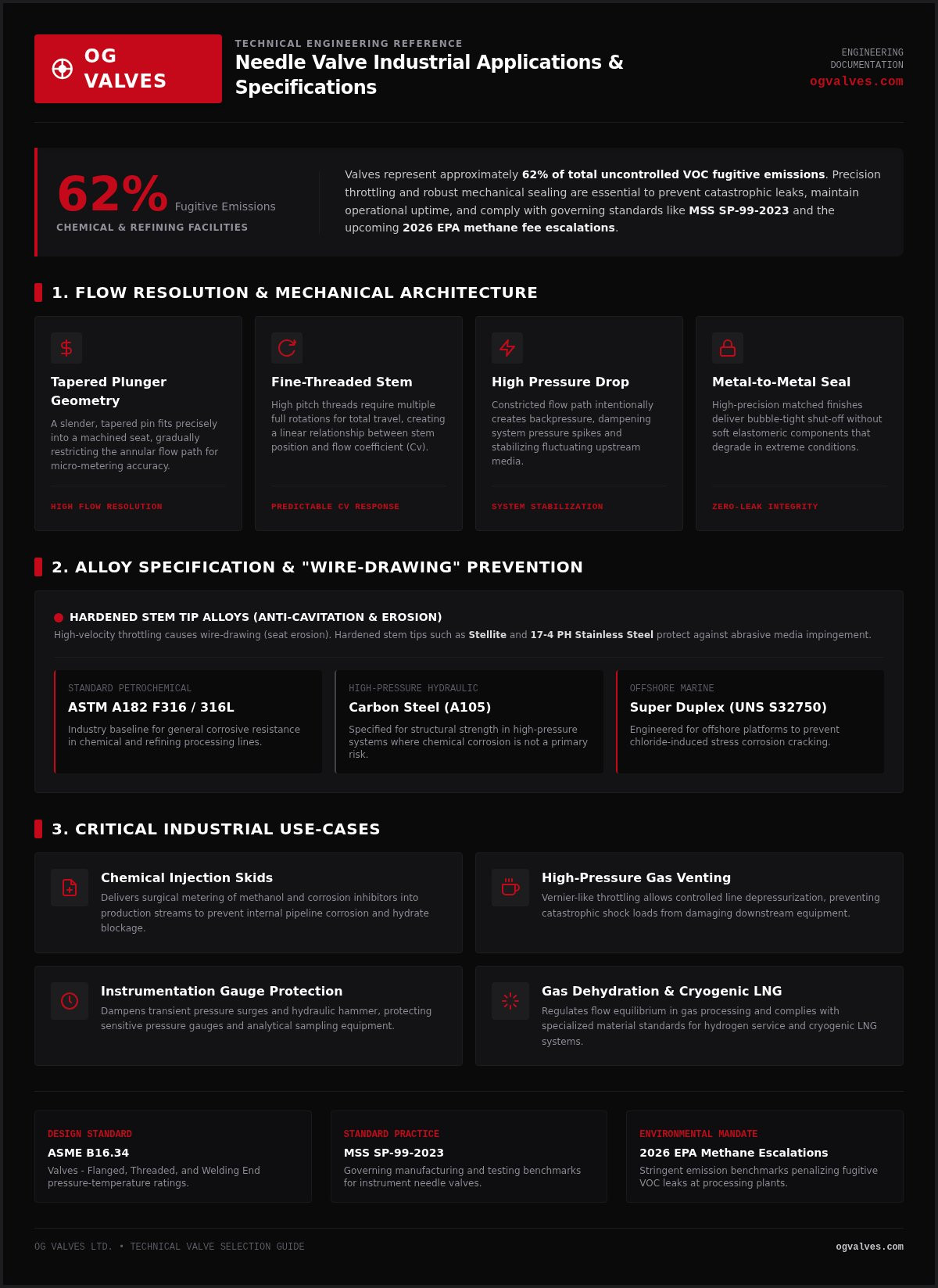
Valves account for approximately 62% of total uncontrolled volatile organic compound (VOC) fugitive emissions at typical chemical processing and refining facilities. In high-stakes industrial environments, a failure in flow regulation doesn’t just compromise system stability; it triggers severe regulatory penalties and operational downtime. You understand that precision throttling is the critical difference between a controlled process and a catastrophic leak. This guide provides an authoritative engineering analysis of needle valve applications across high-pressure industrial systems and critical instrumentation environments.
We’ll examine specific use-cases for these components, material requirements for corrosive service, and the technical standards required to ensure long-term structural integrity. By analyzing governing standards like MSS SP-99-2023 and the 2026 EPA methane fee escalations, we’ll define the parameters for procuring reliable, high-spec components. This technical overview clarifies how to maintain regulatory adherence while achieving the exact flow resolution necessary for modern heavy industry infrastructure. We’ll also address the material selection criteria for hydrogen service and cryogenic LNG applications to ensure your system meets the most rigorous safety benchmarks.
Key Takeaways
- Analyze how tapered pin and matched seat architectures enable the incremental throttling resolution required for precise flow regulation.
- Identify critical needle valve applications within petrochemical processing, including chemical injection skids and gas dehydration systems.
- Evaluate specialized instrumentation use-cases for protecting sensitive pressure gauges and ensuring accurate analytical sampling extraction.
- Apply technical selection criteria based on ASME B16.34 benchmarks and stem packing specifications to ensure durability in high-temperature environments.
- Streamline procurement for global infrastructure projects by integrating technical specification assistance with established industrial supply chains.
Defining the Needle Valve Role in Precision Flow Control
The operational efficacy of a needle valve is rooted in its specific internal geometry. Unlike standard gate or ball valves designed for full-bore flow, the needle valve design and operation centers on a slender, tapered plunger that fits into a precision-machined seat. This configuration allows for the gradual restriction of the flow path, providing the high-resolution control required for sophisticated needle valve applications. When you need to meter fluids at low flow rates with surgical accuracy, the matched conical interface is the only reliable mechanical solution.
Because the fluid must pass through a constricted annular space, these valves naturally create a high pressure drop. This high-resistance flow path is intentional; it provides the backpressure necessary to stabilize flow in systems prone to pressure fluctuations. For high-pressure environments, metal-to-metal sealing is the technical standard. By utilizing high-precision finishes on the stem tip and seat, these components achieve a bubble-tight shut-off without relying on soft seals that might fail under extreme thermal or chemical stress.
The Mechanism of Fine-Threaded Stem Control
The resolution of flow adjustment is directly proportional to the pitch of the stem threads. Needle valves utilize fine-threaded stems that require multiple rotations to achieve full travel. This mechanical advantage allows an operator to make incremental adjustments to the orifice size, resulting in a predictable and repeatable flow coefficient (Cv). It’s this linear relationship between stem position and flow area that makes these valves superior to globe valves for micro-metering tasks. The fine threads also ensure that the stem remains in its set position despite the high axial forces generated by process pressure.
Material Integrity in Throttling Applications
Throttling at high differential pressures accelerates fluid velocity, which often leads to seat erosion or cavitation. This phenomenon, frequently described as “wire-drawing,” can quickly destroy the sealing surfaces of standard valves. To prevent this, high-specification valves utilize hardened stem tips made from materials like Stellite or 17-4 PH stainless steel. These hardened surfaces maintain their structural integrity even when subjected to abrasive media or high-velocity impingement.
OG VALVES LTD. maintains a clinical focus on material durability to prevent premature system failure. The selection of alloys is dictated by the specific chemical and thermal profile of the process media. Typical material options include:
- ASTM A182 F316/316L: The industry standard for general corrosive resistance in chemical and petrochemical service.
- Carbon Steel (A105): Suitable for high-pressure hydraulic systems where corrosion is not a primary concern.
- Super Duplex (UNS S32750): Specified for offshore infrastructure to resist chloride-induced stress corrosion cracking.
Ensuring that the material specification aligns with the environmental demands is the only way to guarantee long-term operational safety.
Critical Applications in Oil, Gas, and Petrochemical Processing
In the oil and gas sector, flow control precision is a safety mandate. Needle valve applications in these environments focus on managing volatile media under extreme pressure conditions. Unlike general-purpose components, these valves provide the incremental adjustments necessary to maintain process equilibrium during high-pressure gas venting. This controlled depressurization of process lines prevents shock loads that could otherwise compromise downstream equipment. As detailed in the Encyclopaedia Britannica guide to valve types, the mechanical design of the needle valve allows for a vernier-like control effect. This is essential for maintaining structural integrity in systems where sudden pressure spikes are common.
Chemical Injection and Metering Precision
Chemical injection skids represent one of the most demanding use-cases for precision metering. These systems must deliver exact amounts of corrosion inhibitors or methanol into the production stream to prevent pipeline degradation and hydrate formation. A consistent flow rate is vital; insufficient injection leads to internal corrosion, while over-injection results in unnecessary operational costs. These units often integrate needle valves with other high-spec industrial valves within complex injection manifolds. In offshore environments, managing high differential pressures requires valves that can maintain a stable orifice setting despite significant vibration and thermal fluctuations.
Upstream and Midstream Throttling Requirements
Wellhead control panels utilize needle valves to regulate hydraulic fluid supplied to actuators and surface safety valves (SSVs). The ability to fine-tune the hydraulic response ensures that safety systems deploy with the correct timing and force. In separator systems, these valves control liquid levels through precise gas venting, ensuring that the separation of oil, gas, and water remains efficient. Turbine and compressor systems also rely on these components for fuel gas regulation, where precise air-to-fuel ratios are required for optimal combustion.
For applications involving sour gas, adherence to NACE MR0175/ISO 15156 is mandatory. This standard ensures that the materials used in needle valve applications resist sulfide stress cracking (SSC) in environments containing hydrogen sulfide. You must verify that every component in the wetted path meets these hardness requirements to avoid catastrophic brittle failure. For projects requiring strictly compliant, high-specification components, consulting with a technical partner like OG VALVES LTD. ensures that material selection aligns with these rigorous international benchmarks. The clinical focus on durability in these midstream and upstream environments is what separates reliable infrastructure from systems prone to frequent maintenance shutdowns.
Instrumentation and Analytical System Applications
Instrumentation loops are the nervous system of industrial facilities. They require components that provide high-resolution control while shielding sensitive transducers from the harsh realities of process lines. Needle valve applications in these environments prioritize instrument longevity and data accuracy. By utilizing a needle valve to incrementally open a process line, you prevent the high-velocity hammer effect that frequently destroys delicate internal diaphragms. This is especially critical during system startup when pressure gradients are most extreme. A needle valve prevents sudden pressure spikes from damaging sensitive pressure transducers by providing a controlled, gradual ramp-up of process pressure.
Pressure Gauge and Instrument Protection
The snubbing effect is a core technical advantage in instrumentation. Needle valves dampen pressure pulsations caused by reciprocating pumps or rapid valve cycling. This stabilization ensures that gauge needles don’t oscillate, which extends the service life of the mechanical linkage and improves readability. For maintenance, these valves allow for the safe isolation of instruments. You can bleed off trapped pressure before removing a gauge, ensuring compliance with OSHA Technical Manual guidelines on flow calibration and instrument safety. This isolation capability is vital for routine calibration without depressurizing the entire system.
Analytical Sampling and Manifold Integration
Obtaining a representative fluid sample requires extracting media without inducing significant pressure drops or phase changes. Analytical sampling systems utilize needle valves to achieve this controlled extraction. They’re often integrated into multi-valve manifolds to streamline the block and bleed process. Common configurations include:
- 2-valve manifolds: Designed for basic isolation and venting of a single instrument.
- 3-valve manifolds: The industry standard for differential pressure transmitters, allowing for zeroing and equalization.
- 5-valve manifolds: These provide additional vent and test ports for complex calibration and purging routines.
In high-purity gas or vacuum applications, zero-leakage performance is mandatory to prevent atmospheric contamination. Low-emission needle valves qualified under API 624 or ISO 15848-1 are essential for sampling volatile organic compounds (VOCs). These certifications ensure leak concentrations remain below the 100 ppmv threshold. Flow meter bypasses also utilize these valves to allow for on-site calibration or meter replacement without requiring a total system shutdown. This maintains operational continuity and prevents the economic losses associated with process interruptions.
Technical Selection Criteria for Industrial Needle Valve Applications
Selecting a needle valve requires a clinical evaluation of the operating environment. You must prioritize structural integrity over initial cost to prevent system failure. ASME B16.34 provides the mandatory benchmarks for pressure-temperature ratings, defining how material strength diminishes as thermal loads increase. For instrument-grade components, MSS SP-99-2023 and MSS SP-105-2023 govern steel and alloy valves NPS 2 and smaller, with pressure ratings extending up to 15,000 psi. If your system operates between 3,000 and 6,000 psi, standard Class 1500 or 2500 ratings are sufficient. However, specialized needle valve applications in waterjet or autoclave systems often require custom configurations rated up to 60,000 psi.
Stem packing selection is equally critical. PTFE is the preferred material for general chemical resistance and low-torque operation at temperatures up to 450°F. When fire-safe performance or higher temperatures are required, die-formed flexible graphite is the technical standard. You must also calculate the flow coefficient (Cv) to ensure the orifice sizing allows for adequate flow without inducing an excessive pressure drop. A mismatched Cv leads to high-velocity erosion, which permanently damages the metal-to-metal seal.
Engineering Standards and Regulatory Compliance
Adherence to international benchmarks is the primary form of brand validation in heavy industry. While API 6D typically covers larger pipeline valves, needle valves used in those systems must often meet the fire-test requirements of API 607. Material traceability is non-negotiable for critical infrastructure. You should demand Positive Material Identification (PMI) testing to verify that the alloy composition matches the Mill Test Report (MTR). Compliance with established API valve standards ensures that every component integrates seamlessly into global projects. For complex procurement needs, view our full technical specifications for industrial needle valves to ensure your project meets these rigorous safety benchmarks.
Environmental and Media Considerations
Corrosive media dictates specific alloy requirements. In chloride-rich or wet H2S environments, standard 316 stainless steel is often insufficient. You should specify Super Duplex or high-nickel alloys like Hastelloy C-276 to prevent sulfide stress cracking. Cryogenic needle valve applications, such as liquid hydrogen or LNG service, require extended bonnets. These extensions maintain the gland packing above -20°C, preventing seal embrittlement at temperatures as low as -423°F. Furthermore, modern environmental audits demand low-emission (Low-E) certified equipment. API 624 mandates a maximum allowable stem leakage limit of 100 ppmv methane. Achieving this standard requires high-precision stem finishes and specialized packing sets that maintain a seal across hundreds of mechanical cycles.
Procuring High-Specification Needle Valves for Global Infrastructure
Industrial infrastructure projects rely on a robust procurement framework that extends beyond simple vendor transactions. The global industrial valves market is valued between $84.8B and $99.6B in the 2025-2026 cycle. With oil, gas, and chemical processing representing over 26% of this demand, the pressure to maintain operational uptime is immense. Procuring components for critical needle valve applications requires a partner capable of verifying material traceability and adherence to international standards. Failure to secure high-specification hardware often results in catastrophic leaks or regulatory non-compliance.
Global Supply and Logistics Capability
OG VALVES LTD. maintains a clinical focus on inventory management to support the petrochemical and power sectors. For maintenance, repair, and operations (MRO), fast-track delivery protocols are essential. Federal civil penalties for Clean Air Act violations exceed $59,000 per day per violation in 2026, making the rapid replacement of non-compliant valves a financial necessity. Our global logistics capability ensures that technical documentation and compliance certificates accompany every shipment, facilitating seamless integration into international facilities. By managing a large-scale inventory of high-spec alloys, we minimize the lead times that typically stall major infrastructure projects.
Technical Partnership and Valve Specification
Selecting the correct component is a collaborative process between project engineers and technical specialists. This partnership identifies the optimal valve for specific needle valve applications based on pressure, temperature, and media profiles. We act as a dependable partner in critical infrastructure, leveraging technical expertise across our entire range. This includes specialized knowledge in butterfly valves and other industrial components to provide total system solutions. Quality assurance is anchored in rigorous testing protocols, ensuring that every valve arrives ready for high-stakes industrial service.
Contact OG VALVES LTD. for technical specifications and procurement support.
Optimizing Flow Control Integrity in High-Pressure Systems
Precision in fluid regulation is a non-negotiable requirement for modern industrial safety. You’ve seen how fine-threaded stem control and tapered needle geometry provide the resolution necessary for metering and instrument protection. Successfully managing needle valve applications requires a rigorous adherence to international standards like ASME B16.34 and API 624. As methane emission charges escalate to $1,500 per metric ton in 2026, the economic cost of poor sealing is as significant as the technical risk. Maintaining structural integrity in corrosive or cryogenic environments depends entirely on precise material selection and verified traceability.
OG VALVES LTD acts as a specialist supplier to the global oil, gas, and petrochemical sectors. We maintain an extensive inventory of high-specification industrial components to support critical infrastructure. Our proven track record in fast-track global logistics ensures that your project stays on schedule without compromising on quality. You don’t have to settle for generic components when high-stakes reliability is required. Request a Technical Quote for Industrial Needle Valves to secure components that meet the most demanding engineering benchmarks. We look forward to supporting your next large-scale industrial demand.
Frequently Asked Questions
What is the primary difference between a needle valve and a globe valve?
Needle valves are engineered for precise micro-adjustments using a slender, tapered plunger, whereas globe valves are intended for general flow regulation and larger volumetric throughput. The fine-threaded stem of a needle valve allows for a vernier-like control effect that globe valves lack. While both utilize a rising stem, the needle valve’s orifice-to-plunger ratio is significantly smaller, facilitating the incremental flow changes required in specialized needle valve applications.
Can needle valves be used for high-pressure gas applications?
Needle valves are ideally suited for high-pressure gas applications due to their robust metal-to-metal sealing and fine-threaded control. Standard configurations are frequently rated for pressures up to 6,000 psi, while specialized instrumentation versions reach 15,000 psi or higher under MSS SP-99-2023 standards. Their design allows for controlled depressurization, which prevents the shock loads often associated with gas venting in high-stakes petrochemical or power generation environments.
Why are needle valves preferred for pressure gauge isolation?
Needle valves are preferred for pressure gauge isolation because they allow for the gradual introduction of process pressure to sensitive transducers. This snubbing effect prevents sudden pressure spikes from damaging internal diaphragms during system startup. Additionally, they facilitate safe maintenance by providing a bubble-tight shut-off, allowing technicians to bleed off trapped pressure before removing the instrument, which ensures adherence to OSHA safety protocols and prevents equipment failure.
What materials are best suited for needle valves in corrosive environments?
In corrosive environments, austenitic stainless steels like ASTM A182 F316/316L serve as the industry benchmark for general chemical resistance. For aggressive media containing chlorides or wet hydrogen sulfide, Super Duplex or high-nickel alloys such as Hastelloy C-276 are required. These materials must meet NACE MR0175/ISO 15156 standards to prevent sulfide stress cracking and maintain long-term structural integrity in offshore or upstream processing systems where failure is not an option.
Are needle valves suitable for high-viscosity fluids?
Needle valves aren’t typically suitable for high-viscosity fluids or media containing significant particulate matter. The narrow, tortuous flow path around the tapered needle creates high resistance, which leads to clogging or excessive pressure drops with thick fluids. In these scenarios, ball valves or plug valves are preferred. Most needle valve applications are technically restricted to clean, low-viscosity liquids and gases where precise metering resolution is the primary operational requirement.
How do I calculate the correct orifice size for a needle valve?
Calculating the correct orifice size involves determining the required flow coefficient (Cv) based on the specific gravity of the media, the desired flow rate, and the allowable pressure drop. Engineers utilize standard sizing equations to ensure the valve provides sufficient control resolution without inducing cavitation or “wire-drawing” erosion. Selecting a valve with an appropriately matched Cv is critical to maintaining the metal-to-metal seal’s integrity during high-differential pressure throttling operations.
What maintenance is required for industrial needle valves?
Maintenance for industrial needle valves focuses on periodic inspection of the stem packing and seat integrity. You should regularly check for fugitive emissions using EPA Method 21 protocols to ensure the valve remains within the 100 ppmv leakage threshold. In high-cycle applications, the stem threads require lubrication with compatible industrial greases to prevent galling. If the valve fails to achieve bubble-tight shut-off, the stem tip or seat may require replacement due to erosion.
What are the common failure modes of needle valves in heavy industry?
Common failure modes in heavy industry include seat erosion, stem galling, and packing degradation. High-velocity flow across the narrow orifice causes “wire-drawing,” which creates permanent leak paths in the metal-to-metal seal. Galling typically occurs when the stem and seat materials aren’t sufficiently hardened or lubricated. Additionally, thermal cycling in cryogenic or high-temperature service leads to seal embrittlement, resulting in fugitive emissions that compromise both safety and regulatory compliance standards.
 Responsive Menu