Specifying the incorrect port configuration is a direct catalyst for systemic hydraulic inefficiency and inflated operational expenditure. You’re likely aware that in high-velocity process lines, excessive pressure drop isn’t just a calculation error; it’s a precursor to cavitation and accelerated valve seat degradation. Selecting between a full bore vs reduced bore ball valve requires a clinical assessment of flow velocity, media characteristics, and long-term maintenance protocols. While a reduced bore valve offers weight and cost advantages in large-scale installations, it’s often the wrong choice for pipelines requiring regular pigging or maximum flow capacity.
OG VALVES LTD. provides this engineering-led analysis of port configurations to help procurement specialists and piping engineers optimize flow efficiency and system costs. You’ll learn how to balance the optimized flow coefficient (Cv) against the mechanical economy of smaller valve bodies. This guide examines compliance with the latest industrial standards, ensuring your selection meets the rigorous demands of heavy industry. We’ll preview the technical trade-offs that define the total cost of ownership, from initial capital outlay to the functional reality of pipeline integrity.
Key Takeaways
- Identify the critical differences in internal bore diameters to ensure compliance with pipeline pigging requirements and flow efficiency benchmarks.
- Analyze the impact of port configurations on the system flow coefficient (Cv) to mitigate excessive pressure drop and the risk of cavitation.
- Assess the mechanical advantages of reduced bore designs, focusing on weight reduction and the resulting decrease in piping support requirements.
- Apply a technical selection matrix for a full bore vs reduced bore ball valve to maintain adherence to API 6D and ASME B16.34 industrial standards.
- Ensure operational longevity by verifying material traceability and adherence to global regulatory benchmarks for high-specification industrial applications.
Defining Full Bore and Reduced Bore Port Configurations
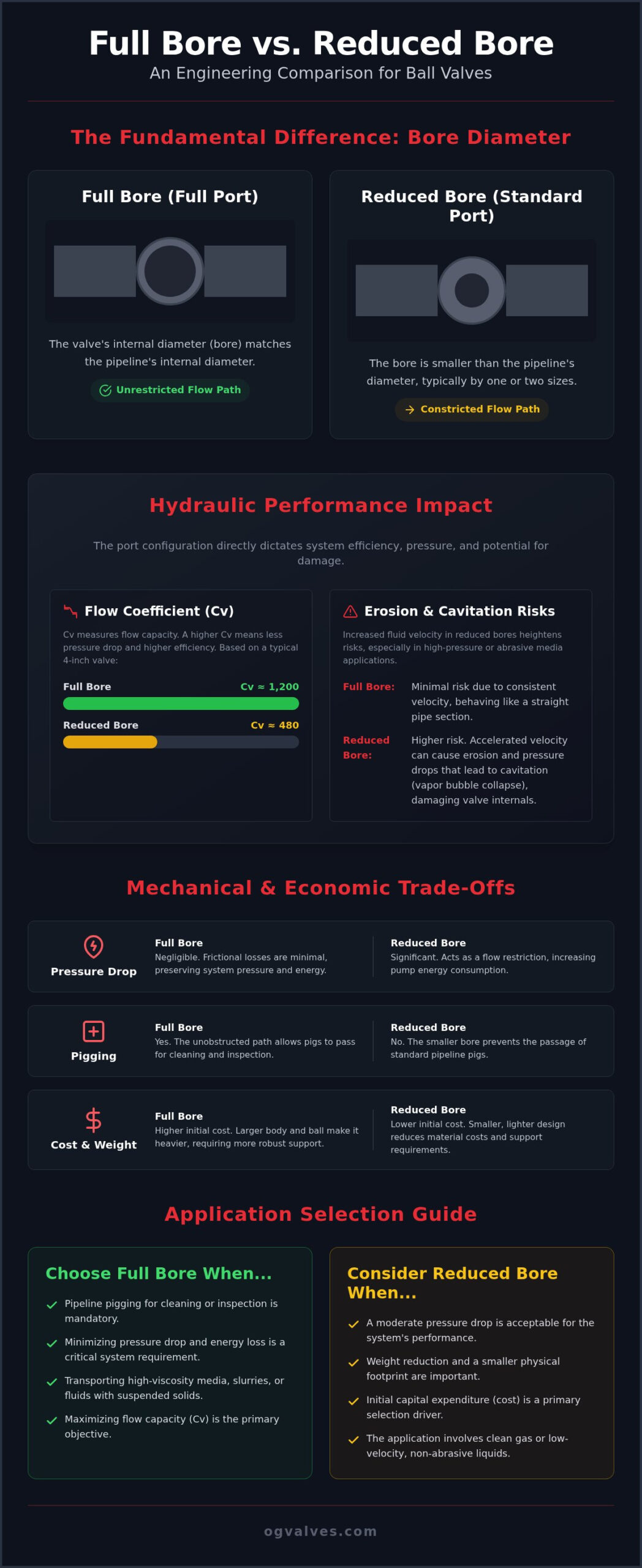
In industrial fluid dynamics, the internal port configuration of a valve directly dictates the hydraulic efficiency and mechanical footprint of the piping system. The primary distinction in a full bore vs reduced bore ball valve lies in the ratio between the valve’s internal flow passage and the nominal diameter of the connecting pipeline. A ball valve functions by rotating a spherical plug with a bored-out center; the geometry of this bore determines whether the fluid experiences a constant velocity profile or a localized constriction.
Port selection isn’t merely a cost-saving measure. It’s a critical engineering variable. Engineers must account for the mechanical relationship between the ball, seat, and flow path to prevent cavitation or excessive frictional losses. A full bore configuration ensures the internal diameter matches the pipe’s internal diameter, whereas a reduced bore typically features a flow path one or two sizes smaller than the nominal pipe size.
The Mechanics of Full Bore Ball Valves
Full bore valves provide a straight through, unobstructed flow path. This design minimizes turbulence and reduces frictional pressure drop to negligible levels, effectively behaving like a continuous section of pipe. In midstream applications, this configuration is mandatory for pipelines requiring regular pigging operations. Without a full opening, a pig cannot pass through the valve body to perform cleaning or inspection. These valves are also the standard for high-viscosity media or slurry transport, where any restriction would lead to media accumulation or localized erosion.
Reduced Bore Valve Design and Port Ratios
Reduced bore valves, often referred to as standard port valves, utilize a smaller ball and body. This creates a Venturi-style flow path where fluid velocity increases as it passes through the constricted port. Standard reduction ratios are predictable; for instance, an 8″ nominal valve might feature a 6″ internal bore (8″ x 6″). This transition is managed through the valve’s internal geometry to minimize the impact of the contraction.
When evaluating a full bore vs reduced bore ball valve, engineers often find that in clean gas systems or low-velocity liquid lines, the minor pressure drop across a reduced port is statistically insignificant. Because the ball and housing are smaller, these valves offer a reduced mechanical footprint. This leads to lower weight and decreased torque requirements for actuation, which translates to a lower total cost of ownership in large-scale infrastructure projects where support structures and actuator sizing are major cost drivers.
Fluid dynamics dictate that port geometry determines the system’s hydraulic envelope. When evaluating a full bore vs reduced bore ball valve, the Bernoulli principle confirms that fluid velocity must increase as the cross-sectional area decreases. This acceleration creates a localized drop in static pressure. In high-velocity lines, a reduced bore valve acts as a flow-limiting orifice, which increases pump energy consumption over the system’s lifecycle. Every additional pound of pressure drop translates into higher kilowatt-hour requirements for the pumping station. Port selection is a primary factor in optimizing operational expenditure.
Flow Coefficient (Cv) Comparisons
The flow coefficient (Cv) quantifies the volume of water at 60°F that will flow through a valve with a pressure drop of 1 psi. For a standard 4-inch full bore valve, Cv values typically exceed 1,200 depending on the manufacturer design. In contrast, a 4×3-inch reduced bore valve may exhibit a Cv of approximately 480. This represents a substantial reduction in capacity. The relationship between port area and pressure loss is non-linear. Minor bore reductions lead to significant turbulence that often disrupts downstream instrumentation, such as ultrasonic flow meters or pressure sensors. Engineers must specify longer straight-run pipe sections to stabilize the flow profile when using reduced ports.
Cavitation and Erosion Risks
Increased fluid velocity within a reduced port accelerates localized erosion, especially when the media contains suspended solids or abrasive particles. Cavitation presents a severe risk in high-pressure liquid applications. It occurs when the static pressure drops below the fluid’s vapor pressure at the vena contracta. Sudden pressure recovery then implodes vapor bubbles against the valve’s internal surfaces. This leads to pitting, vibration, and mechanical failure of the valve seats and ball. Material selection becomes critical when these hydraulic conditions are present.
Specifying hardened trim or a Trunnion Mounted Ball Valve can mitigate these stresses. For critical infrastructure, it’s essential to partner with a supplier that understands these hydraulic implications. You can consult with OG VALVES LTD. to verify that your full bore vs reduced bore ball valve selection aligns with the system’s velocity and pressure requirements to ensure long-term reliability.
Mechanical and Economic Comparison: Full vs Reduced Bore
The mechanical selection of a full bore vs reduced bore ball valve is a function of structural constraints and capital expenditure (CAPEX) limitations. Ball valves represent over 33% of the global oil and gas valve market, and the choice between port configurations has immediate implications for the physical footprint of the piping system. A full bore valve requires a larger valve body to accommodate the full-diameter ball and seat assembly, which results in a heavier component and a larger face-to-face dimension. In contrast, a reduced bore design utilizes a smaller ball and housing, allowing for a more compact installation in space-constrained environments.
Weight and Footprint in Modular Construction
Weight reduction is a primary driver in modular construction, particularly for offshore platforms and skid-mounted units. In these applications, every additional ton of equipment necessitates stronger structural supports and increased deck reinforcement. Specifying a reduced bore valve significantly lowers the total weight of a valve manifold. For large-diameter installations, the weight difference between port types can exceed 20%. Engineers must evaluate these structural considerations during the FEED (Front-End Engineering Design) stage to ensure that the piping supports can handle the static and dynamic loads of the selected valve assembly.
Procurement and Maintenance Costs
Procurement specialists must evaluate the material delta between these configurations. In high-specification projects involving duplex or super-duplex stainless steels, the material savings offered by a reduced bore configuration are substantial. Because the valve body and internal components are smaller, the initial purchase price is typically lower than that of a full-bore equivalent. However, this initial saving must be balanced against the operational efficiency losses associated with higher pressure drops.
Actuation torque is another critical variable. Because a reduced bore valve utilizes a smaller ball surface area, the frictional force against the seats is lower. This reduction in torque often allows for the selection of a smaller, less expensive actuator. Maintenance access also varies; while full bore valves allow for unrestricted internal inspection via pigging, reduced bore valves often exhibit different seat wear patterns. Inventory management is simplified when engineers standardize on specific bore sizes, though this requires a rigorous analysis of spare parts compatibility across the facility’s valve population. OG VALVES LTD. provides technical support to help project teams calculate these trade-offs, ensuring that the selected full bore vs reduced bore ball valve meets both budgetary and performance benchmarks.
Selection Criteria for Industrial Applications
The selection of a full bore vs reduced bore ball valve is governed by standardized frameworks that prioritize hydraulic integrity over initial cost. Compliance with API 6D and ASME B16.34 is the baseline for industrial safety. For pipeline operators in the United States, the Pipeline and Hazardous Materials Safety Administration (PHMSA) has mandated adherence to API Specification 6D, 25th Edition, with a compliance deadline of January 1, 2026. This regulation impacts how engineers specify port configurations for midstream assets. While reduced bore valves are suitable for clean, high-pressure gas lines, full bore remains the non-negotiable standard for lines transporting high-solids media.
Pigging and Pipeline Integrity
Full bore valves are mandatory for smart pigging and pipeline cleaning operations. A reduced port creates a physical obstruction that leads to pig entrapment, causing catastrophic line blockages and potential pipe wall damage. API 6D specifies requirements for full-opening valves to ensure unrestricted passage for pigging tools. Don’t overlook the long-term integrity risks associated with port restriction in piggable lines. You can find more detailed specification data in our Industrial Ball Valves pillar.
Industry-Specific Recommendations
In the oil and gas sector, upstream applications often involve unprocessed crude or sand-laden slurries, making full bore configurations essential to prevent erosion and clogging. Downstream facilities often utilize reduced bore valves in refined gas distribution to optimize weight and cost. Choosing the correct full bore vs reduced bore ball valve ensures the system remains within the designed hydraulic envelope. Power generation facilities typically specify reduced bore valves for high-pressure steam and cooling water circuits where flow restriction is predictable. In chemical processing, managing corrosive media requires careful port design to avoid stagnant zones. Reduced bore valves can minimize the volume of corrosive fluid retained in the valve cavity, though it’s a trade-off against the increased velocity-driven erosion.
To ensure your system meets these rigorous industrial standards, contact OG VALVES LTD. for a technical consultation on your specific port requirements.
Sourcing High-Specification Ball Valves with OG Valves
Procuring the optimal full bore vs reduced bore ball valve configuration requires a supplier capable of balancing technical precision with logistical speed. OG Valves serves as a global partner for heavy industrial sectors, maintaining an extensive inventory of API-compliant components. Our specialized focus on high-pressure and corrosive environments ensures that every valve meets the rigorous demands of critical infrastructure. We provide the technical data and material certifications necessary for procurement specialists to make informed decisions that align with both project budgets and engineering requirements.
Technical Specification Support
Our engineering team assists in the detailed review of piping specifications to ensure that the selected port configuration maintains the required hydraulic profile. We understand that the decision between a full bore vs reduced bore ball valve often hinges on specific media characteristics and system velocities. To support these complex requirements, we supply valves in specialized materials, including Super Duplex and Inconel, across both port types. This ensures that even the most aggressive chemical processes or high-pressure subsea applications remain within safety margins. For a deeper understanding of how these selections impact global compliance, refer to our Valve Selection & Standards guide.
Every component we supply undergoes a clinical validation process. This includes verifying material traceability and ensuring that all ball valves adhere to international benchmarks such as ASME B16.34 and API 6D. Our technical support extends to valve sizing and torque calculation, which is essential for selecting the correct actuation package for reduced bore designs. By providing quantifiable data rather than generalities, we help engineers optimize the flow coefficient while minimizing the mechanical footprint of the installation.
Global Supply and Logistics
Managing the supply chain for large-scale infrastructure projects requires a methodical approach to logistics. OG Valves utilizes a global network to provide fast-track delivery, which is essential for minimizing facility downtime during unplanned maintenance or critical project phases. Our quality assurance protocols include rigorous testing, such as hydrostatic and pneumatic pressure tests, alongside Positive Material Identification (PMI) to confirm alloy compositions. This stoic focus on engineering excellence ensures that every valve delivered is ready for immediate integration into high-stakes environments.
We recognize that the cost of failure in heavy industry is prohibitive. Our role is to act as a dependable partner that understands the hydraulic implications of every specification choice. If you’re ready to finalize your procurement plan, you can request a technical quote for ball valves to receive detailed pricing and availability for your specific project requirements.
Optimizing System Integrity through Technical Selection
Selecting the appropriate full bore vs reduced bore ball valve configuration is a critical decision that influences the long-term hydraulic performance and total cost of ownership of industrial infrastructure. Engineers must prioritize the flow coefficient (Cv) requirements and pigging capabilities of the system while accounting for the mechanical footprint and weight constraints of the installation. Adhering to the latest API 6D and ASME B16.34 standards ensures operational safety and regulatory compliance in high-stakes environments.
OG Valves provides the technical expertise and extensive inventory necessary to support these complex specifications. Our global fast-track delivery capability minimizes facility downtime by ensuring high-specification components are available when project timelines are compressed. We maintain a clinical focus on material traceability and durability for heavy industry applications. You’re encouraged to consult with our technical team for ball valve specifications to verify your selection against rigorous industrial benchmarks. Achieving optimal flow efficiency starts with a precise engineering assessment.
Frequently Asked Questions
Can a reduced bore ball valve be used in a piggable pipeline?
A reduced bore ball valve cannot be used in pipelines requiring pigging operations. The constricted internal diameter acts as a physical barrier that traps pigs and cleaning tools, leading to catastrophic line blockages. For these applications, API 6D mandates the use of full-opening valves to ensure an unobstructed flow path. Specifying a full bore vs reduced bore ball valve for midstream assets requires verifying the pig passage requirements of the entire system.
How much pressure drop should I expect with a reduced bore valve?
The pressure drop across a reduced bore valve is higher than that of a full bore equivalent due to the Venturi effect. Fluid velocity increases as it passes through the smaller port, resulting in a localized drop in static pressure. While this drop is negligible in low-velocity gas lines, it becomes significant in high-velocity liquid systems. Engineers must calculate the system flow coefficient (Cv) to determine the impact on pump energy consumption.
Is a full bore ball valve always more expensive than a reduced bore version?
Full bore ball valves are typically more expensive than reduced bore versions because they require a larger ball and housing. This increase in material volume, especially when utilizing high-specification alloys like Duplex or Inconel, raises the initial procurement cost. However, the higher capital expenditure of a full bore vs reduced bore ball valve is often justified in abrasive or piggable applications where a reduced bore would lead to premature failure or operational constraints.
What are the main advantages of specifying reduced bore valves for offshore platforms?
Specifying reduced bore valves for offshore platforms primarily benefits the project through weight and footprint reduction. These valves are significantly lighter than full bore counterparts, which reduces the total load on the platform’s structural supports. In modular construction, smaller valve bodies also allow for more compact manifold designs. This reduction in physical mass translates to lower fabrication costs for the supporting deck structures without compromising the valve’s pressure rating.
Does a reduced bore valve affect the torque required for actuation?
A reduced bore valve typically requires lower torque for actuation than a full bore valve of the same nominal size. The smaller ball diameter reduces the surface area in contact with the seats, which decreases the frictional forces during rotation. This lower torque requirement often allows for the selection of smaller, more cost-effective pneumatic or electric actuators. Engineers should always consult the manufacturer’s torque data to ensure correct actuator sizing for the specific port configuration.
Are face-to-face dimensions different for full and reduced bore ball valves?
Face-to-face dimensions often differ between full and reduced bore configurations depending on the manufacturer and the pressure class. Full bore valves frequently require a longer body to house the larger ball and seat assembly while maintaining structural integrity. In contrast, reduced bore valves utilize more compact bodies. It’s essential to verify these dimensions against ASME B16.10 standards during the piping layout phase to ensure proper alignment and spacing within the valve train.
Which port configuration is better for abrasive slurry applications?
Full bore configurations are superior for abrasive slurry applications because they maintain a constant velocity profile. The straight-through flow path minimizes turbulence, which is the primary driver for localized erosion on the ball and seats. In a reduced port, the increased fluid velocity through the constriction accelerates material loss on internal surfaces. For high-solids media, selecting a full bore design significantly extends the valve’s service life and reduces maintenance frequency.
How does API 6D define a full-opening valve?
API 6D defines a full-opening valve as one where the internal bore diameter is essentially equal to the internal diameter of the connecting pipe. The standard specifies minimum bore dimensions for various valve sizes to ensure that pigs and other pipeline tools can pass without obstruction. These requirements are more stringent than those found in ASME B16.34, emphasizing functional performance for pipeline integrity rather than just pressure containment and wall thickness.
 Responsive Menu