Specifying a gate valve for high-cycle slurry service based solely on lower initial CAPEX often results in catastrophic seal failure and unbudgeted downtime. You recognize that selecting the correct isolation component is a matter of long-term operational integrity and regulatory compliance rather than mere procurement convenience. In high-stakes industrial environments, the technical decision between a gate valve vs plug valve determines the margin between sustained uptime and costly maintenance cycles. This engineering analysis provides a clinical comparison of these two mechanisms, focusing on material durability, seat design, and strict adherence to API 600 and API 6D standards.
We’ll evaluate mechanical benchmarks, leakage performance in abrasive media, and the specific ASME B16.34 pressure-temperature ratings required to ensure zero-leakage isolation. By examining the structural differences between the sliding wedge of a gate and the rotary plug of a plug valve, you’ll gain the quantifiable data necessary to minimize operational risks. The following sections detail the engineering criteria essential for achieving compliance with global safety benchmarks and maximizing the lifecycle of your critical infrastructure.
Key Takeaways
- Analyze the mechanical distinctions of a gate valve vs plug valve to determine the optimal flow control mechanism for high-pressure industrial isolation.
- Identify the performance advantages of plug valves in abrasive media applications, focusing on seat protection and self-cleaning rotary action.
- Verify compliance with critical industry benchmarks, including API 600, API 6D, and ASME B16.34, to ensure structural integrity under extreme thermal and pressure loads.
- Assess the impact of operational frequency on seal degradation to select components that achieve zero-leakage isolation and extended service life.
- Streamline procurement strategies by leveraging global logistics and extensive high-specification inventories to reduce lead times for critical infrastructure projects.
Fundamental Design Principles of Industrial Gate and Plug Valves
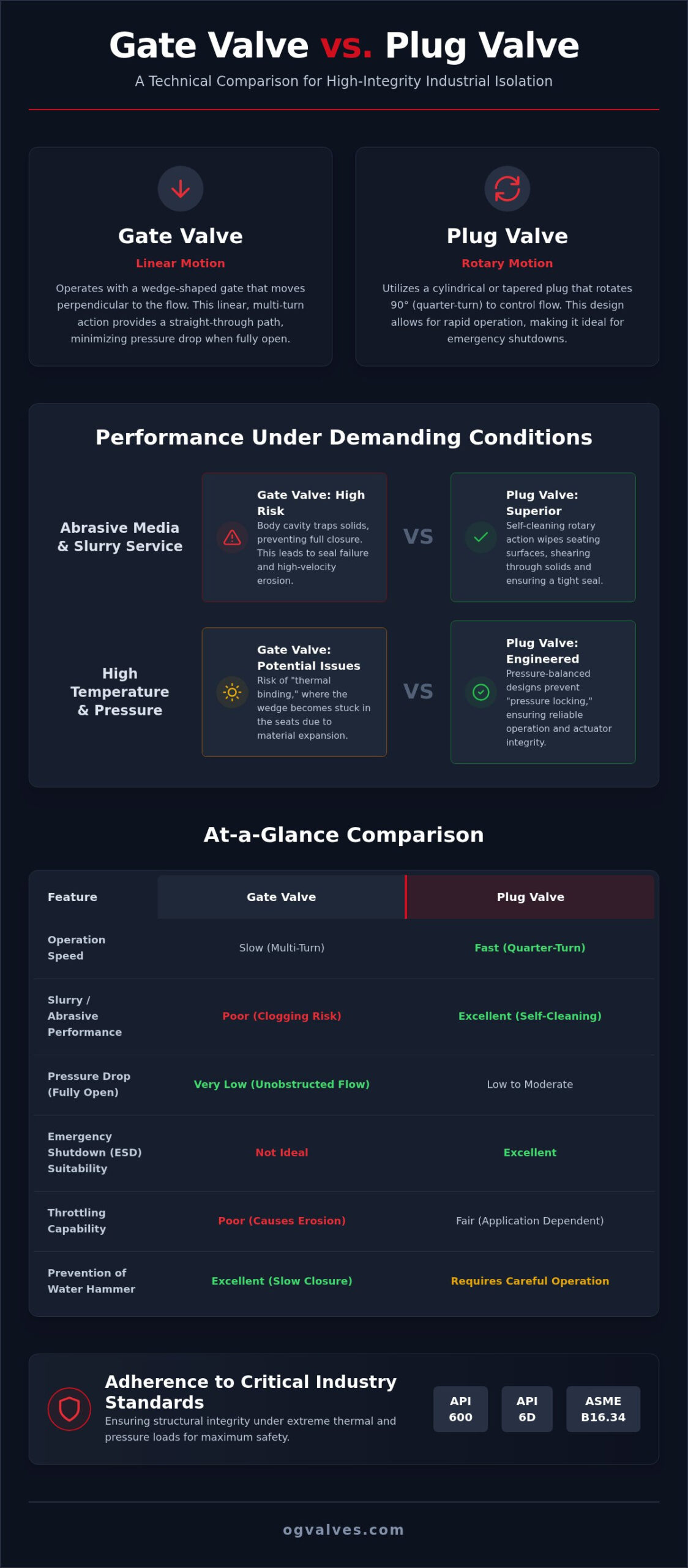
Industrial isolation requires a precise understanding of mechanical motion. Gate valves operate as linear-motion components, where a wedge-shaped disk moves perpendicular to the flow to achieve a seal. Conversely, plug valves utilize a quarter-turn rotary-motion mechanism. This fundamental difference in actuation dictates the valve’s footprint, operational speed, and suitability for specific process conditions. When evaluating a gate valve vs plug valve for high-stakes environments, engineers must consider that Gate Valve Design Principles prioritize a straight-through flow path to minimize pressure drop, whereas the plug valve design emphasizes rapid cycle times and robust sealing surfaces.
Gate Valve Mechanism: The Linear Wedge
The core of the gate valve is the wedge, which is driven by a threaded stem. In heavy industrial applications, rising stem designs are preferred because they provide a visual indication of the valve position, which is critical for safety protocols. Non-rising stems are utilized when vertical space is restricted. The wedge itself comes in several configurations to address specific thermal and pressure challenges:
- Solid Wedge: Offers maximum mechanical strength and simplicity for high-pressure service.
- Flexible Wedge: Features a cut around the perimeter to accommodate thermal expansion and piping misalignment without binding.
- Split Wedge: Comprises two independent pieces that adjust to the seat angle, ensuring a consistent seal in fluctuating temperatures.
Because the gate valve requires multiple turns of the handwheel or actuator, the shut-off process is inherently slow. This mechanical characteristic is advantageous in preventing water hammer, a hydraulic shock that can compromise the structural integrity of piping systems during sudden flow changes.
Plug Valve Mechanism: The Rotary Plug
The plug valve employs a tapered or cylindrical plug with a bored passage. When assessing a gate valve vs plug valve for emergency shutdown (ESD) scenarios, the plug valve’s quarter-turn operation offers superior efficiency. A 90-degree rotation is all that’s required to transition from fully open to fully closed. The plug is housed within the valve body, often with a sleeve or lubricant to reduce friction and maintain seal integrity during high-frequency cycling.
Flow dynamics in these valves are influenced by the port geometry. Rectangular ports are standard, though round ports are specified when pigging operations are necessary. While the rotary action is faster than the linear motion of a gate valve, the plug’s presence in the flow stream can introduce higher turbulence and slightly greater pressure drops compared to the unobstructed path of a fully open gate valve. This trade-off is often accepted in favor of the plug valve’s superior sealing performance in contaminated or abrasive media.
Operational integrity in high-pressure systems depends on a valve’s ability to maintain a seal while subjected to erosive forces. Slurry service exposes the primary structural weakness of the gate valve: the body cavity pocket. As the wedge descends, entrained solids settle in the bottom recess, preventing the gate from reaching its full travel. This obstruction compromises the seal and leads to high-velocity localized erosion. In a gate valve vs plug valve comparison for abrasive media, the plug valve’s rotary action provides a distinct mechanical advantage. The 90-degree rotation wipes the seating surfaces clean during every cycle, effectively shearing through accumulated solids.
Thermal expansion remains a critical variable in high-temperature industrial processes. Metal-to-metal seating in gate valves is often specified for extreme thermal cycles because it lacks the temperature limitations of soft-seated alternatives. However, users must account for the risk of thermal binding, where the wedge becomes stuck in the seats due to material expansion. Technical experts often specify high-performance plug valves with pressure-balanced designs to mitigate these risks. These configurations utilize equalizing holes to ensure that pressure doesn’t build up within the plug cavity, which could otherwise lead to “pressure locking” and actuator failure.
Slurry and Solid Handling Capabilities
The plug valve design is inherently superior for handling media with high solid content. Because there’s no stagnant area for sediment to collect, the risk of body cavity clogging is significantly reduced. In contrast, gate valves in erosive environments require specialized material selection to survive. Common specifications include:
- Stellite Facing: Hard-facing of the wedge and seats to resist particulate impingement.
- Tungsten Carbide Coatings: Applied to critical flow paths to extend operational life in high-velocity slurry.
- Scraper Rings: Integrated into some gate designs to clear the wedge path, though these add mechanical complexity.
High-Temperature and High-Pressure Seals
Sealing integrity under high pressure requires adherence to rigorous API and ASME Standards. While gate valves excel in static, high-pressure isolation, plug valves offer better chemical resistance through the use of PTFE or elastomeric sleeves. These sleeves provide a bubble-tight shut-off that’s difficult to achieve with metal-seated gate valves over long service intervals. For processes requiring fugitive emission control, both valve types must meet ISO 15848-1 requirements. Plug valves often utilize live-loaded packing systems to ensure the stem seal remains intact during frequent cycling, whereas gate valves rely on deep stuffing boxes to manage the linear stem movement without leakage.
Comparative Analysis: Sealing Integrity and Operational Life
Sealing performance in heavy industrial applications is measured by the ability to maintain zero-leakage isolation under high differential pressures. In the clinical evaluation of gate valve vs plug valve, the plug valve often provides a more reliable bubble-tight shut-off in gas and liquid services due to its larger sealing surface area. While gate valves achieve a metal-to-metal seal by wedging the disk between seats, they’re susceptible to seat misalignment and scoring if operated frequently. Consequently, gate valves are typically reserved for isolation where the valve remains in the open or closed position for extended durations.
Operational life is directly influenced by the frequency of actuation. The sliding motion of a gate valve wedge across the seats under high differential pressure causes accelerated wear. In contrast, plug valves utilize a rotary motion that minimizes direct seat impingement. For pipeline applications requiring rigorous testing, API 6D Pipeline Valve Specifications define the requirements for both types, ensuring they meet the necessary safety and performance benchmarks. Regarding flow efficiency, gate valves generally offer higher Cv values than plug valves because their full-bore design presents negligible resistance to the flow stream in the fully open position.
Seal Integrity and Leakage Prevention
Plug valves are frequently specified for critical isolation because of their Double Block and Bleed (DBB) capabilities. This feature allows for the simultaneous sealing of both upstream and downstream ports, providing a verifiable method for checking seat integrity. In gate valves, maintaining wedge-to-seat alignment becomes increasingly difficult as the stem and wedge interface experiences mechanical fatigue. To counteract seal degradation in plug designs, the use of high-pressure seat lubricants is essential. These sealants not only reduce operational friction but also create a secondary barrier against fugitive emissions, whereas gate valves typically lack an on-line method for refreshing seal surfaces.
Operational Torque and Actuation Requirements
The selection of actuation systems depends on the torque profile of the valve mechanism. Multi-turn gate valves require significant rotational input to move the wedge, which often necessitates large, heavy electric actuators for automated service. Quarter-turn plug valves offer a more compact footprint for automation, integrating seamlessly with pneumatic or hydraulic actuators for rapid response. The relationship between plug friction and actuator sizing is defined by the breakaway torque required to overcome the high surface contact between the plug and the valve body or sleeve. This high initial torque requirement must be factored into the sizing of automated systems to ensure reliable operation under maximum differential pressure conditions.
Selection Framework: Adherence to API and ASME Standards
Selection for critical infrastructure is never arbitrary. It’s dictated by a rigorous regulatory framework that ensures component reliability under extreme conditions. When comparing a gate valve vs plug valve, the first point of technical validation is ASME B16.34. This foundational standard establishes the minimum requirements for wall thickness and pressure-temperature ratings across various material groups. Without this baseline, the structural integrity of the valve body remains unverified. Compliance ensures the component survives the mechanical stresses typical of high-pressure steam or volatile petrochemical transport.
Fire safety remains a non-negotiable metric in refinery and pipeline operations. API 607 and API 6FA define the performance standards for valves during and after exposure to flame. These certifications confirm the valve maintains its seal even after soft seating materials are consumed by high heat. For high-stakes environments, Positive Material Identification (PMI) is mandatory. This process verifies that the alloy composition matches the Material Test Reports (MTRs), preventing premature failure caused by incorrect metallurgy in corrosive media.
Industry Standards for Gate Valves
Heavy-duty refinery applications typically demand API 600. This standard specifies thicker walls and larger stem diameters than general-purpose valves, providing a more robust architecture for the sliding wedge mechanism. For a deeper analysis of these specifications, consult A Technical Guide to Industrial Gate Valves. Testing protocols are equally strict. API 598 serves as the primary standard for seat leakage, defining the allowable leakage rates during hydro-testing and pneumatic testing to ensure the wedge achieves the necessary isolation before deployment.
Standards and Certifications for Plug Valves
Plug valves utilized in pipeline or subsea service must adhere to API 6D. This specification is more comprehensive than API 600, covering design, manufacturing, and documentation requirements for pipeline-specific valves. In sour gas environments, compliance with NACE MR0175/ISO 15156 is essential to prevent sulfide stress cracking in carbon and low-alloy steels. Every high-spec plug valve undergoes rigorous quality assurance, including shell hydro-tests at 1.5 times the rated pressure to ensure zero porosity in the casting. Technical procurement specialists rely on these benchmarks to mitigate the risk of catastrophic failure. Whether you’re specifying a gate valve vs plug valve, verifying these certifications is the only way to ensure operational safety. You can source API-certified valves from our extensive inventory to meet your project’s technical requirements.
Strategic Procurement: Sourcing High-Spec Isolation Valves Globally
Procurement efficiency in the energy and petrochemical sectors is as critical as the technical specification itself. When a facility identifies a requirement for a gate valve vs plug valve, the lead time for high-spec components often dictates the project’s critical path. OG VALVES LTD. serves as a specialized global supplier, bridging the gap between rigorous engineering demands and the logistical realities of international infrastructure. By maintaining an extensive inventory of API-certified components, we eliminate the traditional delays associated with custom manufacturing cycles for critical isolation assets.
Minimizing Operational Downtime
Unplanned facility shutdowns result in significant revenue loss and potential safety risks. Rapid procurement of replacement valves is the primary strategy for mitigating these outages. Our technical experts provide essential support in valve sizing and material selection, ensuring that the chosen gate valve vs plug valve configuration aligns with the specific pressure-temperature ratings of the process media. Selecting the wrong component doesn’t just delay operations; it risks material failure in high-stress environments. For a deeper technical analysis of these selection criteria, engineers should reference Industrial Valves: The Engineer’s Comprehensive Guide. This resource assists procurement specialists in navigating the complexities of global standards to ensure long-term performance.
Quality Assurance and Global Delivery
Maintaining structural integrity in corrosive or high-pressure services requires advanced metallurgy. We specialize in sourcing and supplying valves in complex materials such as Duplex and Super Duplex stainless steels. These alloys are essential for resisting chloride-induced stress corrosion cracking and pitting in offshore and desalination applications. Every component in our inventory undergoes strict quality control protocols, including Positive Material Identification (PMI) and hydro-testing, to verify adherence to ASME B16.34 and API 6D benchmarks. Managing the logistics for large-scale projects involves coordinated fast-track delivery to remote industrial sites across the globe. Our logistics network ensures that high-specification valves reach their destination with full material traceability and documentation. To begin your procurement process or request a technical review of your requirements, Contact OG VALVES LTD. for technical specifications and quotes.
Optimizing Industrial Infrastructure Through Technical Precision
The technical selection between a gate valve vs plug valve requires a clinical assessment of process media, cycle frequency, and the specific pressure-temperature ratings defined by ASME B16.34. While gate valves provide an unobstructed flow path for clean fluids, plug valves offer superior seal integrity in abrasive or high-cycle environments through their rotary self-cleaning action. Adhering to API 6D and API 600 standards ensures that these components maintain structural soundness under the extreme mechanical stresses of heavy industrial operations. It’s essential to maintain this focus on regulatory compliance to ensure sustained uptime and safety.
Achieving zero-leakage isolation and minimizing operational downtime depends on sourcing high-specification components from a dependable partner. OG VALVES LTD. maintains an extensive, API 6D and ASME B16.34 compliant inventory, supported by specialist technical support and global fast-track delivery capabilities to remote sites. This rigorous approach to quality control and logistics ensures your critical infrastructure remains resilient and compliant. Request a Quote for High-Specification Industrial Valves to secure the long-term performance of your process systems.
Frequently Asked Questions
What is the primary difference between a gate valve and a plug valve?
The primary difference lies in the mechanical motion and the shape of the closure element. A gate valve utilizes a linear-motion wedge that moves perpendicular to the flow, whereas a plug valve employs a quarter-turn rotary-motion plug with a bored passage. This distinction affects the valve’s operational speed, footprint, and suitability for specific media. In a gate valve vs plug valve comparison, the rotary action is generally faster but introduces more turbulence than the straight-through path of a gate.
Can a gate valve be used for throttling flow in industrial systems?
Gate valves aren’t suitable for throttling flow in industrial systems because they’re designed for full-open or full-closed service only. Attempting to throttle with a gate valve causes high-velocity fluid to impinge on the wedge and seats, leading to rapid erosion and vibration. This damage compromises the valve’s ability to achieve a bubble-tight seal during isolation. For flow regulation, globe valves or needle valves are the industry-standard choices to ensure mechanical integrity.
Which valve is better for handling slurries and abrasive media?
Plug valves are superior for handling slurries and abrasive media due to their rotary wiping action. When the plug rotates, it clears accumulated solids from the seating surfaces, preventing sediment buildup that would otherwise obstruct a gate valve’s wedge path. Gate valves often suffer from body cavity clogging in slurry service, where particles settle in the bottom pocket and prevent a complete shut-off. This makes the plug valve a more reliable choice for high-solids applications.
What are the advantages of a quarter-turn plug valve over a multi-turn gate valve?
The primary advantage of a quarter-turn plug valve is its rapid actuation speed, which is critical for emergency shutdown (ESD) applications. A 90-degree rotation transitions the valve from fully open to fully closed instantly. Multi-turn gate valves require significantly more time and physical effort to operate, which can be a liability in critical safety scenarios. Additionally, quarter-turn designs have a more compact footprint, simplifying integration with automated pneumatic or hydraulic actuators.
Do plug valves require regular lubrication to maintain their seal?
Lubricated plug valves require regular sealant injection to maintain their seal integrity and reduce operational torque. The lubricant fills microscopic voids between the plug and the valve body, creating a secondary hydraulic seal. However, non-lubricated designs utilize PTFE or elastomeric sleeves to achieve isolation without the need for periodic maintenance. Selecting the correct type depends on the process media’s temperature, pressure, and the facility’s available maintenance resources for on-line lubrication.
Are gate valves more cost-effective than plug valves for large-diameter pipes?
Gate valves are typically more cost-effective than plug valves for large-diameter piping systems. The manufacturing complexity and material requirements for large, high-pressure plugs increase exponentially with size. Gate valves offer a simpler mechanical structure that’s easier to scale for large bores while maintaining compliance with API 600 standards. For diameters exceeding 24 inches, gate valves remain the industry benchmark for economical isolation, provided the media is clean and actuation speed isn’t a priority.
Which valve type offers better fire safety for oil and gas applications?
Both valve types can achieve high fire safety ratings, but they must be certified to API 607 or API 6FA standards. Gate valves with metal-to-metal seating are inherently robust in high-heat scenarios. Plug valves often require specialized fire-safe designs that include a secondary metal-to-metal seal to maintain isolation after the primary soft seats or sleeves are consumed by flame. Compliance with these standards is mandatory for valves installed in volatile petrochemical or refinery environments.
How does cavity pressure affect the performance of a plug valve?
Cavity pressure buildup can lead to pressure locking in plug valves, where fluid trapped in the plug port expands due to thermal changes. This increased internal pressure forces the plug against the seats, significantly increasing the torque required for actuation and potentially causing actuator failure. To mitigate this risk, technical experts specify pressure-balanced designs. When evaluating a gate valve vs plug valve, specifying equalizing holes ensures excess cavity pressure vents back into the pipeline, ensuring consistent performance.
 Responsive Menu