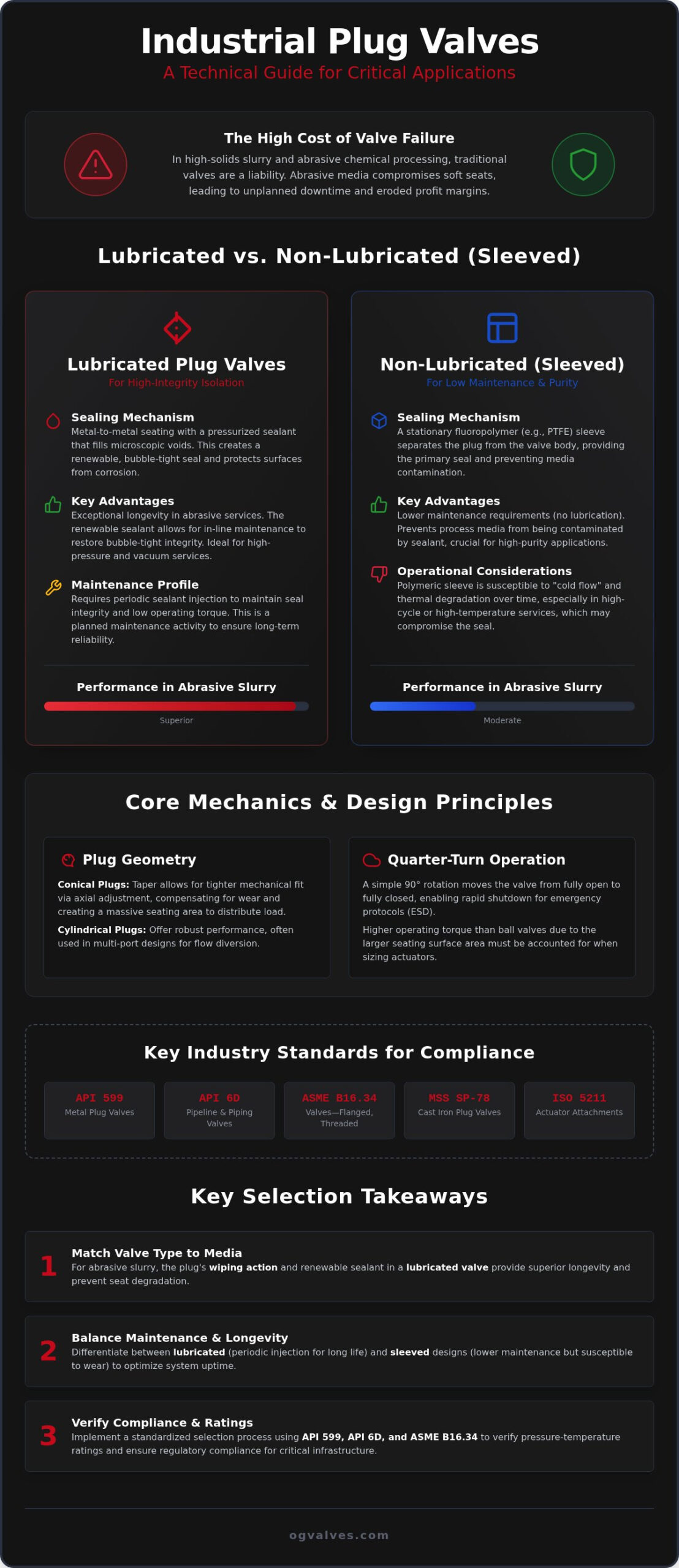
In high-solids slurry handling and abrasive chemical processing, the traditional ball valve is frequently a liability rather than a reliable asset. You’ve likely experienced how abrasive media quickly compromises soft seats, leading to the precise type of unplanned downtime that erodes project margins. When evaluating industrial plug valve applications, the engineering focus must shift from simple flow control to high-integrity isolation under extreme mechanical stress.
This technical guide delivers a comprehensive analysis of plug valve mechanisms, selection criteria, and their critical role in ensuring long-term system reliability. We’ll examine how to maximize operational lifespan in high-cycle environments and ensure strict compliance with API 599 and API 6D standards. By reviewing the latest 2026 regulatory updates, including the revised MSS SP-78 and ISO 5211 standards, you’ll gain the data necessary to select the correct valve type for corrosive or abrasive lines. We’ll conclude with a clinical evaluation of the structural soundness of lubricated versus sleeved designs for critical infrastructure projects where the cost of failure is absolute.
Key Takeaways
- Analyze the mechanical nuances of cylindrical and conical plug geometries to ensure high-integrity isolation in critical infrastructure.
- Differentiate between lubricated and sleeve-lined designs to optimize the balance between maintenance cycles and sealing longevity.
- Master the technical requirements for industrial plug valve applications in abrasive slurry environments where the plug’s wiping action prevents seat degradation.
- Implement a standardized selection process using API 599, API 6D, and ASME B16.34 to verify pressure-temperature ratings and regulatory compliance.
- Maximize system uptime by sourcing high-specification components through global fast-track procurement channels that prioritize material integrity and technical precision.
The Mechanics of Industrial Plug Valves: Design and Functionality
An industrial plug valve is a quarter-turn, high-integrity isolation component designed for rigorous flow control. Unlike other valve types, plug valves utilize a tapered or cylindrical plug that rotates within the valve body to permit or obstruct flow. This design is foundational to many industrial plug valve applications where positive shut-off is non-negotiable. The plug features a bored opening that aligns with the flow path in the open position, providing a direct route for the media. When the plug is rotated 90 degrees, the solid face of the plug completely blocks the channel.
Engineers specify these valves because of their unique seating geometry. The internal plug typically follows either a cylindrical or conical profile. In conical designs, the taper allows for a tighter mechanical fit through axial adjustment, which compensates for seat wear over time. This creates a massive seating area that distributes mechanical load across a wider surface than the line contact found in ball valves. Consequently, the valve body and plug can withstand higher pressure differentials without compromising the integrity of the seal.
The through-port design is another critical mechanical feature. While standard ports are often rectangular to maximize flow area in a compact body, round port designs are available for pigging operations. The port geometry is engineered to manage pressure drop and mitigate flow turbulence, which helps prevent internal erosion in high-velocity systems. This mechanical simplicity ensures that the valve remains functional even in environments where internal debris might jam more complex mechanisms.
Sealing Principles and Bubble-Tight Integrity
Precision-machined metal-to-metal seating provides the primary barrier in lubricated designs. In these configurations, the sealant isn’t merely a lubricant; it’s a structural component of the seal itself. It’s injected under pressure to fill microscopic surface irregularities and ensure bubble-tight integrity. This makes them exceptionally reliable for high-pressure isolation and vacuum services where atmospheric ingress must be prevented. The sealant also serves to protect the machined surfaces from corrosion and debris, extending the component’s operational life.
Quarter-Turn Operation and Actuation Requirements
Operating torque for these units is generally higher than that of industrial ball valves. This is due to the increased friction resulting from the larger seating surface area. When sizing actuators, engineers must account for this breakaway torque, especially in non-lubricated designs where the plug remains in constant contact with a sleeve. Despite the higher torque, the simple 90-degree movement remains the preferred choice for rapid emergency shut-down (ESD) protocols. The speed of a quarter-turn stroke ensures critical isolation occurs within seconds during system failures, providing a level of safety that multi-turn gate valves can’t match.
Lubricated vs. Non-Lubricated Plug Valves: Specification Criteria
The selection between lubricated and non-lubricated designs is a fundamental engineering decision based on process media and maintenance infrastructure. Lubricated plug valves utilize a metal-to-metal seating arrangement where a pressurized sealant fills the interface. Conversely, non-lubricated types employ a stationary sleeve, typically made of fluoropolymers, to separate the plug from the valve body. This choice dictates the long-term reliability of industrial plug valve applications in volatile environments. While lubricated models offer a renewable sealing surface, non-lubricated models prioritize the prevention of media contamination.
Maintenance frequency is the primary trade-off. Lubricated valves require periodic sealant injection to maintain bubble-tight integrity, but they offer superior longevity in abrasive services. Non-lubricated valves are often characterized as low-maintenance, yet the polymeric sleeve is susceptible to cold flow and thermal degradation over time. For high-temperature service, metallurgical requirements for the plug are stringent. Engineers often specify ASTM A494 grade M35-1 or CX2MW to prevent galling against the body or sleeve. These specialized materials ensure the valve maintains its structural soundness when exposed to thermal cycling.
Lubricated Plug Valves for High-Pressure Hydrocarbons
In high-pressure hydrocarbon service, lubricated valves remain the industry standard. The injection of specialized sealant prevents corrosion of the machined surfaces and facilitates smooth rotation under high differential pressures. These valves are critical in “sour” gas environments containing H2S, where the lubricant film provides a sacrificial barrier against sulfide stress cracking. Compliance with API STD 599 ensures the structural integrity of these metal-seated components. The sealant film also performs a self-cleaning function, displacing particulates from the seating surface during every quarter-turn operation.
Non-Lubricated (Sleeve-Lined) Valves for Chemical Processing
Chemical processing plants prioritize the elimination of media contamination. Non-lubricated valves use PTFE or PFA sleeves to provide a low-friction, chemically inert sealing surface. This design is highly effective in corrosive acid service where traditional lubricants would react with the process fluid. While fluoropolymers are excellent for corrosion resistance, their fire-safe performance relies on secondary metal-to-metal contact points that engage if the sleeve fails. For projects requiring high-cycle durability without the need for manual sealant injection, engineers should consult a specialist with a deep industrial valves inventory to ensure correct material matching.

Abrasive media management requires isolation components that maintain integrity despite the presence of suspended solids. In these environments, plug valves are technically superior to industrial gate valves. Standard gate designs feature a bottom pocket where sediment and particulates settle; this accumulation often prevents the wedge from seating fully, leading to persistent bypass. Plug valves eliminate this failure mode because they lack internal cavities where solids can congregate. The quarter-turn rotation provides a mechanical wiping action that clears debris from the seating surface during every cycle. This self-cleaning characteristic is a primary driver for industrial plug valve applications in heavy industrial sectors.
Ball valves present significant risks in slurry service due to the dead space between the ball and the valve body. Solids entrapment in these cavities leads to seat scoring and increased operating torque. Conversely, the plug valve’s design ensures the sealing surfaces remain protected from the flow stream in the open position. For extreme wear resistance, engineers specify hardened plug coatings such as Stellite or tungsten carbide. These overlays provide the necessary surface hardness to withstand the impingement of high-velocity particles without compromising the base metal’s structural soundness.
Mining and Mineral Processing Slurries
Mining operations involve tailings and ore concentrates that exhibit aggressive erosion patterns. High flow velocities in these lines quickly degrade standard isolation components. Utilizing full-bore plug designs minimizes flow turbulence and reduces the localized wear typically seen in restricted-port configurations. These valves also demonstrate superior structural integrity in high-vibration piping systems. The robust, heavy-walled construction of the valve body absorbs mechanical stresses that would cause lighter butterfly or ball valves to fail prematurely.
Pulp and Paper: Handling Fibrous Suspensions
Fibrous suspensions in pulp and paper mills present a unique clogging risk. The plug’s rotation provides a precise shear action that cuts through fibrous media, ensuring a clean shut-off where other valves might bridge. While knife gate valves are frequently used in these lines, plug valves offer more reliable bidirectional isolation and better protection against atmospheric leakage. Material selection is critical here; unbleached pulp lines often utilize standard carbon steel with hardened trims, whereas bleached pulp environments require high-alloy stainless steels or duplex materials to resist chemical corrosion from residual bleaching agents.
Selection Parameters: Standards, Materials, and Flow Characteristics
Engineering selection for industrial plug valve applications is a data-driven process that prioritizes regulatory compliance and material integrity. Failure to align valve specifications with process conditions leads to accelerated seat degradation or catastrophic pressure boundary failure. Procurement specialists must follow a structured five-step verification sequence to ensure system safety:
- Step 1: Identify the applicable industry standard. API 599 is the primary design standard for steel plug valves, while API 6D governs valves used in pipeline service.
- Step 2: Determine the pressure-temperature rating. Engineers must consult ASME B16.34 tables to verify the maximum allowable working pressure (MAWP) at the system’s peak operating temperature.
- Step 3: Select body and plug materials. Common choices include Carbon Steel (WCB/LCC), Stainless Steel (CF8M), or Super Duplex for high-chloride environments.
- Step 4: Evaluate the flow coefficient (Cv). It’s essential to calculate potential pressure drops and assess the risk of cavitation in high-velocity liquid lines.
- Step 5: Verify fire-safe certification. For hazardous or flammable media, valves must meet API 607 or API 6FA requirements to ensure they maintain isolation during a fire event.
For projects requiring verified API 599 compliance and rigorous quality control, procurement teams can source high-specification plug valves through our global inventory.
Understanding API 599 and API 6D Compliance
API 599 specifies the design, materials, and face-to-face dimensions for metal plug valves. It ensures that the valve’s structural soundness meets the demands of heavy industrial service. In contrast, API 6D focuses on the specific testing and quality protocols required for pipeline isolation components. This includes mandatory hydrostatic and pneumatic shell tests. For critical systems, material traceability is non-negotiable. Manufacturers must provide Mill Test Reports (MTRs) for all pressure-retaining components to confirm chemical composition and mechanical properties align with the specified ASTM standards.
Material Selection for Corrosive Environments
Offshore and marine applications necessitate materials with high pitting resistance equivalent numbers (PREN). Super Duplex and Monel are frequently specified for these high-chloride environments to prevent localized corrosion. In sour gas service, compliance with NACE MR0175/ISO 15156 is mandatory to mitigate the risk of sulfide stress cracking. Beyond chemical resistance, engineers must analyze the impact of thermal expansion. In non-lubricated designs, the difference in expansion rates between the metallic plug and the fluoropolymer sleeve can alter clearances, potentially increasing operating torque or compromising the seal at elevated temperatures.
The procurement of high-specification components represents the final critical phase in ensuring the operational safety of heavy industrial systems. For industrial plug valve applications in the oil, gas, and power sectors, sourcing must be conducted through a specialist with a comprehensive industrial valves inventory. This ensures that the components aren’t just available but also verified against the precise metallurgical and mechanical requirements of the project. Technical expertise at the procurement level acts as a safeguard against material failure, particularly when dealing with the high-chloride or sour environments where standard alloys would succumb to rapid degradation.
Quality assurance protocols are the foundation of high-stakes procurement. Every valve should undergo rigorous verification, including Positive Material Identification (PMI) testing to confirm chemical composition and hydrostatic pressure verification to ensure shell and seat integrity. These clinical testing measures eliminate the risk of atmospheric leakage or internal bypass once the unit is integrated into the infrastructure. In an era of global supply chain volatility, the ability to secure fast-track delivery is essential. Minimizing facility downtime during unplanned maintenance or emergency shut-down events requires a partner capable of navigating complex international logistics with precision.
Technical Support and Specification Verification
Specialist suppliers provide more than just stock; they offer the technical oversight necessary to verify complex datasheets against international standards like API 599 and API 6D. This proactive approach includes managing inventory for long-lead-time alloys, such as Super Duplex or Hastelloy, which are often unavailable through generalist vendors. Ensuring every component meets global regulatory benchmarks prevents the project disqualification that stems from non-compliance. This technical alignment is vital for industrial plug valve applications where a single mismatched specification can lead to catastrophic failure.
Global Supply Chain and Logistics Excellence
Large-scale petrochemical and power projects require a methodical approach to logistics. Managing the extensive documentation for international customs and site-specific compliance is a core competency of an established global supplier. This includes the provision of full material traceability and inspection documents as mandated by updated 2026 regulations like TSG 92. For technical experts requiring precision-engineered components for high-integrity isolation, requesting a technical consultation for specialised valve needs is the standard protocol for initiating a secure procurement cycle.
Optimizing Long-Term Isolation Integrity
The technical landscape for industrial plug valve applications in 2026 demands a rigorous focus on material compatibility and regulatory compliance. We’ve examined the mechanical advantages of the quarter-turn plug design, specifically its ability to maintain bubble-tight isolation in abrasive slurry and corrosive hydrocarbon lines where other valves fail. Adhering to API 599 and API 6D standards is no longer optional; it’s the baseline for ensuring structural soundness in critical infrastructure.
Operational excellence requires more than just high-spec hardware. It necessitates a procurement strategy anchored in technical expertise and global logistics precision. By utilizing specialist support to verify complex datasheets and sourcing from an extensive, API-certified inventory, you can mitigate the risks of seat degradation and unplanned downtime. Our commitment to global fast-track delivery ensures that your facility maintains peak output without the delays often associated with long-lead-time alloys.
Ensure your next project benefits from proven engineering excellence and clinical quality control. Request a Technical Quote for Industrial Plug Valves to secure reliable isolation solutions for your heavy industrial requirements. It’s the most direct path to maximizing the operational lifespan of your critical piping systems.
Frequently Asked Questions
What is the difference between a plug valve and a ball valve for isolation?
Plug valves prioritize high-integrity isolation through a larger seating surface area compared to the line contact found in ball valves. While ball valves feature internal cavities that trap debris, the plug valve design eliminates these dead spaces. This makes them significantly more reliable for industrial plug valve applications involving suspended solids or slurries. The robust metal-to-metal contact in lubricated designs also provides superior durability in high-pressure hydrocarbon service.
Are plug valves suitable for throttling applications in industrial systems?
Plug valves aren’t recommended for throttling applications. They’re engineered specifically for full-open or full-closed isolation service. Partial opening exposes the seating surfaces to high-velocity flow and localized erosion, which quickly compromises the valve’s ability to achieve a bubble-tight seal. For flow regulation, globe or needle valves are the technically correct specifications. Using a plug valve for throttling leads to premature component failure and increased maintenance costs in critical systems.
Which API standards govern the design of industrial plug valves?
The primary industry standards include API 599 for the design and materials of metal plug valves and API 6D for valves used in pipeline infrastructure. ASME B16.34 is also essential for determining pressure-temperature ratings and wall thickness requirements. Compliance with these benchmarks ensures that components meet the structural soundness and safety protocols necessary for heavy industrial service. All inventory at OG VALVES LTD. is verified against these international regulatory standards.
How often do lubricated plug valves require sealant injection?
Maintenance intervals for sealant injection vary based on operational cycle frequency and media abrasiveness. High-cycle valves in abrasive slurry service might require weekly injection to maintain the sacrificial lubricant film. Conversely, valves in clean gas service may only require attention during annual turnarounds. Regular injection ensures the sealant acts as a structural component of the seal, protecting machined surfaces from corrosion while reducing the torque required for quarter-turn operation.
Can plug valves handle slurries with high solids content?
High-solids slurries are a core strength for this valve type. The quarter-turn movement provides a mechanical wiping action that clears particulates from the seating surfaces during every cycle. Because the design lacks the internal pockets found in gate or ball valves, there’s no space for solids to accumulate and jam the mechanism. This reliability is why they’re the preferred choice for mining tailings and pulp suspensions in industrial plug valve applications.
What materials are best for plug valves in corrosive chemical service?
Material selection depends on the specific chemical profile and operating temperature. For high-chloride or marine environments, Super Duplex and Monel provide excellent pitting resistance. In sour service, NACE MR0175 compliance is mandatory to prevent sulfide stress cracking. Non-lubricated designs often utilize PTFE or PFA sleeves to provide a chemically inert barrier between the plug and the body. This prevents galling and ensures the valve remains operational in aggressive acid service.
What are the main advantages of a non-lubricated plug valve?
Non-lubricated plug valves utilize a fluoropolymer sleeve to eliminate the risk of media contamination from sealants. This design is highly advantageous in chemical processing where process purity is critical. It also reduces routine maintenance requirements because there’s no need for periodic sealant injection. The low-friction sleeve ensures consistent operating torque throughout the valve’s life; however, it’s susceptible to cold flow if operated beyond its specified temperature and pressure limits.
How does the cost of a plug valve compare to other isolation valves?
Initial capital expenditure for plug valves is typically higher than for standard gate or ball valves. This cost reflects the precise machining required for the plug and body interface and the use of heavy-walled castings for structural integrity. Despite the higher upfront price, the total cost of ownership is often lower in abrasive or corrosive environments. These valves offer a significantly longer operational lifespan and lower failure rates compared to cheaper alternatives.
 Responsive Menu