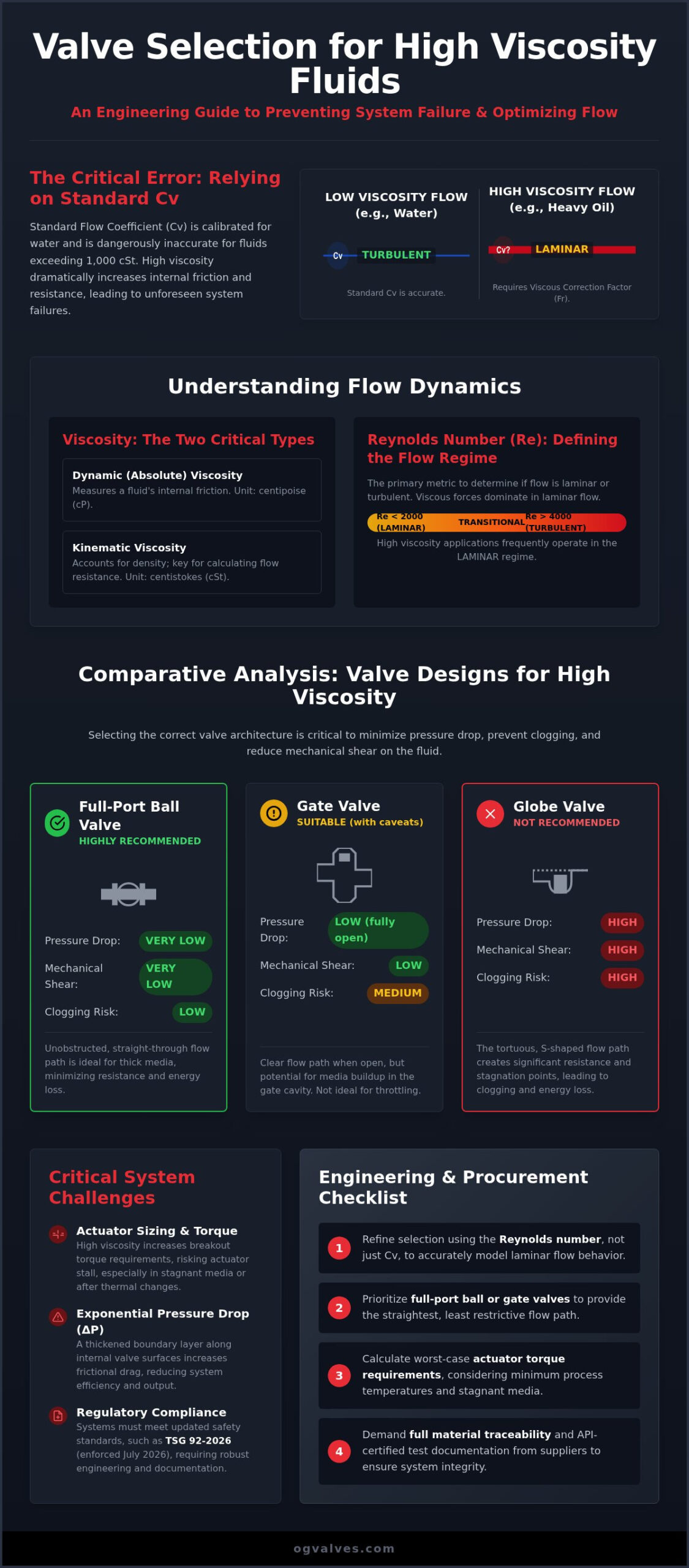
Relying solely on the standard flow coefficient (Cv) is a critical technical error when engineering systems for media exceeding 1,000 cSt. In high-stakes industrial environments, traditional metrics for fluid dynamics often fail to account for the increased mechanical shear and laminar flow resistance inherent in thick media. You understand that valve selection for high viscosity fluids is not merely a procurement task; it is a rigorous engineering requirement to prevent actuator stall and internal clogging. Without a precise match between the valve architecture and the fluid rheology, your system remains vulnerable to unforeseen torque requirements and significant energy loss.
This guide provides a clinical framework for selecting industrial valves that maintain operational output while adhering to the latest safety standards, including the TSG 92-2026 regulations enforced as of July 2026. You’ll master the technical criteria for evaluating full-bore gate, ball, and plug valves to minimize pressure drops and ensure long-term structural soundness. We examine specific material classifications and the fluid dynamics necessary to reduce maintenance downtime and optimize total system efficiency in heavy industrial sectors. This analysis ensures your infrastructure meets the 2026 benchmarks for industrial safety and engineering excellence.
Key Takeaways
- Distinguish between absolute and kinematic viscosity to accurately model fluid behavior in industrial piping systems.
- Refine valve selection for high viscosity fluids by utilizing the Reynolds number to determine the transition to laminar flow.
- Evaluate full-port ball valves and gate valves to identify the optimal architecture for minimizing mechanical shear and pressure drop.
- Establish precise actuator sizing and breakout torque requirements for valves operating in stagnant or high-drag viscous media.
- Secure system integrity by prioritizing suppliers that provide full material traceability and API-certified test documentation.
Viscosity represents a fluid’s internal resistance to flow, a parameter that dictates the efficiency and safety of industrial piping systems. For engineers, understanding the Fundamentals of Viscosity requires a precise distinction between dynamic (absolute) viscosity, measured in centipoise (cP), and kinematic viscosity, measured in centistokes (cSt). While dynamic viscosity measures internal friction, kinematic viscosity accounts for the fluid’s density, making it the primary metric for calculating flow resistance in pressurized systems. In heavy industrial sectors, these values are rarely static and fluctuate based on pressure and thermal conditions.
As viscosity increases, the flow regime shifts from turbulent to laminar. In standard water-based applications, turbulence aids in maintaining velocity across the valve orifice. However, in viscous media, the Reynolds number frequently drops below 2,000, signifying a laminar state where viscous forces dominate inertial forces. This shift renders standard flow coefficients (Cv) inaccurate. Since Cv values are calibrated using water at 60°F, valve selection for high viscosity fluids must incorporate a viscous correction factor (Fr) to prevent undersizing. Failure to apply this technical correction results in excessive pressure drops and reduced operational output.
Rheology and Flow Characteristics
Fluid behavior under shear stress defines its rheological classification and determines how it interacts with valve internals. Newtonian fluids, such as refined oils, maintain constant viscosity regardless of the shear rate. Conversely, non-Newtonian fluids exhibit variable viscosity; shear-thinning fluids become less viscous under stress, while shear-thickening fluids pose significant risks to valve components. When performing valve selection for high viscosity fluids, engineers must calculate the shear rate at the valve seat. High shear stress can lead to localized heating or mechanical degradation of the media, while the viscous flow correction factor ensures the valve remains within its optimal performance curve during throttling operations.
Critical Challenges in High-Viscosity Systems
The primary engineering hurdle is the exponential increase in pressure drop (Delta P) across the valve body. In high-viscosity applications, the boundary layer—the fluid layer in contact with the valve’s internal surfaces—thickens, increasing frictional drag. This effect can lead to media stagnation in tortuous flow paths, such as those found in globe valves. It’s a common cause of internal clogging. Additionally, the mechanical strain on valve stems and seats increases as the actuator fights against fluid resistance. Temperature fluctuations exacerbate these issues. A minor decrease in process temperature can cause viscosity to rise sharply, potentially leading to actuator stall or seat failure if the initial engineering specification didn’t account for worst-case thermal scenarios.
Evaluating Flow Dynamics: Pressure Drop and Reynolds Number
The Reynolds number (Re) serves as the primary dimensionless metric for determining the flow regime within a piping system. In applications involving thick media, Re values frequently fall below 2,000, indicating a transition into the laminar flow regime. This shift is critical during valve selection for high viscosity fluids because it dictates how the internal geometry of a valve interacts with the media. In pressurized industrial systems, the pressure drop across a valve orifice increases proportionally with the fluid’s kinematic viscosity due to heightened internal friction and boundary layer drag.
While cavitation is a well-documented risk in high-velocity water systems, its behavior in viscous media is distinct. High viscosity can dampen the energy of collapsing vapor bubbles, potentially reducing mechanical erosion. However, the risk of flashing remains high if the pressure recovery after the valve vena contracta is insufficient. Engineers must evaluate the pressure recovery factor (FL) alongside viscosity to ensure structural integrity. Streamlined flow paths are essential to mitigate these dynamic risks and maintain operational output.
The Reynolds Number (Re) Threshold
The laminar flow regime, defined by Re < 2000, fundamentally alters the performance of standard valve architectures. In this state, the fluid moves in parallel layers with a parabolic velocity profile, which maximizes frictional contact with the valve walls. Standard globe valves are particularly ill-suited for these conditions. Their tortuous flow paths force multiple direction changes, causing the Reynolds number to drop further and leading to massive energy loss. This phenomenon invalidates standard control valve characteristic curves, often resulting in unpredictable throttling behavior that compromises system precision.
Pressure Drop Calculations for Viscous Media
Accurate sizing for thick media requires the application of a viscosity correction factor to the standard Cv equation. This factor accounts for the energy required to overcome the fluid’s internal shear. Full-bore designs are the technical benchmark for these applications because they provide an unobstructed flow path. Consider a comparative scenario: an API 600 gate valve provides a straight-through bore that minimizes frictional resistance. In contrast, a globe valve of identical size processing a 2,500 cSt fluid can exhibit a pressure drop significantly higher than the gate valve due to its internal obstructions. It’s vital to evaluate industrial valve standards before finalizing your procurement specifications to ensure system efficiency.
Comparative Analysis of Valve Designs for High Viscosity
Successful valve selection for high viscosity fluids depends on identifying a geometry that minimizes internal turbulence and mechanical shear. While globe and needle valves are standard for precise throttling, they’re generally unsuitable for viscous service. Their internal flow paths force the media through multiple 90-degree turns. This geometry causes excessive frictional losses and creates stagnation zones where thick media can solidify or trap particulates. In heavy industrial sectors, engineers prioritize straight-through designs to maintain operational output and system pressure.
Ball Valves and Flow Efficiency
The full-port ball valve is the technical benchmark for viscous media. Its piggable design provides an unobstructed flow path that mirrors the pipe’s internal diameter. When handling thick fluids, engineers must choose between floating and trunnion-mounted configurations. Floating designs rely on upstream pressure to push the ball against the downstream seat. This often results in excessive breakout torque as viscosity increases. Trunnion-mounted valves utilize fixed bearings to support the ball, which reduces the load on the seats and lowers the torque required from the actuator. Seat material selection is critical to prevent media buildup. Metal-seated designs are frequently specified for high-temperature viscous service to ensure structural soundness and positive shut-off.
Gate and Plug Valve Applications
Gate valves provide a straight-through bore that eliminates the pressure drop issues common in tortuous flow paths. Knife gate valves are specifically engineered for highly concentrated viscous slurries. Their sharpened gate edge shears through thick media and particulates to ensure a clean seal. For applications involving heavy solids or abrasive viscous media, plug valves offer a robust alternative. The large seating surface area of a plug valve resists wear better than a standard ball or gate valve in high-cycle environments.
In specific services, certain butterfly valves are employed if the disc profile is optimized to minimize drag. The self-cleaning action of the disc during rotation can prevent media accumulation in moderate viscosity chemical applications. However, for fluids exceeding 1,000 cSt, the full-bore ball or gate design remains the superior choice for reducing maintenance downtime. Every selection must align with API 6D or API 600 standards to ensure compliance with global industrial benchmarks.
Technical Specification: Actuation, Sizing, and Material Integrity
Engineering valve selection for high viscosity fluids requires a shift from standard torque tables to dynamic calculation models that account for fluid drag. In stagnant viscous media, the fluid’s adhesive properties create a “stiction” effect. This is where the force required to initiate movement, known as breakout torque, significantly exceeds the steady-state run torque. While conventional valves often fail when media exceeds 850 cP, high-specification industrial designs utilize specialized seating architectures to maintain functionality. Adherence to ASME B16.34 and API 6D is mandatory. These standards ensure the pressure-containing components can withstand the elevated mechanical stresses inherent in viscous service.
Actuation Torque Requirements
Actuators must be sized with a rigorous safety factor, typically ranging from 1.5 to 2.0, to account for unforeseen viscosity spikes. Pneumatic and electric actuators must overcome both the mechanical friction of the valve assembly and the massive shear resistance of the media. This is especially critical for emergency shutdown (ESD) systems. The valve must close reliably within a specified time frame despite the resistance of thick petrochemical or polymer media. Actuator stall is a common failure point in poorly specified systems. The integration of digital intelligence in smart valves now allows for predictive maintenance. These systems can alert operators to torque increases up to six months before a critical failure occurs. It’s a vital feature for maintaining operational output and system safety.
Material Selection and Surface Treatments
Viscous fluids frequently carry abrasive particulates that necessitate advanced surface treatments to prevent erosion of the sealing surfaces. Hard-facing techniques, such as applying Stellite or Tungsten Carbide overlays, provide the hardness to resist mechanical wear. In petrochemical environments, corrosion resistance is equally vital. Procurement specialists should utilize Positive Material Identification (PMI) to verify that all components meet the exact metallurgical specifications. The 2026 enforcement of TSG 92-2026 regulations emphasizes the need for full material traceability and rigorous inspection reports for all pressure-bearing equipment. This clinical focus on material integrity is a cornerstone of effective valve selection for high viscosity fluids, preventing premature failure and reducing maintenance downtime. To ensure your project meets these global standards, you should consult with OG VALVES for technical support regarding API-certified components and material specifications.
Procurement for heavy industrial infrastructure requires a vendor capable of translating complex rheological data into reliable hardware specifications. Effective valve selection for high viscosity fluids extends beyond the initial design phase; it necessitates a supply partner with deep technical expertise in industrial valves and global regulatory landscapes. In an environment where raw material and logistics costs rose by 5% to 8% in the second quarter of 2026, securing a dependable supply chain is essential for project viability and operational output. A partner that understands the mechanical nuances of high-torque actuation and laminar flow dynamics reduces the risk of costly engineering errors. A vendor that doesn’t provide full material traceability fails to meet modern safety benchmarks.
Technical Support and Procurement
Engineering support is the foundation of successful procurement in high-viscosity applications. Specialists must evaluate process conditions against international benchmarks to ensure component longevity. This includes navigating the 2026 enforcement of TSG 92-2026 standards, which mandates unified supervision for emergency shut-off valves and full traceability of pressure-bearing equipment. Strategic inventory management is the primary mechanism for ensuring minimal downtime. By maintaining an extensive inventory of API-certified components, OG VALVES LTD. provides the fast-track delivery necessary to mitigate the impact of regional geopolitical tensions and supply chain fluctuations. This technical authority ensures that procurement specialists receive components that meet the exact requirements of oil, gas, and chemical sectors.
Quality Assurance and Certification
Validation of valve integrity for viscous service relies on comprehensive documentation and rigorous testing protocols. You must prioritize components that carry EN 10204 3.1 or 3.2 certification, providing verified chemical and mechanical properties for every pressure-containing part. Pressure testing, conducted in accordance with API 598 or ISO 5208, is critical to ensure zero leakage in high-viscosity media where seat loads are extreme. These clinical quality assurance measures position OG VALVES as a benchmark for industrial safety and engineering standards. The next logical step for technical experts is to request a detailed technical quotation. This ensures that every specification, from material overlays to actuator sizing, aligns with the clinical requirements of your complex viscous system.
Optimising Infrastructure for 2026 Industrial Standards
Achieving system efficiency in complex viscous environments requires a departure from standard flow metrics toward a clinical evaluation of rheological properties and mechanical shear. Successful valve selection for high viscosity fluids depends on the precise integration of full-bore architectures and accurately sized actuation systems capable of overcoming stiction. Adhering to API and ASME benchmarks ensures your infrastructure maintains structural integrity under the most demanding laminar flow conditions. We’ve established that selecting the correct material overlays and surface treatments is the primary defense against erosion in abrasive media.
As global industrial standards tighten, partnering with a supplier that maintains an extensive inventory of high-specification industrial valves is essential for project continuity. OG VALVES LTD. provides the technical expertise in material specifications and global logistics capability required to minimize downtime in heavy industrial sectors. We invite you to Request a Technical Quote for High-Viscosity Valve Solutions to ensure your next project benefits from our fast-track delivery and unwavering engineering precision. Your commitment to technical excellence ensures the long-term reliability of your critical infrastructure.
Frequently Asked Questions
What is the maximum viscosity a standard ball valve can handle?
Standard floating ball valves typically encounter operational limits around 850 cP to 1,000 cP due to excessive seat friction. Beyond this range, trunnion-mounted ball valves are required to support the ball independently. These high-specification designs can handle media exceeding 2,500 cSt when paired with appropriate actuators. The exact limit depends on the seat material and the available torque from the actuation system to overcome internal fluid resistance.
How does temperature affect the selection of valves for high viscosity fluids?
Temperature inversely affects viscosity; a decrease in process temperature causes a logarithmic increase in fluid thickness. This thermal sensitivity is a critical factor in valve selection for high viscosity fluids. If temperatures drop below the design point, the resulting viscosity spike can cause actuator stall or stem failure. Engineers must specify metal seats or high-temperature elastomers to ensure structural soundness across the entire operational thermal range.
Why do viscous fluids require higher actuation torque?
Viscous fluids require higher torque because they exert greater frictional drag on the moving internal components and create stiction at the sealing surfaces. The actuator must overcome the shear resistance of the media and the breakout torque required to move a valve that’s been stagnant. Sizing calculations must include a safety factor of 1.5 to 2.0 to ensure reliable operation under worst-case viscosity conditions and prevent mechanical failure.
Can check valves be used in high-viscosity piping systems?
Check valves can be utilized, but standard swing check designs often suffer from delayed closing or slamming in thick media. Viscous drag prevents the disc from responding quickly to flow reversals. Piston-style or nozzle check valves with heavy spring assistance are preferred for these applications. These designs ensure a positive shut-off and prevent backflow despite the high internal resistance of the fluid layers in laminar flow regimes.
What is the difference between Newtonian and non-Newtonian fluids in valve sizing?
Newtonian fluids maintain a constant viscosity regardless of the shear rate, making pressure drop calculations predictable. Non-Newtonian fluids change viscosity when subjected to mechanical stress within the valve orifice. Sizing for non-Newtonian service requires calculating the apparent viscosity at the specific shear rate of the valve. This complexity is essential for accurate valve selection for high viscosity fluids in chemical processing where shear-thinning or shear-thickening behaviors occur.
When should a full-bore design be prioritised over a standard port valve?
Full-bore designs should be prioritized whenever the fluid viscosity exceeds 1,000 cSt or when the media contains suspended solids. A standard port valve introduces a restriction that creates a significant pressure drop and promotes laminar flow stagnation. Full-bore ball and gate valves provide an unobstructed path that mirrors the pipe’s internal diameter. This minimizes frictional energy loss and reduces the risk of internal clogging in tortuous flow paths.
What materials are best for abrasive viscous slurries?
Abrasive viscous slurries require hard-faced materials to resist erosion of the sealing surfaces. Tungsten Carbide or Stellite overlays are the industry standard for protecting ball and seat assemblies. For the valve body, high-alloy steels like Duplex or Super Duplex provide the necessary structural integrity and corrosion resistance. Positive Material Identification (PMI) is mandatory to verify that these components meet the rigorous API 6D or API 600 standards for industrial safety.
How is the flow coefficient (Cv) corrected for high viscosity?
The flow coefficient is corrected by applying a viscous flow correction factor (Fr) to the standard sizing equation. Since Cv is calibrated using water, it doesn’t account for the energy lost to internal fluid friction in laminar regimes. Engineers calculate the Reynolds number to determine the Fr value. This correction prevents the common error of undersizing valves, ensuring the system maintains the required operational output under thick flow conditions without excessive pressure drops.
 Responsive Menu