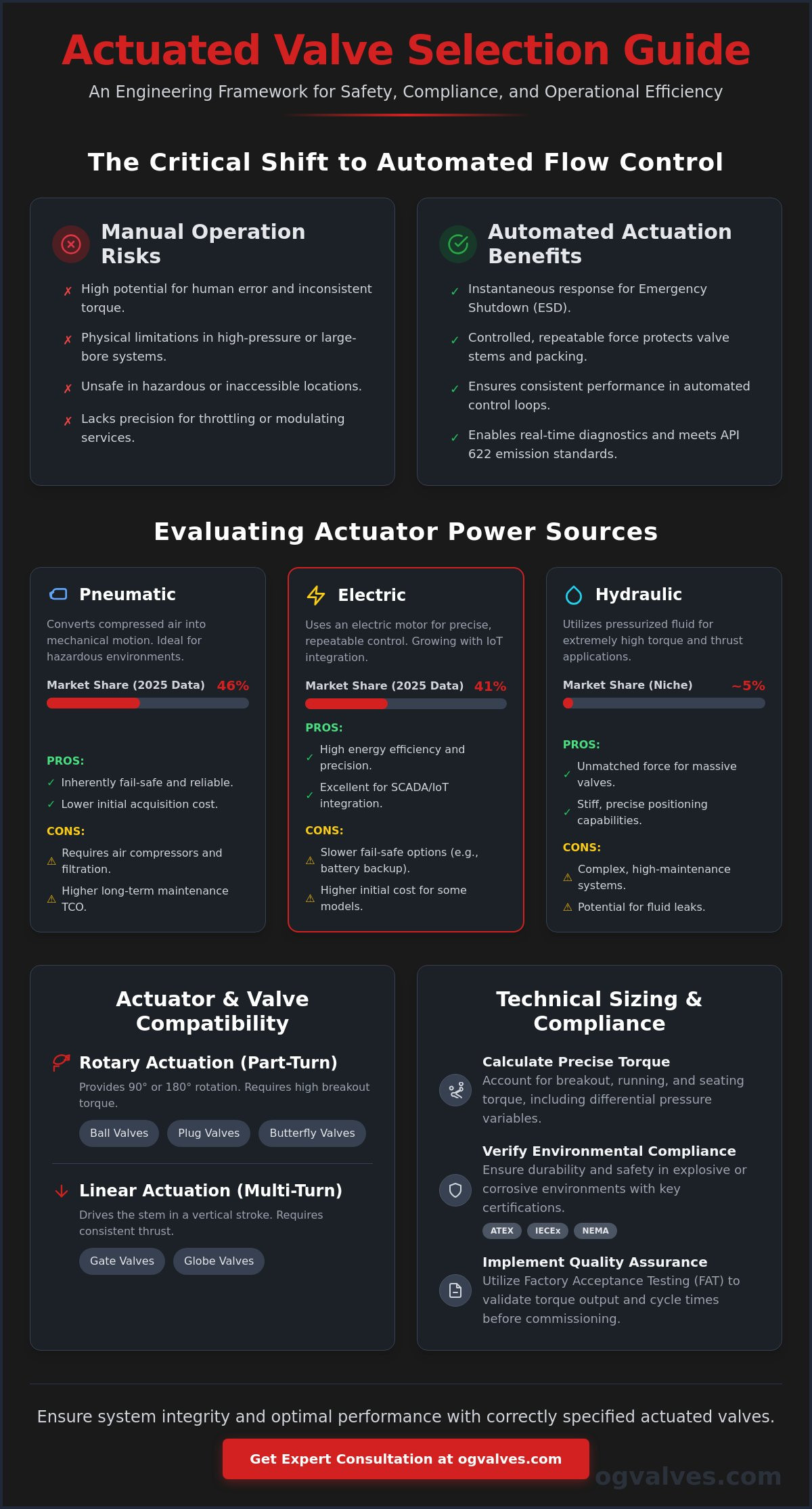
Actuator reliability isn’t a product feature; it’s a calculated output of torque synchronization, environmental hardening, and duty cycle matching. Inaccurate torque sizing remains a primary cause of valve stem damage and catastrophic system failure in high-pressure industrial applications. This actuated valve selection guide provides the technical framework necessary to mitigate these risks through rigorous engineering data. You’re likely aware that unplanned downtime and regulatory non-compliance in explosive atmospheres aren’t just operational hurdles; they’re liabilities that threaten the integrity of critical infrastructure. We’ll provide a comprehensive engineering framework for specifying and sizing actuators that meet the 2026 updates for ISO 5210 and ISO 5211. This article details the integration of intelligent electric actuators, adherence to API 622 fugitive emission standards, and the precise calculation of safety factors for automated assemblies. By following this methodology, you’ll ensure documented compliance with ASME B16.34 requirements and optimize maintenance cycles for long-term operational output in volatile procurement landscapes.
- Understand the transition from manual to automated isolation and the critical role of actuation in emergency shutdown (ESD) and remote operations.
- Compare pneumatic, electric, and hydraulic power sources to align actuator performance with specific SCADA integration requirements and fail-safe reliability.
- Utilize this actuated valve selection guide to calculate precise breakout, running, and seating torque values while accounting for differential pressure variables.
- Verify compliance with ATEX, IECEx, and NEMA standards to ensure equipment durability and safety in explosive or corrosive industrial environments.
- Implement Factory Acceptance Testing (FAT) protocols to validate torque output and cycle times before final site commissioning of the valve-actuator package.
The transition from manual isolation to automated flow control represents a critical shift in industrial safety and operational efficiency. Manual valve operation introduces human error risks and physical limitations, particularly in high-pressure or large-bore systems. A Valve actuator serves as the primary mechanism for remote operation, allowing for instantaneous response in emergency shutdown (ESD) scenarios. Beyond safety, automation ensures that industrial valves maintain consistent performance within complex automated control loops. This actuated valve selection guide emphasizes that the actuator does more than just move the valve; it dictates the mechanical longevity of the valve stem and packing. By applying controlled, repeatable force, actuators eliminate the side-loading and excessive torque often associated with manual levers. Controlled mechanical force reduces the risk of packing leaks, which is essential for meeting the 2026 fugitive emission requirements outlined in API 622.
Automated vs. Manual: When to Specify Actuation
Specifying actuation is mandatory when operational frequency exceeds the capacity of manual labor or when valves are located in inaccessible or hazardous zones. Engineers must identify torque thresholds where manual handwheels become impractical or unsafe for a single operator. For throttling or modulating services, manual control lacks the precision required to maintain stable process variables. Actuation provides the necessary resolution for fine-tuned adjustments in high-stakes environments. It’s essential to evaluate the duty cycle; high-frequency cycling rapidly degrades manual components, whereas a properly sized actuator manages these stresses through engineered mechanical advantage. In 2026, the shift toward intelligent electric actuators also allows for real-time diagnostics, providing data that manual valves cannot generate.
Compatibility with Primary Valve Architectures
Actuator selection depends heavily on the mechanical movement of the valve. Industrial ball valves and plug valves require rotary actuation, typically 90-degree part-turn movements. In contrast, gate and globe valves utilize linear actuators to drive the stem through its vertical stroke. Large-diameter butterfly valves present unique challenges, often requiring high-torque output to overcome high differential pressures and seating friction. Each architecture demands a specific torque profile; for instance, ball valves require high breakout torque, while globe valves require consistent thrust to maintain a tight seal against high backpressure. Proper synchronization between the actuator and the valve architecture prevents premature component wear and ensures seat integrity over thousands of operational cycles. Failure to match the actuator’s output to the valve’s specific torque curve often leads to sheared stems or damaged seats.
Selecting the correct motive force is a foundational step in any actuated valve selection guide. Engineers must balance operational speed, fail-safe requirements, and existing infrastructure availability. Data from 2025 indicates that pneumatic systems maintain a dominant 46% market share, largely due to their inherent safety and reliability in hazardous zones. Electric actuators follow at 41%, seeing rapid adoption as industrial IoT integration becomes a standard requirement for digital plant architectures. Hydraulic systems serve a niche but vital role, providing the extreme force required for massive valve assemblies where pneumatic or electric alternatives lack the necessary thrust. A technical Total Cost of Ownership (TCO) analysis reveals that while pneumatic units have lower initial acquisition costs, the long-term maintenance of air compressors and filtration systems often offsets these savings. Electric units offer higher energy efficiency and lower installation costs in remote areas where running air lines is geographically impractical.
Pneumatic Actuators: Scotch Yoke vs. Rack and Pinion
Pneumatic designs convert compressed air into mechanical torque using two primary architectures. Scotch yoke actuators generate a non-linear torque curve, peaking at the start and end of the stroke. This profile is specifically engineered for valves requiring high breakout torque, such as large-diameter ball valves. Rack and pinion actuators provide a linear torque output, making them the preferred choice for compact installations and smaller bore sizes. Reliability hinges on the selection of fail-safe mechanisms. Spring-return configurations provide a mechanical guarantee of a “fail-open” or “fail-closed” position upon loss of air pressure. It’s critical to ensure high air supply quality; contaminated or wet air quickly degrades solenoid valves and internal seals, leading to premature failure. Technical teams should verify that their chosen power source aligns with the specific torque requirements of their industrial ball valves to prevent mechanical failure.
Electric Actuation: The Move Toward Digital Plants
The industry is seeing a significant shift toward intelligent electric actuators, which are projected to grow at a CAGR of 8.44% through 2031. These units provide unmatched positioning accuracy for modulating globe valves in complex control loops. Modern electric designs have overcome previous fail-safe limitations through the use of high-capacity battery backups or supercapacitors. The primary driver for this adoption is the ability to extract high-fidelity diagnostic data. Integrated sensors monitor motor temperature, cycle counts, and torque profiles in real time. This information feeds directly into SCADA systems, allowing for predictive maintenance that targets components before they reach their failure threshold. Adherence to ISO 5210:2026 and ISO 5211:2026 ensures these actuators interface seamlessly with standardized valve mounting flanges across global supply chains. This compatibility is essential for maintaining the integrity of automated assemblies in high-stakes environments.

Precise torque calculation is the cornerstone of a reliable actuated valve selection guide. Torque requirements aren’t static; they fluctuate throughout the valve’s stroke. Engineers must define three specific values: Breakout Torque (BTO), the force required to move the valve from its seated position; Running Torque (RUN), the dynamic force required during travel; and Seating Torque (ETO), the final force needed to ensure a bubble-tight seal. Differential pressure (ΔP) acts as the primary external variable. High ΔP increases the friction between the closure member and the seat, necessitating a proportional increase in actuator output. If the sizing ignores these dynamic fluctuations, the assembly will likely fail under peak load conditions, leading to incomplete closure or delayed response times in critical loops.
Media Effects on Torque Requirements
The physical properties of the process media significantly alter the friction coefficients within the valve. Slurry and abrasive media create a “sandpaper effect” that increases seating torque as particles accumulate on the sealing surfaces. High-temperature applications introduce thermal expansion, which tightens clearances and increases the force required for operation. Stiction, or static friction, is another critical factor for valves that remain idle for long durations. In these cases, the breakout torque can exceed nominal ratings by 50% or more. Engineering specifications must account for these variables to prevent the actuator from stalling during an essential cycle.
Standardized Calculation Framework
A methodical approach to sizing ensures that the valve-actuator package operates within its mechanical limits while maintaining a necessary buffer for environmental changes. Follow these four steps for accurate specification:
- Step 1: Determine the maximum operating pressure and the worst-case differential pressure across the valve.
- Step 2: Reference the manufacturer’s base torque data for the specific valve model and material classification.
- Step 3: Apply multipliers for media type (e.g., dry gas vs. viscous fluids) and operational temperature extremes.
- Step 4: Select an actuator that provides a minimum 25-30% safety margin above the calculated peak torque.
Environmental hardening is a technical necessity that ensures the reliability of automated assemblies in harsh climates. A comprehensive actuated valve selection guide prioritizes Ingress Protection (IP) ratings to mitigate the risk of internal component failure due to moisture or particulate contamination. In offshore or coastal facilities, IP67 or IP68 enclosures are standard requirements. These ratings represent a clinical baseline for equipment longevity. Fire-safe certifications also play a critical role. Actuators in safety-critical loops must remain operational during thermal emergencies to execute fail-safe commands. This performance is often achieved through specialized intumescent coatings or thermal shielding that protects the internal drive mechanism from extreme heat flux.
Explosive Atmospheres and Spark Prevention
Explosive atmospheres require strict adherence to global spark prevention standards. Engineers must distinguish between Zone 0, 1, and 2 classifications to select the appropriate protection method. Flameproof (Ex d) enclosures are engineered to contain an internal ignition, preventing it from migrating to the external environment. Intrinsic safety (Ex i) takes a different approach by limiting electrical energy to levels insufficient for ignition. Certification from ATEX, IECEx, or NEMA is the primary validator for these systems. Documentation must be verified during the procurement phase to ensure compliance with local safety regulations and insurance requirements. Failure to match the certification to the specific hazardous zone can result in immediate regulatory non-compliance and elevated site risk.
Severe Service Environments
Severe service environments necessitate advanced material selection for actuator housings. Coastal and offshore projects typically specify C5-M high-durability epoxy coatings or full 316 stainless steel construction to prevent galvanic corrosion. Temperature extremes also dictate internal hardware specifications. Arctic deployments require specialized low-temperature seals and thermostatic heaters to maintain lubricant viscosity. Desert applications focus on heat dissipation and UV-resistant finishes to protect non-metallic components. In high-vibration environments, such as power generation plants, actuators must undergo rigorous seismic and mechanical shock testing to ensure structural soundness. For those specifying infrastructure in these high-stakes zones, choosing industrial valves with pre-certified environmental protection is a mandatory step in quality assurance.
The procurement of automated valve assemblies requires a shift from component-based purchasing to integrated system validation. Factory Acceptance Testing (FAT) is the critical milestone in this process. During FAT, technical teams verify that cycle times and torque outputs align with the primary design requirements under simulated load conditions. Single-source accountability is a strategic advantage; sourcing both the valve and the actuator from a single dependable partner eliminates the risk of interface mismatches. This actuated valve selection guide highlights that a unified assembly simplifies the technical resolution of any performance deviations discovered during testing. It’s a method that ensures the final product meets the clinical requirements of the engineering specification without the delays associated with multi-vendor coordination.
Rigorous documentation is a non-negotiable requirement for critical infrastructure projects. Procurement packages must include Material Test Reports (MTRs), certificates of origin, and comprehensive test reports verified against API 598. In the 2026 industrial landscape, global logistics management is essential for maintaining project timelines. High-specification components often involve complex supply chains that require proactive oversight. Effective project management ensures that lead times for specialized materials are accounted for without compromising the structural soundness or quality of the final assembly. This methodical approach to quality assurance guarantees that every component is traceable and compliant with international safety protocols.
Adherence to Global Industrial Standards
Standardization ensures global compatibility and operational safety. ISO 5211:2026 provides the mechanical reference for part-turn actuator attachments, while ISO 5210:2026 governs multi-turn interfaces. API 6D and API 609 define the performance criteria for pipeline and butterfly valve assemblies respectively. For safety-instrumented systems, verifying SIL (Safety Integrity Level) ratings is mandatory to ensure functional safety compliance. These certifications aren’t merely administrative; they’re the primary form of brand validation in heavy industrial sectors. They anchor the assembly’s reliability in rigorous testing and quality control processes that meet the standards of global regulatory bodies.
Optimizing the Supply Chain with OG VALVES LTD.
OG VALVES LTD. provides technical expertise for bespoke actuation specifications across our range of Gate, Ball, Globe, and Butterfly Valves. Our quality control protocols are engineered specifically for high-pressure and high-temperature applications. We maintain a clear focus on durability and regulatory adherence, ensuring that our automated packages perform in the most volatile environments. We offer fast-track delivery capabilities to support critical infrastructure demands and maintain the steady rhythm of your project timelines. Our personality is that of a seasoned industrial expert dedicated to functional reality. Contact OG VALVES LTD. for a technical consultation on your actuation needs.
The integration of automated flow control systems requires a clinical adherence to mechanical torque synchronization and environmental hardening standards. This actuated valve selection guide has detailed the technical framework necessary to mitigate the risks of stem shear, fugitive emissions, and unplanned downtime. Reliability is achieved through the precise calculation of safety factors and the rigorous verification of hazardous area certifications. As industrial infrastructure moves toward digital connectivity and higher safety integrity levels, the necessity for documented quality assurance becomes paramount. Every specification must be anchored in functional reality to ensure long-term performance.
OG VALVES LTD. provides the technical support required for complex engineering specifications. We maintain an extensive inventory of API-certified valves and offer global fast-track delivery expertise to support critical infrastructure projects. Our quality control protocols ensure that every automated assembly meets the highest benchmarks for industrial safety and operational output. It’s a calculated approach that prioritizes engineering excellence over marketing hyperbole.
Request a Technical Quote for Actuated Valve Solutions to secure a dependable partner for your next high-stakes installation. Aligning your procurement strategy with these rigorous standards is the most effective way to guarantee the integrity of your process flow.
What is the difference between a scotch yoke and a rack and pinion actuator?
A scotch yoke actuator generates a non-linear torque curve that peaks at the beginning and end of the stroke, making it ideal for valves requiring high breakout torque. In contrast, a rack and pinion actuator provides a constant, linear torque output throughout its full 90-degree rotation. Rack and pinion designs are generally more compact and cost-effective for smaller bore valves, while scotch yoke architectures are preferred for heavy industrial applications where seating and unseating forces are extreme.
How do I calculate the safety factor for an actuated valve in slurry service?
Slurry services require a conservative safety factor of at least 1.5 to 2.0 to account for the increased friction caused by suspended solids. This actuated valve selection guide recommends applying a “slurry multiplier” to the manufacturer’s base torque data to mitigate the sandpaper effect on sealing surfaces. Engineers must ensure the actuator’s output remains below the valve’s Maximum Allowable Stem Torque (MAST) while providing sufficient force to overcome particle accumulation within the valve body.
What are the primary advantages of electric actuators over pneumatic ones?
Electric actuators provide superior positioning accuracy for modulating services and allow for seamless integration with SCADA systems through digital diagnostic data. They eliminate the need for expensive compressed air infrastructure and are more energy-efficient in remote locations. While pneumatic systems are the industry standard for rapid fail-safe response, modern electric units now utilize supercapacitors or battery backups to achieve reliable fail-to-safe positions without the maintenance requirements of air filtration systems.
Does a fail-safe position require a spring-return actuator?
A fail-safe position doesn’t strictly require a mechanical spring, although spring-return pneumatic actuators are the most common solution for high-stakes reliability. In pneumatic systems, the spring provides a guaranteed mechanical force to close or open the valve upon loss of air pressure. Electric actuators achieve the same result using stored electrical energy in batteries or capacitors. The choice depends on the required safety integrity level (SIL) and the specific fail-safe speed required by the process loop.
What does ISO 5211 compliance mean for valve actuation?
ISO 5211 compliance defines a standardized mechanical interface for the attachment of part-turn actuators to industrial valves. This standard specifies the dimensions of the mounting flanges, the drive square sizes, and the bolt circle patterns to ensure global interchangeability between different manufacturers. Adherence to ISO 5211:2026 ensures that an actuator can be mounted to a valve without the need for bespoke brackets or coupling modifications, reducing the risk of misalignment and stem wear.
How does differential pressure affect the torque required to open a ball valve?
High differential pressure increases the force with which the ball is pressed against the downstream seat, significantly raising the breakout torque. This friction must be overcome before the closure member can begin its rotation. Engineers must size the actuator based on the “worst-case” differential pressure scenario rather than nominal operating conditions. Failure to account for peak ΔP often results in an actuator stalling during critical isolation procedures, which can compromise plant safety and process control.
What certifications are required for actuators in hazardous areas?
Actuators operating in explosive atmospheres must hold ATEX or IECEx certifications to ensure they don’t become an ignition source. These standards classify equipment based on its ability to contain an internal explosion (Ex d flameproof) or operate with energy levels too low to ignite the surrounding gas (Ex i intrinsic safety). In North America, NEMA 7 or 9 ratings are typically required for similar hazardous zone classifications. Procurement specialists must verify these certificates during the technical evaluation phase of any actuated valve selection guide protocol.
Can an actuator be retrofitted to an existing manual gate valve?
Retrofitting an actuator to a manual gate valve is possible through the use of specialized mounting kits and stem extensions. The process requires a precise audit of the existing valve’s torque requirements and stem dimensions to ensure mechanical compatibility. It’s critical to verify that the original valve design can withstand the automated forces without compromising the packing seal or stem integrity. Many technical experts recommend a full factory-assembled package for new installations to ensure single-source accountability and optimal performance.
 Responsive Menu