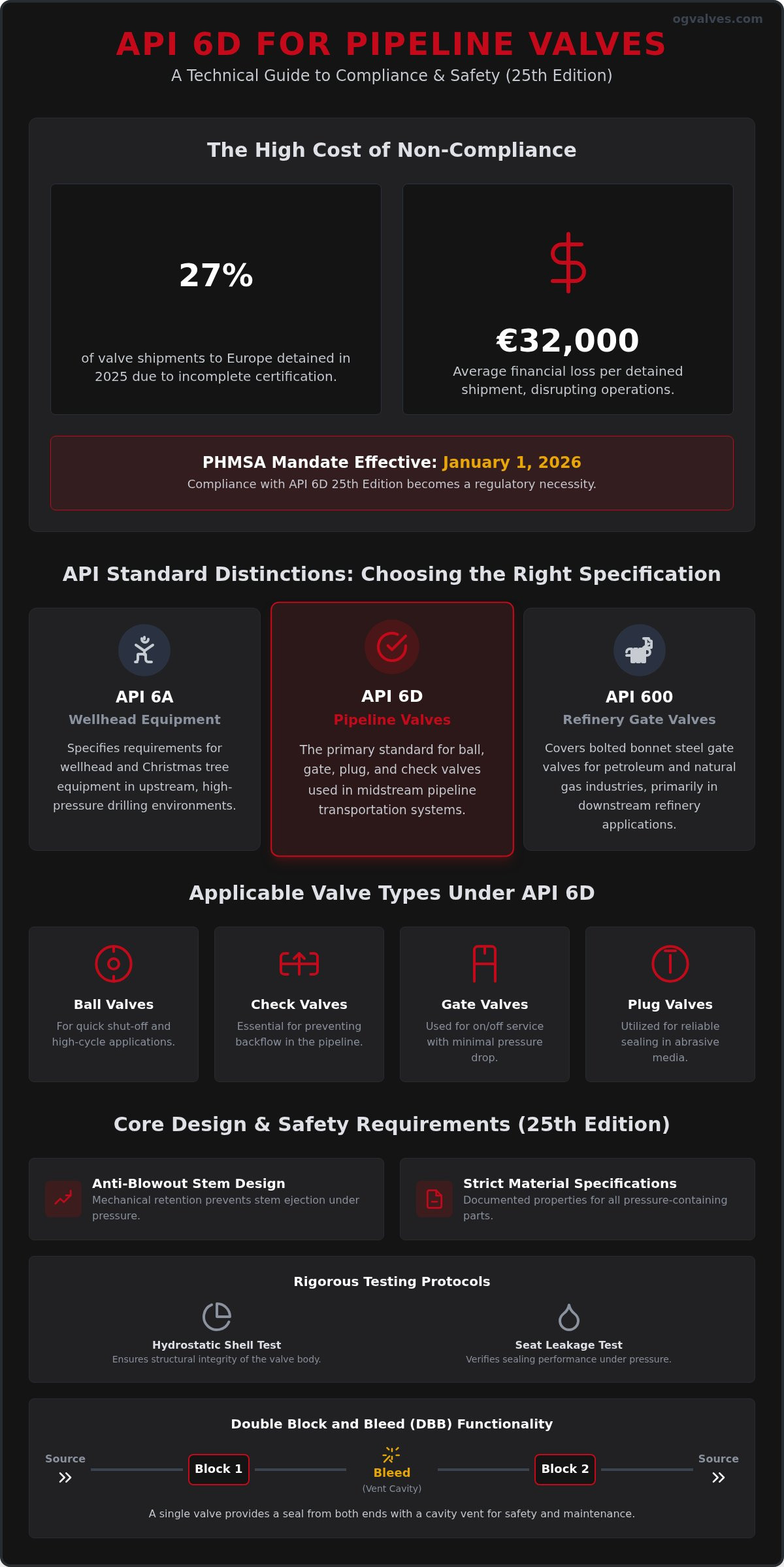
In 2025, 27% of valve shipments to European buyers were detained due to incomplete certification documentation, resulting in average losses of EUR 32,000 per shipment. This data highlights the severe financial and operational risks associated with a lack of precision in understanding api 6d for pipeline valves. In high-pressure industrial environments, the cost of non-compliance extends beyond logistics delays to encompass potential catastrophic failure and significant regulatory penalties.
Technical experts often struggle with the overlapping boundaries of API 6D, API 600, and API 6A, as they don’t always have clear guidance on the mandatory API 6D 25th Edition. This guide clarifies the critical design, testing, and regulatory requirements necessary to ensure pipeline integrity. We will detail the specific technical protocols of the current standard, analyze the recent Addendum 2 provisions for hydrogen service, and provide a framework for differentiating between competing standards. This technical specification guide ensures your procurement and engineering decisions align with the latest PHMSA mandates effective January 1, 2026.
Key Takeaways
- Identify the specific valve types and regulatory mandates governed by the API 6D 25th Edition to ensure full compliance in pipeline transportation systems.
- Gain technical precision in understanding api 6d for pipeline valves by mastering material specifications and mandatory anti-blowout stem design requirements.
- Evaluate structural integrity through rigorous hydrostatic shell and seat leakage testing protocols required to maintain pressure-containing safety.
- Distinguish between API 6D, API 600, and API 6A to prevent costly application errors between pipeline, refinery, and wellhead environments.
- Optimize the procurement process by identifying essential RFQ data points and criteria for selecting dependable, high-specification valve suppliers.
The Scope and Regulatory Purpose of API 6D
API 6D serves as the primary technical specification for valves utilized within pipeline transportation systems. It’s a standard developed by the American Petroleum Institute (API) to ensure the mechanical integrity of pressure-containing equipment. Understanding api 6d for pipeline valves is a prerequisite for engineers and procurement specialists who manage midstream and downstream assets. This standard specifically defines the requirements for ball, check, gate, and plug valves. While API 6A is reserved for upstream wellhead and Christmas tree equipment, API 6D addresses the unique operational demands of transport pipelines, where environmental safety and long-term durability are paramount.
Historical Evolution of the Specification
The standard has evolved from a simple dimensional guide into a complex safety framework. The transition to the 25th Edition represents a significant shift toward higher manufacturing precision. This update mandates the use of API 6DX-compliant actuators and mounting kits, reflecting a move toward integrated system reliability. Historical data from field failures, such as seal compromises and stem ejections, have shaped these current requirements. By tightening tolerances and enhancing testing protocols, the specification aims to eliminate the root causes of pipeline incidents and ensure operational continuity across global networks.
Applicable Valve Types and Pressure Classes
API 6D applies to several critical valve categories designed for heavy industrial use. The following types are covered under this specification:
- Gate Valves: Used for on/off service with minimal pressure drop.
- Ball Valves: Preferred for quick shut-off and high-cycle applications.
- Check Valves: Essential for preventing backflow within the pipeline.
- Plug Valves: Utilized for reliable sealing in abrasive media.
Pressure ratings are categorized according to ASME B16.34 classes, ranging from Class 150 to Class 2500. These classifications dictate the structural requirements for the valve body and internal components. Temperature range considerations are equally critical; standard materials may fail in cryogenic or high-heat environments. Engineers must specify material grades that maintain their mechanical properties under extreme thermal stress to prevent brittle fracture or seal failure.
Adherence to these standards isn’t just a best practice; it’s a regulatory necessity. The U.S. Pipeline and Hazardous Materials Safety Administration (PHMSA) has mandated compliance with the API 6D 25th Edition starting January 1, 2026. This directive makes understanding api 6d for pipeline valves vital for avoiding legal liabilities and ensuring the safety of critical infrastructure. By following these rigorous protocols, operators can maintain high-stakes trust with regulatory bodies and the public.
Design and Construction Requirements Under API 6D
The engineering framework defined by API Specification 6D mandates rigorous design criteria that distinguish pipeline valves from standard industrial counterparts. Material selection for pressure-containing parts, such as the body and bonnet, and pressure-controlling parts, including the ball, gate, and seats, must strictly adhere to documented mechanical and chemical properties. These specifications ensure the valve can withstand the specified pressure classes and environmental stresses without compromising structural integrity. Manufacturers must verify that materials are compatible with the transported media to prevent corrosion or hydrogen-induced cracking.
Understanding api 6d for pipeline valves requires a focus on safety features like the anti-blowout stem design. This mechanical retention system ensures that the stem can’t be ejected by internal pressure even if the packing or top-works are removed. Additionally, standardized face-to-face and end-to-end dimensions are strictly enforced. This standardization allows for the seamless replacement of valves within existing pipeline infrastructures, minimizing downtime during maintenance cycles. For high-stakes applications, secondary sealing mechanisms and emergency sealant injection ports provide a critical redundant barrier against leaks in the seat and stem areas.
Double Block and Bleed (DBB) Functionality
DBB functionality is a core requirement for many midstream applications. According to API 6D, a DBB valve is a single valve with two seating surfaces that, in the closed position, provides a seal against pressure from both ends of the valve. It includes a mechanism to vent or bleed the cavity between the seating surfaces. This design is essential for pipeline pigging operations and manifold isolation, where verifying the integrity of the seal is mandatory for operational safety and preventing product contamination.
Double Isolation and Bleed (DIB) Variations
When standard DBB isn’t sufficient, engineers specify Double Isolation and Bleed (DIB) configurations for enhanced redundancy. DIB-1 valves utilize two bidirectional seats, providing a seal that remains effective even if one seat fails. In contrast, DIB-2 features one bidirectional and one unidirectional seat. These variations offer superior safety in critical isolation zones but often result in higher operating torque. Consequently, actuator sizing must be carefully calculated to account for these mechanical loads. If you’re managing a complex infrastructure project, sourcing high-specification API 6D ball valves ensures these technical nuances are addressed during the manufacturing phase.
Critical Inspection and Testing Protocols
Verification protocols within the Official API Specification 6D serve as the final validation of manufacturing quality before a valve enters service. These tests aren’t merely procedural; they’re essential for ensuring that every component can withstand the extreme stresses of high-pressure transport. Gaining a precise understanding api 6d for pipeline valves involves recognizing that hydrostatic shell testing is the primary method for verifying structural integrity. During this protocol, the valve body is subjected to 1.5 times its rated pressure to identify casting or forging defects that could lead to catastrophic failure.
Seat leakage testing follows a dual-pressure strategy. High-pressure tests verify the valve’s ability to maintain isolation at maximum operating limits, while low-pressure tests ensure seal integrity under minimal load conditions. This dual approach is critical for both soft-seated and metal-seated designs. Additionally, stem seal integrity tests are mandatory to prevent fugitive emissions. These emissions pose environmental risks and represent a loss of operational efficiency. Final acceptance also depends on rigorous visual and dimensional inspections to ensure the finished product matches the engineering drawings exactly.
Standard vs. Supplementary Testing (SR)
Supplementary requirements (SR) offer additional layers of assurance for specialized applications. SR6 involves low-pressure gas testing, while SR15 mandates high-pressure gas testing, which is often requested for gas transmission lines. For installations where fire safety is a priority, SR18 provides the necessary fire-safe testing validation. Non-Destructive Examination (NDE) techniques, such as Radiography (RT) for internal casting quality and Dye Penetrant (PT) for surface integrity, are frequently utilized to detect subsurface anomalies that visual inspections might miss.
Documentation and Certification Packages
Complete documentation is the backbone of regulatory compliance. Every pressure-containing and pressure-controlling part must be accompanied by a Material Test Report (MTR) that details its chemical composition and mechanical properties. Procurement specialists must also secure an API 6D Certificate of Compliance to verify that the manufacturing process met all standard requirements. Digital documentation packages now facilitate lifecycle management, allowing operators to track maintenance history and material pedigree across decades of pipeline service. This transparency is vital for understanding api 6d for pipeline valves in the context of long-term asset management.
API 6D vs. API 600 and API 6A: Key Distinctions
Selecting the correct standard is critical for ensuring the longevity of pressure-containing equipment. While several API specifications govern valve design, their intended service environments aren’t interchangeable. API 600 is the primary standard for heavy-duty steel gate valves used in refinery service. These valves prioritize a large corrosion allowance and robust wall thickness to handle the erosive nature of refined products and high-temperature processing. In contrast, API 6A focuses on upstream wellhead and Christmas tree equipment. This standard addresses the extreme pressures and corrosive, sour-gas environments typical of the extraction phase.
Understanding api 6d for pipeline valves is essential because this specification is optimized for midstream transportation. It focuses on through-conduit designs that facilitate pigging and long-distance flow efficiency. Substituting an API 6D valve for an API 600 valve in a refinery setting is often dangerous; the lower wall thickness and different material tolerances of a pipeline valve may not withstand the aggressive corrosion seen in refinery units. Conversely, using an API 600 valve in a pipeline might introduce unnecessary weight and flow restrictions that the system isn’t designed to support.
Leakage Rate Standards
The criteria for “zero leakage” varies significantly across these standards. API 6D defines bubble-tight shutoff for soft-seated valves, meaning no visible bubbles are permitted during the test period. For metal-to-metal seats, API 6D allows for specific leakage rates depending on the valve size and class, though these are often stricter than refinery standards. API 6A uses even more stringent testing durations due to the high-stakes nature of wellhead isolation. Accurate leakage assessment is vital for environmental compliance and prevents the contamination of high-value refined products during transport.
Wall Thickness and Design Factors
Wall thickness is a major point of divergence. API 600 mandates a heavier shell to provide a safety margin against the corrosive and erosive fluids found in downstream processing. API 6D utilizes a design factor more suited to the predictable flow of crude oil and natural gas over long distances. This difference impacts the overall valve weight and the necessary support structures within the pipeline manifold. When you’re managing complex infrastructure, it’s vital to source API-compliant gate and check valves that match the specific design factors of your operating environment. Proper selection ensures that understanding api 6d for pipeline valves translates into measurable operational safety and reduced maintenance costs.
Specifying and Procuring API 6D Compliant Valves
Procurement efficiency for midstream assets depends on the precision of the initial Request for Quotation (RFQ). To ensure adherence to the 25th Edition of the standard, buyers must provide comprehensive technical data. This includes the Nominal Pipe Size (NPS), the ASME Pressure Class, the specific chemical composition of the media, and the full range of operating temperatures. Incomplete specifications often lead to engineering delays and increase the risk of receiving non-compliant components. Understanding api 6d for pipeline valves requires a focus on these variables, as they dictate the material selection and the rigor of the testing protocols.
Selecting a vendor involves more than comparing unit prices. It requires a clinical evaluation of the supplier’s technical expertise and the depth of their physical inventory. OG VALVES LTD. maintains an extensive stock of gate, ball, and check valves to support urgent infrastructure needs. Fast-track delivery capabilities are essential for minimizing pipeline downtime, especially when operators are facing the January 1, 2026, PHMSA compliance deadline. Our organization ensures regulatory adherence through rigorous supply chain vetting and technical support for complex industrial specifications.
Selecting the Right Valve Type for API 6D Service
Isolation requirements in long-distance transport often dictate the choice of a gate valve. These units provide a reliable metal-to-metal seal with minimal pressure drop when fully open. For high-cycle pipeline applications or scenarios requiring quick quarter-turn shut-off, the advantages of ball valves are well-documented. These valves offer superior sealing performance and typically require lower operating torque. Integrating check valves is equally vital for backflow prevention, protecting upstream pumps and compressors from potential surge damage.
The OG VALVES LTD. Advantage: Global Logistics and Technical Support
Managing the logistics of heavy industrial components for international sites requires a partner who understands the practicalities of global supply chains. OG VALVES LTD. leverages deep technical knowledge to navigate complex project specifications and ensure that every component arrives on site ready for installation. Our final checklist for ensuring API 6D compliance before shipment includes a comprehensive review of all Material Test Reports (MTRs), hydrostatic test charts, and dimensional verification data. This focus on quality control positions us as a dependable partner for critical infrastructure. Understanding api 6d for pipeline valves involves recognizing that the cost of failure far outweighs the investment in qualified engineering and verified supply chains.
Securing Pipeline Integrity through Technical Compliance
Adherence to the API 6D 25th Edition is a critical requirement for maintaining the structural soundness of midstream transportation systems. This standard provides the necessary framework for verifying pressure-containing integrity through rigorous hydrostatic shell testing and specialized seat leakage protocols. Gaining a precise understanding api 6d for pipeline valves allows engineering teams to distinguish between standard industrial applications and the high-stakes demands of global pipeline networks. By prioritizing verifiable material test reports and supplementary testing like SR15, operators can mitigate the risk of non-compliance and environmental incidents.
OG Valves acts as a dependable partner in critical infrastructure, offering an extensive inventory and global fast-track delivery capabilities. Our technical support ensures that every component meets the stringent regulatory mandates effective January 1, 2026. We invite you to Request a Technical Quote for API 6D Compliant Valves to secure your project’s operational safety. We look forward to supporting your next high-specification procurement requirement with industrial precision and unwavering reliability.
Frequently Asked Questions
What is the primary difference between API 6D and API 598?
API 6D is a comprehensive product specification that defines design, manufacturing, and testing requirements specifically for pipeline valves. In contrast, API 598 is strictly a valve inspection and testing standard used for general industrial valves. While API 598 is often referenced in refinery service, API 6D valves must adhere to the specific, often more rigorous, testing durations and leakage criteria defined within the 6D specification. Using API 598 for an API 6D valve is only permissible if explicitly specified by the purchaser.
Does API 6D cover ball valves for subsea applications?
API 6D primarily addresses valves for surface pipeline transportation systems. For subsea applications, the industry utilizes API 6DSS, which is a separate specification providing additional requirements for pressure-containing integrity in submerged environments. While the core engineering of ball valves remains similar, API 6DSS includes specific considerations for external pressure, cathodic protection, and specialized hyperbaric testing. Procurement specialists should specify API 6DSS to ensure durability against saltwater corrosion and high external hydrostatic loads found in offshore projects.
What are the specific marking requirements for an API 6D valve?
Every API 6D valve must feature a permanent nameplate with specific data points to facilitate field identification and traceability. Mandatory markings include the manufacturer name, the API monogram if licensed, the nominal pipe size (NPS), and the pressure class rating. Additionally, the body material, trim material, and unique serial number must be visible. Directional flow arrows are required for unidirectional valves. These markings ensure that understanding api 6d for pipeline valves includes verifying the component’s material pedigree and operational limits.
Can an API 6D valve be used in a refinery setting?
An API 6D valve can be utilized in a refinery, but it’s not the primary standard for that environment. Refineries typically mandate API 600 for gate valves due to the heavier wall thickness and larger corrosion allowances required for aggressive processing fluids. API 6D valves are optimized for the predictable flow of crude oil or natural gas. Using them in refinery units requires a careful engineering review to ensure the material tolerances can withstand high-temperature erosion and chemical degradation typical of downstream processing.
What is the significance of the ‘Q1’ quality program for API 6D manufacturers?
API Spec Q1 is the foundational quality management system (QMS) required for manufacturers to maintain their API 6D monogram license. This program goes beyond ISO 9001 by introducing industry-specific requirements for risk management, contingency planning, and rigorous documentation of manufacturing processes. For procurement specialists, selecting a vendor with a Q1-certified facility provides high-stakes trust that the valve’s structural soundness and performance will meet global regulatory benchmarks consistently. It confirms the organization understands the cost of failure in critical infrastructure.
How does API 6D address fire-safe design requirements?
API 6D doesn’t define fire-safe testing protocols but instead references established standards like API 607 or API 6FA for design validation. A fire-safe design ensures that the valve maintains its pressure-containing integrity even if the primary soft seals are destroyed by extreme heat. Manufacturers must provide test reports proving that the metal-to-metal secondary seals prevented catastrophic leakage during a simulated fire event. This validation is essential for valves installed in hazardous or high-consequence pipeline areas where fire risks are present.
What are the supplementary requirements (SR) in API 6D and when are they needed?
Supplementary requirements (SR) are optional protocols that purchasers can mandate for specialized service conditions. Common SRs include SR6 for low-pressure gas testing and SR15 for high-pressure gas testing, which are critical for gas transmission lines. SR18 is frequently specified to validate fire-safe performance. These requirements are necessary when standard testing doesn’t provide sufficient assurance for the specific environmental or operational risks of a project. Understanding api 6d for pipeline valves involves identifying when these additional layers of verification are mandatory for safety.
Is there a difference between API 6D and ISO 14313?
API 6D and ISO 14313 were historically identical, as they were developed as harmonized standards for the international petroleum and natural gas industries. However, the American Petroleum Institute and ISO have since moved toward independent publication. While they remain technically similar in their scope for ball, check, gate, and plug valves, subtle differences in testing and documentation requirements exist between the latest editions. Engineers must specify the exact standard and edition to avoid discrepancies during the quality assurance process and ensure full regulatory adherence.
 Responsive Menu