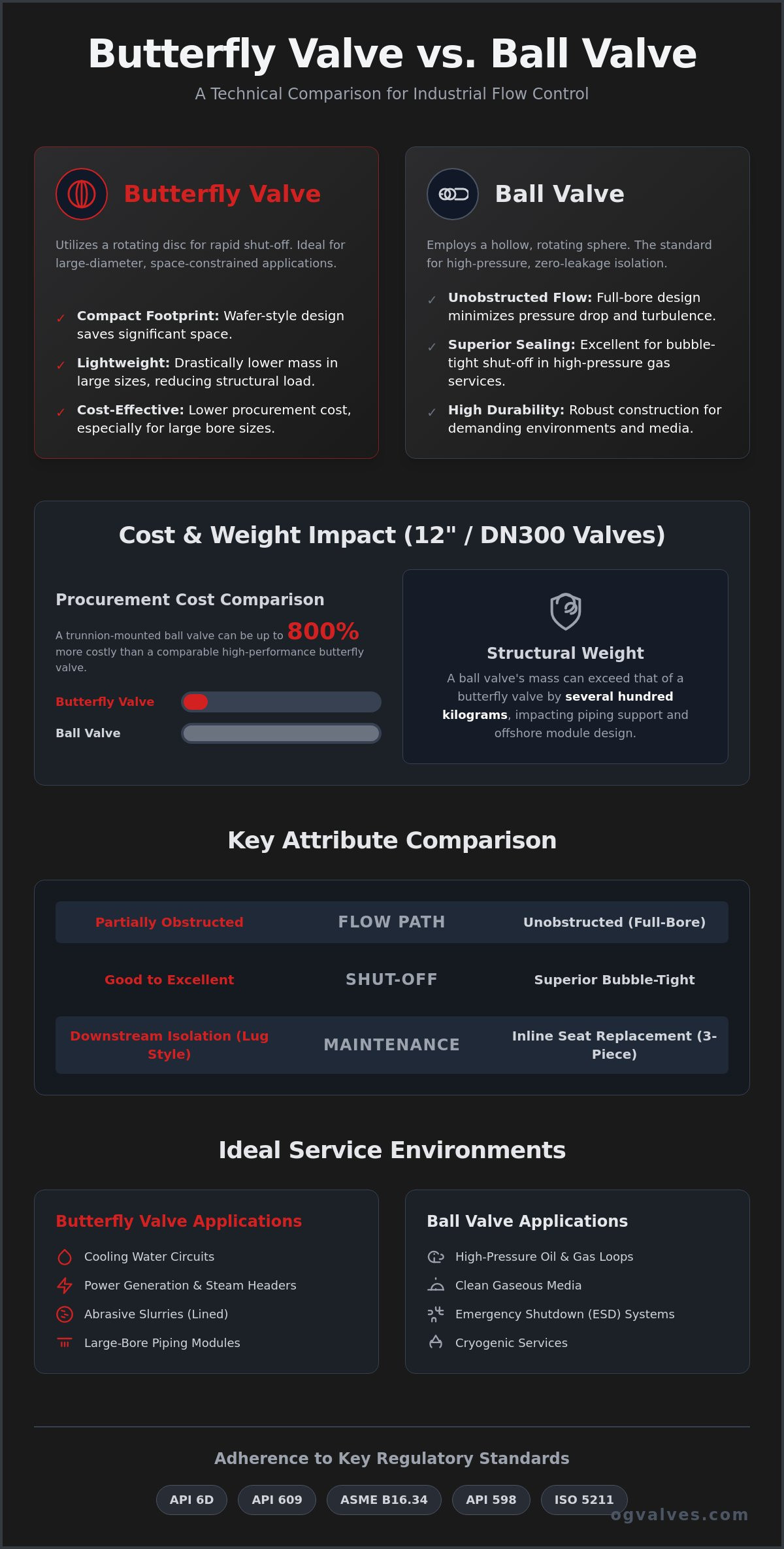
Specifying a 12-inch trunnion-mounted ball valve when a high-performance triple-offset butterfly valve meets the process requirements can increase your procurement costs by up to 800 percent. While ball valves remain a primary choice for high-pressure isolation, the structural weight and cost penalties in large-diameter applications often compromise project margins. You’ve likely faced the challenge of balancing bubble-tight shut-off requirements with the strict weight constraints of offshore piping modules where every kilogram impacts structural integrity. This technical analysis of the butterfly valve vs ball valve debate provides the clinical data necessary to optimize flow efficiency while maintaining rigid adherence to API 6D and API 609 standards. We’ll evaluate how current 2026 material costs for stainless steel and PTFE impact your total cost of ownership across the asset lifecycle. This guide examines quarter-turn mechanism durability, pressure-temperature ratings under ASME B16.34 (2025 Edition), and the latest sealing benchmarks from the 11th edition of API 598. You’ll gain a definitive framework for selecting the optimal valve architecture to prevent seat failure and ensure long-term operational reliability in hazardous environments.
Key Takeaways
- Define the mechanical operational differences between hollow ball and rotating disc configurations for rapid 90-degree isolation.
- Compare structural footprints and weight constraints to identify the superior butterfly valve vs ball valve configuration for large-diameter piping modules.
- Quantify Flow Coefficient (Cv) and pressure drop implications to ensure adherence to ASME B16.34 and API 598 performance benchmarks.
- Evaluate regulatory compliance across API 6D and API 609 specifications to mitigate risk in hazardous high-pressure applications.
- Reduce total cost of ownership by leveraging fast-track delivery and global logistics to minimize facility downtime during critical outages.
The Quarter-Turn Valve Dilemma: Butterfly vs Ball Valve Fundamentals
The selection of industrial isolation components hinges on the mechanical efficacy of the quarter-turn mechanism. Both configurations utilize a 90-degree rotary action to transition from a fully closed to a fully open state. This rapid movement’s critical for emergency shutdown (ESD) systems where millisecond response times prevent catastrophic pressure surges or containment loss. The primary distinction in the butterfly valve vs ball valve comparison lies in the geometry of the closure element. While both provide rapid isolation, their structural differences dictate their performance under extreme pressure and temperature variables.
A ball valve employs a spherical, hollowed-out plug that rotates within the valve body. When aligned with the pipe, it provides an unobstructed flow path, minimizing turbulence. Conversely, a Butterfly valve design utilizes a circular disc mounted on a central shaft. While the ball valve excels in high-pressure isolation due to its robust seat contact and minimal leak paths, the butterfly valve’s often specified for flow regulation in large-bore systems. The disc remains in the flow stream, which introduces different hydraulic characteristics compared to the full-bore ball design.
Similarities in Actuation and Control
Standardization across the industry ensures that both valve types integrate seamlessly with modern automation suites. Most high-specification units feature mounting pads that adhere to ISO 5211, facilitating the interchangeability of pneumatic, electric, and hydraulic valve actuators. This quarter-turn logic simplifies the control interface; sensors only need to monitor a 90-degree arc to confirm valve position. It’s a design choice that reduces the complexity of procurement for large-scale projects requiring diverse valve architectures across a single facility.
Primary Industrial Service Environments
Operational environments dictate the selection between these two mechanisms. Ball valves are the benchmark for clean gaseous media and high-pressure oil loops where bubble-tight shut-off is non-negotiable. Butterfly valves demonstrate superior performance in power generation steam headers and cooling water circuits. When managing abrasive slurries, specialized lined butterfly valves offer a resilient alternative to ball valves. Ball valves often suffer from seat erosion if particles become trapped in the internal cavity. The butterfly valve vs ball valve decision ultimately rests on the specific media characteristics and the required flow coefficient for the process loop.
Mechanical Design and Structural Integrity
Structural footprint and total assembly mass represent the primary engineering constraints in the butterfly valve vs ball valve selection process. Wafer-style butterfly valves utilize a compact, face-to-face dimension that significantly reduces the required installation space between pipe flanges. In contrast, ball valves require a robust, elongated body to house the spherical closure element and its associated seating assembly. This difference becomes critical in offshore piping modules where weight constraints are absolute. At sizes of 12 inches (DN300) and above, a ball valve’s mass can exceed that of a comparable butterfly valve by several hundred kilograms, complicating structural support requirements and increasing the complexity of the piping layout.
Sealing integrity relies on material metallurgy and seat configuration. Soft-seated designs frequently utilize Polytetrafluoroethylene (PTFE), currently valued at approximately $12.97 per kilogram, to achieve bubble-tight shut-off in lower temperature applications. Extreme environments require metal-to-metal contact to maintain structural soundness. Maintenance protocols also differ; a 3-piece ball valve allows for inline seat replacement by swinging the center section out, while lug-style butterfly valves permit the removal of downstream piping without losing system pressure on the upstream side. This serviceability ensures that facility downtime remains within projected windows during scheduled maintenance cycles.
Ball Valve Configuration: Floating vs Trunnion
Floating ball designs rely on upstream pressure to force the ball into the downstream seat, creating a reliable seal in low-to-medium pressure services. However, as bore size and pressure ratings increase, the resulting torque can exceed the limits of standard operators. High-pressure, large-bore industrial ball valves utilize trunnion-mounted designs. These provide mechanical support at both the top and bottom of the ball, which reduces operating torque and allows for smaller, more cost-effective actuator sizing. For projects requiring rapid deployment, our technical team provides fast-track procurement support for high-specification valve assemblies.
Butterfly Valve Geometry: Concentric vs Triple Offset
Concentric butterfly valves feature a resilient seat and are typically reserved for non-critical water services or low-pressure utilities. High-stakes industrial isolation requires the Triple Offset (TOV) design. The third offset employs an elliptical seat geometry that ensures the disc only contacts the seat at the final point of closure, eliminating friction-induced wear during the 90-degree rotation. This geometry allows for a metal-to-metal, bubble-tight seal that withstands high-temperature cycles without the degradation typical of soft-seated alternatives. The result’s a high-performance component capable of meeting the rigorous demands of refinery and petrochemical processing loops.

The unobstructed bore of a full-port ball valve achieves the maximum possible flow coefficient (Cv), effectively mimicking a continuous section of pipe. In the butterfly valve vs ball valve comparison, the latter’s flow path efficiency reduces parasitic energy losses in high-velocity gas applications. Conversely, butterfly valves feature a disc situated permanently in the flow stream. Even when fully open, this element introduces a permanent pressure drop that engineers must factor into system-wide energy loss calculations to ensure pumping requirements remain within design limits.
Thermal expansion dynamics differ significantly between the two architectures. A solid ball possesses greater thermal mass, leading to slower expansion rates but potential binding in high-temperature steam service if seat tolerances don’t remain precise. The thinner disc of butterfly valves allows for rapid thermal equilibration, mitigating the risk of mechanical seizure during rapid temperature transients. While ball valves provide superior isolation, they aren’t typically suited for regulation. High-performance butterfly designs offer more linear flow characteristics, making them more effective for throttling than standard ball valves, which frequently experience seat erosion when held in a partially open position.
Sealing Performance and Leakage Classes
Verification of sealing integrity must adhere to the 11th Edition of API 598 (published February 2023) or ISO 5208:2015. Achieving Class VI shut-off, the benchmark for bubble-tight performance, is standard for resilient-seated designs but requires precision engineering in metal-to-metal configurations. In double-block-and-bleed (DBB) ball valve applications, cavity pressure relief is a critical safety requirement. This prevents the catastrophic failure of the valve body due to the thermal expansion of trapped liquid media.
Transient Mitigation and Water Hammer
Rapid closure in liquid pipelines generates pressure transients, commonly known as water hammer. While both quarter-turn designs offer the speed required for emergency shutdown, this velocity can be detrimental to system integrity. Large-scale butterfly valves often utilize mechanical damping to control the final stages of closure. The hydrodynamic profile of the disc directly determines the magnitude of downstream turbulence and the resulting pressure recovery factor.
Regulatory compliance defines the operational boundary between commercial suitability and industrial-grade safety. In the butterfly valve vs ball valve selection process, adherence to specific API standards ensures that components withstand the rigors of high-stakes infrastructure. API 6D serves as the primary specification for pipeline valves, typically governing the construction and testing of trunnion-mounted ball valves used in midstream transmission. Conversely, API 609 dictates the design requirements for butterfly valves, covering Double Flanged, Lug, and Wafer types. Both architectures must conform to the pressure-temperature ratings established in the 2025 edition of ASME B16.34 to ensure structural integrity across varying process conditions.
Material selection for sour gas (H2S) environments must strictly follow NACE MR0175/ISO 15156. This standard prevents sulfide stress cracking, a failure mode that can lead to catastrophic containment loss. The metallurgical requirements for these environments often necessitate the use of specialized alloys or specific heat treatment protocols for both the closure element and the valve body. Engineers must verify that every component in the wetted path meets these rigorous chemical and mechanical properties before deployment in corrosive petrochemical loops. It’s a critical step in mitigating the risk of material fatigue and ensuring long-term asset reliability.
Alloy Selection for Corrosive Industrial Media
Offshore and subsea isolation demands materials with superior pitting resistance. Utilizing Super Duplex and 6Mo stainless steel provides the necessary durability against chloride-induced corrosion in maritime environments. For high-temperature chemical processing, Monel or Inconel cladding offers a cost-effective method to enhance the lifespan of carbon steel bodies without sacrificing structural soundness. The choice between forged and cast bodies impacts fatigue resistance; forged components generally offer superior grain structure for high-cycle applications. Our technical inventory includes a comprehensive range of high-alloy industrial valves designed for these extreme service conditions.
Fire-Safe and Emissions Standards
Hazardous zone installations require components certified to API 607 or API 6FA fire test standards. These certifications ensure that the valve maintains external and internal sealing integrity even after the primary soft seats have been consumed by extreme heat. Environmental safety also hinges on fugitive emission compliance, with ISO 15848-1 setting the benchmark for stem seal leakage rates in modern processing plants. Graphite-based gaskets and metal-to-metal seat interfaces represent the critical seal materials required to maintain pressure containment during a fire-safe certification test. Request a technical consultation for API-certified components and fast-track delivery options.
Strategic Procurement: Optimising Lead Times and Reliability
Strategic procurement in 2026 requires a rigorous evaluation of the Total Cost of Ownership (TCO). While the initial purchase price of a butterfly valve vs ball valve differs significantly, it’s the long-term maintenance and energy loss parameters that define the true expenditure. Data from July 2026 indicates that for 12-inch (DN300) specifications, a ball valve can be 4 to 8 times more expensive than a comparable butterfly valve. With the global industrial valves market projected to reach up to $105.75 billion this year, optimising these selections is essential for maintaining project viability amidst fluctuating steel prices, currently averaging $2,660.55 per ton for structural grades.
Reliability hinges on the completeness of technical documentation. Procurement specialists must demand comprehensive certification packs, including Material Test Reports (MTRs) and Positive Material Identification (PMI) results. These documents verify that the metallurgy meets the specific requirements of the process media, particularly when dealing with high-alloy components. Fast-track delivery remains a critical factor; the cost of an unplanned facility outage often dwarfs the capital expenditure of the valve itself. Securing a technical partner with established global logistics ensures that critical infrastructure remains operational during urgent maintenance windows.
Quality Assurance and PMI Testing
Verification protocols must include rigorous hydrostatic and pneumatic shell testing to confirm zero-leakage performance before site delivery. Positive Material Identification (PMI) ensures that alloy specifications, such as Super Duplex or Inconel, strictly adhere to the project’s metallurgical requirements. We coordinate with third-party inspection (TPI) agencies to provide independent validation for global infrastructure projects. This ensures every unit complies with the 2025 edition of ASME B16.34 and the latest API 598 testing standards.
The OG Valves Industrial Advantage
OG VALVES LTD. maintains an extensive inventory of API-certified ball and butterfly valves, enabling rapid response to urgent industrial demands. Our technical team provides expert support for sizing and selection, including evaluations for gate valve alternatives when linear isolation is more appropriate for the application. By leveraging our global logistics network, we minimise facility downtime and provide the technical expertise necessary for high-pressure and high-alloy valve procurement. We don’t just supply components; we act as a technical partner for critical infrastructure projects worldwide.
Advancing Industrial Infrastructure through Precise Valve Selection
Successful project execution in heavy industrial sectors depends on the clinical evaluation of quarter-turn mechanisms. The butterfly valve vs ball valve decision isn’t merely a matter of capital expenditure; it’s an engineering trade-off between the unobstructed flow path of trunnion-mounted balls and the compact, lightweight profile of triple-offset discs. Adhering to the 2025 edition of ASME B16.34 and the latest API 598 testing protocols ensures that chosen components withstand the thermal and pressure transients inherent in critical process loops. Managing total cost of ownership requires balancing initial procurement with the necessity for bubble-tight shut-off and long-term mechanical reliability.
OG VALVES LTD. provides the technical expertise necessary to navigate these specifications while ensuring minimal facility downtime through fast-track global delivery. Our inventory consists of API-certified components designed for high-pressure and corrosive environments. We act as a technical partner to ensure your procurement aligns with rigorous safety standards and operational output targets. Request a Technical Specification Quote from OG Valves to secure high-performance isolation for your next project. Optimising your valve selection today ensures the long-term integrity and safety of your industrial assets.
Frequently Asked Questions
What is the main difference between a butterfly valve and a ball valve?
The primary mechanical distinction lies in the geometry of the closure element. A ball valve utilizes a rotating hollowed sphere to provide an unobstructed flow path, while a butterfly valve employs a circular disc mounted on a central shaft that remains in the flow stream. This structural variance dictates differences in pressure drop, flow coefficient (Cv), and total assembly weight.
When should I choose a butterfly valve over a ball valve for large pipes?
Specify a butterfly valve for large-diameter piping, typically 4 inches (DN100) and above, when weight constraints and procurement costs are primary engineering factors. For 12-inch (DN300) applications, a butterfly valve is significantly more economical and can be 4 to 8 times less expensive than a comparable ball valve while requiring less structural support infrastructure.
Are ball valves better than butterfly valves for high-pressure systems?
Ball valves are the technical benchmark for high-pressure isolation due to their robust seat architecture and ability to maintain sealing integrity under extreme differential pressures. In the butterfly valve vs ball valve comparison for high-stakes oil and gas service, trunnion-mounted ball designs offer superior resistance to disc deflection and seat bypass compared to traditional butterfly configurations.
Can butterfly valves provide a bubble-tight shut-off?
High-performance triple-offset butterfly valves (TOV) achieve bubble-tight shut-off compliant with API 598 Class VI standards. These designs utilize metal-to-metal seating and elliptical geometry to eliminate friction during the 90-degree rotation. This ensures zero-leakage performance in hazardous industrial environments where resilient seats would otherwise degrade due to temperature or chemical exposure.
Which valve type is more suitable for throttling flow?
Butterfly valves demonstrate superior performance in throttling and flow regulation applications due to their more linear control characteristics. Standard ball valves are generally reserved for on-off isolation; using them for regulation often results in seat erosion and turbulence-induced vibration. High-performance butterfly discs are specifically engineered to manage flow dynamics without compromising the valve’s structural soundness.
What are the torque requirements for butterfly vs ball valves?
Ball valves typically require higher operating torque than butterfly valves of an equivalent size because of the extensive surface area contact between the ball and the seats. This necessitates larger, more costly actuators. Butterfly valves benefit from lower torque requirements, though engineers must still account for hydrodynamic torque caused by fluid velocity acting against the disc surface during operation.
How does the weight of a ball valve compare to a butterfly valve?
Butterfly valves provide a significant weight advantage, particularly in large-bore applications where offshore piping modules have strict mass limits. A wafer-style butterfly valve can weigh up to 70 percent less than a full-bore ball valve of the same diameter. This reduction in mass simplifies installation logistics and minimizes the need for heavy-duty structural pipe supports.
What are the typical maintenance requirements for industrial quarter-turn valves?
Maintenance protocols focus on seat integrity, stem seal adjustment, and actuator calibration to prevent fugitive emissions and operational failure. While 3-piece ball valves allow for inline component replacement, lug-style butterfly valves permit the removal of downstream piping for maintenance without losing upstream pressure. Regular inspection ensures adherence to ISO 15848-1 environmental safety standards.
 Responsive Menu