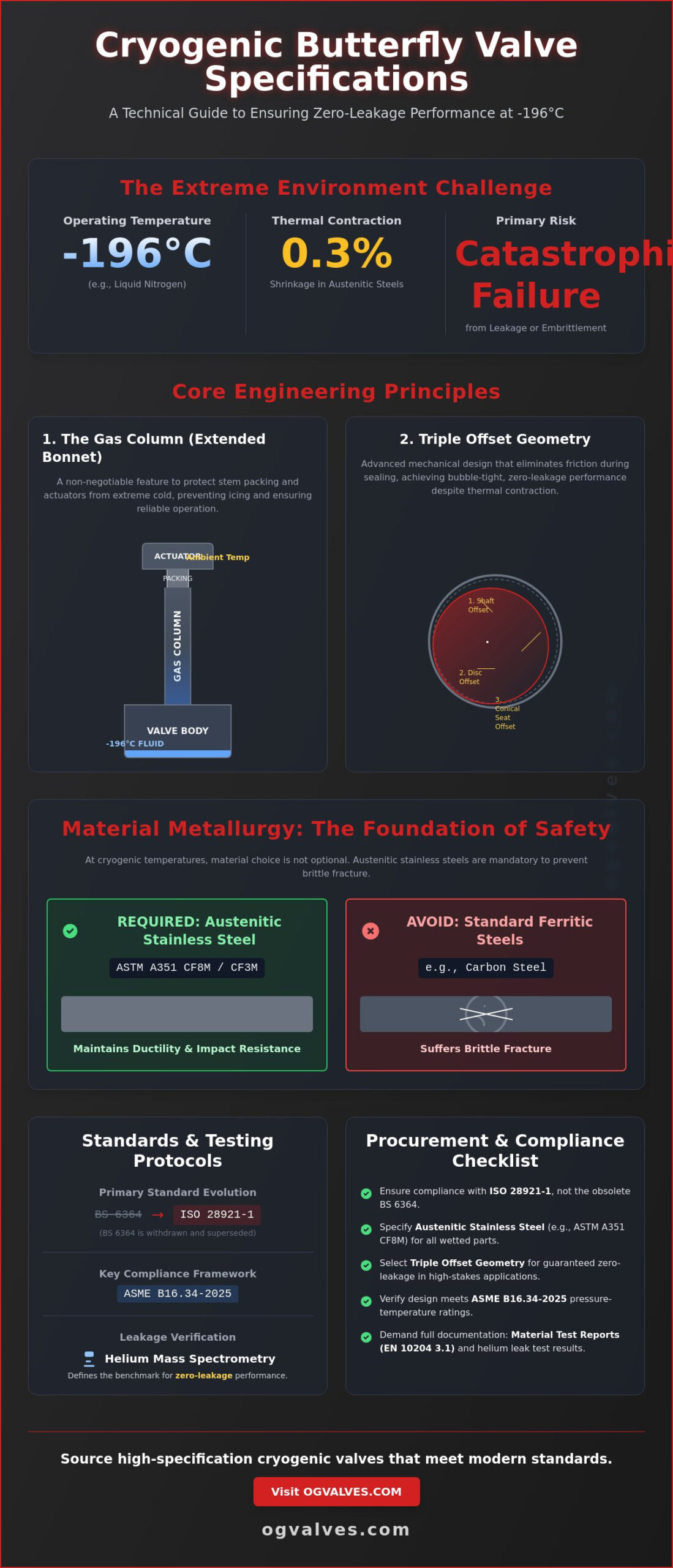
In cryogenic processing, a single millimeter of thermal contraction can transform a high-performance seal into a catastrophic failure point. Engineers and procurement specialists understand that operating at temperatures as low as -196°C leaves no room for margin or marketing hyperbole. Adhering to precise cryogenic butterfly valve specifications is the only method to ensure operational safety and prevent material embrittlement in critical infrastructure. While older standards like BS 6364 have been withdrawn and superseded, staying current with modern regulatory frameworks is vital for maintaining system integrity.
It’s clear that the pressure to source reliable, high-spec components often clashes with rising material costs and complex global supply chains. This technical guide provides an authoritative analysis of the mandatory design offsets and material standards required for modern industrial applications. You’ll gain a definitive checklist of ASTM and API requirements, alongside a breakdown of ISO 28921-1:2013 and the updated ASME B16.34-2025 protocols. We will preview the mechanical benefits of triple offset designs and the rigorous testing procedures, such as helium mass spectrometry, that define the current benchmark for zero-leakage performance.
Key Takeaways
- Identify the critical transition from BS 6364 to ISO 28921-1 as the primary global standard for low-temperature isolating valve performance.
- Understand the metallurgical necessity of austenitic stainless steel grades like ASTM A351 CF8M to maintain ductility and prevent brittle fracture at -196°C.
- Analyze the mechanical advantages of triple offset geometry in achieving zero-leakage performance despite extreme thermal contraction in high-stakes environments.
- Access a definitive technical checklist of cryogenic butterfly valve specifications to streamline procurement and ensure compliance with ASME B16.34-2025.
- Master the documentation requirements for industrial supply chains, including the verification of Material Test Reports and helium mass spectrometry protocols.
Core Engineering Principles of Cryogenic Butterfly Valves
Cryogenic butterfly valves are specialized quarter-turn flow control devices engineered to maintain structural integrity and sealing performance at temperatures ranging from -50°C to -196°C. These components are indispensable in high-stakes sectors like LNG processing, air separation units, and liquid hydrogen storage. Unlike standard industrial valves, cryogenic butterfly valve specifications must account for the extreme physics of sub-zero environments, where standard elastomers fail and metallic components undergo significant volumetric changes. Precision in these applications isn’t a preference; it’s a safety mandate for critical infrastructure.
Thermal contraction represents the primary engineering hurdle. When materials cool from ambient to cryogenic levels, austenitic stainless steels can contract by approximately 0.3%. This shrinkage alters internal tolerances and can lead to seat leakage or mechanical binding. Engineers must utilize advanced butterfly valve design principles to compensate for these shifts. This includes the use of materials with high fracture toughness and the implementation of design offsets that ensure the disc and seat interface remain bubble-tight despite the physical reduction in component size.
The Gas Column (Extended Bonnet) Functionality
The extended bonnet, often referred to as a gas column, is a non-negotiable requirement for cryogenic service. Its primary purpose is to distance the stem packing and actuator from the cryogenic fluid. By creating a stagnant gas buffer, the column ensures the packing remains at a temperature high enough to prevent icing and hardening. Calculation of the extension length depends on the insulation thickness and the specific temperature of the media. While BS 6364 historically provided the framework for these dimensions, modern procurement now prioritizes ISO 28921-1 and MSS SP-134-2025 to define extension heights that prevent packing failure and ensure reliable actuation.
Operational Dynamics in Sub-Zero Environments
The transition of media between gaseous and liquid phases within the valve body creates unique operational pressures. Cryogenic valves typically require significantly higher actuation torque than their ambient counterparts. This is due to the increased friction at the seal interface and the potential for “thermal locking” caused by differential contraction rates between the disc and the body. Furthermore, anti-static design is a mandatory safety feature. In flammable applications like LNG or hydrogen, the flow of cryogenic fluids can generate static electricity. Integrated grounding paths ensure that any electrical charge is safely dissipated, preventing ignition risks in hazardous zones. These cryogenic butterfly valve specifications ensure that the valve functions as a reliable fail-safe within the broader process architecture.
Material Metallurgy and Body Construction Standards
The selection of materials for cryogenic butterfly valve specifications is governed by the physical reality of sub-zero metallurgy. At the temperatures required for LNG or liquid nitrogen, standard ferritic steels lose their impact toughness. This leads to brittle fracture, where the metal shatters under stress rather than deforming. Consequently, austenitic stainless steels are the industry baseline. ASTM A351 CF8M is the standard choice. It maintains excellent ductility and impact resistance even at -196°C because it lacks a ductile-to-brittle transition temperature.
Material traceability is a non-negotiable requirement for high-stakes industrial procurement. Every critical pressure-retaining component must be accompanied by EN 10204 3.1 or 3.2 certifications. These documents provide a verified trail of chemical composition and mechanical testing. For applications involving non-lubricating media, surface treatments like nitriding or specialized coatings are applied to the disc edge. This reduces friction and extends the service life of the industrial butterfly valves used in these systems.
ASTM Grades for Cryogenic Body and Disc
CF8M is the cast equivalent of 316 stainless steel and offers superior corrosion resistance. CF3M, the low-carbon variant, is often specified when extensive welding is required. It prevents chromium carbide precipitation at grain boundaries, which preserves the material’s integrity. To validate these properties, Charpy V-notch impact testing is mandatory. These tests are conducted at the actual service temperature to ensure the material absorbs sufficient energy without fracturing. While Duplex steels offer high strength, their use in cryogenic service is typically limited to -50°C unless specific metallurgical adjustments are made for offshore environments.
Stem and Internal Component Metallurgy
Internal components require higher mechanical strength than the body to handle actuation torques. XM-19, commonly known as Nitronic 50, is frequently specified for valve stems. It provides double the yield strength of 316 stainless steel while retaining cryogenic toughness. Managing the thermal expansion coefficients between the body, disc, and stem is vital to prevent mechanical interference during temperature cycles. Precise material matching of internal parts is necessary to prevent galling, which occurs when metallic surfaces seize due to high friction in dry, cold environments. This careful selection ensures that cryogenic butterfly valve specifications meet the rigorous demands of long-term operational output.

The selection of the mechanical architecture is a pivotal decision in defining cryogenic butterfly valve specifications. While concentric designs serve ambient water applications, they’re physically incapable of handling sub-zero environments where elastomeric liners harden and shatter. High-performance double-offset valves offer an improvement by using an interference fit to create a seal, yet they still suffer from seat wear due to friction during the opening and closing cycles. For high-stakes LNG and hydrogen applications, the triple offset valve (TOV) has become the definitive industry standard. Its design eliminates the rubbing between the seat and the seal ring, which is critical when materials are at their most brittle.
TOVs provide a metal-to-metal, bubble-tight shutoff that remains consistent despite the volumetric contraction of the valve body. This reliability is why technical experts prioritize these cryogenic butterfly valve specifications for critical isolation points. For a broader context on how these mechanical layouts differ from standard configurations, consult The Engineer’s Guide to Industrial Butterfly Valves. These designs ensure that the valve doesn’t just meet a standard but exceeds the operational safety requirements of volatile fluid management.
The Triple Offset Advantage
The engineering superiority of the TOV lies in its three distinct geometric offsets. The first offset places the shaft behind the sealing plane, allowing for a continuous sealing surface. The second offset shifts the shaft centerline away from the pipe centerline, creating a cam-like action during operation. The third, and most critical, offset is the conical geometry of the sealing components. By machining the seat into an inclined cone, the disc only contacts the seat at the final point of closure. This eliminates friction and wear, ensuring the valve maintains its zero-leakage rating over thousands of cycles at -196°C. This geometric precision is essential for maintaining flow characteristics and high Cv values in high-pressure cryogenic pipelines.
Sealing Mechanisms and Seat Integrity
Seat integrity in cryogenic service relies on the torque-seated principle. Unlike position-seated valves that rely on the disc reaching a specific point, torque-seated valves use the actuator’s force to wedge the disc into the seat. This creates a more robust seal as the pressure or temperature drops. Laminated seals, which alternate layers of stainless steel and graphite, provide the necessary resilience to handle thermal cycling. These seals offer better recovery than solid metal seats when the valve undergoes rapid temperature shifts. By combining the durability of metal with the conformability of graphite, these seals maintain a reliable barrier against fugitive emissions in the most demanding industrial environments.
Testing Protocols and Regulatory Compliance (BS 6364)
Validation of cryogenic butterfly valve specifications occurs through rigorous laboratory testing that simulates the thermal and mechanical stresses of liquid nitrogen environments. While BS 6364 has been withdrawn and superseded by the ISO 28921 series, it remains a foundational reference in many legacy engineering specifications. The core of this protocol involves a submerged helium gas test at -196°C. Unlike ambient pressure testing, cryogenic validation requires the valve to be fully immersed in a liquid nitrogen bath until the body temperature stabilizes. This ensures that all components have reached their maximum thermal contraction before the seat leakage test begins.
Helium is the mandatory test medium because its small molecular size identifies seal imperfections that larger molecules might miss. Leakage is measured through a calibrated flow meter or via a water column to detect individual bubbles. In a clinical engineering context, “Zero Leakage” typically aligns with Rate A of ISO 5208, indicating no visible leakage during the test duration. Post-test inspection is equally vital. Engineers must verify that the rapid thermal cycling didn’t cause structural deformation or galling of the internal components. If your project demands this level of verified precision, you can source high-specification industrial butterfly valves that meet these rigorous benchmarks.
Mandatory Non-Destructive Testing (NDT)
Body integrity is verified through a series of mandatory non-destructive testing protocols. Dye Penetrant Inspection (DPI) is utilized to identify surface-level cracks or casting defects that could propagate under thermal stress. For internal structural verification, Radiographic Testing (RT) identifies subsurface porosity or inclusions. Positive Material Identification (PMI) is performed on every pressure-retaining component to verify alloy composition against the 3.1 certification. It is a critical technical distinction that Magnetic Particle Inspection (MPI) is not applicable to these valves, as the austenitic stainless steels required for cryogenic service are non-magnetic.
Global Standards and Certifications
Design and pressure-temperature ratings are governed by API 609 and the updated ASME B16.34-2025. These standards define the minimum wall thickness and bolting requirements necessary to maintain a safe pressure boundary. Adherence to these global benchmarks ensures that the cryogenic butterfly valve specifications are compatible with the broader piping architecture. For a complete list of relevant benchmarks and regulatory requirements, consult our guide on Industrial Valve Standards. This documentation provides the necessary technical assurance for procurement specialists managing high-stakes industrial infrastructure.
Strategic Procurement of High-Specification Cryogenic Valves
Procuring components for low-temperature service requires a shift from commodity purchasing to high-precision technical supply. The primary challenge in the current market is the management of long lead times, which can exceed 30 weeks for custom-engineered solutions. To mitigate project delays, procurement specialists must balance the use of stocking distributors with the necessity of custom manufacturing for unique cryogenic butterfly valve specifications. Selecting a partner with deep inventory levels of semi-finished bodies and standardized internal components allows for faster assembly and testing, significantly reducing the interval between order placement and site delivery.
Verification of quality is achieved through a comprehensive documentation package that must accompany every shipment. This includes Material Test Reports (MTRs) that confirm chemical and mechanical properties, alongside specific cryogenic test reports and certificates of conformity. These documents aren’t mere administrative requirements; they’re the legal and technical proof that the valve will perform under extreme thermal stress. For automated systems, ensure that the valve’s torque profile is accurately matched with industrial actuators, accounting for the increased breakaway torque common in sub-zero environments. Fast-track global logistics remain essential for critical infrastructure repair, where every hour of downtime carries significant financial and operational costs.
Inventory and Technical Support
OG VALVES LTD. prioritizes a clinical approach to industrial supply by maintaining a robust inventory of high-specification components ready for immediate configuration. Our technical consultation process ensures that every material selection and design offset aligns perfectly with your project’s specific cryogenic butterfly valve specifications. We don’t just act as a vendor; we function as a technical extension of your engineering team. By leveraging strategic global logistics, we ensure that critical replacement parts and new project builds reach their destination without the typical delays associated with international heavy industrial shipping.
The OG VALVES LTD. Advantage
Our commitment to international standards is absolute. Every valve in our portfolio adheres to the rigorous benchmarks set by API, ASME, and the ISO standards that have superseded BS 6364. We focus exclusively on heavy industrial sectors, including Oil, Gas, and Power Generation, where the cost of failure is unacceptable. This specialization allows us to provide a level of engineering depth that generalist suppliers cannot match. If your facility requires a dependable partner for high-stakes fluid control, Request a technical quote for cryogenic butterfly valves to begin the specification matching process.
Advancing Operational Reliability in Cryogenic Infrastructure
Maintaining system integrity in sub-zero environments depends on the clinical application of modern engineering standards. The transition from legacy BS 6364 to the ISO 28921 series and ASME B16.34-2025 highlights the industry’s push for more rigorous safety benchmarks. Success in these high-stakes applications requires a technical focus on triple offset geometry and the use of verified austenitic stainless steels to prevent brittle fracture. Ensuring that your project aligns with the latest cryogenic butterfly valve specifications is the most effective way to eliminate the risk of seat leakage and catastrophic component failure during thermal cycling.
Reliable infrastructure demands more than just hardware. It requires comprehensive technical documentation and strict adherence to API 609 protocols. OG VALVES LTD. provides the engineering expertise and global fast-track delivery necessary to support critical infrastructure repairs and new project builds. Every component is backed by verified Material Test Reports and rigorous helium mass spectrometry testing to ensure long-term performance in LNG and hydrogen systems. Consult with an OG VALVES LTD. Specialist for Cryogenic Specifications to secure the precision your operation requires. We look forward to supporting your technical goals.
Frequently Asked Questions
What is the difference between a standard butterfly valve and a cryogenic one?
Cryogenic valves feature extended bonnets and specialized metallurgy to handle temperatures ranging from -50°C to -196°C. Standard valves utilize elastomeric seals that become brittle and fail in extreme cold. Cryogenic versions require triple offset geometry and austenitic stainless steel to manage the physical realities of thermal contraction and maintain seal integrity during sub-zero operations.
Why is helium used for cryogenic valve testing instead of air or water?
Helium is the mandatory test medium because its small molecular size allows for the detection of micro-leakage points that air or water cannot identify. It remains in a gaseous state at -196°C, whereas other mediums would liquefy or freeze. This ensures the integrity of the cryogenic butterfly valve specifications during submerged liquid nitrogen testing, providing a more rigorous validation of the pressure boundary.
What are the standard extension lengths for cryogenic valve bonnets?
Extension lengths are determined by the specific operating temperature and insulation thickness, typically following MSS SP-134-2025 or ISO 28921-1 guidelines. A common benchmark for liquid nitrogen service is a minimum length of 250mm to 300mm. This specific dimension ensures the stem packing remains at ambient temperature, preventing icing and subsequent seal failure during continuous cryogenic service.
Can a double offset butterfly valve be used for cryogenic service?
Double offset valves are suitable for moderate low-temperature service, but they’re generally less effective than triple offset designs for high-stakes isolation. The interference fit inherent in double offset geometry leads to increased seat wear during thermal cycling. Triple offset remains the preferred industrial standard for achieving a bubble-tight, metal-to-metal seal at temperatures as low as -196°C.
What ASTM materials are most common for cryogenic valve bodies?
ASTM A351 CF8M and CF3M are the primary materials utilized for cryogenic valve bodies and discs. These austenitic stainless steels are selected for their high fracture toughness and the absence of a ductile-to-brittle transition temperature. For internal stem components, high-strength alloys like XM-19 are frequently specified to handle the increased actuation torque required in cold environments.
How does BS 6364 define acceptable leakage rates?
BS 6364 defines acceptable leakage based on the valve’s nominal diameter and the specific test medium employed. For helium gas testing, the standard traditionally allowed a maximum leakage rate of 0.3 cubic millimeters per second per millimeter of nominal diameter. However, modern cryogenic butterfly valve specifications often mandate more stringent “zero leakage” criteria as defined by ISO 5208 Rate A benchmarks.
What is the role of the gas column in a cryogenic valve?
The gas column creates a stagnant vapor buffer that protects the stem packing and actuator from extreme thermal stress. As the cryogenic liquid boils within the extended bonnet, it forms a gas layer that insulates the upper assembly. This mechanism prevents the packing from freezing or hardening, ensuring the valve remains fully operable and leak-free during long-term industrial service.
How often should cryogenic butterfly valves be tested in service?
In-service testing frequency depends on the criticality of the application and the specific safety protocols of the facility. Most industrial standards suggest a comprehensive inspection and leak test during scheduled plant turnarounds, which typically occur every 3 to 5 years. High-cycle valves in volatile service may require more frequent diagnostic monitoring to ensure continued adherence to safety and performance standards.
 Responsive Menu