Emergency Shutdown Valve Testing Frequency: A Technical Engineering Guide (2026)
April 19, 2026
Home+Emergency Shutdown Valve Testing Frequency: A Technical Engineering Guide (2026)
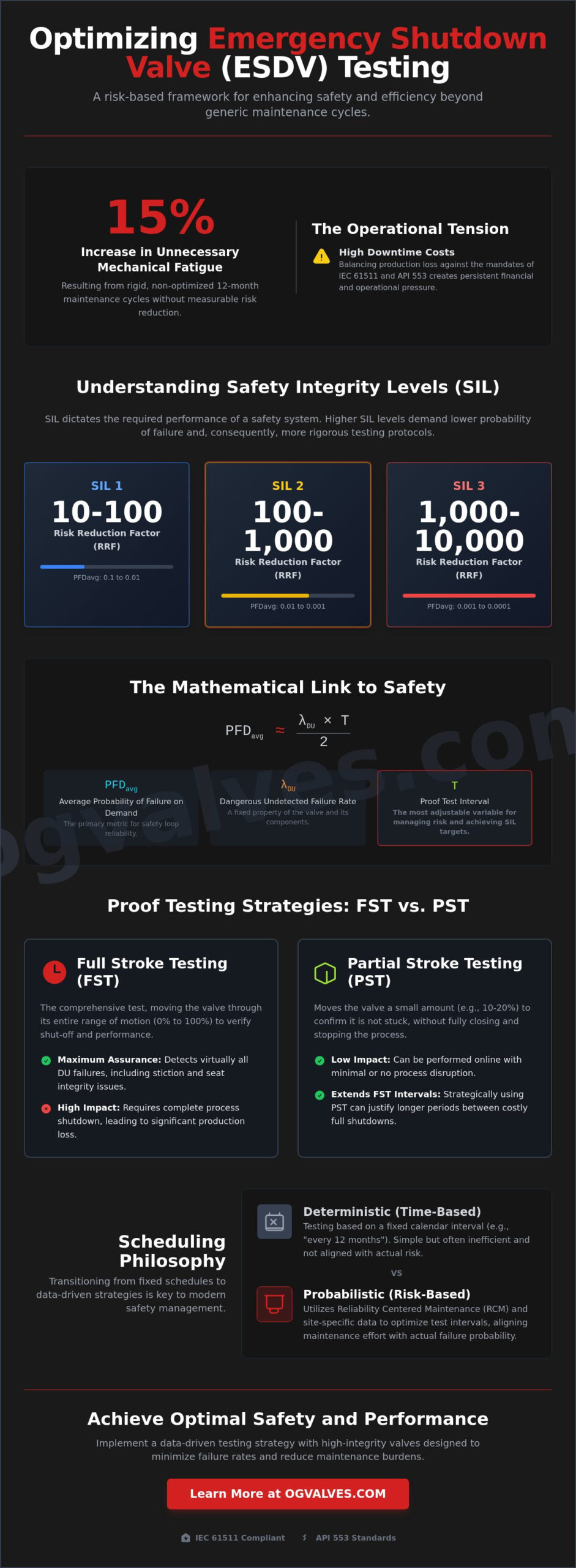
Adhering strictly to a generic 12 month maintenance cycle for final control elements often results in a 15% increase in unnecessary mechanical fatigue without a measurable reduction in risk. For high integrity pressure protection systems, the emergency shutdown valve testing frequency must be a calculated output of a Safety Integrity Level (SIL) verification rather than a manufacturer’s recommendation.
You’ve likely found that balancing the high cost of production downtime against the mandates of IEC 61511 creates a persistent operational tension. It’s difficult to justify the capital expenditure for Partial Stroke Testing (PST) equipment when the return on investment isn’t clearly quantified against the Probability of Failure on Demand (PFD).
This technical guide provides a precise framework for determining optimal test intervals through risk-based optimization and rigorous adherence to API 553 standards. We’ll analyze the quantitative impact of PST on safety lifecycles and define strategies to extend full-stroke intervals while maintaining total system integrity.
Key Takeaways
Analyze the technical correlation between testing intervals and Probability of Failure on Demand (PFDavg) to maintain required Safety Integrity Level (SIL) ratings.
Ensure rigorous regulatory compliance by aligning maintenance protocols with international engineering standards, including IEC 61511 and API 553.
Optimize the emergency shutdown valve testing frequency by integrating Partial Stroke Testing (PST) to extend Full Stroke Testing (FST) intervals without compromising system integrity.
Evaluate the transition from deterministic scheduling to probabilistic, risk-based approaches utilizing Reliability Centered Maintenance (RCM) and site-specific performance data.
Reduce long-term maintenance burdens through the strategic selection of high-integrity materials and valve designs engineered to mitigate corrosion-related stiction.
Understanding ESDV Testing Frequency and Safety Integrity Levels (SIL)
Functional Safety Management requires a rigorous approach to the maintenance of final elements in a Safety Instrumented System (SIS). The emergency shutdown valve (ESDV) serves as the final barrier against catastrophic events in high-pressure oil and gas environments. Testing these units isn’t a matter of routine maintenance; it’s a regulatory necessity under IEC 61508 and IEC 61511. Proof testing identifies Dangerous Undetected (DU) failures that diagnostic systems cannot capture during normal operation. Adopting a “set-and-forget” mentality leads to unquantified risk. Engineers must determine the emergency shutdown valve testing frequency based on the required Risk Reduction Factor (RRF) and the device’s failure rate data.
The Mathematical Relationship Between Intervals and Safety
The Average Probability of Failure on Demand (PFDavg) is the primary metric for assessing safety loop reliability. For a single-channel system, the simplified formula is PFDavg ≈ (λDU × T) / 2, where λDU represents the rate of dangerous undetected failures and T represents the proof test interval. This equation demonstrates that the testing frequency is a linear multiplier of risk. If a valve has a high failure rate, increasing the frequency can mathematically lower the PFDavg to meet a specific SIL target. This isn’t a substitute for high-quality hardware. Excessive testing increases mechanical wear and process downtime. The emergency shutdown valve testing frequency remains the most adjustable variable for compliance when hardware geometry is fixed.
SIL Ratings and Required Risk Reduction
Safety Integrity Level is the measure of safety system performance. Each SIL level requires a specific PFDavg range in low-demand mode. SIL 1 requires a range of 10^-1 to 10^-2, SIL 2 requires 10^-2 to 10^-3, and SIL 3 requires 10^-3 to 10^-4. An ESDV in a SIL 3 loop must demonstrate 99.9% availability to satisfy safety requirements. This target dictates the maximum allowable time between proof tests. For instance, a valve with a λDU of 5.0E-07 per hour might require a 6-month testing interval to maintain SIL 3 compliance, whereas a 12-month interval might only satisfy SIL 2. Rigorous adherence to these intervals ensures that the risk reduction remains within the design specification for the entire lifecycle of the asset.
SIL 1: Risk Reduction Factor 10 to 100; PFDavg 0.1 to 0.01.
SIL 2: Risk Reduction Factor 100 to 1,000; PFDavg 0.01 to 0.001.
SIL 3: Risk Reduction Factor 1,000 to 10,000; PFDavg 0.001 to 0.0001.
Regulatory Standards and Compliance Frameworks (IEC 61511 & API)
Determining the correct emergency shutdown valve testing frequency requires alignment with established international frameworks. Compliance isn’t a suggestion; it’s a technical mandate that ensures the integrity of high-hazard processes. The IEC 61511 standard serves as the primary global benchmark for safety instrumented systems (SIS) in the process industry. It dictates that every Safety Instrumented Function (SIF) must have a documented Safety Requirement Specification (SRS). This document explicitly defines the intervals for proof testing to ensure the Probability of Failure on Demand (PFD) remains within acceptable limits for the life of the plant.
IEC 61511: Functional Safety in the Process Sector
Engineers must verify that the chosen testing interval meets the target risk reduction factor (RRF) for the specific SIL rating of the loop. If a valve is rated for SIL 3, the testing frequency will be significantly higher than a SIL 1 application to account for the lower tolerance for failure. Documentation is critical. Regulatory bodies and insurance providers require rigorous logs of every test event. These records must prove that the valve performed its safety function within the specified response time. Failure to maintain these records can lead to immediate decertification of the safety loop during a 2026 audit.
API 553 and Refinery-Specific Protocols
In downstream environments, API 553 provides the technical foundation for emergency isolation valves (EIVs). This standard emphasizes the distinction between routine functional checks and comprehensive proof tests. While a routine check might verify actuator movement, a proof test must confirm tight shut-off and seat integrity under process conditions. This level of precision is fundamental when adhering to Industrial Valves: The Engineer’s Comprehensive Guide, which outlines how global standards influence material selection and design. For offshore operations, engineers must also adhere to 30 CFR § 250.880 testing requirements, which mandate specific quarterly and semi-annual inspections for safety valves in high-pressure environments.
Adherence to ASME B16.34 and ISO 5208 during the initial specification phase ensures that the valve body and seals can withstand the mechanical stress of frequent testing. Organizations like the Health and Safety Executive (HSE) in the UK or OSHA in the US enforce these regimes through periodic site audits. They focus on the “as-tested” reliability data to ensure it matches the original design intent. For facilities looking to optimize their safety protocols, consulting with an experienced valve manufacturer ensures that both hardware and testing schedules remain compliant with the latest 2026 industry updates.
SRS Documentation: Must include PFD calculations and the logic behind the test interval.
RRF Verification: Testing must prove the valve meets its designated Risk Reduction Factor.
Regulatory Audits: Proof of testing is the primary defense during HSE or OSHA inspections.
Initial Specification: ASME and ISO standards must be met before the valve enters service.
Full Stroke Testing (FST) vs. Partial Stroke Testing (PST) Intervals
Determining the optimal emergency shutdown valve testing frequency requires a balanced approach between Full Stroke Testing (FST) and Partial Stroke Testing (PST). FST stands as the definitive proof of valve integrity, verifying that the assembly can transition from a fully open state to a zero-leakage closed state. While FST provides 100% diagnostic coverage, its implementation often necessitates a complete production halt or the use of bypass systems. PST has emerged as a critical diagnostic supplement that allows operators to verify valve movement without interrupting the process flow.
Full Stroke Testing (FST): The Gold Standard
Engineers recognize FST as the only method to validate the total functional safety of the valve assembly. These tests typically occur during planned annual or biennial turnarounds, as they require the valve to reach the full limit of its travel. This process is essential for verifying seat leakage and mechanical closure integrity, which PST cannot evaluate. Following the guidelines in API Recommended Practice 14B is mandatory for maintaining compliance in high-pressure environments. FST remains a non-negotiable requirement regardless of intermediate testing because it identifies 100% of “fail-to-close” scenarios that partial movement might miss.
Partial Stroke Testing (PST): Extending the Safety Lifecycle
PST improves the Probability of Failure on Demand (PFD) by detecting approximately 70% of common valve failures. It’s particularly effective at identifying “stiction,” where the valve becomes stuck in its seat due to corrosion or polymer buildup. It also monitors for actuator spring fatigue, ensuring the stored energy is sufficient to move the stem. By implementing a monthly or quarterly emergency shutdown valve testing frequency through PST, facilities can extend the time between mandatory FST intervals while maintaining a high Safety Integrity Level (SIL).
PST detects 70% of potential failures without stopping production.
Automated routines are often integrated with industrial valve actuators to ensure consistent data logging.
PST cannot verify the 100% seal or internal seat condition.
Relying solely on PST is a technical risk. While it confirms the valve isn’t seized, it doesn’t guarantee the unit will hold pressure during a critical event. Engineers must use PST to bridge the gap between major turnarounds, utilizing the data to predict maintenance needs before a total component failure occurs. This data-driven approach ensures that the safety system remains functional throughout its operational life without incurring the costs of unnecessary shutdowns.
Deterministic vs. Probabilistic Approaches to Test Scheduling
Refining the emergency shutdown valve testing frequency involves a choice between deterministic and probabilistic methodologies. The deterministic approach utilizes fixed intervals established by manufacturer specifications or industry standards such as API 553. It’s a conservative strategy that applies historical averages to all units, regardless of local operating conditions. While this ensures a baseline level of safety, it often leads to over-maintenance in benign environments or under-maintenance in severe service applications.
The probabilistic, or risk-based, approach integrates Reliability Centered Maintenance (RCM) to tailor schedules to specific assets. By calculating the Probability of Failure on Demand (PFD), engineers can adjust intervals based on real-time risk profiles. Several factors accelerate mechanical failure and necessitate tighter schedules:
High-cycle applications that exceed 500 strokes per year.
Media containing corrosive agents or abrasive particulates.
Extreme temperature fluctuations that induce thermal fatigue.
Valve geometry also dictates maintenance needs. A trunnion-mounted ball valve typically resists fouling better than a butterfly valve in high-solids applications. The disc of a butterfly valve remains in the flow path, creating turbulence and potential sites for mineral scaling. These design characteristics must be factored into the final testing matrix to ensure operational integrity.
Environmental and Media Impact on Frequency
Media composition dictates the rate of component degradation. Sour service environments involving H2S require strict adherence to NACE MR0175 standards and often demand 25% more frequent testing than sweet service counterparts. Abrasive slurries cause rapid erosion of the seat and seal interface, requiring quarterly inspections to prevent bypass. Proper Industrial Ball Valve material selection is the primary defense against such corrosion. Cryogenic service at -196°C and high-heat service above 400°C both compromise seal elasticity, making periodic leakage tests essential for maintaining safety thresholds.
Analyzing Historical Failure Data
Engineers utilize Mean Time To Failure (MTTF) data to validate the extension or reduction of test intervals. By comparing “As-Found” condition reports with “As-Left” settings, maintenance teams can identify wear patterns before a critical failure occurs. If data shows a valve maintains its seal integrity over three consecutive years, the emergency shutdown valve testing frequency may be safely extended. Historical data is the only empirical basis for risk-based scheduling. This rigorous analysis aligns with ISO 10423 requirements for performance verification in high-pressure systems.
Review our technical specifications for high-performance valves engineered for aggressive media.
Optimizing Valve Selection to Minimize Testing Burden
The selection of high-integrity valve components directly influences the required emergency shutdown valve testing frequency by reducing the Probability of Failure on Demand (PFDavg). Engineers can extend proof-test intervals by specifying hardware that resists common failure modes like seat leakage and stem stiction. It’s essential to utilize corrosion-resistant alloys (CRAs) such as Super Duplex UNS S32750 or Inconel 625 to prevent the accumulation of scale and oxidation that leads to mechanical binding. These materials maintain surface integrity in aggressive environments, ensuring the valve remains operable even after long periods of inactivity.
Actuator reliability is equally critical. Selecting units with high Mean Time To Failure (MTTF) ratings and SIL 3 certification provides the necessary torque margins to overcome breakaway forces. A robust actuator design minimizes the risk of partial stroke test failures. This helps maintain the safety integrity level without necessitating frequent full-stroke interventions. Precision in component selection shifts the maintenance strategy from reactive repairs to optimized, data-driven schedules. High-specification components don’t just improve safety; they reduce the operational overhead associated with mandatory compliance cycles.
Specifying for Reliability
Adherence to API 6D and API 600 standards ensures that valves meet rigorous wall thickness and structural integrity requirements for high-pressure service. Metal-seated ball valves are often preferred over soft-seated alternatives because they resist the failures caused by elastomer degradation or particulate embedding. For high-performance isolation needs where space is a constraint, engineers often specify Industrial Butterfly Valves that utilize triple-offset designs to achieve zero-leakage performance. These configurations reduce the friction-induced wear that typically accelerates the emergency shutdown valve testing frequency required by plant safety protocols under IEC 61511.
OG Valves Procurement and Technical Support
OG Valves provides a clinical focus on supplying components that exceed international safety specifications. We prioritize the delivery of valves that undergo 100% hydrostatic and pneumatic testing before dispatch. Our global logistics network ensures that critical safety components reach site locations within specified turnaround windows, preventing costly delays in infrastructure projects. We manage complex procurement cycles for the oil, gas, and water treatment sectors, maintaining an inventory of high-specification valves ready for immediate deployment. Consult with OG Valves for your high-integrity valve specifications.
Optimizing Asset Integrity through Quantitative Testing Protocols
Adhering to the 2026 updates for IEC 61511 and API 553 standards is essential for maintaining Safety Integrity Level (SIL) 3 performance across high-pressure environments. Engineers must move beyond static maintenance schedules to adopt probabilistic models that prioritize data-driven reliability. Determining the precise emergency shutdown valve testing frequency isn’t just a compliance requirement; it’s a fundamental strategy for preventing catastrophic failure while maximizing plant uptime. Integrating Partial Stroke Testing (PST) can effectively extend intervals between Full Stroke Testing (FST) cycles by up to 50%, significantly reducing operational disruptions.
OG Valves supports these critical safety objectives with a comprehensive inventory of API 6D and ISO 9001 certified valves. We provide deep technical expertise in SIL-compliant valve assemblies, ensuring every component meets rigorous engineering specifications. Our global fast-track delivery system is engineered to mitigate downtime in heavy industry sectors including oil, gas, and water treatment. We’re ready to partner with your engineering team to deliver long-term durability and precision.
What is the standard testing frequency for an emergency shutdown valve?
The standard emergency shutdown valve testing frequency typically ranges between 12 and 24 months as dictated by IEC 61511 standards. High-demand systems require more frequent intervals, often every 6 months, to maintain the required Probability of Failure on Demand. Engineers must calculate specific intervals based on the device’s failure rate and the targeted Safety Integrity Level. Adhering to these rigorous schedules ensures compliance with international safety protocols and minimizes industrial risk.
Can Partial Stroke Testing (PST) replace Full Stroke Testing (FST)?
Partial Stroke Testing cannot replace Full Stroke Testing because it only detects approximately 70% of potential failure modes. While PST extends the interval between full shutdowns, it doesn’t verify the valve’s ability to achieve a tight shut-off or validate seat integrity. IEC 61508 requires periodic FST to address the remaining 30% of dangerous undetected failures. Operators use PST as a diagnostic tool to improve reliability without halting production cycles.
How does SIL 2 vs SIL 3 affect the required testing interval?
A SIL 3 rating requires a Probability of Failure on Demand between 0.001 and 0.0001, which often necessitates testing intervals 50% more frequent than SIL 2 configurations. While a SIL 2 system might permit a 24-month test cycle, a SIL 3 loop frequently demands a 12-month or 6-month proof test to meet the higher risk reduction factor. These calculations depend on the specific hardware fault tolerance and the verified reliability data of the valve assembly.
What are the legal requirements for ESDV testing in the UK?
Legal requirements for ESDV testing in the UK are governed by the Health and Safety at Work Act 1974 and the Pressure Systems Safety Regulations 2000. Regulation 8 of PSSR explicitly mandates a Written Scheme of Examination that defines the nature and frequency of inspections. Failure to comply with these statutory requirements can result in HSE enforcement actions. Operators must maintain detailed records of every proof test for at least 5 years to demonstrate compliance.
What happens if an ESDV fails its proof test?
If an ESDV fails its proof test, the facility must initiate an immediate technical investigation and implement compensatory measures to maintain safety. The valve is typically removed for overhaul or replaced if it doesn’t meet the leakage rates specified in API 598 or ANSI/FCI 70-2. Engineers must record the “as-found” condition to determine if the failure was systematic or random. This data then informs adjustments to the future emergency shutdown valve testing frequency.
How do environmental conditions like subsea or desert environments change test frequency?
Subsea and desert environments increase the failure rate of components, often requiring a 30% reduction in testing intervals compared to temperate onshore installations. Subsea valves face hydrostatic pressure and internal scaling, while desert units deal with 50 degree Celsius temperatures and abrasive particulate ingress. These conditions accelerate seal degradation and actuator fatigue. Engineers utilize ISO 12490 guidelines to adjust proof test intervals based on these specific site stress factors and material performance.
Is there a difference in testing frequency between pneumatic and electric actuators?
Pneumatic actuators typically require more frequent seal inspections due to elastomer aging, whereas electric actuators demand specialized diagnostic testing of the motor drive and battery backup systems every 6 months. Pneumatic systems are susceptible to instrument air contamination, which can cause internal sticking. Electric units, while less prone to air quality issues, face electronic component degradation in high-vibration environments. Both types must undergo full functional testing at intervals defined by the loop’s SIL target.
How is stiction detected during an ESDV test?
Stiction is detected by analyzing the relationship between the actuator’s supply pressure and the valve’s stem position during a Partial Stroke Test. A sudden jump in movement after a significant pressure increase indicates a static friction threshold higher than the operational norm. Modern digital positioners record this data, providing a stiction percentage. If stiction exceeds 5% of the total stroke range, the valve requires immediate lubrication or packing adjustment to prevent a fail to move scenario.
 Responsive Menu