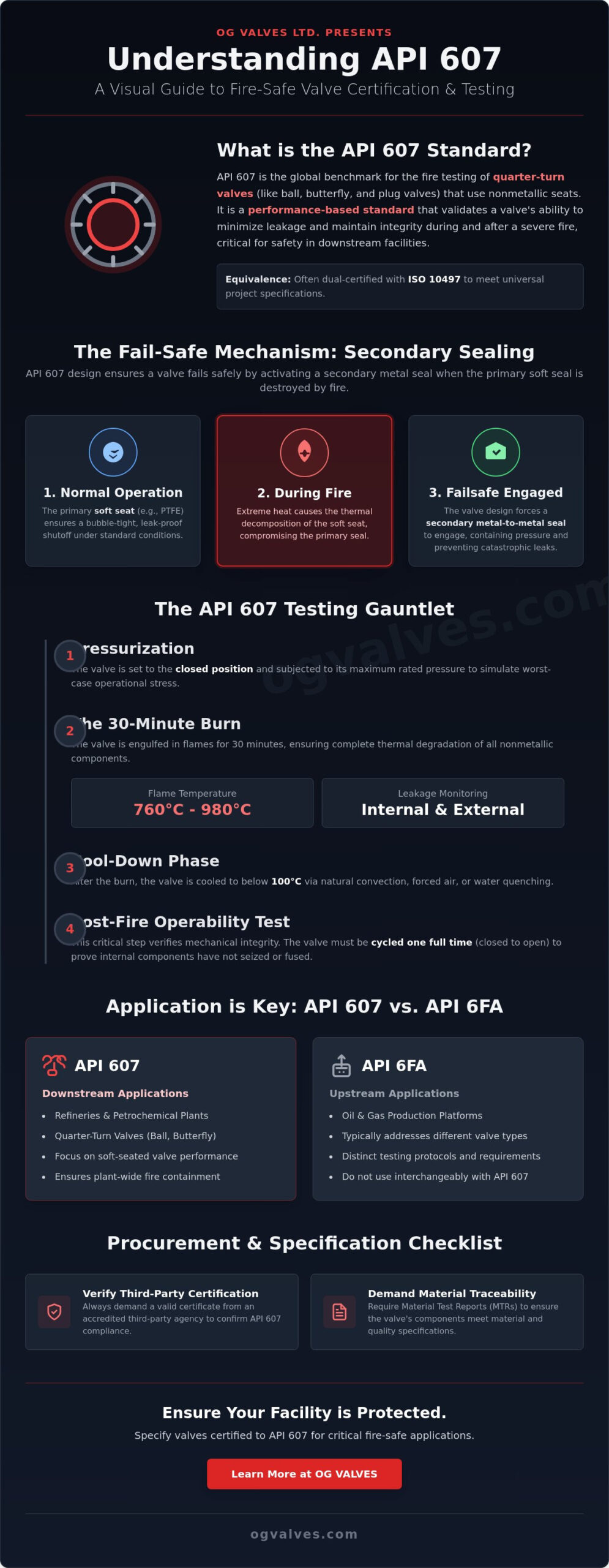
In high-pressure industrial environments, the difference between a controlled shutdown and a catastrophic failure often rests on the activation of a secondary metal-to-metal seal. Adherence to rigorous fire safe valve design standards api 607 ensures that quarter-turn valves and components with nonmetallic seats maintain integrity when primary soft seals perish in a thermal event. This standard defines the benchmarks for durability in refineries and downstream facilities where the cost of failure is absolute.
Technical experts recognize that distinguishing between various fire-testing protocols is a complex task. The ambiguity between downstream requirements and upstream standards like API 6FA often leads to procurement errors that compromise high-hazard zones. This article provides a clinical analysis of API 607 8th Edition parameters, focusing on the engineering of secondary sealing mechanics and the equivalence of ISO 10497. You’ll gain a precise understanding of testing protocols and certification requirements to ensure your specifications for ball, butterfly, or plug valves meet the highest global benchmarks for industrial safety and regulatory adherence.
Key Takeaways
- Analyze the mandatory 30-minute burn period and flame temperature benchmarks required for API 607 certification.
- Understand how secondary metal-to-metal sealing provides failsafe integrity after the thermal decomposition of primary soft seats.
- Master the fire safe valve design standards api 607 to properly differentiate between downstream requirements and the upstream-focused API 6FA.
- Implement rigorous procurement protocols by verifying third-party certifications and ensuring material traceability via Material Test Reports.
Defining Fire Safe Valve Design and the API 607 Standard
The industrial sector relies on standardized testing to quantify the resilience of critical infrastructure components. API 607 serves as the benchmark fire test for quarter-turn valves and valves equipped with nonmetallic seats. It isn’t a mere material classification. It’s a performance-based designation that validates a valve’s ability to maintain pressure containment during and after a fire. The current 8th Edition, published in October 2022, continues to refine these requirements to ensure global regulatory adherence. This standard has seen universal adoption across international markets, often being dual-certified with ISO 10497 to meet diverse project specifications in heavy industrial sectors.
Standard operational parameters often dictate the use of soft-seated ball valves or butterfly valves for bubble-tight shutoff. These primary seats, typically manufactured from PTFE or RPTFE, provide superior sealing under normal conditions but fail rapidly when exposed to extreme thermal loads. The fire safe valve design standards api 607 mandate an engineered fail-safe design where the destruction of these nonmetallic components triggers a secondary metal-to-metal seal. This transition is critical for preventing the uncontrolled release of flammable media into a high-risk environment. Engineering teams must distinguish between valves that are “fire safe by design” and those that have undergone third-party certification to ensure operational output matches safety mandates.
The Core Objective of Fire-Safe Certification
The primary objective of API 607 certification is the mitigation of fire escalation within petrochemical and refinery facilities. By ensuring that a valve maintains its structural integrity and seat tightness after a 30-minute burn period, the standard allows for the safe isolation of downstream systems. This containment is essential for emergency shutdowns. It prevents a localized fire from becoming a facility-wide catastrophe. Reliability in these scenarios isn’t optional. It’s a fundamental requirement for industrial safety. The focus remains on two specific leakage paths: external leakage through the stem or body seals and internal leakage through the valve seat during the burn and cool-down phases.
Applicability Across Valve Architectures
While API 600 and API 6D focus on the general design and construction of gate, globe, and check valves, API 607 specifically addresses the fire-testing of quarter-turn valves like ball, butterfly, and plug valves. Multi-turn valves with metal seats are often inherently fire-safe by design, yet quarter-turn valves require rigorous testing due to their reliance on soft materials for operational efficiency. The standard ensures that even if the primary seal is compromised, the valve remains a dependable barrier against high-pressure leaks. This distinction is vital for procurement specialists who must select components for high-risk industrial environments where the failure of a single valve can lead to catastrophic consequences.
The validation of fire safe valve design standards api 607 requires a methodical and destructive testing sequence. A valve is subjected to total flame envelopment for a duration of 30 minutes. During this period, the flame temperature must be maintained between 760°C and 980°C. This ensures the complete thermal degradation of nonmetallic components. The test is conducted with the valve in the closed position and under maximum rated pressure. This pressure varies depending on the specific valve class being certified. Throughout the burn period, technicians monitor both internal and external leakage rates to ensure they remain within the strict limits defined by the API Standard 607. If you are specifying components for high-risk zones, selecting certified ball and butterfly valves is the only way to guarantee this level of thermal resilience.
The Operational Test Phase
Once the 30-minute burn period concludes, the valve enters the cooling phase. This is achieved through natural convection, forced air, or water quenching. A critical requirement often overlooked in surface-level technical summaries is the post-fire operability test. After the valve has cooled to below 100°C, it must be cycled one full time from the closed to the open position under a specific pressure differential. This step confirms that the internal components haven’t fused or distorted to the point of total seizure. Leakage is measured again after this cycle. The allowable leakage for a 6-inch valve during the burn period is typically capped at 400 ml per minute, while external leakage must not exceed 100 ml per minute.
Certification of Valve Size and Pressure Classes
API 607 provides a framework for qualifying a range of products through a single successful test. This efficiency is governed by strict rules regarding size and pressure class. For example, testing a Class 300 valve qualifies both Class 150 and Class 300 valves of the same design. However, testing a Class 150 valve does not qualify higher pressure classes. Size qualification follows a similar logic; testing a 2-inch valve qualifies sizes 2-inch, 2.5-inch, 3-inch, and 4-inch. Material integrity is also paramount. If the body material is changed from carbon steel to stainless steel, the valve may require re-testing unless the materials fall within the same group classification. This ensures that the structural soundness and thermal expansion characteristics remain consistent across the certified product line.
Engineering the Secondary Seal: How API 607 Valves Prevent Leakage
In standard operations, soft-seated valves utilize nonmetallic inserts like PTFE or RPTFE to achieve a zero-leakage seal. These materials act as sacrificial components during a thermal event. When the environment reaches the temperatures specified in the fire safe valve design standards api 607, these soft seats undergo rapid thermal decomposition. As the nonmetallic material vanishes, the valve relies on its internal geometry to maintain containment. Line pressure or internal spring-loading mechanisms force the ball or disc downstream against a machined metal shoulder. The secondary seal’s effectiveness depends on the precise machining of the metal seat ring to ensure a continuous contact surface with the closure element after the nonmetallic components have disintegrated. This transition is a mechanical failure by design. It ensures the valve remains an effective barrier against high-pressure media release even in a compromised state.
Stem and Body Sealing in Fire Conditions
Stem integrity is a primary concern during the 30-minute burn test. Standard O-rings fail instantly. Fire-safe designs employ flexible graphite packing instead. This material maintains its volume and sealing properties at temperatures exceeding 1000°C. Similarly, body gaskets must withstand extreme heat without yielding. Engineers specify spiral wound gaskets featuring stainless steel windings and graphite fillers. These gaskets provide the necessary resilience to prevent external leakage through the body-to-cap interface. Fire-resistant bolting, typically manufactured from high-strength alloys like ASTM A193 Grade B7, ensures the valve assembly remains intact under the combined stress of internal pressure and thermal expansion.
Material Integrity and Thermal Expansion
Managing the differential thermal expansion between the ball and the valve body is critical for maintaining operability. If the internal closure element expands at a higher rate than the surrounding body, the valve will seize. High-performance industrial valves are engineered with specific clearances and material pairings to accommodate these dimensional changes. Using fire-resistant alloys with matched coefficients of thermal expansion prevents mechanical binding. This engineering precision allows the valve to be cycled after the fire has been extinguished. Without these considerations, the structural soundness of the valve would be compromised. This could lead to a loss of containment or a failure to operate during an emergency shutdown.
Selection Framework: API 607 vs. API 6FA and ISO 10497
Differentiating between global fire-testing protocols is essential for establishing reliable procurement specifications in heavy industrial sectors. Technical experts must often decide between API 607, API 6FA, and ISO 10497 based on the specific application and valve architecture. The current fire safe valve design standards api 607, specifically the 8th Edition published in October 2022, are technically equivalent to ISO 10497. This alignment allows for dual certification, which simplifies the global supply chain and ensures adherence to international benchmarks. In contrast, API 6FA addresses a broader scope of valve types, including gate and check valves, and is primarily utilized in upstream environments. Understanding these technical nuances prevents the misapplication of components in high-pressure systems where the cost of failure is absolute.
When to Choose API 607
Refineries and petrochemical facilities prioritize API 607 for soft-seated, quarter-turn isolation components. This standard specifically validates the performance of nonmetallic seats under extreme thermal stress. It’s the mandatory specification for butterfly valves and ball valves used in fire-critical lines where bubble-tight shutoff is required during normal operations. Selecting API 607 ensures the valve meets the stringent 30-minute burn criteria required for downstream safety. For procurement specialists, this certification acts as the primary form of brand validation in hazardous environments. It guarantees that the valve’s fail-safe design will activate predictably when primary seals perish.
The Scope of API 6FA
The scope of API 6FA extends beyond the quarter-turn designs covered by API 607. It’s frequently specified for upstream wellhead and pipeline applications where gate and check valves are the standard. A new draft of API 6FA, the 6th Edition, was released for public review with a closing date of April 24, 2025. This update signals a continued shift toward more rigorous upstream safety benchmarks. While API 6FA is often perceived as more demanding due to its application across diverse architectures, its leakage allowances and testing durations remain comparable to API 607 in most categories. Engineers must verify if a project requires the specific upstream focus of 6FA or the downstream precision of 607 to maintain regulatory adherence.
Comparative analysis of leakage allowances reveals that API 607 and ISO 10497 share identical limits for through-seat and external leakage. API 6D fire-safe valves typically refer back to these standards for their testing protocols rather than establishing independent criteria. To ensure your facility meets these rigorous benchmarks, consult our technical experts for API 607 certified ball, butterfly, and plug valve specifications. Choosing the correct standard is a matter of functional reality and long-term performance in critical infrastructure.
Procurement Specifications for Fire-Critical Applications
The selection of components for high-risk industrial environments requires an unwavering focus on durability and regulatory adherence. Rigorous adherence to fire safe valve design standards api 607 must be validated through third-party certification from recognized bodies such as Lloyd’s Register or DNV. This independent oversight ensures the valve’s performance during the destructive testing phase matches the engineering claims. Material traceability is equally vital. Procurement specialists must demand comprehensive Material Test Reports (MTRs) to verify that the body, ball, and stem materials align with the tested configurations. MTRs provide this verification. For automated systems, specifying fire-safe actuators is essential to ensure the entire assembly maintains control during a thermal event. It’s a fundamental step in preventing external leakage through the stem assembly.
Critical Checklist for Valve Specification
A clinical approach to specification prevents the risk of catastrophic failure in high-pressure systems. You must confirm the valve is ‘fire-tested’ and certified rather than merely being ‘fire-safe by design’. The latter lacks the empirical evidence required by fire safe valve design standards api 607 to prove containment under thermal load. Every specification should include the following points:
- Verify the specific certification range for size and pressure class to ensure it covers your operational needs.
- Review the manufacturer’s internal quality control protocols and the proximity of their testing facilities to global benchmarks.
- Confirm that secondary metal-to-metal sealing is activated by mechanical line pressure or spring loading.
- Audit manufacturer quality control protocols to ensure consistency between the tested prototype and the production units.
The OG VALVES Advantage in Global Supply
OG VALVES operates as a seasoned industrial expert in the provision of certified flow control solutions. We maintain an extensive inventory of API 607 certified ball valves, butterfly valves, and plug valves for immediate dispatch. Our technical teams possess the expertise to align complex project demands with international regulatory benchmarks. We understand that emergency facility maintenance requires fast-track delivery. Our global logistics network is engineered to minimize downtime in high-stakes industrial sectors. Whether your project requires gate, globe, or check valves for standard service or certified quarter-turn components for fire-critical lines, we deliver the structural soundness and operational output necessary for long-term performance. You’ll find that our commitment to engineering excellence acts as a benchmark for industrial safety.
Advancing Industrial Safety Through Standardized Excellence
Mastering the engineering requirements of fire safe valve design standards api 607 is fundamental to ensuring the integrity of downstream infrastructure. This technical analysis has defined the critical 30-minute burn parameters and the mechanical activation of secondary metal-to-metal sealing required for high-pressure containment. It’s clear that certification isn’t a secondary consideration but a primary requirement for safety in high-risk zones. Selecting the correct standard ensures that your facility maintains regulatory adherence and operational resilience during a thermal event. Precise procurement, backed by third-party verification and material traceability, remains the only path to mitigating the risk of catastrophic failure.
Reliability in critical infrastructure depends on the precision of your specifications. OG VALVES provides the technical expertise and comprehensive inventory of high-spec components necessary to meet these rigorous global benchmarks. Our global logistics network supports fast-track delivery to minimize downtime during emergency maintenance or large-scale project execution. We invite you to Request a Technical Quote for API 607 Certified Valves to secure your facility’s long-term performance. We look forward to partnering with your engineering team to deliver dependable flow control solutions that prioritize industrial safety.
Frequently Asked Questions
Is API 607 the same as API 6FA?
API 607 and API 6FA are distinct standards with different scopes. API 607 targets quarter-turn valves with nonmetallic seats, primarily in downstream refineries. API 6FA covers upstream wellhead equipment and pipelines, including gate and check valves. While both use similar temperature benchmarks, their application across different valve architectures and pressure classes makes them non-interchangeable in procurement specifications.
What defines a valve as ‘fire-safe’?
A valve is defined as fire-safe when it achieves a performance-based certification for pressure containment during a thermal event. It’s not a material classification. The design must prevent external and internal leakage after the primary soft seals decompose. Compliance with fire safe valve design standards api 607 confirms that the valve will maintain structural integrity and allow for emergency isolation in hazardous industrial environments.
Can a metal-seated valve be API 607 certified?
Metal-seated valves can undergo API 607 testing, but they’re often considered inherently fire-safe by design. The standard specifically addresses valves that rely on nonmetallic components for primary sealing. If a metal-seated valve requires certification for a downstream project, it must pass the same 30-minute burn and post-test operability criteria. This ensures the metal-to-metal contact remains effective under extreme thermal expansion.
How long does an API 607 fire test last?
The standardized fire test duration is exactly 30 minutes of total flame envelopment. During this period, the valve must withstand temperatures ranging from 760°C to 980°C while under constant pressure. Monitoring leakage rates during this window is mandatory. After the burn, the valve must cool to below 100°C before the final operability and leakage tests begin.
What is the difference between API 607 and ISO 10497?
API 607 and ISO 10497 are technically equivalent in their current editions. This alignment ensures that a valve tested to one standard automatically satisfies the requirements of the other. Most manufacturers pursue dual certification to streamline global supply chain compliance. This equivalency simplifies the selection process for procurement specialists managing international projects with diverse regulatory requirements.
Are all ball valves fire-safe by default?
Standard ball valves are not fire-safe by default. Most utilize soft seats like PTFE that fail rapidly at high temperatures. To be fire-safe, the valve must incorporate a secondary metal-to-metal seal and fire-resistant packing. It must also pass a certified fire test. Using fire safe valve design standards api 607 as a benchmark is the only way to verify these capabilities.
What happens if a valve fails the post-burn operability test?
Failure of the post-burn operability test results in the immediate disqualification of the valve design. The standard requires the valve to be cycled once from the closed to the open position after it has cooled. This confirms that internal components haven’t fused or distorted. If the valve cannot cycle or if leakage exceeds the post-test limits, it doesn’t meet the safety criteria for critical service.
Does API 607 certification expire?
API 607 certification remains valid for the specific design version and material group tested. It doesn’t have a calendar expiration date. However, when the American Petroleum Institute publishes a new edition, such as the 8th Edition in October 2022, manufacturers should re-verify their designs against the updated criteria. Any significant changes to the valve’s body material or internal geometry typically mandate a new fire test.
 Responsive Menu