Forged vs Cast Steel Valve Comparison: A Technical Engineering Guide (2026)
April 27, 2026
Home+Forged vs Cast Steel Valve Comparison: A Technical Engineering Guide (2026)
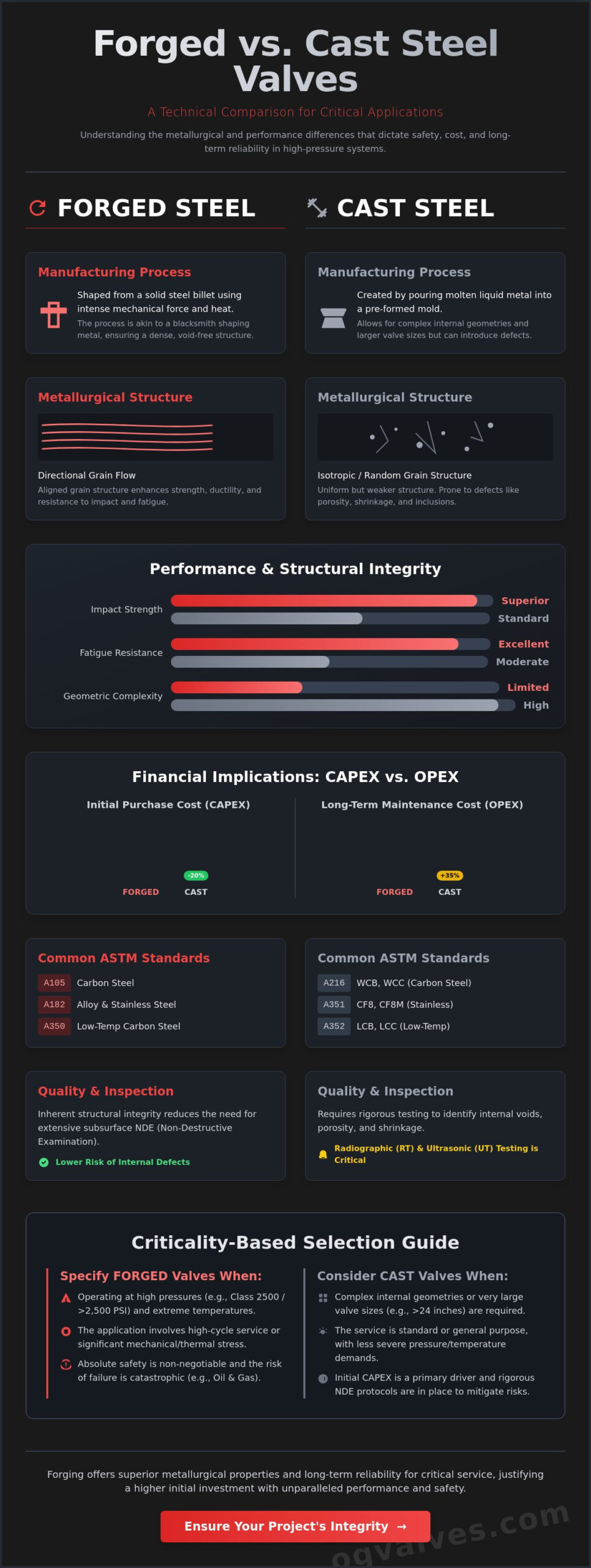
Selecting a cast valve body to reduce initial CAPEX by 20% often results in a 35% increase in long-term maintenance costs due to subsurface defects. While casting allows for complex internal geometries, it lacks the directional grain flow that gives forged components their superior impact strength. This forged vs cast steel valve comparison examines the metallurgical differences that dictate performance in extreme environments. It’s a critical distinction for engineers who cannot afford the risk of internal porosity in high-pressure systems.
You’re aware that maintaining API 600 or API 602 compliance isn’t optional when operating at pressures exceeding 2,500 PSI. Navigating complex ASME B16.34 pressure-temperature ratings requires a precise understanding of how casting porosity or forging grain flow affects system integrity. This guide provides the technical data necessary to justify material selection and mitigate the risk of failure in critical service. We’ll help you balance project lead times with the non-negotiable requirement for absolute safety.
This article delivers an authoritative breakdown of how forged and cast steel behave under intense thermal cycling and mechanical stress. We’ll evaluate specific selection criteria for 2026 industrial projects, ensuring your procurement decisions align with the highest global safety standards. You’ll gain a clear roadmap for identifying which manufacturing process meets the rigorous demands of your specific infrastructure application.
Key Takeaways
Analyze the metallurgical distinctions between directional grain flow in forged components and the complex geometric capabilities provided by the casting process.
Establish clear regulatory alignment by differentiating between API 600 and API 602 standards for small-bore and large-scale valve specifications.
Apply this technical forged vs cast steel valve comparison to select appropriate materials for Class 2500 pressure ratings and extreme thermal environments.
Identify critical quality control protocols, including radiographic and ultrasonic testing, required to mitigate risks associated with internal porosity and shrinkage.
Assess mechanical integrity requirements to ensure industrial compliance and long-term performance in high-stakes oil, gas, and water treatment infrastructure.
The Metallurgical Foundation: Defining Cast and Forged Steel Valves
The selection process for industrial flow control requires a precise forged vs cast steel valve comparison to ensure mechanical integrity under extreme pressure. At the metallurgical level, the distinction begins with the initial state of the raw material. Casting utilizes molten liquid metal poured into pre-formed molds, a method that facilitates the creation of complex internal geometries and larger valve sizes. Conversely, forging involves the mechanical deformation of a solid steel billet through intense heat and compressive force. This fundamental difference in thermal processing dictates the final grain structure and molecular density of the valve body. Casting allows for isotropic properties where the metal is uniform in all directions, while forging creates a directional grain flow that aligns with the shape of the component, resulting in higher impact strength and fatigue resistance.
Cast Steel Valve Manufacturing Processes
Cast valves are typically produced via sand casting or investment casting. Sand casting remains the industrial standard for larger diameter valves, utilizing compacted silica to form the mold cavity. Investment casting, or lost-wax processing, provides superior surface finishes and tighter dimensional tolerances for smaller, high-precision components. The primary advantage of casting lies in its ability to form intricate internal flow paths that are difficult to achieve through machining alone. Engineers specify cast materials based on service temperature and pressure. Common grades include ASTM A216 WCB for general purpose, WCC for higher pressure ratings, and LCB for low-temperature applications down to -46°C.
Forged Steel Valve Manufacturing Processes
The forging process relies on open-die or closed-die methods to shape the valve body. Open-die forging is generally reserved for very large components, while closed-die forging, or impression-die, is the standard for high-pressure gate, globe, and check valves. The Metallurgical Foundation: Defining Forged Steel highlights how the application of thermal energy below the melting point preserves the solid-state integrity of the metal. This mechanical working refines the grain structure, eliminating internal voids and gas pockets common in liquid-state transitions. This results in enhanced metal elasticity and structural reliability in high-cycle environments. Standard forged specifications include ASTM A105 for carbon steel, ASTM A182 for stainless and alloy steels used in corrosive service, and ASTM A350 LF2 for low-temperature carbon steel requirements. Understanding these material foundations is critical when conducting a forged vs cast steel valve comparison for API 600 or API 602 compliance.
Mechanical Integrity and Structural Performance Comparisons
Mechanical reliability in severe service hinges on the internal microstructure of the pressure-retaining envelope. A forged vs cast steel valve comparison reveals that while both methods satisfy baseline ASME B16.34 requirements, their behavior under cyclic loading differs significantly. Forging eliminates internal voids through mechanical compression. Casting relies on rigorous volumetric inspection to identify subsurface defects that are inherent to the solidification process.
The Grain Structure Advantage in Forging
Grain flow is the primary differentiator in mechanical reliability. In forgings, the metal undergoes controlled plastic deformation that refines the grain size and aligns it with the valve’s geometric contour. This directional orientation increases resistance to stress corrosion cracking (SCC) by approximately 25% compared to the random, dendritic structures found in cast components. These refined grains provide superior impact toughness, maintaining structural integrity at temperatures as low as -196°C in cryogenic applications.
Porosity and Inclusion Risks in Castings
Castings are susceptible to gas porosity and sand inclusions during the transition from liquid to solid state. Large-bore cast valves often require extensive radiographic testing (RT) to meet API 600 standards; it’s common for these inspections to mandate weld repairs to achieve compliance. While modern vacuum casting techniques reduce these defects by 40% compared to traditional sand casting, the resulting structure remains isotropic. Forging avoids these volumetric flaws entirely, ensuring a higher degree of safety in high-pressure steam and hydrocarbon service. Engineers seeking maximum safety often specify forged components for critical isolation points where the cost of a pressure boundary failure is catastrophic.
Tensile strength in forged F316H stainless steel remains more consistent across the cross-section than in cast CF8M equivalents. In power generation, thermal fatigue resistance is a critical metric for long-term performance. Forgings withstand rapid temperature ramps of 50°C per minute without the risk of crack propagation that can occur at casting shrinkage sites. This structural homogeneity ensures a longer fatigue life in 600-series pressure classes and above. This forged vs cast steel valve comparison underscores why high-energy piping systems prioritize forged materials for safety-critical infrastructure.
Industry Standards and Regulatory Alignment: API 600 vs. API 602
Engineering specifications for industrial valves rely on strict adherence to international standards to ensure safety and performance under high-pressure conditions. The forged vs cast steel valve comparison is defined by the size-and-class divide dictated by the American Petroleum Institute (API) and the American Society of Mechanical Engineers (ASME). ASME B16.34 serves as the foundational standard, establishing the pressure-temperature ratings and minimum wall thickness requirements for both forged and cast valve bodies across all material groups.
The selection between forging and casting is rarely arbitrary; it’s a direct response to the valve’s nominal pipe size (NPS) and pressure class. Small-bore systems, typically defined as NPS 4 and smaller, utilize forged components to manage the stresses of high-pressure instrumentation. Larger systems transition to cast steel to maintain cost-efficiency and geometric complexity that forging cannot easily achieve. Standardized compliance ensures that a valve’s structural integrity matches the operational demands of the refinery or power plant.
API 602 and the Forged Standard for Small-Bore Systems
API 602 governs the design and construction of compact forged steel gate, globe, and check valves. This standard is the industry benchmark for valves NPS 4 and smaller, particularly in Class 800 and Class 1500 applications. Forging is the default manufacturing method here because it eliminates internal porosity and gas pockets, which are common risks in small-scale castings. These valves provide the high-integrity sealing required for volatile fluids and high-pressure steam. Engineers often reference these standards when selecting industrial ball valves to ensure material consistency across a project’s piping specification. The dense grain structure of API 602 valves facilitates superior resistance to thermal fatigue and mechanical shock in compact systems.
API 600 and Large-Bore Cast Valve Requirements
API 600 defines the heavy-duty requirements for cast steel gate valves used in refinery and oil and gas services. This standard is more rigorous than ASME B16.34 alone, as it mandates additional wall thickness to compensate for potential material variability inherent in the casting process. By requiring extra “corrosion allowance” and structural bulk, API 600 ensures a longer service life in corrosive or erosive environments. This standard is critical for large-bore valves where forging is technically or economically unfeasible. For a deeper technical analysis of these heavy-duty components, consult A Technical Guide to Industrial Gate Valves. API 600’s focus on robust internal clearances and stem diameters makes it the primary specification for critical infrastructure where failure isn’t an option. It’s the definitive framework for maintaining safety in large-scale fluid transport.
Criticality-Based Selection: When to Specify Forged vs. Cast
Engineering specifications dictate the forged vs cast steel valve comparison based on mechanical stress, thermal cycles, and the potential consequences of component failure. For high-pressure systems operating at ASME Class 2500 or above, forged steel is the industry benchmark. The forging process eliminates internal porosity and gas pockets, ensuring structural integrity under extreme pressure fluctuations. In cryogenic applications reaching -196°C or super-heated steam lines exceeding 540°C, the grain refinement of forged materials prevents brittle fracture and thermal fatigue.
Cast valves offer distinct advantages in erosive environments despite the superior strength of forgings. The casting process facilitates the production of thicker wall sections that often exceed standard ASME B16.34 requirements. This additional material serves as a vital corrosion allowance for systems handling abrasive slurries or corrosive fluids where material loss is anticipated over the valve’s lifecycle. Selecting the correct manufacturing method requires balancing these physical properties against the project’s total cost of ownership.
High-Pressure and Critical Safety Applications
In hydrocarbon service designated as ‘lethal’ under ASME Section VIII, forged valves are mandatory to mitigate the risk of fugitive emissions and catastrophic body rupture. While the initial procurement cost for forged components is typically 20% to 35% higher than cast alternatives, the long-term ROI is realized through reduced maintenance downtime. Data from high-vibration environments, such as those near reciprocating compressors, indicate a 15% lower failure rate in forged valves compared to cast units because of their superior fatigue resistance and impact strength.
Large-Bore and General Industrial Service
For pipeline diameters exceeding 12 inches, cast steel remains the economic necessity. Producing forged bodies at these scales is often cost-prohibitive and requires specialized heavy-press capacity that limits supply chain flexibility. Cast valves perform reliably in water treatment facilities and low-pressure utility lines where pressures remain below Class 600. Engineers should consult Industrial Valves: The Engineer’s Comprehensive Guide to determine specific wall thickness requirements and material grades for general service applications.
Contact OG Valves today to request a technical consultation on material selection for your next high-pressure infrastructure project.
Procurement Excellence: Quality Control and Testing Protocols
The selection process in a forged vs cast steel valve comparison concludes with a rigorous verification of structural integrity. Cast components require extensive volumetric examination to identify internal porosities or inclusions. Radiographic Testing (RT) remains the industry standard for mapping internal casting densities. Ultrasonic Testing (UT) provides precise depth data for subsurface flaws, ensuring the material’s internal soundness meets ASME Section V requirements.
Surface examinations utilize Magnetic Particle Testing (MT) for ferromagnetic materials and Dye Penetrant Testing (PT) for non-magnetic alloys. These methods ensure that the valve body is free from linear indications or cracks that could propagate under cyclic loading. Forged bodies, while inherently more dense, still undergo these tests to confirm that the forging process hasn’t introduced surface laps or folds during production.
Non-Destructive Testing (NDT) for Castings
Engineers utilize a ‘Criticality Level’ system for RT inspection, often categorized as Level 1 through Level 4 based on the severity of allowable indications. This system ensures that cast steel valves meet the specific safety factors required for high-pressure steam or hazardous chemical service. The following standards and criteria govern these inspections:
MSS-SP-55 Compliance: This standard defines the visual acceptance criteria for surface irregularities, ensuring consistency across different foundries and preventing the use of components with harmful hot tears or shrinkage.
Volumetric Precision: RT and UT are used to detect internal voids that could compromise the pressure-containing capability of the valve body.
ASTM Standards: Evaluations are typically performed against ASTM E446 or E186 reference radiographs to determine the grade of the casting.
Positive Material Identification (PMI) is an absolute necessity to prevent material grade mix-ups that can lead to catastrophic component failure in high-pressure environments. This non-destructive method uses X-ray fluorescence to confirm the exact alloy composition before the valve enters the global supply chain.
Technical Verification and Global Logistics
When finalizing a forged vs cast steel valve comparison for procurement, engineers must prioritize the Material Test Report (MTR) as the ultimate proof of compliance. OG Valves manages technical support for complex international projects by providing comprehensive documentation and engineering oversight. Every shipment includes an MTR to verify chemical composition and mechanical properties, confirming the valve meets API 600, API 602, or ASME B16.34 standards.
Our logistical framework supports fast-track delivery for critical infrastructure needs. We ensure that technical verification and speed aren’t mutually exclusive. This commitment to precision allows us to serve as a dependable partner in the oil, gas, and water treatment sectors. Contact OG Valves for a technical consultation on your valve specifications to ensure your project meets all regulatory and safety benchmarks.
Advancing Operational Safety through Rigorous Material Selection
Successful infrastructure management depends on a precise forged vs cast steel valve comparison to determine the optimal metallurgical fit for specific pressure classes. Forged steel units, typically specified under API 602, provide the grain flow necessary for high-stress environments. Cast steel components, following API 600 guidelines, offer the scalability required for large-bore flow control. Adhering to ASME B16.34 standards ensures that every installation meets the 2026 requirements for thermal and mechanical endurance. OG Valves provides specialist technical support for heavy industry sectors, ensuring your procurement aligns with ISO 9001 quality benchmarks. Our supply chain is optimized for fast-track global delivery of critical industrial components, reducing downtime in oil and gas operations. We maintain strict adherence to API, ASME, and ISO quality standards for every unit produced. It’s essential to baseline your requirements against verifiable performance data. Request a Technical Specification Quote from OG Valves to secure high-performance hardware for your next project. We look forward to supporting your engineering goals.
Frequently Asked Questions
Is a forged steel valve always better than a cast steel valve?
No, the selection depends on the specific pressure class and nominal pipe size of the system. Forged valves provide superior mechanical properties and grain flow for high-pressure systems under 2 inches. Cast valves allow for the complex internal geometries and large diameters required in main transmission lines where forging isn’t technically feasible.
Engineers must evaluate the forged vs cast steel valve comparison based on ASME B16.34 pressure-temperature ratings. While forging offers higher structural integrity, casting provides the versatility needed for sizes up to 80 inches.
Why are large-bore valves typically cast rather than forged?
Large-bore valves exceeding 24 inches are typically cast because the forging process requires massive presses that aren’t commercially viable for extreme dimensions. Casting allows for intricate flow paths and larger bodies with reduced material waste. Forging a 36-inch valve body would require hydraulic presses with capacities exceeding 50,000 tons, which are limited to a few global facilities.
What are the most common material grades for forged vs cast valves?
Common forged grades include ASTM A105 for carbon steel and ASTM A182 for stainless steel variants like F316. Corresponding cast grades are ASTM A216 WCB and ASTM A351 CF8M. These materials ensure compliance with API 600 and API 602 standards during a forged vs cast steel valve comparison. Using the correct grade is vital for maintaining pressure boundary integrity in corrosive environments.
Can cast steel valves be used in high-pressure steam applications?
Cast steel valves are regularly deployed in high-pressure steam applications if they utilize ASTM A217 alloy grades like WC6 or WC9. These materials offer the necessary creep resistance for temperatures reaching 593°C. ASME Section I mandates that these castings undergo 100% volumetric examination to identify internal discontinuities before they’re cleared for service.
How do lead times differ between forged and cast valve orders?
Forged valve lead times are typically 25% shorter for standard small-bore sizes because manufacturers maintain inventories of forged blanks. Cast valve production involves pattern preparation and foundry cooling cycles, often requiring 14 to 18 weeks for delivery. If a project requires specialized alloys, casting lead times can extend beyond 30 weeks due to limited foundry availability.
What NDT tests are mandatory for cast steel valves used in oil and gas?
Mandatory non-destructive testing for oil and gas castings includes Radiographic Testing (RT) and Magnetic Particle Inspection (MPI) to detect subsurface and surface flaws. Ultrasonic Testing (UT) verifies wall thickness compliance with API 600 standards. These tests ensure the valve body can withstand cyclic loading and high-pressure surges without catastrophic failure.
How does the price of a forged valve compare to a cast valve of the same size?
Forged valves usually command a higher unit price for small-bore sizes because the forging process is more labor-intensive. Industry reports show a 1-inch forged valve can cost 10% to 20% more than a cast version. However, for valves larger than 4 inches, casting becomes the more economical choice because the cost of forging dies and heavy machinery scales exponentially.
Which valve type is preferred for cryogenic service?
Forged stainless steel is the preferred choice for cryogenic service at temperatures as low as -196°C. The forging process eliminates the risk of internal porosity, which is critical for preventing gas leakage at molecular levels. ASTM A182 F316 forged components provide the impact strength needed to resist brittle fracture during rapid thermal cycling in LNG applications.
 Responsive Menu