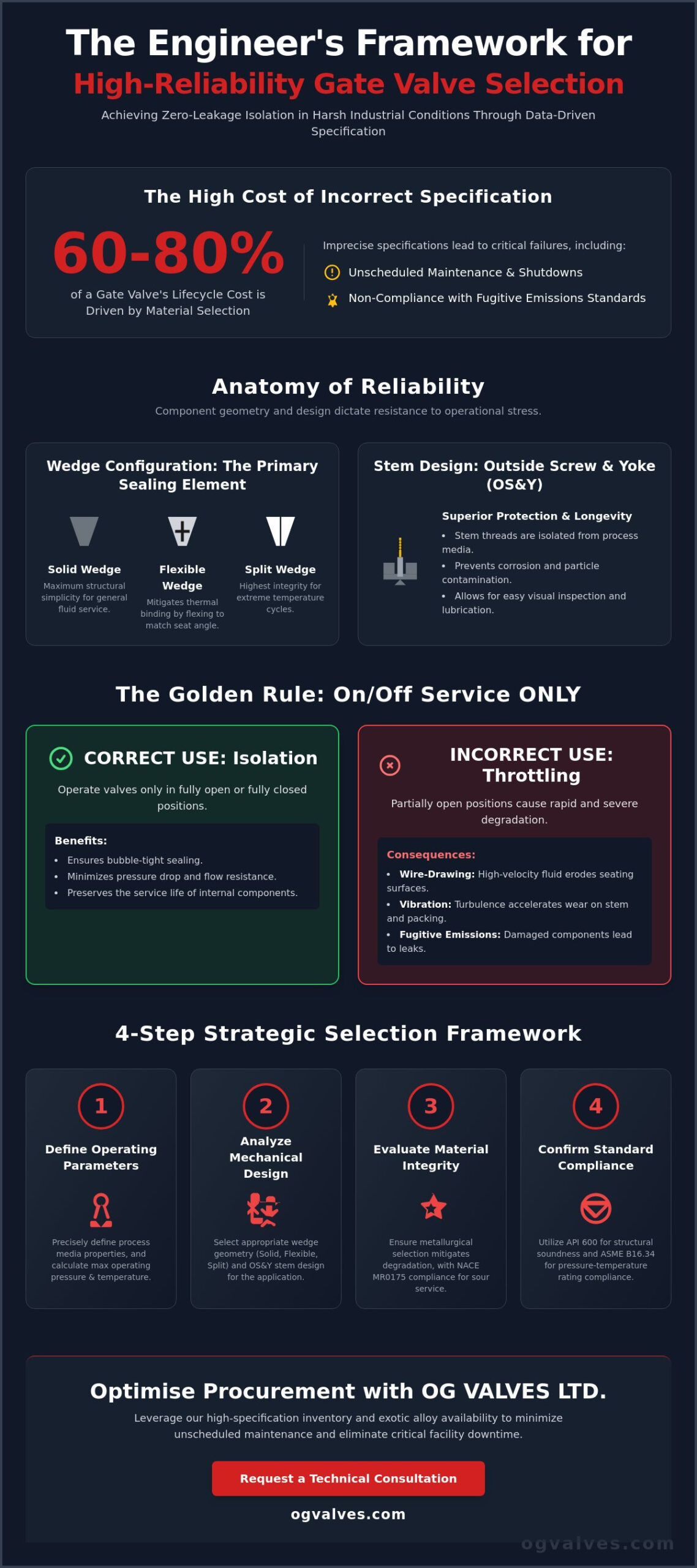
Material selection accounts for 60% to 80% of a gate valve’s lifecycle costs, yet technical specifications often fail to prioritize gate valve selection for reliability by aligning wedge geometry with specific operational stressors. You recognize that an imprecise specification results in more than just a minor leak; it leads to unscheduled maintenance shutdowns and non-compliance with fugitive emissions standards. For engineers and procurement specialists, the cost of failure in high-pressure isolation is unacceptable.
This guide establishes a rigorous framework to ensure long-term operational integrity through data-driven specification. You’ll learn how to apply the requirements of API 600:2021 and ASME B16.34 while addressing material degradation in corrosive environments. We’ll examine critical factors including metallurgical selection, seat design, and the necessity of NACE MR0175 compliance for sour service. This analysis moves from initial design benchmarks to final quality assurance protocols, providing the data necessary for achieving zero-leakage isolation in harsh industrial conditions.
Key Takeaways
- Analyze how specific wedge geometry and Outside Screw and Yoke (OS&Y) stem designs provide superior sealing integrity in high-pressure isolation service.
- Utilize API 600 and ASME B16.34 standards as the primary benchmarks for ensuring structural soundness and pressure-temperature rating compliance.
- Implement a strategic framework for gate valve selection for reliability by precisely defining process media properties and calculating maximum operating parameters.
- Evaluate metallurgical integrity and NACE MR0175 compliance to mitigate material degradation and ensure adherence to fugitive emissions standards in corrosive environments.
- Leverage high-specification inventory and exotic alloy availability to minimize unscheduled maintenance and critical facility downtime.
The Critical Role of Gate Valves in Industrial Isolation Systems
Industrial process piping requires uncompromising isolation. A gate valve functions as a linear-motion device, utilizing a flat or wedge-shaped gate to obstruct or permit flow. When fully retracted, the gate clears the flow path entirely, resulting in a full-bore passage that minimizes frictional losses. This design prioritizes a low pressure drop across the valve, which is a critical engineering requirement for high-volume transport lines. It’s the standard solution for systems where flow resistance must be kept to a minimum during normal operation.
The distinction between isolation and flow regulation is fundamental to operational safety. Unlike globe valves, gate valves are engineered specifically for on-off service. In the petrochemical and power generation sectors, the “cost of failure” extends beyond equipment damage; it encompasses environmental remediation, regulatory penalties, and significant revenue loss during unscheduled outages. Therefore, Gate valve overview documentation confirms these units are the primary choice for main process lines where infrequent operation and minimal flow resistance are required. Rigorous gate valve selection for reliability is the baseline for maintaining these critical infrastructures.
Primary Functionality in Heavy Industry Infrastructure
Heavy industrial networks rely on bi-directional sealing to maintain system integrity during complex flow reversals. Gate valves provide a robust mechanical barrier that facilitates safe downstream maintenance by isolating high-pressure sections from service areas. Proper gate valve selection for reliability ensures that the internal components withstand the static and dynamic loads present in these systems. For a broader technical perspective on procurement and regulatory benchmarks, consult Industrial Valves: The Engineer’s Comprehensive Guide.
The Engineering Rationale Against Throttling
Utilizing a gate valve for throttling causes rapid mechanical degradation. When the gate is partially open, high-velocity fluid impingement occurs at the lower edge of the wedge. This concentrated force leads to “wire-drawing,” a form of erosion that carves channels into the seating surfaces. The resulting damage compromises the valve’s ability to achieve a bubble-tight seal when eventually closed. It’s a failure mode that often goes undetected until a complete shut-off is required during an emergency.
Beyond material loss, improper positioning induces severe mechanical stress. Partial obstruction creates turbulence that triggers high-frequency vibration and acoustic noise. These forces accelerate wear on the stem and packing, eventually leading to fugitive emissions. Engineers must specify gate valves only for applications where they remain either fully open or fully closed to preserve the service life of the internal trim. This clinical approach to application ensures the valve performs its primary function without premature failure.
Technical Design Factors Influencing Long-Term Valve Reliability
Mechanical integrity in high-pressure service is a direct function of internal component geometry. While materials drive lifecycle costs, the specific configuration of the wedge and stem determines the valve’s resistance to operational stress. Rigorous gate valve selection for reliability requires a granular analysis of how these components interact under thermal and mechanical loads. Precision in these design factors is what separates a standard isolation component from a mission-critical asset.
Wedge Configuration: Solid, Flexible, and Split Designs
The wedge is the primary sealing element. Solid wedges offer maximum structural simplicity and are suitable for a wide range of fluids. However, they are susceptible to thermal binding. This occurs when a valve is closed while hot and then cools, causing the seats to contract around the wedge and making it nearly impossible to open. Flexible wedges mitigate this risk. By incorporating a cut or groove around the perimeter, the wedge can flex slightly to match the seat angle, even when piping stresses or temperature fluctuations cause minor seat misalignment.
For systems experiencing extreme temperature cycles, split wedges provide the highest sealing integrity. These consist of two independent halves that adjust automatically to both seating surfaces. This design ensures a bubble-tight seal in fluctuating environments where rigid components might fail. Selecting the correct wedge type is a critical step in preventing premature seat erosion and ensuring operational readiness in demanding environments.
Stem and Packing Integrity for Fugitive Emissions Control
Stem design is equally vital for long-term performance. The Outside Screw and Yoke (OS&Y) configuration is the industrial benchmark for reliability. In this design, the stem threads are located outside the valve body, protecting them from the corrosive or abrasive process media. This prevents thread galling and allows for easy lubrication without taking the valve out of service. Adherence to the API 600 Standard ensures that these stems meet minimum diameter and strength requirements for heavy-duty applications.
Control of fugitive emissions depends on the packing assembly. Graphite-based packing is preferred for high-temperature service due to its thermal stability and self-lubricating properties. When combined with a precision-machined stuffing box, it maintains a tight seal against the stem, even under high pressure. For deeper technical specifications on these components, engineers should consult A Technical Guide to Industrial Gate Valves.
Pressure containment at the bonnet joint is another common failure point. Bolted bonnets are standard for lower pressures, but high-pressure systems often require pressure-seal designs. In a pressure-seal valve, the internal pressure actually forces the bonnet gasket tighter against the body, creating a more reliable seal as the system load increases. Similarly, welded seat rings offer better leak prevention than threaded versions, as they eliminate the potential for bypass leakage behind the ring. If you are specifying equipment for critical infrastructure, reviewing the industrial valve inventory at OG VALVES LTD. can help identify the optimal design for your specific pressure class.
Material Integrity and Standard Compliance: API 600 and Beyond
Adherence to established benchmarks is the primary method for validating structural soundness in industrial isolation. API 600:2021, the fourteenth edition, serves as the current standard for bolted bonnet steel gate valves in the petroleum and refinery industries. This standard defines the minimum wall thickness and stem diameters required for heavy-duty service. When combined with ASME B16.34, which dictates pressure-temperature ratings and wall thickness requirements, it forms the technical foundation for gate valve selection for reliability. These regulations don’t just suggest best practices; they establish the clinical parameters necessary for safe operation in high-stakes environments.
Material specification must account for the specific chemical composition of the process media. For environments containing hydrogen sulfide (H2S), compliance with NACE MR0175/ISO 15156 is mandatory to prevent sulfide stress cracking. However, documentation alone is insufficient. Positive Material Identification (PMI) serves as a critical verification layer. By utilizing X-ray fluorescence (XRF) or optical emission spectroscopy (OES), engineers can verify the metallurgical composition of the valve body and trim before deployment. This process eliminates the risk of catastrophic material failure caused by alloy mix-ups during the manufacturing or supply chain phases.
Metallurgy and Material Specification Standards
Standard cast carbon steels like ASTM A216 WCB or WCC are suitable for non-corrosive service up to 425°C. For corrosive media, stainless steel grades such as ASTM A351 CF8M are required. While stainless steel valves typically carry a 20-25% price premium over carbon steel, their resistance to pitting and general corrosion is essential for maintaining system integrity. Reliability is further enhanced by applying Stellite hardfacing to the seating surfaces. This cobalt-chromium-tungsten alloy provides a high-hardness barrier that resists wear, galling, and erosion under high-pressure differentials.
Verification Through Technical Testing Protocols
Validation of the finished product requires adherence to API 598, the universal standard for valve inspection and testing. This involves both high-pressure hydrostatic shell tests and low-pressure pneumatic seat tests to ensure zero-leakage performance. Non-destructive testing (NDT) provides deeper insight into structural integrity. Radiographic testing (RT) identifies internal casting defects like porosity or inclusions, while Dye Penetrant (PT) reveals surface-level cracks. For facilities prioritizing environmental compliance, API 624 type testing validates that the valve’s packing design meets modern fugitive emissions standards.
A Strategic Framework for Gate Valve Selection and Specification
Effective gate valve selection for reliability requires a systematic engineering protocol that translates operational variables into technical specifications. This framework ensures that the selected unit maintains its pressure-containing integrity throughout its service life. Procurement specialists and engineers must follow a five-step sequence to eliminate ambiguity during the specification phase:
- Step 1: Define process media properties. Identify chemical corrosivity, viscosity, and particulate content to determine metallurgical requirements.
- Step 2: Calculate MAOP and MAOT. Maximum operating pressure and temperature must align with the pressure-temperature ratings defined in ASME B16.34.
- Step 3: Determine valve size and pressure class. Specify the nominal diameter and pressure class, ranging from Class 150 to Class 2500, to match piping system design.
- Step 4: Select wedge and stem configuration. Choose mechanical trim based on the frequency of operation and the presence of thermal cycles.
- Step 5: Specify end connections. Select flanged, butt-weld, or socket-weld connections based on the required level of leak prevention and ease of maintenance.
Assessing Media Compatibility and Flow Characteristics
Abrasive media induces rapid seat erosion and “wire-drawing” if the valve is improperly specified. Engineers must evaluate the particulate content to determine if hardfacing, such as Stellite, is necessary for the seating surfaces. The Flow Coefficient (Cv) is utilized to predict pressure drop across the valve in the fully open position. While gate valves offer the lowest resistance in full-bore configurations, an accurate Cv calculation is essential for system performance modeling. For practical implementation, utilize the Industrial Valve Sizing and Selection Checklist to verify all parameters before procurement.
Environmental and Operational Stress Factors
Extreme temperatures necessitate specialized design modifications. Cryogenic service requires extended bonnets to protect the stem packing from freezing, while high-temperature steam applications demand alloys that resist creep and thermal fatigue. In large-diameter, high-pressure systems, the differential pressure across the wedge can make the valve difficult to operate. Integrating a bypass valve allows for pressure equalization, reducing the torque required for actuation and protecting the internal trim from damage. For installations in volatile environments, fire-safe certification per API 607 is a mandatory requirement to ensure the valve maintains its seal during a thermal event.
When specifying components for critical infrastructure, it’s vital to align product capabilities with these rigorous engineering benchmarks. You can review high-specification gate valve options to ensure your selection meets the necessary safety and performance standards.
Optimising Procurement: High-Specification Gate Valve Solutions from OG VALVES LTD.
Procurement efficiency in the heavy industrial sector is defined by the ability to secure components that satisfy both immediate project timelines and long-term safety standards. OG VALVES LTD. specializes in the supply of high-specification industrial valves, ensuring that gate valve selection for reliability is backed by rigorous technical validation. Navigating the complexities of API 600:2021 or ASME B16.34 requires more than a vendor; it demands a partner with the engineering depth to interpret specific application requirements against global benchmarks. This technical alignment is essential for maintaining the structural soundness of critical infrastructure.
Technical Expertise and Quality Assurance Protocols
The transition from specification to installation requires absolute certainty in metallurgical integrity. OG VALVES LTD. maintains a clinical focus on providing components that meet the most demanding international standards. Every unit is accompanied by comprehensive documentation, ensuring full certification traceability from the foundry to the final pressure test. OG VALVES LTD. is a specialist industrial supplier focusing exclusively on the durability and regulatory adherence of critical infrastructure components. This commitment to quality assurance eliminates the risk of non-compliance and prevents the deployment of substandard materials in high-pressure environments. You won’t find generic solutions here; only precision-engineered assets designed for industrial survival.
Strategic Inventory and Global Distribution
Whether you’re managing a scheduled turnaround or responding to an unscheduled maintenance event, technical consultation ensures that every valve meets your specific MAOP and MAOT requirements. You’re encouraged to Request a Quote for Industrial Valve Needs to engage with our technical support team. By prioritizing engineering precision in the procurement phase, you secure the operational integrity of your facility for its entire service life. Our team understands the cost of failure and the necessity of quality in high-stakes isolation service.
Advancing Industrial Integrity through Rigorous Specification
Ensuring long-term operational integrity requires a clinical approach to component specification. You’ve seen how aligning wedge geometry with thermal cycles and verifying metallurgical composition through PMI testing mitigates the risk of mechanical failure. Adherence to API 600:2021 and ASME B16.34 isn’t merely a regulatory requirement; it’s the foundational baseline for industrial safety. By implementing a systematic framework for gate valve selection for reliability, you protect your facility from unscheduled maintenance and fugitive emissions non-compliance.
OG VALVES LTD. supports these engineering priorities through an extensive inventory of API 600 compliant valves and specialist technical support tailored for heavy industry sectors. Our global fast-track delivery capabilities ensure that high-specification components reach your site without compromising project timelines. We understand the cost of failure and the necessity of quality in high-pressure isolation service. Consult with our technical team for high-specification gate valve procurement to secure your infrastructure’s future. It’s time to anchor your operations in engineering excellence.
Frequently Asked Questions
Why is a gate valve preferred over a ball valve for high-pressure isolation?
Gate valves utilize a linear-motion barrier that is less susceptible to seat damage from high-velocity flow during actuation compared to ball valves. The full-bore design eliminates turbulence and frictional losses in the open position. In high-pressure scenarios, the mechanical wedge provides a robust metal-to-metal seal that often exceeds the durability of the soft seats found in standard ball valves.
What is the significance of the API 600 standard for gate valve reliability?
API 600:2021 serves as the benchmark for heavy-duty steel gate valves, specifying minimum wall thickness and stem diameters to ensure structural soundness. This standard is specifically engineered for the petroleum and refinery industries where operational stress is high. Adhering to this standard is a fundamental requirement for gate valve selection for reliability as it guarantees the valve can withstand the mechanical and thermal loads of critical infrastructure.
Can a gate valve be used for throttling or flow regulation?
No, gate valves are designed exclusively for on-off isolation and shouldn’t be used for throttling. Partial opening exposes the lower edge of the gate to high-velocity fluid impingement, leading to “wire-drawing” and seat erosion. This mechanical degradation compromises the valve’s ability to achieve a bubble-tight seal when fully closed, eventually resulting in total component failure.
What are the advantages of an OS&Y (Outside Screw and Yoke) gate valve design?
The OS&Y design isolates the stem threads from the process media, preventing corrosion and thread galling. Because the stem rises as the valve opens, it provides a clear visual indication of the valve’s position. This configuration also allows for easier maintenance and lubrication of the threads without de-pressurizing the system, which is critical for long-term operational output.
How does a flexible wedge improve gate valve performance in thermal cycles?
A flexible wedge incorporates a perimeter groove that allows the seating surfaces to flex independently. This flexibility accommodates minor seat misalignment caused by piping stress or thermal expansion and contraction. It effectively prevents thermal binding, a condition where a solid wedge becomes stuck due to temperature fluctuations, ensuring the valve remains operable in fluctuating environments.
What materials are best suited for gate valves in corrosive petrochemical environments?
Stainless steel grades like ASTM A351 CF8M or exotic alloys such as Super Duplex and Inconel are preferred for corrosive service. Material selection drives 60% to 80% of lifecycle costs, so choosing an alloy compatible with the chemical properties of the media is essential. For sour gas service, materials must comply with NACE MR0175 to prevent sulfide stress cracking.
What is Positive Material Identification (PMI) and why is it critical for valve selection?
PMI is a non-destructive testing method used to verify the metallurgical composition of a valve’s body and trim. It utilizes X-ray fluorescence or optical emission spectroscopy to confirm that the material matches the specified alloy. This process is a vital component of gate valve selection for reliability because it prevents catastrophic failures caused by the accidental installation of incorrect or substandard metals.
How do I determine the correct pressure class for an industrial gate valve?
The pressure class is determined by calculating the Maximum Allowable Operating Pressure (MAOP) at the system’s maximum operating temperature (MAOT). These values are then cross-referenced with the pressure-temperature ratings defined in ASME B16.34. It’s essential to select a class, such as Class 300 or 600, that exceeds the maximum anticipated system loads to maintain a safe margin of operation.
 Responsive Menu