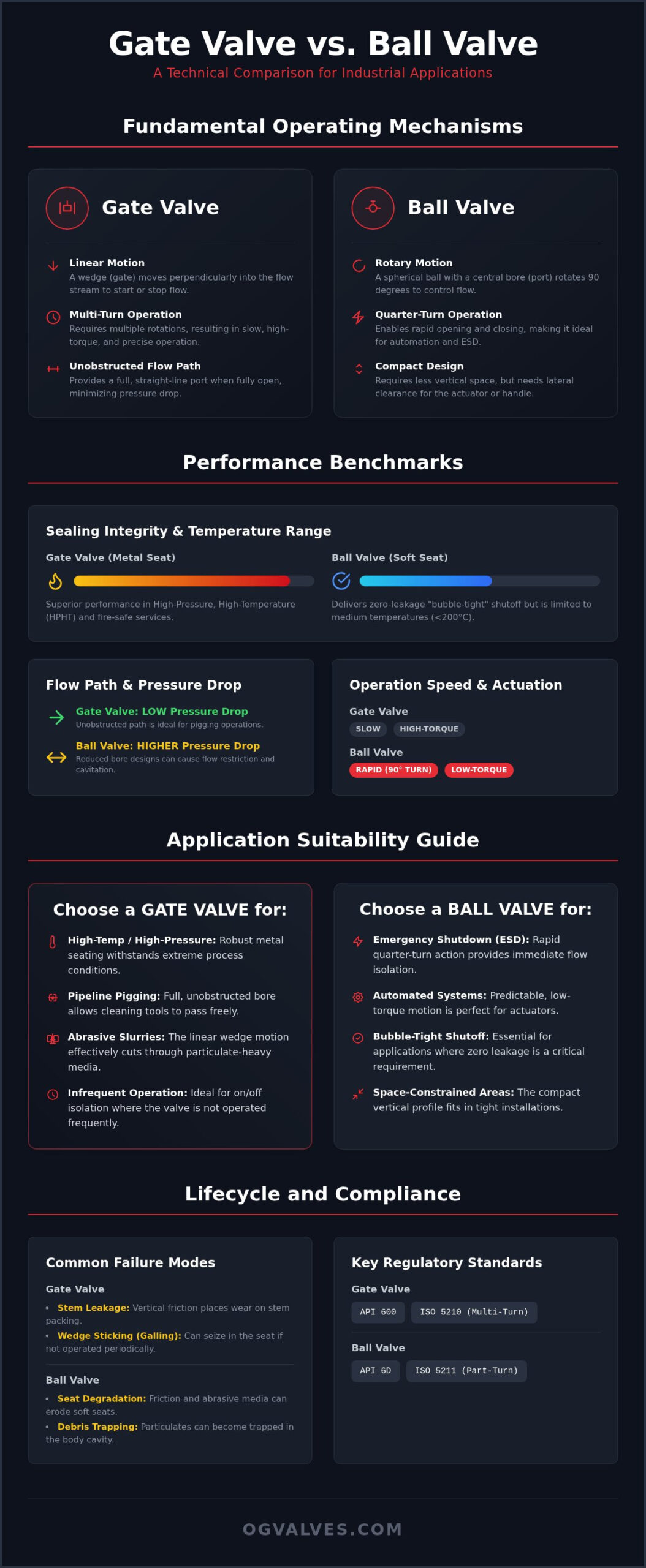
While gate valves maintained a 28% revenue share of the industrial market in 2025, the selection between a gate valve vs ball valve remains a critical engineering decision where the cost of a single seat failure often exceeds the initial component price by a factor of ten. You recognize that in heavy industrial isolation, the margin for error is non-existent. A mismatch between valve architecture and process conditions leads to unplanned downtime, excessive friction loss, and potential non-compliance with the latest API and ASME standards. This technical analysis evaluates the mechanical and operational parameters of both valve types to ensure your infrastructure meets the rigorous demands of the 2026 regulatory environment.
We provide a clinical comparison of sealing mechanisms and flow coefficients while addressing the implications of the 7th Edition of API RP 591. This guide examines the structural soundness of multi-turn versus part-turn actuators under the updated ISO 5210:2026 and ISO 5211:2026 specifications. By the conclusion of this report, procurement specialists will have the quantifiable data necessary to determine the most cost-effective valve for a specified lifecycle; this ensures long-term operational output and minimized maintenance intervals in critical infrastructure projects.
Key Takeaways
- Evaluate the mechanical interface requirements between linear wedge operation and 90-degree rotary ports to ensure compatibility with ISO-certified actuator attachments.
- Analyze the specific flow coefficient (Cv) and sealing integrity trade-offs in the gate valve vs ball valve comparison to optimize pumping efficiency and minimize system pressure drops.
- Identify the appropriate metallurgy and seat design for high-pressure high-temperature (HPHT) environments and abrasive slurry applications to prevent premature component failure.
- Implement standardized maintenance protocols to mitigate common industrial failure modes, including stem leakage and wedge sticking, thereby extending asset lifecycle.
- Verify regulatory compliance by mastering the technical distinctions between API 600 and API 6D standards alongside EN 10204 3.1 material traceability requirements.
Fundamental Mechanisms: How Gate and Ball Valves Differ in Operation
Divergent mechanical principles define the primary selection criteria for industrial isolation. Gate valves utilize a linear motion to lower or raise a wedge into the flow path. This traditional Gate valve design and operation relies on a multi-turn stem to achieve a metal-to-metal seal. Conversely, ball valves employ a 90-degree rotary motion to align a spherical port with the pipe. This quarter-turn functionality allows for rapid isolation, which is a critical requirement in emergency shutdown systems (ESD). The fundamental choice in the gate valve vs ball valve debate often begins with this distinction between slow, high-torque closure and rapid, low-torque operation.
Spatial constraints also dictate the mechanical specification. Gate valves require significant vertical clearance to accommodate the rising stem and the full height of the wedge when retracted. Ball valves occupy a smaller vertical footprint but require adequate lateral clearance for the lever or actuator assembly. In dense manifold environments, these dimensional requirements are as critical as the pressure ratings themselves.
Linear Wedge vs. Rotary Ball Mechanics
Industrial systems prioritize reliability in stem and packing interfaces. Gate valves often utilize an Outside Screw and Yoke (OS&Y) design, which keeps the stem threads isolated from the process media to prevent corrosion. This multi-turn stem subjects the packing to vertical friction, necessitating specific maintenance protocols to prevent leaks. Ball valves utilize rotary stems that experience lower mechanical stress on the packing glands. For automated systems, ball valves are the standard choice due to the predictable rotary torque requirements defined by ISO 5211:2026. Gate valves necessitate multi-turn actuators under ISO 5210:2026, which increase the total weight and complexity of the valve assembly.
Full Bore vs. Reduced Bore Flow Paths
Fluid dynamics vary significantly based on internal geometry. Gate valves provide an unobstructed path when fully open. This makes them the primary choice for pipelines requiring regular pigging to maintain throughput. Ball valves offer versatility through full-bore or reduced-bore port designs. A reduced-bore ball valve creates a venturi effect, increasing velocity and potentially causing cavitation in sensitive media. In particulate-heavy or slurry applications, the linear wedge of a gate valve effectively clears the seating area. Ball valves can trap debris within the body cavity, leading to seat degradation or torque spikes that compromise the actuator’s performance. Understanding these flow path obstructions is essential for maintaining system efficiency and preventing unplanned downtime.
Performance evaluation in the gate valve vs ball valve specification process requires a clinical analysis of sealing materials and fluid dynamics. Selection depends on the specific trade-off between the rapid isolation capabilities of rotary designs and the superior thermal resilience of linear wedge architectures. In high-velocity industrial systems, the choice of valve significantly impacts the energy efficiency of the entire infrastructure. Engineers must prioritize quantifiable data over general operational preferences to ensure long-term system stability.
Sealing Mechanisms and Bubble-Tight Integrity
Soft-seat ball valves utilize elastomeric or polymeric inserts, such as PTFE or PEEK, to achieve bubble-tight shut-off. While these materials provide excellent zero-leakage performance in low-to-medium temperature ranges, they are susceptible to thermal degradation and deformation in environments exceeding 200°C. Metal-seated gate valves provide a robust alternative for high-temperature steam and fire-safe applications. The metal-to-metal contact between the wedge and the seat rings accommodates thermal expansion without compromising the seal, a critical factor in power generation and petrochemical refining.
Seat wear is a primary driver of unplanned maintenance. Ball valves experience constant friction between the ball and the seat during every quarter-turn operation. Gate valves only engage the sealing surfaces at the final point of closure, which reduces the cumulative mechanical wear on the seats in clean media. To ensure adherence to API 607 fire-test standards, technical teams should consult a Forged Steel Valve Selection Guide when specifying components for volatile or high-pressure environments. This ensures that material classifications align with the required safety benchmarks.
Pressure Drop and System Efficiency
Friction loss across a valve assembly directly correlates to pumping costs and overall Total Cost of Ownership (TCO). Gate valves provide a straight-through flow path with a cross-sectional area equal to the pipe diameter, resulting in a negligible pressure drop. In contrast, reduced-port ball valves introduce turbulence and flow restriction, which increases the energy demand on upstream pump motors. Flow Coefficient (Cv) is the standard industrial metric defined as the volume of water in US gallons per minute that will flow through a valve with a pressure drop of 1 psi.
- Gate Valves: Inherently high Cv values due to unobstructed flow paths.
- Full-Port Ball Valves: Comparable Cv to gate valves but with higher weight and cost profiles.
- Reduced-Port Ball Valves: Lower Cv values that may necessitate higher pump head pressures.
Optimizing system efficiency requires a detailed comparison of these coefficients against the projected lifecycle of the facility. Selecting the correct bore size and valve type can lead to significant energy savings over decades of operation. Professionals seeking to refine these specifications can evaluate the industrial valve inventory to compare flow data across various pressure classes and material grades.
Application Analysis: High-Pressure, Slurry, and Critical Isolation
Application-specific selection in the gate valve vs ball valve hierarchy is dictated by media viscosity and operational frequency. While previous sections detailed mechanical differences, the functional reality in the field centers on how these designs interact with abrasive or volatile fluids. Critical infrastructure requires isolation solutions that maintain integrity under High-Pressure High-Temperature (HPHT) conditions without compromising safety. Engineers must evaluate whether the process requires the repeatable speed of a rotary design or the robust, metal-seated resilience of a linear wedge.
Handling Slurries and Corrosive Media
Gate valves are inherently susceptible to sediment buildup in particulate-heavy environments. The recessed bottom cavity of a standard gate valve allows solids to settle, which eventually prevents the linear wedge from achieving a full seal. This obstruction leads to seat erosion and bypass leakage, necessitating frequent maintenance. Ball valves provide a superior self-cleaning alternative. The 90-degree rotation causes the spherical port to wipe the seat surface during every cycle, effectively clearing debris. For a deeper analysis of material selection and global standards, technical teams should consult Industrial Valves: The Engineer’s Comprehensive Guide. In corrosive media, ball valves often utilize specialized coatings like Tungsten Carbide to resist abrasive wear in slurry service.
Critical Isolation in Petrochemical Refineries
Operational reliability in petrochemical refineries hinges on fire-safe performance and rapid response times. API 607 testing is the benchmark for ensuring a valve maintains its seal during and after a fire event. For emergency shutdown (ESD) systems, ball valves are the standard specification. Their quarter-turn operation allows for significantly faster actuation compared to the multi-turn requirement of gate valves. This speed is vital when isolating sections of a plant during a pressure surge or leak.
Material compatibility in sour gas (H2S) environments is another non-negotiable factor. Engineers must specify alloys and elastomers that meet NACE MR0175/ISO 15156 standards to prevent sulfide stress cracking. While gate valves are often prioritized for infrequent isolation in high-temperature steam lines because their metal seats don’t “set” over time, high-cycle applications demand the repeatable precision of a trunnion-mounted ball valve. This ensures that the primary isolation point remains functional over thousands of cycles without the torque escalation common in aging gate assemblies. Selecting the correct valve for these environments directly impacts the facility’s safety rating and insurance compliance.
Lifecycle Management: Durability, Maintenance, and Failure Prevention
Industrial lifecycle management requires a shift from disposal-based thinking to rigorous maintenance protocols. In the gate valve vs ball valve comparison, durability isn’t just a function of material hardness. It’s a measure of how effectively internal components can be serviced to prevent total system failure. Procurement specialists must account for the accessibility of internal parts during scheduled overhauls to ensure that the initial capital expenditure aligns with the projected asset life. A clinical focus on failure prevention reduces the risk of catastrophic leaks in high-stakes environments.
Preventative Maintenance vs. Reactive Repair
Heavy industrial sectors face unplanned downtime costs that escalate exponentially with every hour of lost production. OG Valves’ technical support assists engineering teams in developing predictive maintenance schedules based on real-world duty cycles and media characteristics. In high-pressure steam service, gate valves typically offer an extended service life because their metal-seated design resists thermal degradation. However, this longevity depends on regular packing adjustments and stem lubrication. Reactive repair often occurs too late, resulting in seat scarring that necessitates a full valve replacement rather than a simple seal adjustment.
Common Failure Modes in Industrial Environments
Throttling represents a significant risk for both valve architectures. Neither design is suitable for flow control; using them as such leads to cavitation and rapid internal degradation. For a detailed breakdown of linear motion standards and wedge design, consult A Technical Guide to Industrial Gate Valves. Seat scarring is the primary cause of isolation failure in ball valves. Other frequent failure modes include:
- Stem Leakage: Often caused by packing wear or improper torque during installation.
- Wedge Sticking: A common issue in gate valves subjected to extreme temperature fluctuations without proper OS&Y maintenance.
- Trunnion Seizure: Resulting from a lack of lubrication in high-cycle ball valve applications.
Predicting these failures involves Positive Material Identification (PMI) and hydrostatic testing to ensure adherence to API 598. Quality control processes must verify that alloy compositions meet specific metallurgical requirements before the valve enters service. This rigorous testing phase is the benchmark for industrial safety. Professionals requiring immediate replacement components to mitigate the risk of unplanned downtime should contact OG Valves for fast-track global delivery of API-certified components.
Compliance and Procurement: Selecting Industrial-Grade Isolation Solutions
Industrial procurement professionals must prioritize regulatory adherence to ensure the structural soundness of critical infrastructure. The decision-making process for a gate valve vs ball valve selection concludes with a verification of international certifications. These standards provide the clinical assurance that a component will perform under the specified pressure-temperature ratings of a given project. Without this rigorous validation, systems are vulnerable to catastrophic failure and legal non-compliance.
API and ASME Standards for Valve Specification
Differentiating between standards is essential for accurate project tenders and safety compliance. API 600 specifies requirements for bolted bonnet steel gate valves, focusing on wall thickness for refinery service. Small-bore applications follow API 602 criteria. ASME B16.34 verification is also mandatory to ensure pressure-temperature ratings align with material classifications. For technical analysis, refer to the Industrial Ball Valves: A Technical Engineering & Specification Guide.
Primary standards include:
- API 600: Heavy-duty flanged and butt-welding gate valves for refinery service.
- API 6D: Pipeline and piping valves, including specific ball valve architectures.
- ASME B16.34: Global benchmark for pressure-temperature ratings and material requirements.
Procurement Strategy for Minimal Downtime
Global supply chain volatility necessitates a procurement strategy prioritizing immediate inventory availability and rigorous material traceability. EN 10204 3.1 certification is the clinical standard for verifying mechanical properties of valve components from the foundry to the final assembly. OG Valves utilizes a global logistics network to support fast-track delivery for international projects, which minimizes facility downtime during emergency overhauls. This project management capability ensures high-specification petrochemical solutions reach the site without the delays of custom manufacturing cycles.
The 2026 selection criteria for industrial isolation remain focused on functional reality in the gate valve vs ball valve debate. Gate valves continue to be the standard for high-temperature, infrequent isolation in steam and clean media environments. Ball valves are the preferred choice for high-cycle, rapid-closure applications where bubble-tight integrity is paramount. Finalizing a specification requires balancing these mechanical advantages against the logistical capabilities of a dependable global partner. Selecting a valve based on these clinical benchmarks minimizes the risk of unplanned maintenance and maximizes the return on investment for high-stakes infrastructure.
Optimizing Infrastructure Through Technical Specification
Selecting the correct isolation component requires a clinical evaluation of the process environment and regulatory benchmarks. The gate valve vs ball valve decision rests on the specific trade-offs between linear wedge durability in high-temperature steam and the rapid isolation speed of quarter-turn architectures. Engineers must prioritize adherence to API 600 and API 6D standards to ensure structural soundness and long-term operational output. By focusing on quantifiable data such as flow coefficients and material traceability, procurement specialists effectively minimize unplanned maintenance and system friction loss.
As you refine your 2026 infrastructure projects, leveraging a dependable global partner is essential for maintaining critical inventory. Contact OG VALVES LTD. for technical specifications and fast-track global delivery to secure API-certified components. Our deep technical expertise in ASME standards and extensive specialist industrial inventory ensure your facility meets the highest benchmarks for engineering excellence. We look forward to supporting your next high-specification project with the reliability your operations demand.
Frequently Asked Questions
What is the primary difference between a gate valve and a ball valve in industrial use?
The primary distinction in the gate valve vs ball valve comparison lies in the mechanical method of flow obstruction. Gate valves utilize a linear motion to lower a wedge into the flow path; this creates a metal-to-metal seal ideal for infrequent isolation. Ball valves employ a quarter-turn rotary motion to align a spherical port with the pipe. This allows for rapid operation and bubble-tight shut-off in high-cycle industrial environments where speed is a critical safety requirement.
Can ball valves be used for throttling in high-pressure systems?
Ball valves are not recommended for throttling in high-pressure systems because high-velocity flow causes rapid seat erosion and cavitation. When the ball is partially open, the exposed seating surfaces experience uneven wear; this compromises the valve’s ability to achieve a tight seal during subsequent isolation. For precision flow control, engineers should specify globe valves or specialized needle valves rather than using isolation-class ball or gate valve architectures for fluid modulation.
Which valve type is better for high-temperature steam applications?
Gate valves are superior for high-temperature steam applications due to their metal-seated construction and ability to accommodate thermal expansion. Unlike soft-seated ball valves, which utilize polymers like PTFE that degrade at high temperatures, the metal wedge of a gate valve maintains its structural integrity under extreme heat. This resilience prevents seat deformation and ensures dependable isolation in power generation and refinery steam headers where operating temperatures frequently exceed the limits of elastomeric seals.
Why are ball valves preferred for automated isolation systems?
Ball valves are preferred for automated systems because their 90-degree rotary motion requires lower and more predictable torque compared to multi-turn gate valves. This quarter-turn functionality simplifies actuator selection and allows for significantly faster response times in emergency shutdown (ESD) scenarios. The standardized mounting interfaces defined by ISO 5211:2026 further streamline the integration of pneumatic or electric actuators; this ensures reliable remote operation in complex petrochemical manifolds without excessive weight or mechanical complexity.
What are the common causes of gate valve failure in oil and gas?
Common failure modes for gate valves in the oil and gas sector include sediment accumulation in the body cavity and stem packing degradation. Particulates trapped in the bottom of the valve prevent the wedge from reaching its full seating position; this leads to bypass leakage and seat erosion. Additionally, extreme temperature fluctuations can cause wedge sticking or thermal binding. Regular lubrication of the OS&Y assembly and packing adjustments are essential to mitigate these risks.
How do API 6D and API 600 standards affect valve selection?
API 600 is the primary standard for heavy-duty, bolted bonnet steel gate valves used in refinery and petrochemical services where wall thickness is critical. API 6D focuses on pipeline valves; it covers the design, manufacturing, and testing of ball, gate, and check valves for midstream transport systems. Selecting the correct standard ensures that the valve meets specific wall thickness, pressure rating, and fire-safety benchmarks required for the intended industrial application and regulatory environment.
Which valve has a higher pressure drop, gate or ball?
Full-port gate valves provide an unobstructed flow path with the same diameter as the pipe; this results in a negligible pressure drop and high flow coefficients (Cv). Reduced-port ball valves introduce internal restrictions and turbulence; this increases friction loss and upstream pumping costs. While full-port ball valves offer comparable performance to gate valves, they are often heavier and more expensive. Selection should be based on the specific fluid dynamics and energy efficiency requirements of the system.
Is a gate valve or a ball valve more cost-effective for long-term maintenance?
Cost-effectiveness depends on the frequency of operation and the media type. Gate valves are more economical for infrequent isolation in clean, high-temperature fluids because their metal seats don’t set over time. However, ball valves are more cost-effective for high-cycle applications where their self-cleaning rotary action reduces seat wear. OG VALVES LTD. supports long-term maintenance strategies by providing fast-track delivery of API-certified components; this ensures minimal facility downtime during scheduled or emergency maintenance intervals.
 Responsive Menu